
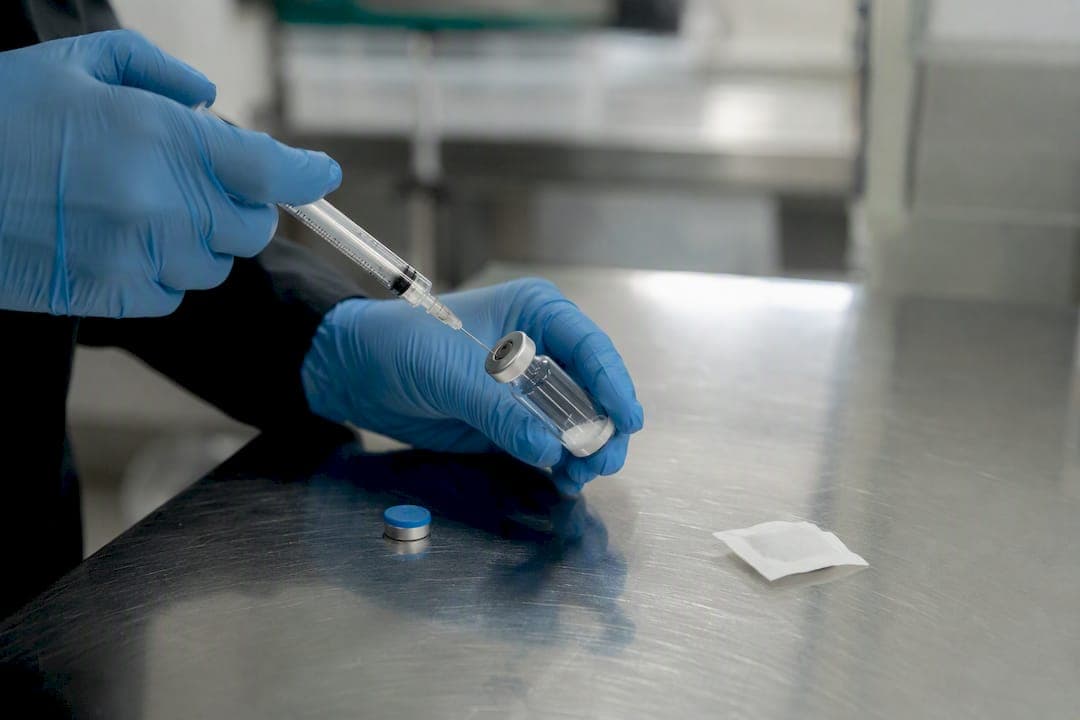
The difference comes down to one ingredient: benzyl alcohol. Bacteriostatic water is sterile water with 0.9% to 1.1% benzyl alcohol added as a preservative, which lets you draw from the same vial repeatedly, typically for up to 28 days. Sterile water has no preservative and is meant for one use only. If you're reconstituting peptides for multiple doses, bacteriostatic water is usually the right call. If you're mixing a single dose, working with a neonate, or the drug label says otherwise, use sterile water instead.
TL;DR:
- Bacteriostatic water contains benzyl alcohol, which inhibits bacterial growth and extends the vial's usability to about 28 days, unlike sterile water.
- Sterile water has no preservative and must be used immediately after opening, making it suitable only for single-dose applications.
- Neither water is safe for direct IV injection without adding solutes to make the solution isotonic; benzyl alcohol's presence also contraindicates neonatal use.
- The choice depends on whether multiple doses are needed, for neonatal safety, or if the solution will be injected into a vein, with label instructions taking priority.
- Clinician oversight ensures compatibility, safety, and proper reconstitution, especially for neonatal cases or long-term dosing protocols.
Table of Contents
- Bacteriostatic Water Vs Sterile Water: How the Preservative Changes Everything
- Sterile Water for Injection: Why It's Built for One Use Only
- Bacteriostatic Water Vs Sterile Water at a Glance
- How to Reconstitute Peptides and Injectable Powders Safely
- Storage and Shelf Life After You Open the Vial
- Safety Warnings You Cannot Skip: Neonates, IV Use, and Drug Compatibility
- What the Official Labels and Health Agencies Actually Say
- Airmed Fit's Perspective: Why Clinician Oversight Changes the Risk Picture
- Get Clinician-Supervised Reconstitution Through Airmed Fit
- Where to Verify the Details Yourself
- Sources
Bacteriostatic Water Vs Sterile Water: How the Preservative Changes Everything
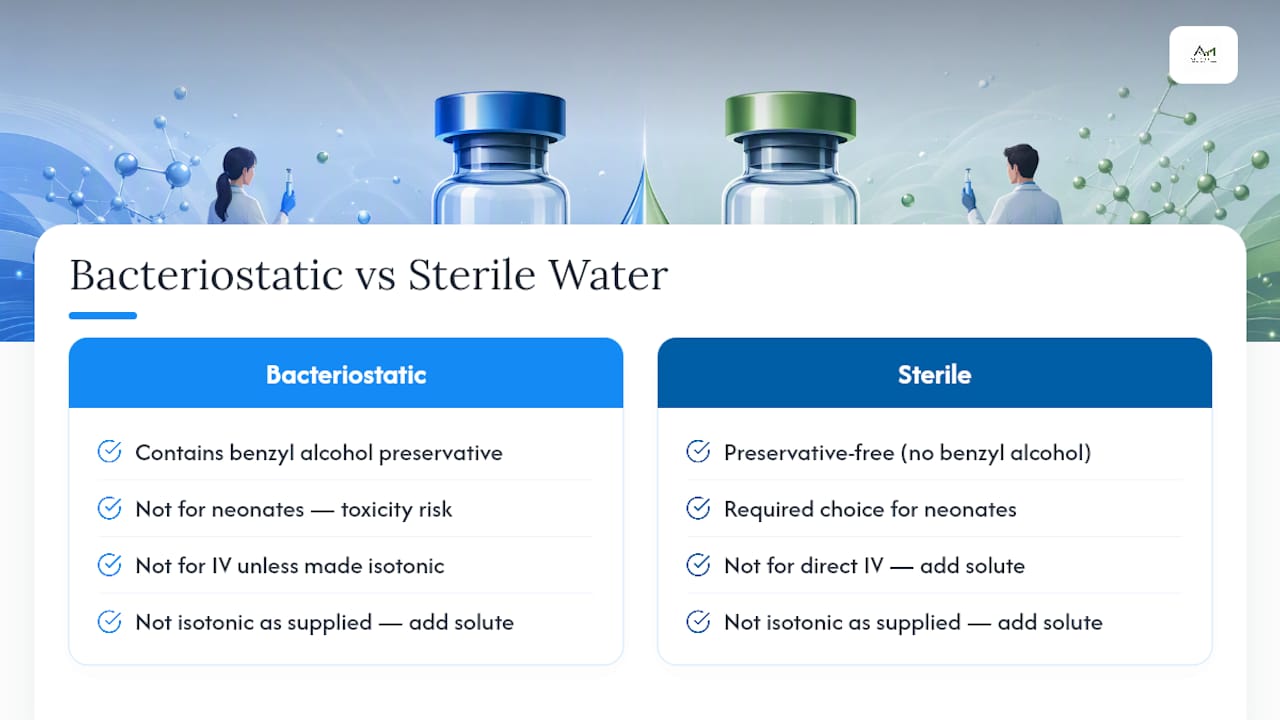
Bacteriostatic Water for Injection (USP) is defined as sterile, non-pyrogenic water carrying 0.9% to 1.1% benzyl alcohol as an added antimicrobial preservative. That's the entire distinction from plain sterile water, but it changes how the product gets used in practice. Benzyl alcohol doesn't sterilize the solution outright. It inhibits bacterial growth inside the vial between withdrawals, which is why the term is "bacteriostatic" rather than "bactericidal." The preservative buys you a safety margin every time a needle pierces the stopper.
That margin is exactly why manufacturers package bacteriostatic water in multiple-dose vials rather than single-use containers, and why the DailyMed label explicitly describes it as intended for repeated withdrawals. A few labeling details matter if you're comparing products at the pharmacy counter:
- It's sold as Rx-only in the United States, not as an over-the-counter item at standard retail pharmacies.
- Vials are generally small to limit the cumulative benzyl alcohol dose per patient.
- Labels carry a compatibility warning, so you should verify drug compatibility before assuming bacteriostatic water is safe to use with it.
Sterile Water for Injection: Why It's Built for One Use Only
Sterile Water for Injection, USP contains no antimicrobial agent at all. That absence is the whole point. Once a vial is opened and the water is exposed to air or a needle, there's nothing inside stopping bacterial growth, so the DailyMed monograph restricts it to single-dose use. You draw what you need and discard the rest.
That's a meaningfully different job than saline. Saline (0.9% sodium chloride) arrives isotonic and ready for many IV applications. Sterile water does not. A few practical points separate the two:
- Sterile water is a diluent for dissolving or diluting a drug, not a ready-to-infuse IV fluid on its own.
- Adding solute (commonly sodium chloride) is required before sterile water becomes an isotonic, IV-safe admixture.
- Any unused portion after the first puncture should be discarded, not stored for later use.
Bacteriostatic Water Vs Sterile Water at a Glance
The practical decision usually hinges on four factors: whether a preservative is present, how many times you'll draw from the vial, who the patient is, and whether the solution is going into a vein.
| Factor | Bacteriostatic Water | Sterile Water for Injection |
|---|---|---|
| Preservative content | 0.9%–1.1% benzyl alcohol | None |
| Recommended use case | Multi-dose vials, repeated withdrawals | Single-dose, immediate use only |
| Neonate suitability | Contraindicated for neonatal preparations | Preferred choice when water is needed for neonates |
| IV/isotonic considerations | Not isotonic; add solute, and confirm the drug tolerates benzyl alcohol before IV use | Not isotonic; requires added solute to become IV-safe |
| Typical in-use window after puncture | Around 28 days when stored per label | Use immediately; discard unused portion |
Two things trip people up here. First, neither product is ready for IV administration straight out of the vial. Both are hypotonic as supplied, and injecting either one directly into a vein without adding solute risks hemolysis, red blood cells rupturing because the surrounding fluid is too dilute. Second, the benzyl alcohol that makes bacteriostatic water convenient for multi-dose use is the same ingredient that makes it inappropriate for neonates, a point regulators have been explicit about for decades.
How to Reconstitute Peptides and Injectable Powders Safely
Start with the decision rule, then handle the math. If you'll be drawing multiple doses from the same vial over days or weeks, bacteriostatic water is the standard choice. If you need a single immediate dose, or the drug label prohibits preservatives (as with most neonatal preparations), use sterile water.
- Check the label first. The manufacturer's instructions for that specific peptide or drug override any general rule of thumb.
- Calculate concentration before you draw anything. Divide total peptide content (mg) by total diluent volume (mL) to get mg/mL. A 5 mg vial mixed with 2 mL of diluent yields 2.5 mg/mL, regardless of whether you used bacteriostatic or sterile water. The diluent type doesn't change the math, only the vial's shelf life.
- Wipe the stopper with alcohol before every withdrawal. This matters more with multi-dose vials, where repeated punctures are the main contamination risk.
- Add diluent slowly, down the side of the vial. Swirl gently instead of shaking to avoid degrading the peptide's structure.
- Label the vial with the reconstitution date. This is how you track the in-use window without guessing.
- Use a new sterile syringe for each draw, and confirm compatibility if you're unsure whether benzyl alcohol interacts with the specific drug.
Pro Tip: If a peptide's instructions don't specify a diluent, that's a signal to call the pharmacy or prescriber rather than assume, especially since some peptides are sensitive to benzyl alcohol and require sterile water even for multi-dose protocols.
Storage and Shelf Life After You Open the Vial
Bacteriostatic water in a multi-dose vial typically remains usable for a few weeks after the first puncture, provided it's stored as directed, usually refrigerated or at controlled room temperature. Sterile water carries no such window. Use it immediately and discard whatever's left.
A few handling rules apply to both:
- Store vials as the label instructs; don't assume refrigeration is optional just because the vial "looks fine."
- Discard any solution that turns cloudy, changes color, or shows particles floating in it.
- Toss the vial if the rubber stopper looks damaged or has been punctured more times than the label allows.
- Never combine leftover sterile water from one session with a new vial for later use.
Safety Warnings You Cannot Skip: Neonates, IV Use, and Drug Compatibility
Benzyl alcohol toxicity in neonates isn't a theoretical caution. The CDC's report on neonatal deaths linked to benzyl alcohol exposure is the reason preservative-free sterile water is the required choice whenever water is used in neonatal preparations. That's not a judgment call left to preference.
A safety note worth repeating for every use-case, not just neonatal care: neither bacteriostatic nor sterile water is isotonic as supplied. Injecting either directly into a vein without first adding an appropriate solute risks hemolysis. Pfizer's labeling reinforces this directly, stating bacteriostatic water should not be used for IV injection unless the result is an isotonic admixture. Always confirm the specific drug you're diluting tolerates benzyl alcohol before reaching for the multi-dose option.
What the Official Labels and Health Agencies Actually Say
The clearest guidance comes straight from the monographs and product labels, not general advice columns. The USP monograph for bacteriostatic water specifies the antimicrobial content and flags compatibility as something to verify per substance, not assume.
Bacteriostatic Water for Injection is water for injection that has been sterilized and suitably packaged, containing one or more suitable antimicrobial preservatives. Compatibility of the preservative with the medicinal substance to be dissolved or diluted must be verified before use.
That single line explains most of the confusion people run into. The preservative that makes multi-dose convenience possible is also the variable that changes case by case, depending on what you're mixing it with, and why the manufacturer's own instructions should always outrank a general rule found online.
Airmed Fit's Perspective: Why Clinician Oversight Changes the Risk Picture
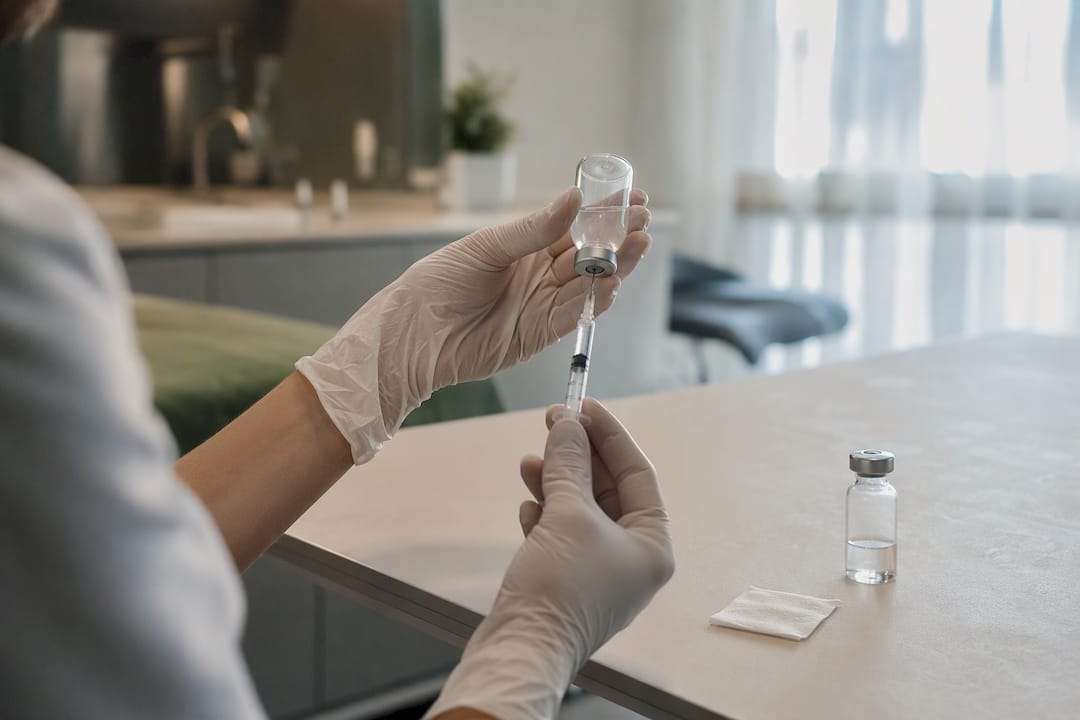
Getting the diluent right is only half the equation. The other half is knowing whether your specific drug, dose, and patient situation calls for an exception to the general rule, and that's where a label alone can't help you. Airmed Fit builds clinician oversight into every reconstitution protocol precisely because compatibility questions, neonatal exclusions, and repeated-dosing schedules are exactly the situations where guesswork causes harm.
If you're uncertain whether a peptide tolerates benzyl alcohol, managing care for an infant, or planning weeks of repeated dosing from one vial, that's the moment to get a second set of trained eyes on the plan rather than defaulting to whichever water happens to be on the shelf.
— Organic
Get Clinician-Supervised Reconstitution Through Airmed Fit
Reading the label correctly is one thing. Having a physician confirm your specific dose, drug, and diluent combination is another. Airmed Fit pairs FDA-regulated peptides and GLP-1 medications sourced from licensed U.S. manufacturers with physician oversight at every step, so you're never left guessing whether bacteriostatic or sterile water is the right call for your protocol.
That supervision extends past the initial prescription. Lab panels track how your body responds over time, and ongoing consultations catch compatibility issues before they become safety problems, the kind of oversight a printed label can't provide on its own. If you're managing peptide therapy or hormone optimization and want a physician confirming your reconstitution protocol instead of piecing it together from product inserts, start a consultation with Airmed Fit to get a plan built around your actual prescription and dosing schedule.
Where to Verify the Details Yourself
For the exact label language behind every claim in this guide, check these sources directly:
- Bacteriostatic Water for Injection, USP labeling on DailyMed
- Sterile Water for Injection, USP labeling on DailyMed
- Pfizer's product page on bacteriostatic water, including neonatal and IV warnings
- CDC's historical report on benzyl alcohol toxicity in neonates
This article is general information, not a substitute for advice from a qualified doctor. Consult a qualified healthcare professional about your own circumstances before acting on anything here.