
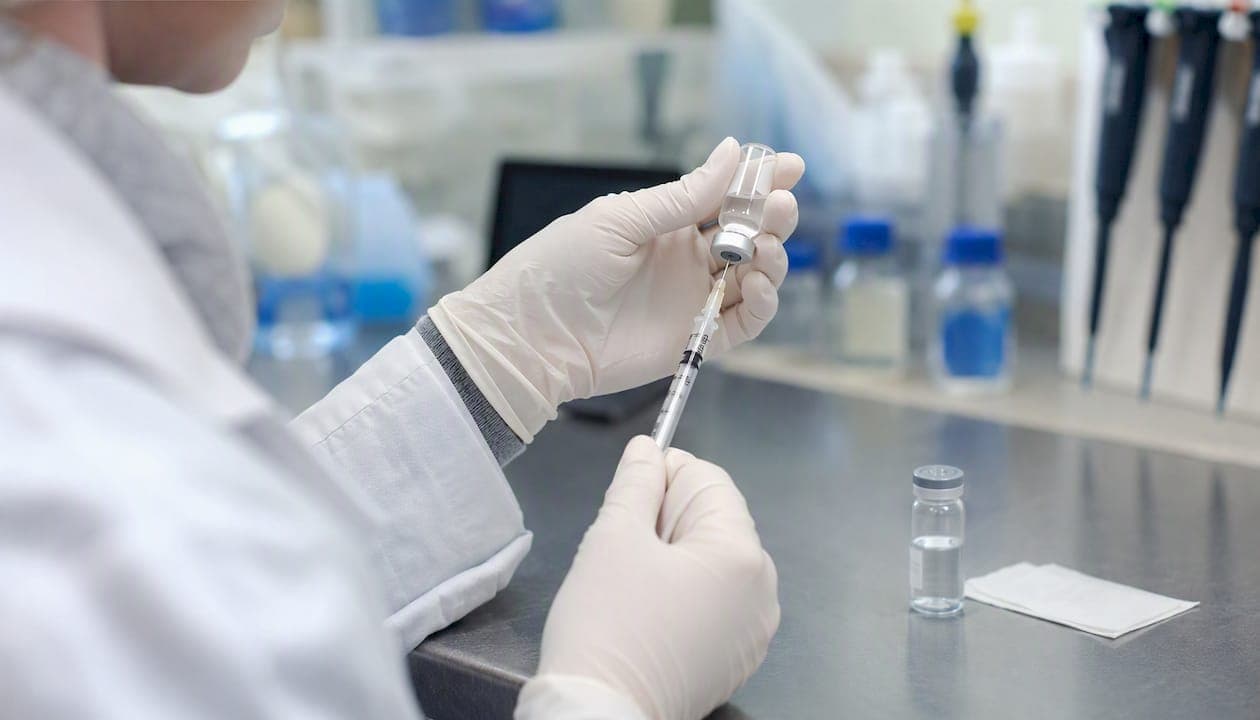
CJC-1295 combined with Ipamorelin is one of the most commonly prescribed peptide stacks in supervised hormone optimization practice, and its main draw is straightforward: it amplifies your body's own growth hormone pulses rather than replacing them outright. The stack works best in the no-DAC (pulsatile) format, dosed under a clinician's watch rather than as a self-directed experiment.
The pairing works because the two peptides hit different receptors. CJC-1295 primes the pituitary through the GHRH receptor, while Ipamorelin triggers an actual release through the ghrelin receptor. Run together, they produce a bigger GH pulse than either one alone. The biggest safety consideration isn't the injections themselves. It's what happens downstream: IGF-1 and blood glucose need regular checks, because those are the two markers that tell you whether your dose is doing what it should.
Before starting, a reasonable protocol looks like this:
- Get baseline IGF-1, fasting glucose, and A1c drawn
- Consult an endocrinologist or a clinician experienced with peptide therapy
- Consider an 8 to 12 week supervised trial with a scheduled recheck rather than an open-ended run
Key Takeaways
CJC-1295 paired with Ipamorelin amplifies natural GH pulses most effectively in the no-DAC form, and its safe use depends on baseline and follow-up IGF-1 and metabolic monitoring.
| Point | Details |
|---|---|
| Choose no-DAC for stacking | The short half-life preserves the pulsatile signal that Ipamorelin is designed to trigger. |
| Time doses around sleep | Pre-bed injection matches the natural nocturnal GH pulse for the strongest effect. |
| Monitor IGF-1 and glucose | Check baseline labs before starting and recheck IGF-1 around 4 to 8 weeks in. |
| Evidence gap is real | No RCT tests this exact combination; protocols are pharmacology-informed, not trial-proven. |
| Source through licensed clinicians | Airmed Fit provides physician-supervised programs with prescription-based sourcing and lab monitoring. |
Table of Contents
- What Are CJC-1295 and Ipamorelin?
- DAC or No-DAC: Why the Choice Matters for This Stack
- How Does the CJC-1295 and Ipamorelin Combination Work?
- What Benefits Does the Stack Actually Support?
- What Dosage and Timing Do Clinicians Actually Use?
- What Are the Side Effects and Who Should Avoid This Stack?
- Is CJC-1295 and Ipamorelin Legal, and How Do You Source It Safely?
- What Does the Clinical Evidence Actually Show?
- How to Start a Supervised Peptide Program
- Frequently Asked Questions
- Sources
What Are CJC-1295 and Ipamorelin?
CJC-1295 is a synthetic analog of growth hormone releasing hormone (GHRH). It comes in two versions that behave very differently in the body. The no-DAC version, also called Modified GRF 1-29, has a short half-life of around 30 minutes, so it produces a quick, contained signal to the pituitary. The DAC version binds to albumin in the bloodstream, which stretches its half-life out to several days and creates a steady, sustained GHRH signal instead of a pulse.
Ipamorelin is a five-amino-acid peptide (a pentapeptide) that acts as a selective agonist at the ghrelin receptor, known as GHS-R1a. Its selectivity is the whole point: unlike older growth hormone releasing peptides, it triggers GH release without meaningfully raising cortisol or prolactin, according to foundational pharmacology research on ipamorelin.
Think of it this way: CJC-1295 sets the size of the wave, and Ipamorelin decides when the wave breaks. One increases the amplitude of the GH signal, the other provides the trigger. Neither does much alone compared to what they do paired.
For someone weighing this stack, the practical takeaways are:
- CJC-1295 (no-DAC) acts fast and clears fast, matching your body's own pulse pattern
- Ipamorelin adds a clean, selective release trigger without the cortisol spike seen in older compounds
- IGF-1 is the lab value that reflects how well the combination is actually working
- Onset of a measurable IGF-1 shift generally takes several weeks, not days
DAC or No-DAC: Why the Choice Matters for This Stack
The DAC-versus-no-DAC decision shapes everything downstream, from side effect profile to how closely the therapy mimics natural physiology. DAC's albumin binding gives it a multi-day half-life, which means constant, low-grade GHRH stimulation. No-DAC clears in under an hour, which means it only works when timed around a natural or intended GH pulse, like the one that occurs during deep sleep.
Most supervised peptide programs default to no-DAC CJC-1295 when pairing with Ipamorelin, because a sustained DAC signal essentially works against the pulsatile release Ipamorelin is designed to spark. Pairing DAC with a ghrelin agonist can blunt the very pulse quality the stack is trying to produce.
That said, DAC has a place. Some clinicians choose it for patients who struggle with daily injection adherence, since it can be dosed less frequently.
- No-DAC pro: Preserves natural pulse timing, pairs cleanly with Ipamorelin
- No-DAC con: Requires more frequent dosing, timing-sensitive
- DAC pro: Fewer injections, more convenient for adherence
- DAC con: Sustained signal can blunt pulsatility and shift the side effect profile
For most people running this combination for recovery or body composition goals, no-DAC is the more physiologically sound choice.
How Does the CJC-1295 and Ipamorelin Combination Work?
The mechanism comes down to two separate receptor pathways converging on the same outcome. CJC-1295 binds the GHRH receptor on pituitary somatotroph cells, which increases GH synthesis and primes those cells to release more hormone when triggered. Ipamorelin binds GHS-R1a, the ghrelin receptor, which does two things at once: it triggers an acute release of the GH already stored up, and it suppresses somatostatin, the hormone that normally puts the brakes on GH secretion.
That's why the combination isn't just additive. The two peptides remove two separate constraints at the same time, one on production and one on inhibition, and the resulting pulse tends to be larger than what you'd get by doubling the dose of either peptide alone. A phase 1 trial of CJC-1295 recorded GH increases of roughly 2 to 10 times baseline and IGF-1 increases of about 1.5 to 3 times baseline after a single dose, depending on how much was given.
Timing around sleep isn't incidental. A substantial share of daily GH secretion happens during early slow-wave sleep, which is the physiological reason most protocols schedule the injection right before bed. You're not creating a GH pulse from nothing. You're amplifying one that's already scheduled to happen.
- GHRH pathway (CJC-1295): boosts GH synthesis and pituitary priming
- Ghrelin pathway (Ipamorelin): triggers release and lifts the somatostatin brake
- IGF-1: the downstream marker that reflects whether the combined signal translated into real hormone output
- Selectivity matters: Ipamorelin's clean receptor profile means less cortisol and prolactin noise clouding the response
What Benefits Does the Stack Actually Support?
People start this stack expecting better sleep, faster recovery, improved body composition, and sometimes better skin quality. Some of these claims are on firmer ground than others.
Sleep quality improvements have a plausible mechanism, since GH pulses concentrate during deep sleep and the stack is timed to amplify exactly that window. Body composition changes, meaning modest fat loss and lean mass support, are consistent with what's known about GH and IGF-1 physiology, though they show up gradually rather than overnight. Recovery claims, like reduced soreness or faster tissue repair, are mechanistically reasonable given GH's role in tissue metabolism, but they're harder to isolate from training variables in real-world use. Skin and anti-aging claims are the weakest of the bunch. Interesting on paper, thin on direct evidence.
Here's the honest evidence gap: there's no large randomized controlled trial testing this exact no-DAC CJC-1295 plus Ipamorelin combination in healthy adults. What exists is solid pharmacology data on each peptide individually, plus reviews on GH secretagogue physiology that support the rationale for combining them. The protocol itself is clinically derived, built from mechanism and practice experience rather than a dedicated trial.
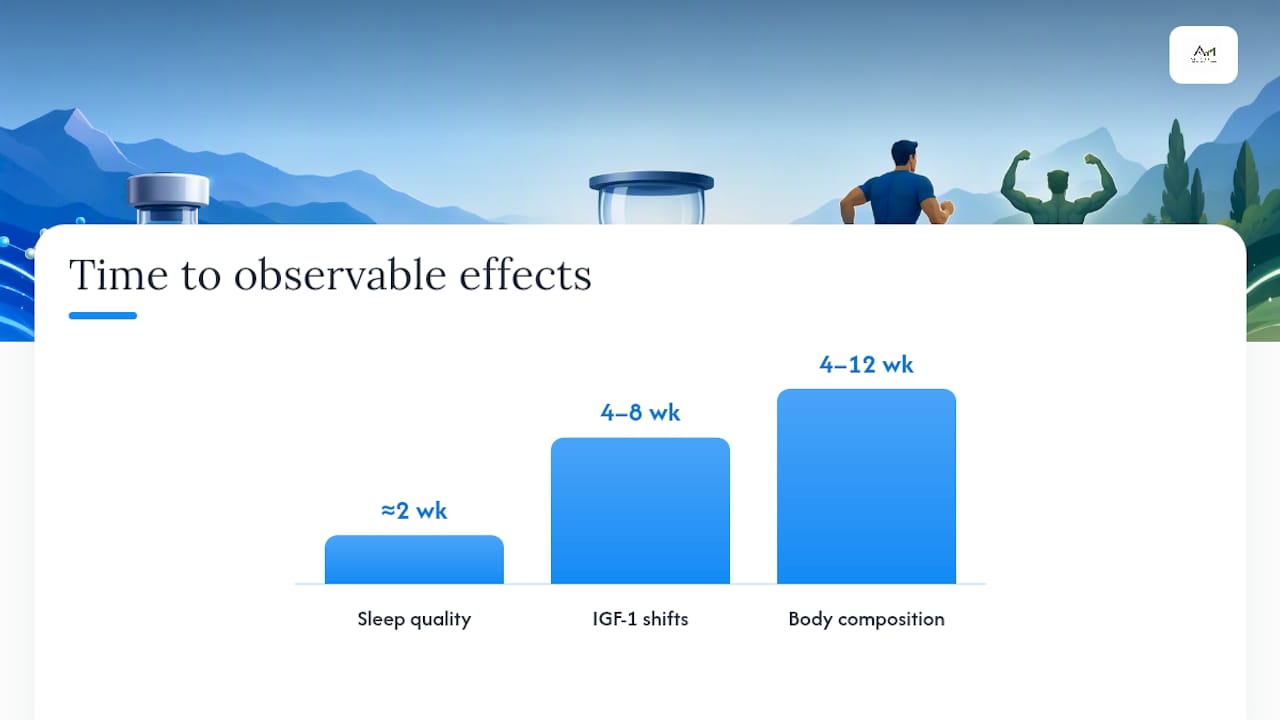
Evidence snapshot: IGF-1 shifts often show up within 4 to 8 weeks of starting therapy. Sleep changes tend to register earlier, sometimes within a couple of weeks. Body composition changes are usually measurable over a 4 to 12 week window, and response varies meaningfully from person to person based on age, baseline IGF-1, and metabolic health.
- Sleep quality: plausible, tied directly to nocturnal GH pulse timing
- Recovery: plausible but hard to isolate from training and diet variables
- Body composition: supported by GH/IGF-1 physiology, shows up over weeks not days
- Skin and anti-aging claims: weakest evidence tier, treat with skepticism
What Dosage and Timing Do Clinicians Actually Use?
Dosing in supervised practice tends to fall into a few tiers, and your clinician will adjust based on baseline labs and response rather than a fixed chart. Conservative protocols start low and build; higher tiers are typically reserved for patients with an established response history and normal IGF-1 trending.
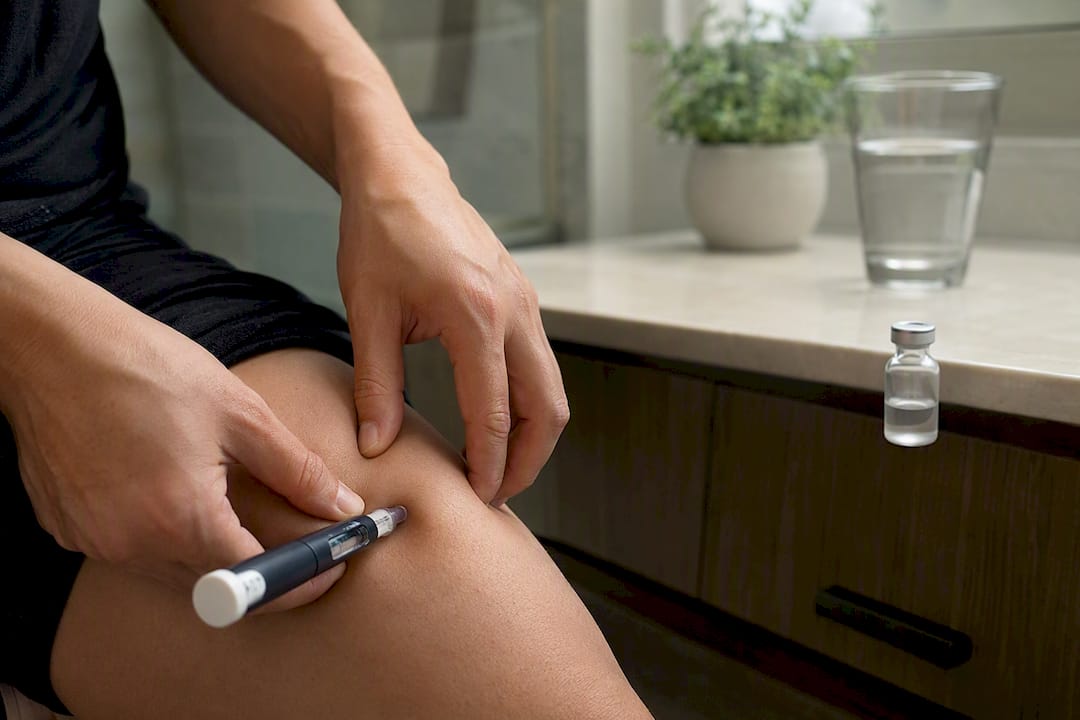
Frequency and timing options vary. A single pre-bed injection is the most common starting point, since it lines up with the natural nocturnal GH pulse. Some protocols add a second dose, often post-workout on training days, though adding pulses increases injection burden without necessarily proportional benefit. Injecting on a fasted stomach is common practice, since circulating insulin can blunt the GH response, and rotating injection sites (abdomen, thigh) helps avoid localized tissue irritation over a multi-week cycle.
Reconstitution is a clinician task, not a kitchen-table project. At a high level, peptides typically arrive as a lyophilized powder in a vial, mixed with a specific volume of bacteriostatic water to reach a target concentration. Getting that concentration wrong changes your actual dose per injection, which is exactly why this step belongs with a prescribing clinician or pharmacy, not a DIY calculation.
Cycle length in most supervised programs runs 8 to 12 weeks on, followed by roughly 4 weeks off, though some clinicians extend active phases to 12 to 16 weeks based on how IGF-1 and symptom response track. IGF-1 results guide whether the dose stays flat, increases, or gets paused entirely.
Pro Tip: If injection frequency is becoming a barrier to consistency, that's a conversation for your clinician about DAC trade-offs, not a reason to skip doses or double up on your own.
Before your first dose, a reasonable checklist looks like this:
- Baseline IGF-1, fasting glucose, and A1c drawn and reviewed
- Sterile injection supplies confirmed (syringes, alcohol swabs, sharps container)
- Reconstitution handled or verified by a licensed clinician or pharmacy
- Injection site rotation plan agreed upon
- Follow-up lab date scheduled, typically 4 to 8 weeks out
What Are the Side Effects and Who Should Avoid This Stack?
Most people tolerate the combination reasonably well, but it isn't side-effect free. Injection-site redness or minor irritation is common and usually resolves on its own. Mild water retention, transient headaches, and a temporary bump in appetite show up often enough to be considered expected rather than alarming. Less common but worth watching for are shifts in blood sugar handling and noticeable fluid shifts that don't settle within a few days.
Certain groups need to sit this out entirely or proceed only with close oversight. Active or recent cancer is a firm no, since GH-axis stimulation isn't appropriate when malignancy is a live concern, a caution echoed in clinical guidance on growth hormone therapy. Pregnancy and lactation are also contraindicated. Uncontrolled diabetes or significant insulin resistance raises the risk profile substantially, and active pituitary disorders need specialist management before any GH-axis peptide enters the picture.
A reasonable monitoring schedule:
- Baseline: IGF-1, fasting glucose, A1c, comprehensive metabolic panel, thyroid panel
- Week 4 to 8: repeat IGF-1 and fasting glucose to gauge response
- Ongoing: periodic metabolic recheck for the duration of active use
- Any diabetes medication use should be flagged to your prescribing clinician, since GH-axis changes can shift insulin needs
- Injection-site reactions and mild appetite increase: common, generally manageable
- Water retention and headache: expected in a subset of patients, usually transient
- Glucose handling changes: the reason fasting glucose and A1c belong in every monitoring plan
- Stop and reassess if IGF-1 climbs above your clinician's defined threshold, or if fluid retention or nerve-related symptoms persist
Is CJC-1295 and Ipamorelin Legal, and How Do You Source It Safely?
In the United States, these peptides require a prescription and are legally dispensed through licensed compounding pharmacies, generally operating under 503A or 503B FDA compounding frameworks. Rules and pharmacy availability can shift by state and by current FDA compounding guidance, so what's available changes over time, not just by location.
If you compete in regulated sport, know that both peptides fall under prohibited categories on the WADA Prohibited List, which covers GH-related agents and performance peptides broadly. Check with your sport's governing body before starting anything in this category if competition status matters to you.
Safe sourcing comes down to a short checklist:
- Confirm the pharmacy is a licensed 503A or 503B compounding facility
- Ask for a certificate of analysis on the specific batch you're receiving
- Require a clinician's prescription, not a self-directed online order
- Avoid unverified international sellers or research-chemical marketplaces, regardless of price
Airmed Fit's programs route through this exact model: physician oversight paired with monitored, prescription-based sourcing.
What Does the Clinical Evidence Actually Show?
The strongest data points come from studies on each peptide individually rather than the combination as a whole. The 2006 phase 1 trial on CJC-1295 established its dose-dependent effect on GH and IGF-1 in healthy adults, giving the DAC form its pharmacological baseline. Foundational work on Ipamorelin established its selective receptor profile, showing GH release without the cortisol and prolactin bump seen in older secretagogues. Broader reviews of GH physiology and secretagogue mechanisms provide the rationale for why pairing a GHRH analog with a ghrelin agonist makes physiological sense.
No large randomized controlled trial has tested the specific no-DAC CJC-1295 plus Ipamorelin combination in otherwise healthy adults. What clinics run is a protocol built on solid individual pharmacology, not a dedicated head-to-head trial of the pairing itself.
By the numbers: the 2006 trial found GH increases of roughly 2 to 10 times baseline depending on dose, a figure that still anchors most dosing conversations around CJC-1295 today.
A grounded take on where this stack fits
The honest version of this story isn't as clean as most peptide marketing makes it sound. The individual pharmacology is genuinely solid. The combination protocol is reasonable and mechanistically sound, but it's built on clinical judgment layered over that pharmacology, not a trial of the pairing itself. That distinction matters when you're deciding how aggressively to dose or how long to run a cycle. Airmed Fit's approach leans on that honesty: physician-supervised programs with lab monitoring built in, because the biomarkers are what tell you whether your specific body is responding, not the marketing copy on a peptide vial.
How to Start a Supervised Peptide Program
If you've read this far, you already know the gap between a reasonable protocol and a risky one comes down to who's watching your labs. Airmed Fit runs physician-supervised peptide programs built specifically around that gap: baseline IGF-1 and metabolic panels before your first dose, a prescribed dosing plan matched to your labs and goals, and scheduled follow-up testing so adjustments are based on your actual numbers rather than guesswork borrowed from a forum post.
Getting started is a short process. You book a consultation, complete baseline lab work, and receive a prescribed plan from a clinician who reviews your results directly, with follow-up testing built into the membership rather than left up to you to schedule. If you're ready to move past research mode and into a monitored program, start with a consultation at Airmed Fit.
Frequently Asked Questions
Is CJC-1295 with Ipamorelin safe for long-term use? Long-term safety data specific to this combination is limited. Supervised programs manage risk through periodic IGF-1 and metabolic monitoring rather than relying on indefinite use without recheck.
How long before I notice results from CJC 1295 and Ipamorelin? Sleep changes often show up within a couple of weeks. IGF-1 shifts typically appear in 4 to 8 weeks, and body composition changes usually take 4 to 12 weeks to become measurable.
What is the typical ipamorelin dosage used in supervised protocols? Clinics adjust ipamorelin dosage based on baseline labs and individual response, generally starting conservative and increasing only if IGF-1 and symptom tracking support it.
Can women use this peptide stack? Yes, though dosing and monitoring frequency may differ based on hormonal status, age, and metabolic baseline, which is why a clinician-guided plan matters more than a generic protocol.
Is this combination legal to buy online? Legitimate access requires a prescription filled through a licensed compounding pharmacy in the United States. Unverified online sellers operating outside that framework carry real quality and legal risk.
This article is general information, not a substitute for advice from a qualified doctor. Consult a qualified healthcare professional about your own circumstances before acting on anything here.
Sources
- hormone (GH) and insulin-like growth factor I secretion by CJC-1295, a long-acting analog of GH-releasing hormone, in healthy adults. J Clin Endocrinol Metab. 2006.
- European and foundational ipamorelin pharmacology and selectivity review (PMC2439518).
- WADA Prohibited List (final 2026).