

Estrogen builds and maintains the uterine lining, protects bone density, and shapes cardiovascular and brain function throughout life. Progesterone stabilizes that lining after ovulation, sustains early pregnancy, and produces calming, sedative-like effects on the nervous system. The most consequential clinical difference: anyone with a uterus taking systemic estrogen needs progesterone alongside it, or the endometrium is left unprotected.
- Peak timing: estrogen peaks mid-cycle before ovulation; progesterone peaks about a week after, typically in the mid-luteal phase
- Main production sites: estrogen from ovarian follicles (and the placenta in pregnancy); progesterone from the corpus luteum, then the placenta
- Primary clinical roles: estrogen treats hot flashes and bone loss; progesterone protects the uterine lining and supports early pregnancy
- Contraception: both appear in combined pills; progestin-only options exist alone
- Safety flag: estrogen without progesterone raises endometrial cancer risk in patients with an intact uterus
- Mood profile: estrogen tends to lift mood and sharpen cognition; progesterone tends to sedate and reduce anxiety
Key Takeaways
Estrogen builds and protects tissue across the reproductive system, bone, and brain, while progesterone stabilizes the uterine lining and must accompany estrogen therapy whenever a uterus is present.
| Point | Details |
|---|---|
| Different core jobs | Estrogen builds and protects tissue; progesterone stabilizes the lining and supports pregnancy. |
| Uterus changes the rules | Systemic estrogen requires added progesterone or a progestin to protect against endometrial cancer. |
| Timing drives testing accuracy | Progesterone should be tested in the mid-luteal phase, around day 19 to 23 of a 28-day cycle. |
| Safety review is non-negotiable | Blood clots, stroke history, and prior breast cancer rule out standard hormone therapy. |
| Individualized care matters | Airmedfit offers physician-supervised HRT with lab panels timed to your cycle for personalized dosing. |
Table of Contents
- What Are Estrogen and Progesterone, Exactly?
- How Estrogen and Progesterone Work Together
- How Each Hormone Affects Your Body Systems
- When Are Estrogen and Progesterone Used Clinically?
- Signs of Estrogen and Progesterone Imbalance
- How Doctors Test and Interpret Hormone Levels
- Treatment Options and Safety Considerations
- When to See a Clinician About Hormone Symptoms
- A Clinician-Minded Take on Hormone Decisions
- Physician-Supervised HRT Through Airmedfit
- Frequently Asked Questions
- Sources
What Are Estrogen and Progesterone, Exactly?
Estradiol, often shortened to E2, is the dominant form of estrogen circulating in the body during the reproductive years. It's the hormone doctors mean when they talk about "estrogen" in most clinical contexts, though estrone and estriol also play smaller roles at different life stages. Progesterone is the single hormone responsible for maintaining the uterine lining after ovulation, and it's produced first by the corpus luteum, then largely by the placenta once pregnancy takes hold.
Clinically, both hormones come in multiple delivery forms:
- Estradiol: oral tablets, transdermal patches or gels, and vaginal rings or creams
- Progesterone: oral micronized capsules, vaginal suppositories, and IUD-based progestins
- Synthetic progestins: injectable options and combination oral contraceptives
Pro Tip: "Progesterone" and "progestin" aren't interchangeable. Progesterone is the molecule your body makes naturally; progestins are synthetic compounds engineered to mimic it. The distinction matters because progestins carry a different side-effect profile, and some patients tolerate bioidentical progesterone better than synthetic versions.
How Estrogen and Progesterone Work Together
These two hormones don't compete. They alternate, each one rising exactly when the reproductive system needs it. That handoff is the entire logic behind the menstrual cycle.
- Follicular phase: estrogen climbs steadily as an egg matures
- Ovulation: estrogen hits its peak, triggering the LH surge that releases the egg
- Luteal phase: progesterone rises from the corpus luteum, converting the lining into a receptive, secretory state
- Pregnancy: progesterone stays elevated to sustain the uterine environment, eventually with placental support
- Menopause transition: both hormones decline, but progesterone often drops first, sometimes years before estrogen falls significantly
A single blood draw can only capture one frame of a moving picture. Estrogen and progesterone shift in a coordinated rhythm rather than a fixed ratio, so a value that looks "low" on day 10 might be exactly where it belongs. Picture the cycle as a two-act play: estrogen builds the set in act one, progesterone stages the scene in act two. Testing on the wrong day is like reviewing a play after watching only the first ten minutes.
How Each Hormone Affects Your Body Systems
Estrogen and progesterone reach far beyond the reproductive tract. Their receptors sit in bone, brain, skin, and blood vessels, which explains why hormonal shifts show up as symptoms that seem unrelated to periods or fertility at first glance.
- Reproductive system: estrogen thickens the uterine lining; progesterone stabilizes it and supports implantation
- Bone: estrogen slows bone breakdown, and its decline accelerates bone loss, which is why estrogen therapy is used to prevent osteoporosis in menopausal patients
- Brain and mood: estrogen supports serotonin activity and cognitive sharpness; progesterone has a calming, GABA-related sedative effect that can influence sleep and anxiety
- Heart and blood vessels: estrogen supports vascular flexibility and favorable cholesterol patterns during reproductive years
- Metabolic effects: estrogen influences fat distribution and insulin sensitivity; progesterone can cause mild fluid retention and bloating
- Skin: estrogen supports collagen and skin thickness, which is one reason skin changes often track with menopause timing
That estrogen and bone connection isn't a minor footnote. It's the mechanism behind why declining estrogen at menopause is one of the leading drivers of postmenopausal fracture risk, and why HRT remains one of the most studied interventions for preventing it.
When Are Estrogen and Progesterone Used Clinically?
Contraception, fertility support, and menopause management each lean on these hormones differently, and the prescribing logic changes depending on the goal.
- Contraception: combined pills use estrogen plus a progestin to suppress ovulation; progestin-only pills, implants, and hormonal IUDs work without estrogen for patients who can't take it
- Fertility care: progesterone supplementation supports the luteal phase after ovulation induction or embryo transfer
- Menopause and HRT: estrogen-only therapy is reserved for patients without a uterus, while patients with an intact uterus need combined estrogen and progesterone
That last point isn't a preference. It's a safety requirement: adding progesterone or a progestin to systemic estrogen therapy is medically necessary in patients with a uterus to counter the endometrial cancer risk that estrogen alone can create. Formulations vary widely, from bioidentical capsules to branded combination products, and MedlinePlus lists several approved combinations that clinicians choose between based on risk profile and patient preference.
Signs of Estrogen and Progesterone Imbalance

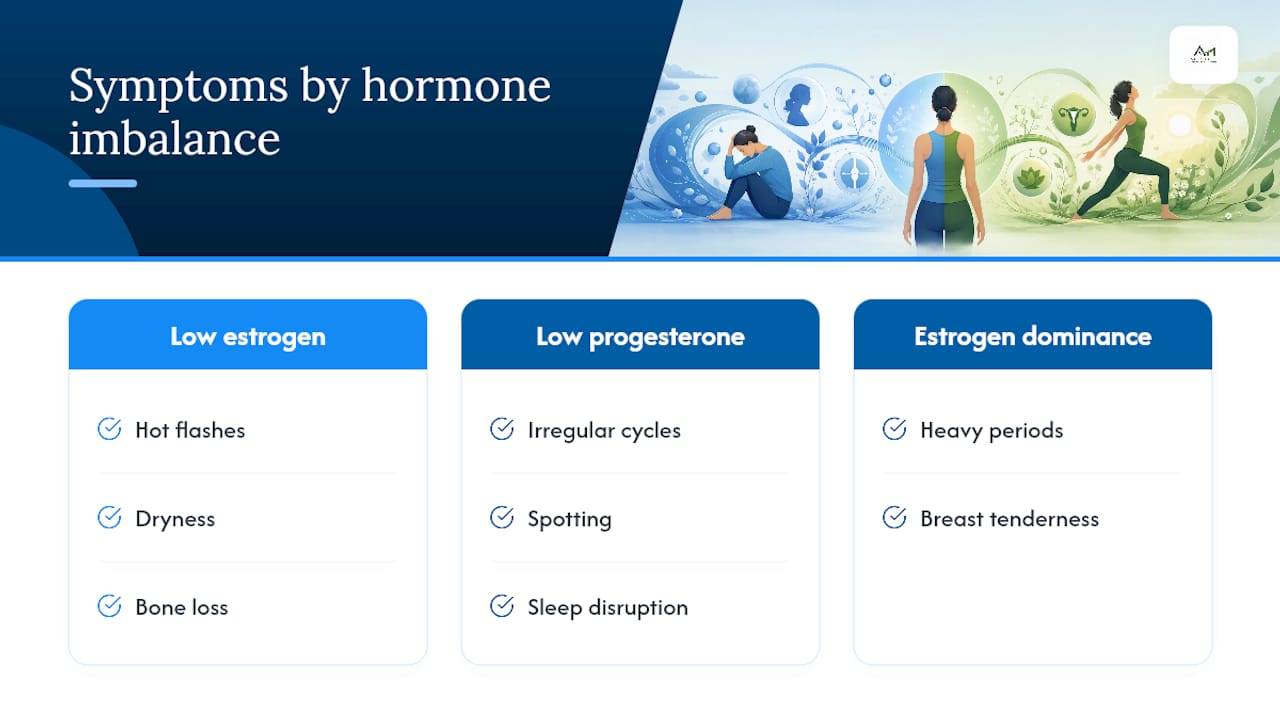
Low estrogen often shows up as hot flashes, vaginal dryness, and accelerated bone loss. High estrogen relative to progesterone can bring heavy periods, breast tenderness, and mood swings. Low progesterone frequently causes irregular cycles, spotting before periods, and anxiety or poor sleep. High progesterone, usually from supplementation, can cause drowsiness and bloating.
Perimenopause complicates the picture because progesterone typically declines before estrogen does, creating a temporary imbalance that mimics "estrogen dominance" without estrogen actually being high. PCOS follows a different pattern entirely, driven by irregular or absent ovulation rather than a simple excess or deficiency.
"Estrogen dominance" is a popular label, but it's frequently an oversimplification: the real driver in most cases is irregular ovulation, not an excess of estrogen itself.
How Doctors Test and Interpret Hormone Levels
Timing determines whether a hormone test means anything. Estradiol can be checked at various cycle points depending on the clinical question, but progesterone is different.
- Test progesterone in the mid-luteal phase, roughly day 19 through 23 of a typical 28-day cycle
- Order estradiol testing based on the specific question, such as confirming ovulation or evaluating menopause status
- Use dynamic panels or repeat testing when cycles are irregular and a single date can't be reliably targeted
Progesterone drawn outside the mid-luteal window can look artificially low even in a normal ovulatory cycle, leading to a false read on fertility or hormonal status.
Pro Tip: Track your cycle for at least two months before testing progesterone. Matching the blood draw to ovulation, not the calendar date, is what makes the result meaningful.
Treatment Options and Safety Considerations
Clinicians tailor estrogen and progesterone regimens to the specific goal, whether that's symptom relief, endometrial protection, or fertility support. A common starting point for menopausal vasomotor symptoms is 0.5 to 1 mg of estradiol combined with 100 mg of progesterone taken once daily in capsule form, though clinicians adjust the dose based on symptom response and individual risk factors.
Certain conditions rule out hormone therapy entirely:
- Undiagnosed abnormal uterine bleeding
- History of breast cancer or known estrogen-dependent tumors
- Active or prior venous thromboembolism (VTE)
- Active arterial thromboembolic disease, such as recent stroke or heart attack
- Significant liver disease
Full prescribing information for combined estradiol and progesterone capsules outlines these contraindications in detail, along with monitoring requirements clinicians follow throughout treatment.
Hormone therapy relieves real symptoms and protects bone density, but it isn't risk-free. Blood clots, stroke, and a possible increase in breast cancer risk are documented concerns that require individualized assessment, ongoing monitoring, and a physician's supervision at every stage.
When to See a Clinician About Hormone Symptoms
A hormone workup usually starts with a detailed symptom history: cycle patterns, sleep quality, mood changes, and any bleeding irregularities. From there, a clinician orders labs timed to the right cycle phase, weighs personal and family risk factors, and builds a treatment plan collaboratively rather than handing down a fixed prescription.
- Review symptoms and cycle history in detail
- Order labs timed to the correct phase, not a random draw
- Assess personal risk factors before starting any hormone therapy
- Set a monitoring schedule, including blood pressure checks and mammography where relevant
- Reassess periodically, since needs change with age and life stage
Whether bioidentical or synthetic hormones make more sense depends on individual risk and tolerance, and that conversation belongs with a physician, not a search engine.
A Clinician-Minded Take on Hormone Decisions
Patients often arrive wanting a single number to explain everything, but hormones don't work in isolation. Estrogen and progesterone move together, and the smartest path is shared decision-making grounded in timed labs and an honest look at personal risk.
- Track symptoms daily for at least one full cycle
- Note the actual date of ovulation or period start, not just a rough estimate
- Schedule labs to match cycle phase before drawing conclusions
- Bring your risk history to the conversation about therapy options
Physician-Supervised HRT Through Airmedfit
Interpreting estrogen and progesterone results on your own is where most people get stuck, especially when a single test doesn't match the timing that actually matters. Airmedfit built its HRT program around that gap: physician-supervised care, lab panels timed to your cycle or menopause stage, and dosing adjusted to your actual results rather than a generic starting point.

The team works with FDA-regulated medications sourced from licensed US manufacturers, so every prescription decision comes with clinical oversight and follow-up monitoring built in. If irregular cycles, menopause symptoms, or confusing lab results have you wondering whether estrogen, progesterone, or both belong in your plan, schedule a consultation with Airmedfit to get labs drawn at the right time and a treatment plan built around your actual numbers.
Frequently Asked Questions
Do I need progesterone with estrogen? If you have a uterus and are taking systemic estrogen, yes. Estrogen alone thickens the uterine lining without limit, which raises endometrial cancer risk. Progesterone or a progestin counteracts that effect.
Can estrogen and progesterone levels be tested on any day of the cycle? Estradiol testing can be timed to specific clinical questions, but progesterone needs mid-luteal timing, generally day 19 through 23 of a 28-day cycle, to reflect true ovulatory function.
What's the difference between estrogen vs progesterone symptoms of imbalance? Low estrogen tends to cause hot flashes, dryness, and bone loss. Low progesterone often causes irregular cycles, spotting, and sleep disruption. High estrogen relative to progesterone brings heavy periods and breast tenderness.
Is bioidentical progesterone safer than synthetic progestins? Both protect the endometrium, and bioidentical progesterone is often better tolerated, though the right choice depends on individual risk factors and should be discussed with a physician.
Does progesterone affect men too? Men produce small amounts of progesterone via the adrenal glands and testes, where it serves as a precursor in testosterone synthesis rather than playing a major independent role.
This article is general information, not a substitute for advice from a qualified doctor. Consult a qualified healthcare professional about your own circumstances before acting on anything here.
Sources
- Hormone replacement therapies can help women with bothersome menopausal symptoms — FDA
- Estradiol and progesterone capsules — DailyMed prescribing information
- Estrogen and progestin (Hormone replacement therapy) — MedlinePlus
- Hormonal testing and clinical interpretation — PMC