

Short answer: sometimes. Whether Wegovy, Zepbound, Ozempic, Mounjaro, or Foundayo gets covered depends on three things: your plan type (Medicare, Medicaid, employer, or marketplace), whether your diagnosis matches the drug's FDA-approved label, and whether your specific plan carved out an exclusion for anti-obesity medications. There's no single national rule, which is exactly why two coworkers on the same employer plan can get completely different answers from the same pharmacy.
Type 2 diabetes diagnoses tend to clear coverage far more easily than weight-loss-only claims, because insurers match the prescription against the drug's FDA indication before anything else happens. A GLP-1 approved for diabetes prescribed off-label for weight loss frequently gets flagged and denied by automated pharmacy benefit manager (PBM) filters before a human ever reviews the chart. Add in the 2026 Medicare GLP-1 Bridge demonstration, new state Medicaid rules, and shifting employer benefit designs, and "does insurance cover GLP-1" becomes a plan-by-plan question, not a yes-or-no question.
Here's how to get a real answer fast:
- Pull up your plan's online formulary and search the specific drug name, not just "GLP-1."
- Call the number on the back of your insurance card and ask your PBM directly whether the drug is covered for your diagnosis code.
- If you're on an employer plan, ask HR or your benefits broker whether anti-obesity medications are excluded at the plan level.
- Ask your prescriber's office what prior authorization (PA) paperwork they typically submit for that drug.
Pro Tip: Write down the exact phrase the PBM representative uses when they cite an exclusion. "Not covered" and "excluded from the pharmacy benefit at the plan level" are two very different problems, and the second one usually can't be appealed.
Keep reading for the specific numbers, the Medicare Bridge rules, sample appeal language, and what actually works when a claim gets denied.
Key Takeaways
GLP-1 insurance coverage hinges on plan type, FDA-matched diagnosis, and plan-level exclusions, which means the same drug can be covered for one patient and denied for another on the identical insurer.
| Point | Details |
|---|---|
| Coverage depends on three factors | Plan type (Medicare, Medicaid, employer, marketplace), FDA indication match, and plan-level exclusions all determine your outcome. |
| Medicare Bridge caps copays at $50 | The demonstration covers eligible beneficiaries for specific GLP-1 drugs but doesn't count toward TrOOP or your Part D deductible. |
| Verify before you fill | Check the formulary, call your PBM, and ask HR whether anti-obesity medications are excluded at the plan level. |
| Denials aren't always final | PA denials for missing documentation are often fixable; ERISA plan-level exclusions usually aren't. |
| Airmedfit supports the process | Physician-supervised prescribing, lab monitoring, and benefits verification help build a documented case from the start. |
Table of Contents
- Medicare GLP-1 Bridge: What Changed in 2026 and Who Qualifies
- Why Private Plans Vary So Much on GLP-1 Coverage
- What to Check in Major Commercial Plans
- What GLP-1 Medications Actually Cost, With or Without Coverage
- How to Verify Your Own Coverage Before You Fill a Prescription
- If Your GLP-1 Claim Gets Denied: Appeals and Documentation
- What Benefits Experts Say Actually Drives Coverage Decisions
- Common Scenarios: When Coverage Is Likely vs. Unlikely
- How Airmed Fit Approaches GLP-1 Access for Patients
- Get Help Verifying Your GLP-1 Coverage and Access
- Sources
Medicare GLP-1 Bridge: What Changed in 2026 and Who Qualifies
The Medicare GLP-1 Bridge is a demonstration program, not a permanent change to Part D. CMS built it to expand access to specific GLP-1 drugs for eligible Part D beneficiaries, with a flat $50 monthly copayment for the drugs included in the program. That copay structure is the headline feature, and it's dramatically lower than what many beneficiaries were paying out of pocket before the Bridge existed.

The program sits outside the normal Part D payment flow. CMS describes these demonstrations as operating separately from standard benefit administration, which has a practical consequence most people miss: Bridge copays don't count toward your True Out-of-Pocket threshold or your annual Part D deductible. You're getting a cheaper drug, but you're not necessarily moving toward catastrophic coverage faster.
| Bridge feature | Detail |
|---|---|
| Monthly copay | $50 flat rate for included GLP-1 drugs |
| Counts toward TrOOP/deductible | No, the demonstration operates outside standard Part D accounting |
| Eligibility basis | Set eligibility criteria published by CMS, tied to diagnosis and plan enrollment |
| Program structure | Voluntary demonstration, not a permanent Part D benefit change |
Eligibility isn't automatic just because you're on Medicare Part D. CMS ties participation to specific criteria around diagnosis and plan enrollment, and your plan may still require prior authorization before dispensing, even within the Bridge structure.
What actually determines whether the $50 copay applies to you:
- Confirm your Part D plan is participating in the Bridge demonstration. Not every plan sponsor opted in.
- Confirm the specific GLP-1 you've been prescribed is one of the drugs included in the demonstration.
- Ask your prescriber whether a prior authorization is still required under your plan, even for a Bridge-eligible drug.
- Call 1-800-MEDICARE or your Part D plan directly to confirm your enrollment status before you fill the prescription.
The demonstration timeline matters, too. Because this is a voluntary model rather than a statutory benefit, the rules and participating drugs can shift as CMS adjusts the program, so reconfirming eligibility each plan year is worth the ten-minute phone call.
Why Private Plans Vary So Much on GLP-1 Coverage
Three separate parties shape whether your specific plan covers a GLP-1, and none of them are your doctor. The employer or plan sponsor decides what the benefit design includes. The insurer administers the medical side of the plan. The PBM manages the pharmacy formulary, the tier placement, and the utilization rules that determine whether a prescription clears at the counter.
Coverage genuinely depends on plan type, your diagnosis, and the specific drug, and that's true even within the same insurance carrier. A large self-funded employer plan administered by Aetna might exclude anti-obesity drugs entirely, while a smaller fully-insured plan from the same carrier in the same state covers them with a prior authorization requirement.
Formularies and FDA indications drive most of the automated denials you'll encounter. If your diagnosis code says "obesity" and the drug's label says "type 2 diabetes," the PBM's system will often reject the claim before a pharmacist even sees it. That's an off-label mismatch, and it's the single most common reason a technically-approved drug gets denied for a specific patient.
Beyond the indication match, expect these utilization controls on nearly every commercial plan:
- Prior authorization requiring documented BMI, comorbidities, or failed conservative treatment.
- Step therapy that requires trying a cheaper drug or lifestyle program first.
- Quantity limits capping how many doses you can fill per month.
- Reauthorization benchmarks, often requiring proof of a minimum percentage of weight loss to continue coverage past an initial period.
Pro Tip: When you call HR or the PBM, ask specifically: "Is this an exclusion at the plan document level, or a coverage decision that requires prior authorization?" Plan-level exclusions almost never get overturned by an appeal. PA denials frequently do.
Here's the sequence that actually determines your outcome:
- Your employer's benefit design either includes or excludes anti-obesity medications from the pharmacy rider.
- If included, the PBM's formulary places the drug on a specific tier with specific PA criteria.
- Your prescriber submits documentation matching those criteria.
- The PBM's system either approves automatically or routes the case for clinical review.
What to Check in Major Commercial Plans
Large carriers like UnitedHealthcare, Aetna, and the various Blue Cross Blue Shield plans each publish policy pages and formulary documents that spell out exactly how they handle GLP-1 medications. Blue Cross plans and similar large payers have been updating these policies as utilization and cost pressures shift, so the document you find in 2026 may reflect tighter rules than what a friend describes from a year or two ago.
When you pull up a formulary or policy page, look for these specific items:
- Whether the drug sits on the preferred or non-preferred tier, since non-preferred placement usually means a higher copay and stricter PA.
- Whether the drug appears on an explicit excluded-drug list, separate from the general formulary.
- The actual PA form, which will list the exact clinical criteria the prescriber must document.
Payer policy guides commonly show BMI cutoffs around 30 or higher, or 27 or higher with a qualifying comorbidity like hypertension or sleep apnea, along with reauthorization rules that require proof of continued weight loss to keep the prescription covered. These thresholds aren't universal law. They're set by each payer's clinical policy, so the exact number on your plan's PA form is the one that counts, not a general rule of thumb.
Before you call anyone, gather these three documents:
- The Summary Plan Description (SPD), which spells out what your employer plan actually covers or excludes.
- The pharmacy benefit rider, which is a separate document from the medical benefit and often contains the anti-obesity exclusion language.
- The current formulary PDF from your PBM, searchable by drug name.
Insurer policy pages and PBM clinical criteria documents aren't just reference material. Bring the specific BMI and comorbidity language from those documents to your prescriber's office before your appointment, so the PA request is written to match the payer's own criteria the first time.
What GLP-1 Medications Actually Cost, With or Without Coverage
Cost swings wildly depending on where you land in the coverage maze. Insured patients with a favorable formulary placement often pay a copay in the tens of dollars per fill. Patients whose plans exclude the drug, or who haven't cleared prior authorization yet, can face list prices that run into four figures a month without any manufacturer assistance.
| Scenario | Typical monthly cost |
|---|---|
| Medicare Bridge, eligible beneficiary | $50 flat copay |
| Commercial plan, preferred tier with PA approved | Copay tier pricing, often a fraction of list price |
| Commercial plan, excluded or PA denied | Full list price, commonly into four figures |
| Cash-pay, no insurance involved | Full list price or compounded-product pricing |
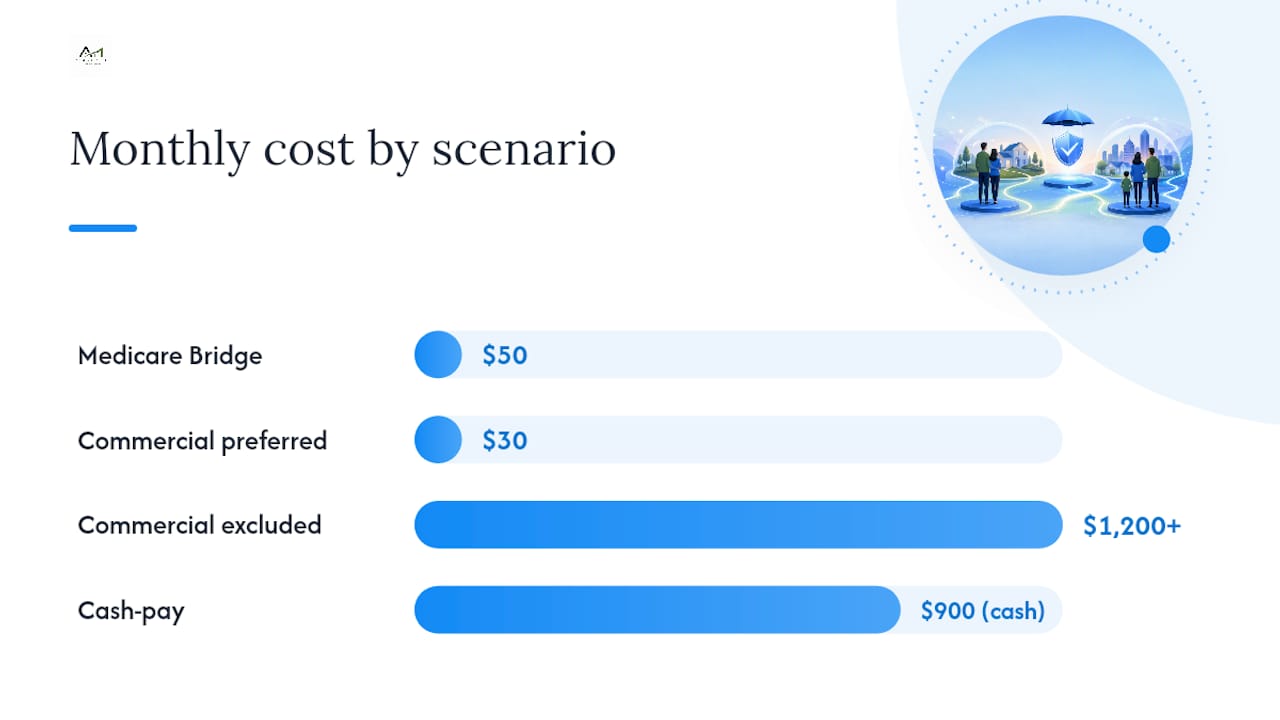
Consumer guides consistently note that private plans frequently exclude GLP-1s for weight loss specifically, which pushes a meaningful share of weight-loss patients toward manufacturer savings cards or cash-pay arrangements even when they technically have insurance.
Manufacturer savings cards can knock the monthly price down substantially for commercially insured patients whose plan covers the drug but leaves a high copay. The catch: most of these programs explicitly exclude patients on Medicare, Medicaid, or other government insurance, so if you're on the Bridge or on Medicaid, the manufacturer card usually isn't an option for you regardless of what the fine print promises.
Compounded GLP-1 products and cash-pay telehealth programs operate entirely outside insurance. They're an access route for people who can't get coverage any other way, but they aren't a coverage solution, and they won't apply toward any deductible or out-of-pocket maximum tracked by your actual insurance plan.
Pro Tip: Check three things together before assuming a drug is unaffordable: the formulary tier, whether a manufacturer program applies to your insurance type, and whether your plan requires mail-order dispensing for specialty drugs, since mail-order pricing sometimes differs from retail.
How to Verify Your Own Coverage Before You Fill a Prescription
Don't wait for the pharmacy counter to find out whether your GLP-1 is covered. The process takes four steps and usually less than a day if you're organized about it.
- Pull your plan's Summary Plan Description and pharmacy benefit rider, and search for "anti-obesity" or the specific drug name.
- Log into your insurer or PBM's member portal and search the online formulary for the exact drug and dosage form your prescriber wants to use.
- Call the number on your insurance card and ask the PBM representative directly whether the drug requires prior authorization, step therapy, or is excluded outright.
- If you're on an employer plan, call HR or your benefits broker and ask whether anti-obesity medications are excluded at the plan document level.
When you call, ask these exact questions and write down the answers:
- "Is this specific drug on the formulary, and what tier is it?"
- "Does it require prior authorization, and what clinical documentation does the PA form require?"
- "Is there a quantity limit or reauthorization requirement after the first fill?"
- "Is this drug excluded from the pharmacy benefit at the plan level, separate from any PA process?"
PA decisions typically take anywhere from a few days to a couple of weeks depending on the payer, though utilization controls have expanded across payers recently, which can stretch timelines further than patients expect. Ask the representative for the specific turnaround time on your plan and get it in writing if possible.
Before your prescriber submits a PA, have these ready: your current BMI and weight history, any documented comorbidities (hypertension, sleep apnea, prediabetes), records of prior weight-loss attempts, and your diagnosis code as it will appear on the claim.
If Your GLP-1 Claim Gets Denied: Appeals and Documentation
A denial isn't the end of the process, but the path forward depends entirely on why you were denied. An automated PA denial for missing documentation is usually fixable. A plan-level exclusion written into your employer's benefit design is a much harder wall to climb.
The standard appeals sequence looks like this:
- File an internal appeal with your insurer, typically within 180 days of the denial, though your plan's specific deadline is listed on the denial letter.
- If the internal appeal fails, request an external review through your state's independent review process or the federal external review system, depending on your plan type.
- If your case involves urgent medical need, ask specifically for an expedited review, which compresses the standard timeline to days rather than weeks.
Successful appeals almost always include the same core documentation: a full BMI history showing the trend over time, a list of comorbidities with supporting clinical notes, records of prior conservative treatment attempts (diet programs, other medications), and a letter of medical necessity from the prescriber tying all of it together. A structured lifestyle program and documented prior treatment failures are frequently the difference between an approved and denied PA, and their absence is one of the most common, and most fixable, reasons a first request gets rejected.
Here's the harder truth: if your denial cites a self-funded employer plan's ERISA exclusion of anti-obesity medications specifically, an appeal usually won't work. Those exclusions sit outside most state insurance mandates, and no amount of clinical documentation changes a plan document that simply doesn't cover the drug category. Knowing the difference before you spend weeks building an appeal file saves real time and frustration.
Pro Tip: Copy your HR benefits manager and the PBM's clinical review contact on your written appeal, not just the insurer's general claims department. Benefits managers can sometimes flag process errors internally, and it puts a paper trail in front of the people who actually control the plan design.
What Benefits Experts Say Actually Drives Coverage Decisions
Plan benefit design, not clinical need, is usually the deciding factor in whether your GLP-1 gets covered. Two patients with identical BMI, identical comorbidities, and identical prescriber documentation can get opposite outcomes if one works for an employer that includes anti-obesity medications in the pharmacy benefit and the other doesn't. That's not a clinical decision. It's a benefits-design decision made months earlier during an annual plan renewal.
Off-label use is the other quiet killer. When a T2D-approved drug gets prescribed for weight loss, the diagnosis code and the drug's FDA label don't match, and PBM systems are built to catch that mismatch automatically. It gets rejected at the system level, often before any human reviewer ever sees the chart, which is why matching the diagnosis code to an FDA-approved indication for weight loss (where the drug carries that indication) matters more than most patients realize.
If you're trying to figure out your own odds before you even start, ask your HR benefits contact this exact question: "Does this plan exclude anti-obesity medications from the pharmacy benefit?" It's a yes-or-no question that cuts through formulary jargon and tells you immediately whether you're dealing with a coverage problem or a documentation problem.
Pro Tip: If the answer is yes, your plan excludes the category, stop building a PA file and start looking at appeal limits, alternative benefit years, or cash-pay and manufacturer program options instead. There's no clinical argument that overturns a category-level plan exclusion.
Common Scenarios: When Coverage Is Likely vs. Unlikely
Matching your situation to a similar case saves time before you invest weeks in paperwork.
Coverage is likely when:
- You have a documented type 2 diabetes diagnosis and the prescribed drug (Ozempic, Mounjaro) carries that FDA indication.
- You qualify for the Medicare GLP-1 Bridge and your Part D plan participates in the demonstration.
- You have obesity with a qualifying cardiovascular indication and your plan follows payer criteria that recognize that combination for drugs like Wegovy.
- Your state Medicaid program has added coverage for GLP-1s and you meet that state's specific criteria.
Coverage is unlikely when:
- You're seeking a T2D-labeled drug off-label for weight loss without a diabetes diagnosis on file.
- Your employer plan carries an explicit anti-obesity medication exclusion at the plan document level.
- You're relying on a compounded GLP-1 product, which sits outside insurance entirely regardless of your plan.
- You're on a state Medicaid program that hasn't added obesity-drug coverage, since state Medicaid coverage for these drugs is optional and varies significantly, with some states adding coverage in recent years and others declining to.
If Medicaid is your coverage source, check your specific state's preferred drug list (PDL) directly rather than assuming national rules apply, since state-level differences here are larger than in almost any other coverage category.
How Airmed Fit Approaches GLP-1 Access for Patients
Working with patients navigating this system day after day makes one thing obvious: the biggest obstacle usually isn't the medication itself, it's untangling which document (SPD, formulary, PA form) actually controls the answer. Airmedfit's physician-supervised approach to GLP-1 prescribing exists specifically because patients need more than a prescription. They need someone who understands lab monitoring, dosing protocols, and how to document a case in the language a PBM's clinical review team actually looks for.
Because Airmedfit works with FDA-regulated GLP-1s sourced from licensed U.S. manufacturers and pairs every prescription with physician oversight and lab panels, patients get a documented, medically supervised record from day one, which matters enormously if a PA or appeal ever needs that history. If you're trying to figure out where you stand on coverage or need help building a case for medical necessity, Airmedfit is a reasonable place to start that conversation.
Get Help Verifying Your GLP-1 Coverage and Access
Chasing down formulary PDFs, PA criteria, and HR benefits contacts on your own eats hours you probably don't have. Airmedfit shortens that process by pairing your prescription with physician oversight from the start, so the documentation a PBM asks for during prior authorization, BMI history, comorbidities, prior treatment attempts, already exists in your chart instead of getting assembled after a denial.
Airmedfit's physician-supervised model includes benefits verification support, letters of medical necessity when a prescriber determines they're appropriate, and ongoing lab monitoring so your treatment record stays current if your plan requires reauthorization. If you're ready to find out where you stand, have your insurance card, current weight and BMI history, and any prior treatment records ready and start a consultation through Airmedfit's platform. A telehealth intake typically starts with a benefits and eligibility conversation before any prescription decision gets made, so there's no commitment required just to get a clear answer about your options.
Sources
Verifying your own coverage means going straight to the source rather than relying on secondhand summaries.
- Weight loss drugs
- Does Insurance Cover GLP-1s 2026? Coverage by Plan Type | Telehealth Ally
- Patients Face New Barriers for GLP-1 Drugs - Penn LDI
- Medicaid
This is general information about insurance policies and coverage patterns, not a guarantee of what your specific plan will approve. Confirm your plan's actual rules with your insurer, PBM, or a licensed benefits professional, and talk to your prescriber about what documentation applies to your individual case.
This article is general information, not a substitute for advice from a qualified doctor. Consult a qualified healthcare professional about your own circumstances before acting on anything here.