

Hormone replacement therapy does not melt fat off the scale. Decades of trial data, including Cochrane's pooled analysis, show HRT alone produces no clinically meaningful weight loss. What it can do is shift where fat sits on your body and improve metabolic markers, and a 2026 Mayo Clinic cohort suggests it may boost how well tirzepatide works. Neither makes HRT a weight-loss drug.
TL;DR:
- HRT does not cause significant weight loss but may shift fat storage and improve metabolic markers, especially when combined with medications like tirzepatide.
- Estrogen influences fat oxidation, insulin response, and visceral fat reduction, which can lead to decreased waist circumference even without weight change.
- Progress in fat loss from HRT occurs gradually over months and is best measured by waist measurement and metabolic labs, not scale weight.
- Combining HRT with GLP-1 medications may enhance weight loss, but HRT alone remains ineffective for substantial weight reduction.
- Weight management should focus on lifestyle factors, as HRT's primary indications are symptom relief, bone health, and metabolic support, not weight loss.
Table of Contents
- Why Weight Tends to Climb During Perimenopause and Menopause
- What the Best Studies Actually Show About HRT and Weight
- How Estrogen Actually Affects Fat, Metabolism, and Appetite
- What to Realistically Expect, Month by Month
- Combining HRT with GLP-1 Medications and Lifestyle Changes
- Who Should Actually Consider HRT, and What the Risks Are
- How We Think About Coordinated HRT and Metabolic Care
- Getting Started with Physician-Supervised Care
- Sources
Why Weight Tends to Climb During Perimenopause and Menopause
Blame biology before you blame hormones alone. Resting metabolic rate drops as women age, partly from losing lean muscle mass, and Mayo Clinic estimates this can total roughly 250 calories a day if nothing else changes. Eat the same, move the same, and that gap shows up as weight, usually gathering around the abdomen instead of the hips and thighs, since falling estrogen redirects fat storage toward visceral depots.
A handful of other factors compound the shift:
- Sleep disruption from night sweats reduces recovery and raises cortisol, which favors fat storage.
- Vasomotor symptoms (hot flashes) disturb sleep architecture even when a woman doesn't fully wake.
- Mood changes and fatigue often reduce daily activity and increase reliance on convenience food.
Most women notice these changes in their late 40s to early 50s, right as periods become irregular, well before menopause is officially diagnosed.
What the Best Studies Actually Show About HRT and Weight
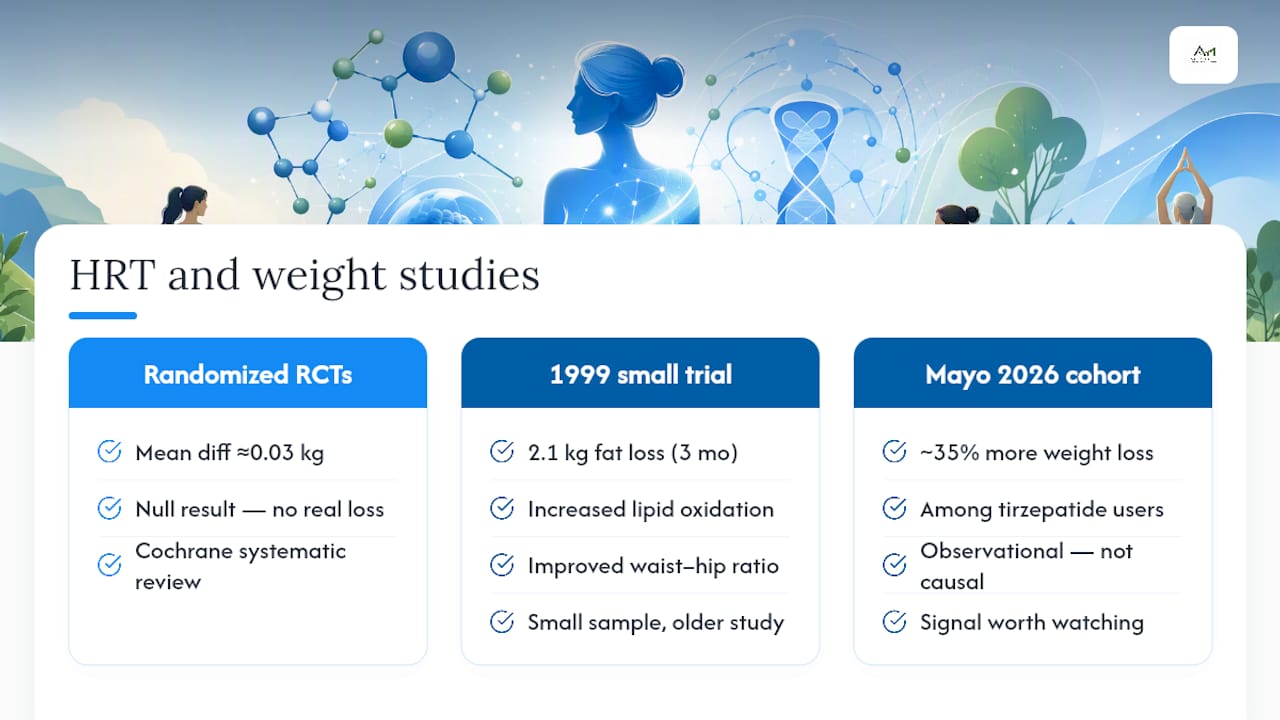
The evidence splits into two tiers, and mixing them up is where most confusion starts.
Randomized trials say: no real weight loss. The Cochrane systematic review pooling multiple RCTs found a mean weight difference of about 0.03 kg between HRT and placebo groups. That's not a rounding error worth debating. It's a null result.
Small older trials hint at composition benefits. A 1999 clinical trial in obese menopausal women found combined HRT increased lipid oxidation and produced a modest 2.1 kg fat loss with improved waist to hip ratio over three months. It was a small sample, but the mechanism (better fat burning, not appetite suppression) still holds up.
The 2026 signal that changed the conversation: A Mayo Clinic observational cohort reported that postmenopausal women taking tirzepatide alongside menopausal hormone therapy lost roughly 35% more weight than women on tirzepatide without HRT.
That's a striking number, and it's already reshaping how clinicians talk about hrt and weight loss together. But it's observational, meaning the women weren't randomly assigned to HRT. Something else about who chooses HRT (health status, engagement with care, other lifestyle factors) could explain part of the gap. It's a real signal worth watching, not proof of cause and effect.
How Estrogen Actually Affects Fat, Metabolism, and Appetite

Estrogen does far more than regulate cycles. It helps control appetite signaling through pathways involving POMC neurons in the hypothalamus, the same brain circuitry that GLP-1 drugs like semaglutide target. That overlap may explain why HRT and GLP-1 medications appear to interact rather than simply run in parallel.
Beyond appetite, estrogen influences several measurable systems:
- Lipid oxidation, or how efficiently the body burns fat for fuel, tends to improve with estrogen therapy.
- Insulin response and fasting glucose often improve modestly, even without weight change, according to reviews of HRT's metabolic effects.
- Visceral fat storage, the metabolically active fat around organs, responds more to estrogen than fat stored elsewhere.
That's why waist circumference can shrink while the number on the scale barely budges. Pro Tip: Track a tape measure at your navel monthly instead of relying only on the scale. Visceral fat loss shows up there long before total body weight reflects it. Delivery method matters too. Transdermal estradiol carries a different metabolic and clotting risk profile than oral estrogen, which is one reason clinicians increasingly favor patches or gels for patients with metabolic concerns.
What to Realistically Expect, Month by Month
Progress with HRT unfolds slowly and unevenly, and the scale is often the last thing to move.
- Weeks 2 to 4: Hot flashes and night sweats start easing. Some women notice temporary water retention as the body adjusts.
- Weeks 4 to 12: Sleep quality improves, appetite regulation feels more predictable, and clothes may fit differently around the waist even without a lower number on the scale.
- Months 3 to 6: This is when measurable shifts in waist circumference or visceral fat show up in some studies, while total body weight often stays essentially flat.
Judge progress by waist measurement, how clothes fit, and metabolic labs like fasting glucose and lipids, not just body weight.
Combining HRT with GLP-1 Medications and Lifestyle Changes
GLP-1 and GIP/GLP-1 drugs remain the primary tools for meaningful weight loss. Trial data on tirzepatide shows weight reductions near 20% at higher doses, a category HRT simply doesn't compete in. HRT isn't a substitute for these medications; it serves a different purpose entirely.
The Mayo Clinic cohort's 35% figure suggests estrogen may enhance how the body responds to GLP-1 signaling, not replace it.
Coordinating both therapies safely requires a few practical steps:
- Reconcile all medications with your prescriber before starting either therapy, especially around blood pressure and glycemic monitoring.
- Set realistic expectations. Fewer than half of the benefit likely comes from HRT itself.
- Keep communication open between whoever manages your hormone therapy and whoever manages your metabolic medication.
None of this replaces the fundamentals. A caloric deficit, resistance training to preserve lean mass, and consistent sleep still do most of the heavy lifting.
Who Should Actually Consider HRT, and What the Risks Are
Weight loss alone isn't a reason to start HRT. The North American Menopause Society's position lists the real indications: vasomotor symptom relief, genitourinary syndrome of menopause, and bone protection. Weight management doesn't appear on that list.
Before starting, a clinician should weigh several factors:
- Age and years since your last period, since risk profiles shift with time from menopause.
- Personal or family history of breast cancer, blood clots, or cardiovascular disease.
- Route of administration, since oral and transdermal estrogen carry different clotting risks.
Pro Tip: Ask your prescriber for baseline labs (lipids, fasting glucose, liver function) before starting HRT, then repeat them at three to six months so you have real data instead of guesswork about whether it's helping. Discuss your specific goals and risk factors with a licensed clinician. Don't start HRT solely chasing a number on the scale.
How We Think About Coordinated HRT and Metabolic Care
We built Airmedfit's care model around a simple observation: HRT and metabolic therapy solve different problems, and treating them as one thing does patients a disservice. Physician-supervised HRT addresses symptoms and bone health. FDA-regulated GLP-1 medications address weight. When both are clinically appropriate, coordinating them under one supervised plan, with lab monitoring and a real feedback loop, beats managing them in isolation. That's the evidence-first approach we think the 2026 data actually supports.
— Organic
Getting Started with Physician-Supervised Care
If you're weighing HRT for symptom relief and wondering how it fits alongside weight management, Airmedfit gives you a single coordinated path instead of piecing together separate providers who never talk to each other.

Airmedfit's model centers on physician consultations, baseline and follow-up lab panels, and direct access to FDA-regulated GLP-1 medications and peptides sourced from licensed US manufacturers. For readers wanting an outside look at how HRT service models and pricing typically work across providers, this HRT services review offers useful context before you commit to any program.
A good first step looks like this: book a consultation, complete baseline labs, and get a personalized plan built around your actual symptoms and metabolic goals rather than a generic protocol. If your goals include both hormone balance and weight management, start with a consultation at Airmedfit to see whether coordinated care fits your situation.

This article is general information, not a substitute for advice from a qualified doctor. Consult a qualified healthcare professional about your own circumstances before acting on anything here.
Sources
- Cochrane Library — estrogen and progestogen HRT for weight and fat distribution
- Beneficial effect of hormone replacement therapy on weight loss in obese menopausal women — PubMed (1999)
- Mayo Clinic news — New study links combination of hormone therapy and tirzepatide to greater weight loss after menopause
- PMC review on HRT and metabolic outcomes