

Ipamorelin produces cleaner, more selective growth hormone pulses, which makes it a common pick for recovery and body composition goals. Sermorelin mimics natural GHRH and gets chosen when physiological pituitary support and a longer clinical track record matter more than pulse strength. Neither peptide is inherently "better." Both require physician oversight, baseline labs, and a real plan for what you're trying to fix.
- Choose Ipamorelin if: you want stronger, more selective GH release for training recovery, sleep depth, or body composition, with less concern about cortisol or prolactin creep.
- Choose Sermorelin if: you want a GHRH-style approach that supports the pituitary's own natural signaling, especially if you value its longer regulatory history.
- Do this next: get baseline IGF-1 and metabolic labs drawn, then discuss both goals and tolerability with a supervising clinician before starting either one.
Key Takeaways
Ipamorelin favors recovery and body composition through selective, low-side-effect GH pulses, while Sermorelin favors physiologic pituitary support with a longer regulatory history behind it.
| Point | Details |
|---|---|
| Match peptide to goal | Ipamorelin suits recovery and body composition; Sermorelin suits sleep-focused, physiologic pituitary support. |
| Mechanisms differ by receptor | Sermorelin drives GH synthesis via GHRHR; Ipamorelin releases stored GH via GHSR. |
| Results take weeks, not days | Expect early sleep and energy changes by week 4, and IGF-1 or body composition shifts by weeks 8 to 12. |
| Stacking has a real rationale | Combining both peptides can produce additive GH output, but usually only after a single-agent trial plateaus. |
| Supervised care lowers risk | Airmedfit combines physician evaluation, lab monitoring, and verified US-sourced peptides for safer dosing decisions. |
Table of Contents
- Ipamorelin vs Sermorelin at a Glance
- What Is Sermorelin and How Does It Work?
- What Is Ipamorelin and Why Does Selectivity Matter?
- How Do Their Mechanisms Actually Differ in Practice?
- When Will You Notice Results?
- Who Tends to Do Best on Sermorelin?
- Who Tends to Do Best on Ipamorelin?
- Why Do Clinicians Combine Ipamorelin and Sermorelin?
- What Side Effects and Safety Signals Should You Watch For?
- How Should You Actually Choose Between Them?
- Why Physician Supervision Changes the Risk Profile
- Ready to Start Physician-Supervised Peptide Therapy?
- A Clinician's Closing Note on Individualized Dosing
- Sources
Ipamorelin vs Sermorelin at a Glance
The core difference comes down to receptor targets. Ipamorelin is a ghrelin mimetic that binds the GHSR-1a receptor and triggers release of GH already stored in the pituitary. Sermorelin is a GHRH analog that binds the GHRH receptor and stimulates the gland to actually synthesize more GH, not just release what's on hand.
Half-life separates them in practice, too. Ipamorelin's subcutaneous half-life runs around two hours, giving it a wider dosing window and more flexibility for multiple daily injections. Sermorelin clears from plasma within minutes when given intravenously, but subcutaneous dosing timed before sleep produces a longer effective GH response that lines up with the body's natural nocturnal GH surge.
- Mechanism: GHSR agonist (Ipamorelin) vs. GHRH receptor agonist (Sermorelin)
- Half-life: ~2 hours subcutaneous (Ipamorelin) vs. minutes IV, longer effective window subcutaneous (Sermorelin)
- Typical timing: flexible, often multiple daily doses (Ipamorelin) vs. usually one dose before bed (Sermorelin)
- Regulatory history: limited formal approval history (Ipamorelin) vs. former FDA approval as Geref (Sermorelin)
- Cost and monitoring: both need lab-based titration; Ipamorelin's selectivity can simplify side-effect tracking
What Is Sermorelin and How Does It Work?
Sermorelin is a synthetic GHRH 1-29 analog. It binds the GHRH receptor on pituitary somatotrophs and stimulates both GH synthesis and release, a mechanism that preserves the body's own somatostatin feedback loop. That matters because the pituitary still gets to apply its own brakes, which is part of why clinicians describe Sermorelin's action as more "physiologic" than a straight GH injection.
Sermorelin has real regulatory pedigree. The FDA once approved it as Geref for pediatric growth hormone deficiency, and though the branded product was later discontinued for commercial reasons, that approval history left behind a deeper clinical dataset than most peptides used today ever accumulate.
- Typical protocols use subcutaneous dosing before bed to match nocturnal GH secretion patterns.
- Physician-supervised programs usually start conservative and adjust based on IGF-1 response.
- Monitoring generally includes baseline labs and a follow-up panel 6 to 12 weeks in.
Pro Tip: If sleep quality is your main driver, ask your clinician whether Sermorelin's bedtime dosing schedule fits your routine better than a peptide requiring multiple daily injections.
What Is Ipamorelin and Why Does Selectivity Matter?
Ipamorelin is a five-amino-acid peptide, a growth hormone releasing peptide (GHRP) that activates the ghrelin receptor, GHSR-1a. Instead of prompting new GH synthesis, it triggers release of GH already stored in the pituitary, producing a fast, sharp pulse.
What sets Ipamorelin apart from older GHRPs is selectivity. Research on its clinical pharmacology found it produces strong GH pulses with minimal increases in cortisol and prolactin, a real advantage for anyone worried about the puffiness, mood shifts, or stress-hormone effects that plagued earlier growth hormone secretagogues.
- Subcutaneous half-life runs close to two hours, wider than Sermorelin's plasma clearance.
- Dosing windows are more flexible, which supports once, twice, or multiple daily injections depending on the protocol.
- Minimal off-target hormone activity simplifies monitoring for body composition and recovery goals.
- Standard physician-supervised ranges start low and titrate against IGF-1 and symptom response.
Pro Tip: If cortisol sensitivity or water retention has been an issue with other peptides, Ipamorelin's selective profile is usually the easier one to tolerate.
How Do Their Mechanisms Actually Differ in Practice?
The receptor-level split explains almost everything downstream. Sermorelin activates GHRHR, which increases GH gene transcription and secretion while keeping somatostatin's inhibitory feedback intact. Ipamorelin activates GHSR, which mainly dumps stored GH without engaging that same synthesis pathway.
This is why Sermorelin gets described as more physiologic. The pituitary still checks itself through somatostatin, so a "runaway" response is less likely even if dosing runs a bit high. Ipamorelin, by contrast, produces a cleaner, more predictable pulse because it largely sidesteps the messier off-target signaling that comes with less selective ghrelin mimetics.
One number worth sitting with: in the pharmacology data behind Ipamorelin's approval-track research, GH release happened with only minimal cortisol and prolactin elevation compared with older secretagogues tested under similar conditions. That gap is the reason so many clinicians reach for Ipamorelin first when a patient has had a rough time with other GHRPs.
For titration, the practical difference shows up at your follow-up labs. Sermorelin's synthesis-driven mechanism tends to build gradually, so clinicians often wait longer between IGF-1 checks to see a true signal. Ipamorelin's release-driven mechanism shows up faster, but because it doesn't touch synthesis the same way, some protocols cycle it or pair it with a GHRH analog once a patient's response plateaus.
- Sermorelin: increases GH synthesis, preserves somatostatin feedback, more gradual titration curve.
- Ipamorelin: releases stored GH, higher selectivity, faster observable pulse, better fit for tighter monitoring windows.
- Pituitary reserve testing matters more with Sermorelin, since its mechanism depends on the gland's remaining synthetic capacity.
When Will You Notice Results?
Expectations matter as much as mechanism here. Neither peptide works overnight, and the timeline differs by what you're measuring.
- Weeks 2 to 4: Subjective changes tend to show up first, usually better sleep depth and steadier daytime energy.
- Weeks 6 to 8: IGF-1 levels typically start shifting enough to show on a follow-up lab panel, giving your clinician the first objective read on response.
- Weeks 8 to 12+: Body composition changes (less fat, better recovery from training) generally become noticeable, though this varies with age, baseline GH axis function, and any medications you're on.
- Ongoing: Clinics typically recheck labs every 6 to 12 weeks to confirm the dose is still doing what it should without drifting into overtreatment.
Age and baseline pituitary function drive most of the variability. A 45 year old with a sluggish GH axis may see slower IGF-1 movement than someone in their late 20s starting from a stronger baseline, regardless of which peptide they use.
Who Tends to Do Best on Sermorelin?
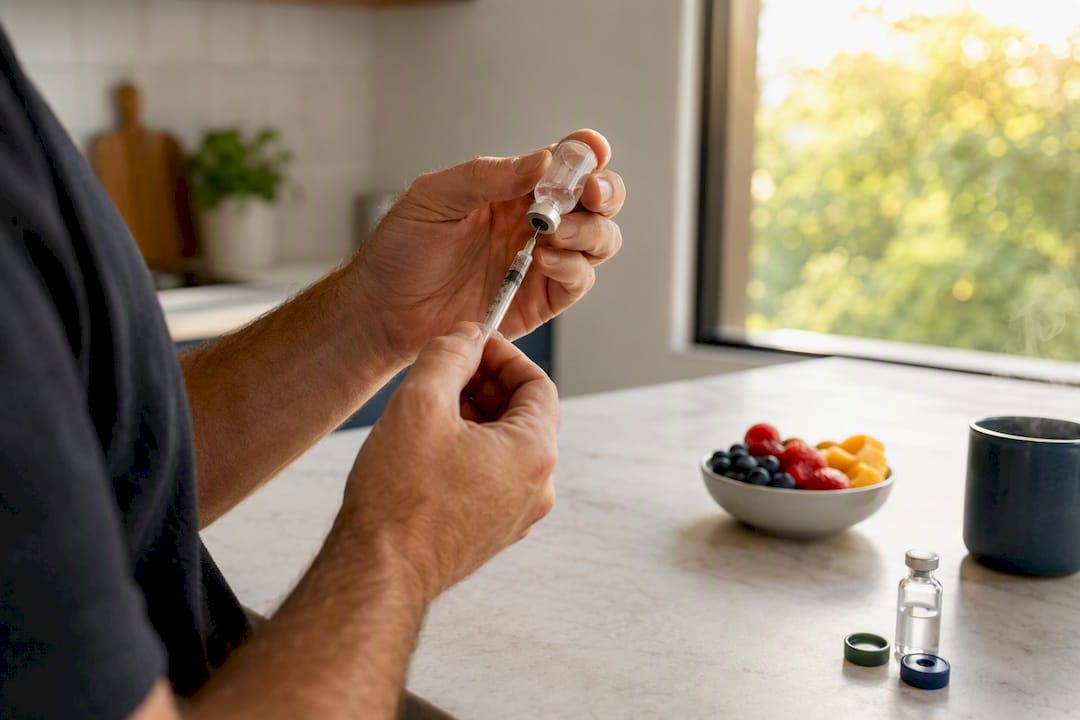
Sermorelin fits patients who want their own pituitary doing the work rather than a peptide forcing a pulse. It's a common choice for pituitary conditioning protocols, physiologic sleep-focused regimens, and long-term maintenance where preserving the somatostatin feedback loop is the priority.
Clinicians often lean toward Sermorelin specifically because of its documented history. Decades of Geref-era data give prescribers a comfort level that newer peptides haven't had time to build.
- Best fit: patients prioritizing a physiologic pattern over peak GH output.
- Best fit: those who want a once-nightly injection instead of multiple daily doses.
- Trade-off: shorter plasma half-life means precise bedtime timing matters more.
- Trade-off: higher doses can nudge cortisol and prolactin slightly, so monitoring still applies.
Who Tends to Do Best on Ipamorelin?
Ipamorelin suits patients chasing measurable body composition change, faster training recovery, or deeper sleep without the off-target hormone noise that comes with less selective peptides.
Its longer half-life is a practical convenience. A roughly two-hour subcutaneous window gives more flexibility for dose timing than Sermorelin's narrower nocturnal target, and predictable titration makes it easier for a clinician to fine-tune dosing across follow-up visits.
- Best fit: recovery from training or injury, where a strong discrete pulse matters more than gradual synthesis.
- Best fit: patients who've had cortisol or prolactin issues with other GH secretagogues.
- Trade-off: its clinical evidence base, while solid, is smaller than Sermorelin's regulatory-approval dataset.
Why Do Clinicians Combine Ipamorelin and Sermorelin?
Stacking the two isn't a marketing gimmick. Because they hit different receptors, GHRH analog plus GHRP combinations produce additive or synergistic GH release compared with either peptide used alone. Sermorelin primes synthesis, Ipamorelin triggers release, and together they can produce more total GH output than either agent working solo.
Many supervised protocols use this exact logic: lower doses of each peptide instead of a high dose of one, which can boost output while limiting the side-effect load either agent might cause at a higher solo dose.
- Combination protocols usually make sense once a single-agent trial has already shown some response but plateaus.
- Cost and injection burden go up with a stack, so it's worth reserving for patients with a clear, unmet goal.
Pro Tip: Don't start with a stack. Trial one peptide first so you and your clinician know which agent is actually driving your results before adding a second.
What Side Effects and Safety Signals Should You Watch For?
Both peptides carry generally favorable safety profiles in published research when used at standard, physician-directed doses, with serious adverse events rarely reported. That doesn't mean either is monitoring-free.
- Injection-site reactions: flushing, redness, or mild swelling are the most common complaint with both peptides.
- Headache and transient water retention: more likely with higher-dose Sermorelin protocols, given its broader synthesis-driven action.
- Cortisol and prolactin shifts: possible with either peptide at excessive doses, though Ipamorelin's selectivity makes this less common at standard ranges.
- Baseline labs to run: IGF-1, a metabolic panel, and fasting glucose before starting, then again at follow-up.
- Who should avoid either peptide: anyone with active malignancy, pregnant patients, and pediatric patients outside specialist oversight.
- Red flags requiring urgent review: unexplained joint pain, vision changes, or signs of insulin resistance developing during treatment.
How Should You Actually Choose Between Them?
Turning this comparison into a decision is easier with a clear checklist rather than a gut call.
- Name your primary goal. Recovery and body composition point toward Ipamorelin. Sleep-focused, physiologic pituitary support points toward Sermorelin.
- Weigh your tolerance priorities. If you've had cortisol or prolactin issues before, Ipamorelin's selectivity is usually the safer starting point.
- Consider your evidence preference. If you want a peptide with a longer regulatory track record behind it, Sermorelin's Geref history carries weight.
- Bring the right information to your clinician: recent labs, full medication list, sleep patterns, and training or recovery goals.
- Plan a real trial. An 8 to 12 week single-agent trial with measurable endpoints (IGF-1, symptom tracking, body composition) tells you far more than guessing.
- Reassess before stacking. Only consider combining Ipamorelin and Sermorelin once a single-agent trial shows partial but insufficient response.
Pro Tip: Write down your goal in one sentence before your first consult. "Better recovery from lifting" and "deeper sleep" point toward different peptides, and a clear goal keeps the conversation focused.
Why Physician Supervision Changes the Risk Profile
Peptide therapy works best as a monitored process, not a one-time purchase. Airmedfit builds its approach around physician evaluation, baseline and follow-up lab testing, and sourcing peptides and FDA-regulated GLP-1s from licensed US manufacturers, which matters because product quality varies widely across unregulated sellers.
Supervised dosing means adjustments happen based on your actual IGF-1 and metabolic panel results, not a generic protocol pulled from a forum. That reduces the odds of overtreatment, catches side effects early, and confirms you're getting what's actually on the label.
- Physician evaluation before starting, to confirm the peptide matches your goals and health history.
- Baseline and follow-up labs to track IGF-1 and metabolic markers as your dose gets adjusted.
- Verified sourcing from licensed US manufacturers, reducing the quality risk common with unregulated peptide sellers.
- A clear next step: schedule an eligibility conversation before committing to any protocol.
Ready to Start Physician-Supervised Peptide Therapy?
Reading about Ipamorelin and Sermorelin only gets you so far. The next step is a real evaluation: a physician consult, baseline labs, and a monitored dosing plan built around your actual goals, not a generic protocol.
Airmedfit runs that process end to end. You start with a consultation, move to lab work that establishes your baseline IGF-1 and metabolic markers, and then begin a supervised dosing plan using peptides and FDA-regulated GLP-1s sourced from licensed US manufacturers, so you know what you're actually injecting. Adjustments happen based on your follow-up labs, not guesswork. If you're ready to find out whether Ipamorelin, Sermorelin, or a combination protocol fits your goals, schedule a consultation with Airmedfit and get your baseline labs on the calendar.
A Clinician's Closing Note on Individualized Dosing
The comparison in this article gives you a framework, not a prescription. In practice, the right choice depends on your labs, your goals, and how your body responds over the first several weeks, which is exactly why single-agent trials with real endpoints matter more than picking a peptide off a forum thread. Every patient's GH axis behaves a little differently, and dose adjustments should follow that data, not a fixed template.
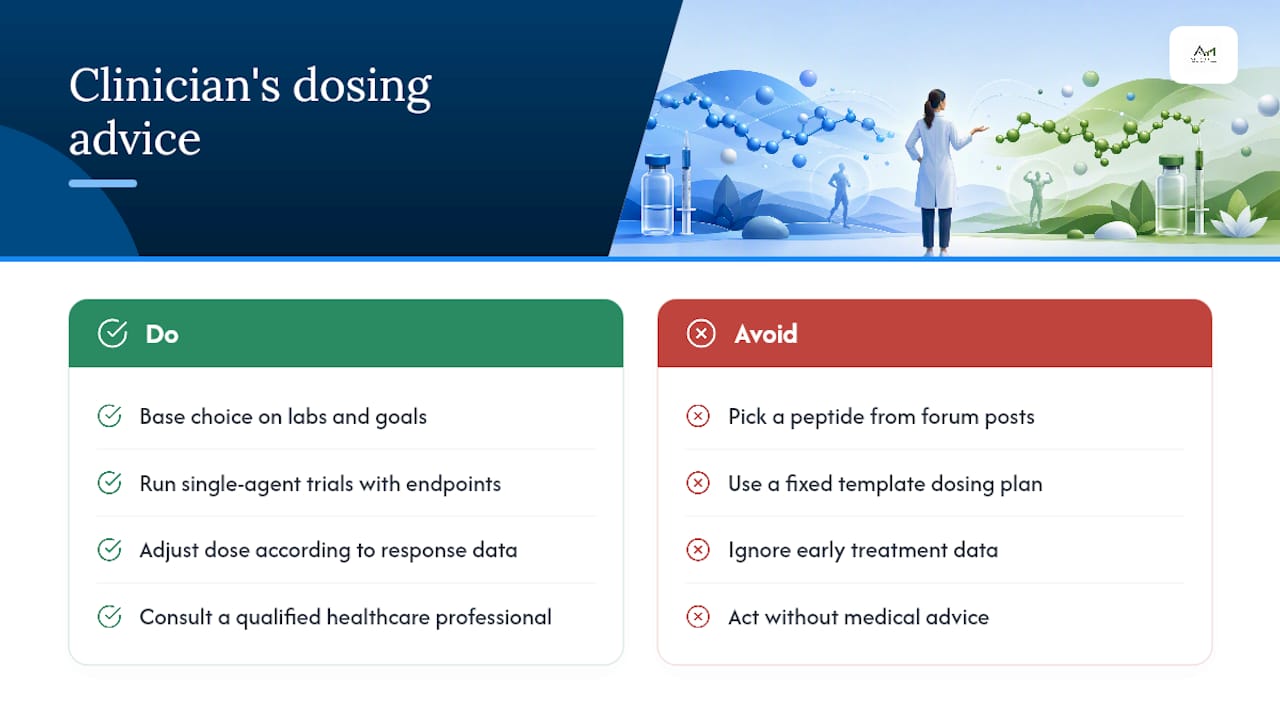
This article is general information, not a substitute for advice from a qualified doctor. Consult a qualified healthcare professional about your own circumstances before acting on anything here.
Sources
- Raun K et al. — clinical pharmacology study (PMID: 9849822)
- Review article on GH-releasing hormones and clinical use (PMC5632578)
- Regulatory/clinical discussion referencing Geref/Sermorelin (PMID: 16352683)
- Study/review describing GHRH + GHRP combination effects (PMID: 25331030)