
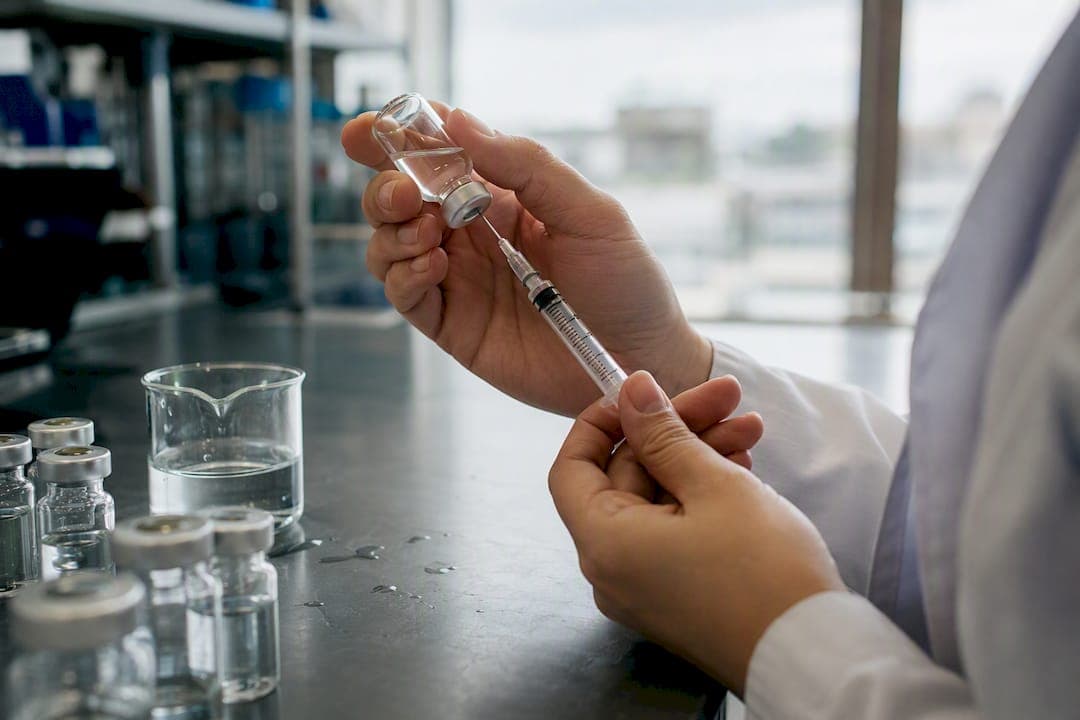
Peptide reconstitution is the process of returning a lyophilized (freeze-dried) peptide to a usable liquid state. For nearly all multi-use lab workflows, the answer is: reconstitute with bacteriostatic water using the inject-down-the-wall-and-swirl method, then label and refrigerate immediately.
Bacteriostatic water is the default solvent because its 0.9% benzyl alcohol content inhibits microbial growth in a vial that gets punctured repeatedly, which sterile water cannot do. That single difference is why bacteriostatic water supports weeks of storage while sterile water demands same-day use.
The core technique, in short:
- Warm the vial to room temperature and swab the septum with 70% isopropyl alcohol.
- Inject the solvent slowly down the interior wall of the vial, never directly onto the powder.
- Swirl gently until clear, then label with compound, concentration, and date, and refrigerate.
Pro Tip: If a peptide's Certificate of Analysis (COA) specifies a nonstandard solvent or unusual solubility profile, follow that documentation over any generic protocol. Sequence-specific exceptions exist, and a prescriber or supervising chemist should sign off on anything outside standard practice.
Key Takeaways
Reconstituting a peptide correctly comes down to using bacteriostatic water, injecting solvent down the vial wall, swirling instead of shaking, and refrigerating a labeled vial within its stability window.
| Point | Details |
|---|---|
| Default solvent | Bacteriostatic water preserves multi-use vials for about 28 days refrigerated; sterile water is same-day only. |
| Core technique | Warm the vial, inject solvent down the wall, and swirl gently, never shake or vortex. |
| Concentration math | Divide vial mass in mcg by diluent volume in mL to get mcg/mL, then convert to syringe units. |
| Special solvents | Use dilute acetic acid or DMSO only for peptides that resist aqueous dissolution, and dilute DMSO before any cell assay. |
| Clinical handling | Airmedfit provides physician-supervised, COA-backed peptides for readers who prefer pharmacy-prepared reconstitution. |
Table of Contents
- What Do You Need Before You Reconstitute Peptides?
- How Do You Reconstitute a Peptide Step by Step?
- When Do You Need DMSO or Acid Instead of Water?
- How Long Do Reconstituted Peptides Stay Stable?
- Why Is My Reconstituted Peptide Cloudy or Gel-Like?
- When Should a Clinician Handle Reconstitution Instead?
- Where Can You Verify This Protocol?
- What Does the Research Actually Support Here?
- Where Can You Get Physician-Supervised Peptides Instead?
- Sources
What Do You Need Before You Reconstitute Peptides?
A clean bench setup matters more than most people assume. Missing even one item on this list is how contamination or dosing errors happen.
- Bacteriostatic water — the standard multi-use diluent, chosen for its preservative content.
- Sterile water or saline — acceptable substitutes only when the vial will be used once, immediately, since neither contains a preservative.
- Insulin syringes (U-100) — for both drawing solvent and later measuring doses in units.
- Alcohol swabs (70% isopropyl) — for sterilizing every septum before puncture.
- Needles of appropriate gauge — a slightly wider gauge for drawing solvent, finer for injection work.
- A sharps container — for compliant disposal of every needle and used syringe.
The math behind reconstitution is simpler than it looks. Concentration in mcg/mL equals the vial's peptide mass (converted to micrograms) divided by the diluent volume in mL. A 5 mg vial holds 5,000 mcg. Add 2 mL of bacteriostatic water and you get 2,500 mcg/mL. On a U-100 insulin syringe, where 100 units equals 1 mL, that works out to 25 mcg per unit.
| Vial Size | Diluent Volume | Resulting Concentration | Mcg per Syringe Unit |
|---|---|---|---|
| 5 mg | 2 mL | 2,500 mcg/mL | 25 mcg |
| 10 mg | 2 mL | 5,000 mcg/mL | 25 mcg |
| 10 mg | 3 mL | 2,500 mcg/mL | 25 mcg |
| 20 mg | 2 mL | 5,000 mcg/mL | 100 mcg |
These figures come from standard reconstitution conversion tables used across research settings. Choosing diluent volume is a trade-off: less solvent means a more concentrated stock and smaller injection volumes, but it also makes small dosing errors proportionally larger. More solvent gives you finer dosing resolution at the cost of a bulkier vial.
Pro Tip: Pick a diluent volume that lands your target dose on a clean, easy-to-read syringe mark, like 20 or 25 units, rather than an awkward number like 17.3. It reduces measurement error every single draw.
How Do You Reconstitute a Peptide Step by Step?
Every step in this protocol maps to a specific failure mode. Skip one and you risk degrading the peptide, contaminating the vial, or wasting product you cannot recover.
- Bring the vial to room temperature. Injecting cold solvent into a cold vial encourages condensation and pressure imbalance inside the vial, which can force lyophilizate out through the septum on withdrawal. Inspect the cake visually first. It should look like a compact, slightly off-white plug, not a scattered dust or a discolored residue.
- Swab the septum with a 70% isopropyl wipe and let it air dry. Wiping alone doesn't sterilize; the alcohol needs a few seconds of contact time to actually kill surface organisms before the needle passes through.
- Draw the solvent slowly. Pulling the plunger too fast introduces cavitation bubbles and air into the syringe, which then get injected into the vial and can shear the peptide during dissolution.
- Insert the needle at a slight angle and direct the solvent down the interior wall, not straight onto the powder. This dissipates the force of the stream and equalizes vial pressure gradually instead of blasting the lyophilizate into suspension.
- Swirl or gently roll the vial between your palms. Never shake or vortex it. Mechanical shear at the air-liquid interface is one of the dominant mechanisms behind peptide aggregation, and shaking creates exactly that kind of turbulence.
- Wait. Most peptides clear within 5 to 10 minutes. Poorly formed lyophilizate cakes can take longer to dissolve, and patience beats agitation every time. If it hasn't cleared after 15 to 20 minutes of gentle swirling, move to the troubleshooting steps below rather than shaking harder.
- Aliquot if needed and label immediately. Calculate aliquot volume based on typical single-use draws, then label each container with compound name, concentration, reconstitution date, and your initials. Do this before the vial goes anywhere near a refrigerator; unlabeled stocks are one of the fastest ways to lose track of what you're holding.
- Dispose of needles and syringes in a sharps container the moment you're done. Never recap a used needle by hand.
- Room temperature vials prevent condensation and pressure shock.
- Slow solvent injection down the wall avoids splashing the cake into suspension.
- Gentle swirling, not shaking, protects the peptide's structure.
Pro Tip: Keep a small log next to your reconstitution station: compound, lot number, mg, diluent volume, and date. It takes ten seconds and saves you from ever wondering how old a vial is.
When Do You Need DMSO or Acid Instead of Water?
Bacteriostatic water dissolves most peptides, but not all of them. Solvent choice really comes down to the peptide's sequence: net charge, hydrophobicity, and the presence of oxidation-prone residues all dictate which diluent actually works.
Basic or highly hydrophobic peptides that resist aqueous dissolution often need dilute acetic acid, typically in the 0.1% to 1% range, added in the minimum volume needed to reach clarity. Dilute this into working buffer immediately after dissolution. Long-term storage in acid isn't advisable. Acid-catalyzed cleavage at Asp-X bonds is a real risk if a peptide sits in acidic solution for extended periods.
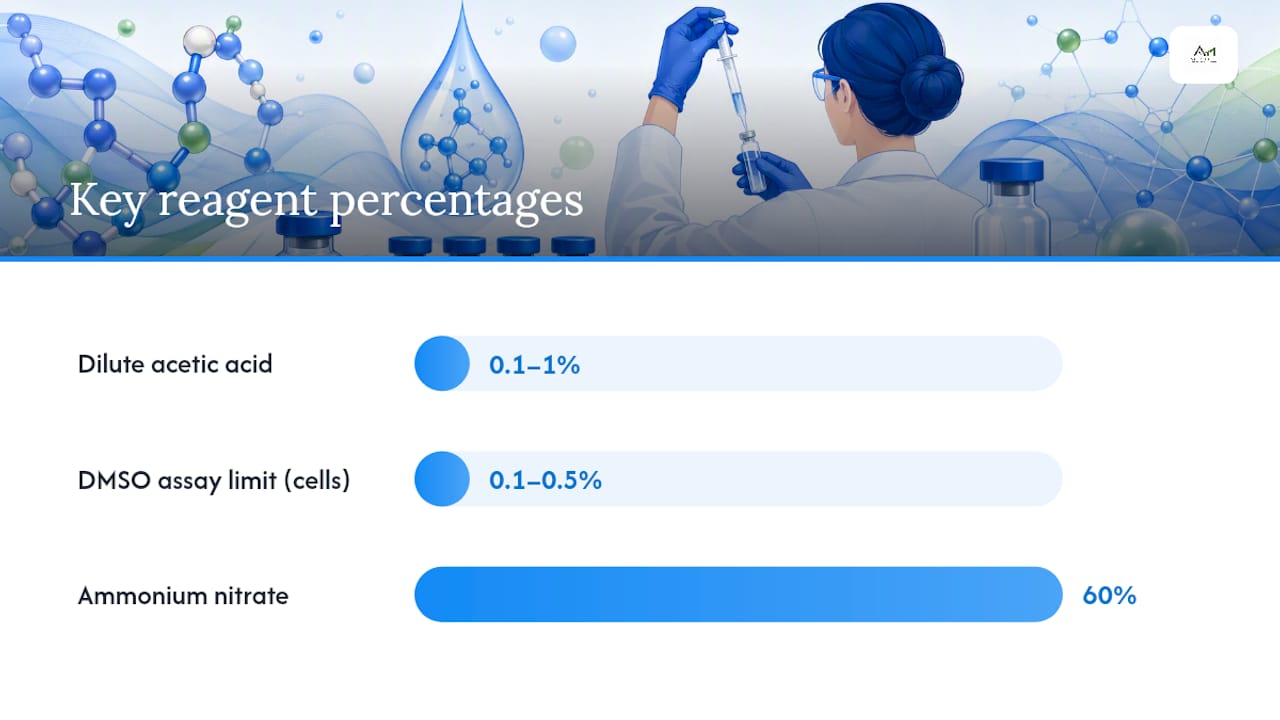
DMSO handles hydrophobic peptides that acid can't touch, but it comes with two caveats. First, DMSO can oxidize methionine and cysteine residues over time, so DMSO stocks should be used relatively quickly and stored cold. Second, DMSO must be diluted down before it reaches biological assays. Cell-based assays generally tolerate DMSO only at 0.1% to 0.5% v/v final concentration, and going above that threshold risks confounding your results with solvent toxicity rather than peptide activity.
For assays like circular dichroism (CD), DMSO is a bigger problem: it produces a high background absorbance that masks the actual peptide signal. One validated workaround is a vapor-diffusion solvent exchange, where DMSO droplets are placed on a coverslip above a 60% ammonium nitrate solution for up to 16 hours, evaporating the DMSO and leaving a dried peptide film that gets reconstituted directly into aqueous buffer like 20 mM Tris with 100 mM NaCl. It takes patience and the right setup, but it's the difference between a clean CD spectrum and one buried in solvent noise.
- Acid works for basic, water-resistant peptides, short-term only.
- DMSO works for hydrophobic peptides, but oxidizes Met/Cys over time.
- Solvent-exchange protocols remove DMSO before sensitive spectroscopic assays.
How Long Do Reconstituted Peptides Stay Stable?
Reconstitution starts a clock. A lyophilized peptide can sit frozen and stable for months or years, but the moment it's dissolved, degradation begins on a much faster timeline.
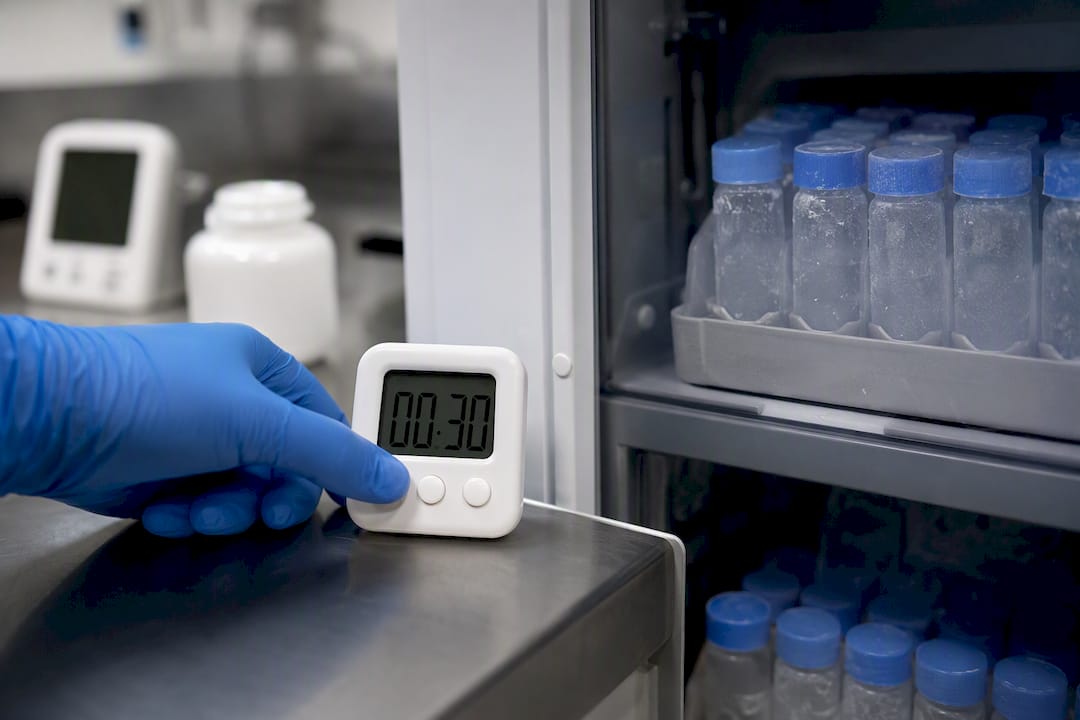
Peptides reconstituted in bacteriostatic water and kept refrigerated are commonly stable for around 28 days, though this varies by sequence. Peptides with oxidation-prone residues or inherently unstable structures degrade faster, and time-sensitive compounds like NAD+ may need to be used within days rather than weeks. Sterile water reconstitutions, lacking any preservative, should be used the same day.
Freeze-thaw cycling is one of the fastest ways to ruin an otherwise good stock. Ice crystal formation and repeated thermal stress promote aggregation, so if you need long-term storage, aliquot the vial into single-use portions before freezing rather than thawing and refreezing the same container repeatedly.
- Bacteriostatic water stocks: refrigerate, generally usable within about 28 days.
- Sterile water or saline stocks: same-day use only.
- Never refreeze a thawed aliquot; portion out single-use amounts up front.
- Label every vial with compound, concentration, lot, date, and initials, and keep the COA on file for reference.
Why Is My Reconstituted Peptide Cloudy or Gel-Like?
Cloudiness right after reconstitution is often just a slow-dissolving cake. Give it another 10 to 15 minutes of gentle swirling before assuming something's wrong.
If cloudiness persists, a small additional volume of solvent sometimes resolves it, but if the solution still won't clear, discard it rather than guessing. Gel formation is usually concentration-dependent self-assembly. Adding solvent in small increments, swirling gently between additions, and recalculating concentration each time will often break the gel. Stop and discard if it doesn't resolve after a few increments. Visible particles, discoloration, or an off odor point to contamination. Don't try to troubleshoot around that. Discard the vial.
- Cloudy after mixing: wait longer, then add a small increment of solvent if needed.
- Gel formation: add solvent incrementally, recalculating concentration each time.
- Particles or odd color: assume contamination and discard immediately.
Pro Tip: When potency is in question, don't rely on visual inspection alone. HPLC or a functional assay is the only way to confirm a peptide's actual concentration and purity after a rough reconstitution.
When Should a Clinician Handle Reconstitution Instead?
Airmedfit operates on a physician-supervised model, sourcing peptides exclusively from licensed US manufacturers and providing a Certificate of Analysis for every compound in its catalog. That sourcing standard matters most when a peptide has a complex structure, a narrow stability window, or is intended for clinical administration rather than bench research.
- Complex or fragile sequences often benefit from pharmacy-prepared reconstitution, where dosing and sterility are handled under controlled clinical conditions.
- Anyone administering a peptide therapeutically, rather than researching it, should have a clinician review the protocol and confirm the COA before use.
- Readers can request a COA or consult with a prescriber through Airmed Fit before starting any physician-supervised program.
Where Can You Verify This Protocol?
These sources cover the calculations, solvent-exchange techniques, and storage data referenced throughout this protocol.
- How to Reconstitute Peptides With Bacteriostatic Water walks through the concentration formula and syringe unit conversion tables in detail.
- Protocol for reconstituting peptides/peptidomimetics from DMSO to aqueous buffers for circular dichroism analyses covers the vapor-diffusion solvent-exchange method for DMSO removal.
- Peptide reconstitution methodology: solvents, concentration, and stability explains sequence-dependent solvent selection and stability trade-offs.
- Always cross-check sequence-specific decisions against the peptide's own Certificate of Analysis before finalizing a protocol.
What Does the Research Actually Support Here?
Most reconstitution guides treat every peptide as interchangeable: warm it, mix it, store it, done. That's misleading. The sequence itself, its hydrophobicity, its charge, its oxidation-prone residues, determines whether bacteriostatic water even works, and conventional advice glosses over that almost entirely.
The bigger blind spot is the "clock" framing. Researchers plan meticulously for the reconstitution moment and then treat the resulting stock as static. It isn't. Degradation starts immediately, and the 28-day window quoted everywhere is a ceiling for well-behaved sequences, not a guarantee. Anyone working with an unfamiliar or fragile peptide should treat that number as optimistic and verify potency with HPLC rather than trusting the calendar.
If there's one thing worth prioritizing over technique, it's documentation. A perfectly executed reconstitution with no label, no date, and no COA reference is still a liability sitting in your refrigerator. Protocol discipline matters, but record-keeping is what actually prevents costly mistakes down the line.
— Organic
Where Can You Get Physician-Supervised Peptides Instead?
If you'd rather skip the vial math and hand reconstitution off to a licensed professional, Airmedfit gives you that option without sacrificing quality. Every peptide in the catalog comes from licensed US manufacturers with a Certificate of Analysis attached, and reconstitution or dosing decisions are made under physician supervision rather than left to a bench protocol you're running solo.
That matters most for readers using peptides as part of an actual wellness or metabolic program, not just a research bench. Airmedfit's physician-supervised model pairs FDA-regulated GLP-1 medications and peptide therapies with lab panels, consultations, and ongoing membership support, so dosing accuracy and sourcing integrity aren't things you have to verify yourself. If you're weighing whether to reconstitute a peptide on your own or have it handled clinically, start by requesting a consultation through Airmedfit to review your options and get a COA for any compound you're considering.
This article is general information, not a substitute for advice from a qualified doctor. Consult a qualified healthcare professional about your own circumstances before acting on anything here.
Sources
- Protocol for reconstituting peptides/peptidomimetics from DMSO to aqueous buffers for circular dichroism analyses
- How to Reconstitute Peptides: A Lab Protocol
- How to Reconstitute Peptides With Bacteriostatic Water
- Peptide reconstitution methodology: solvents, concentration, and stability | Compound Review
- How to Reconstitute Peptides: Step-by-Step Guide | QSC Research