

GLP-1 agonists and insulin, both peptide-based drugs, carry decades of clinical trial data behind their metabolic benefits. Most injectable "wellness" peptides sold online, including BPC-157 and TB-500, do not; they remain experimental compounds backed mainly by preclinical studies. The real question isn't whether peptide therapy works. It's whether the specific peptide you're considering has been through the FDA process or is still an unregulated bet, which is exactly the distinction a physician-supervised program like Airmedfit is built to sort out.
TL;DR:
- Only FDA-approved peptides like insulin and GLP-1 agonists have proven safety and efficacy through extensive clinical trials, manufacturing standards, and documented side effects.
- Unregulated peptides sold online often lack oversight, proper testing, and clinical evidence, increasing risks of contamination, incorrect dosing, and unknown long-term effects.
- The strongest evidence supports peptides for metabolic weight management, with GLP-1 agonists demonstrating significant weight loss and blood sugar control in trials.
- Evidence for other claims, such as muscle recovery, tissue healing, or skin improvement, remains mostly anecdotal or based on preliminary studies, not large human trials.
- Safe peptide therapy requires medical evaluation, sourcing from licensed manufacturers, physician oversight, and regular lab monitoring to ensure safety and effectiveness.
Table of Contents
- How peptide therapy works and what peptides actually do
- The peptide therapies with real clinical evidence behind them
- Peptide benefits by category: what's proven and what's still speculative
- Safety risks and how peptide sourcing affects your results
- What the evidence gap actually means for experimental peptides
- Getting started with peptide therapy safely
- Takeaways on peptide therapy benefits
- A measured take on the peptide hype cycle
- How Airmedfit approaches peptide therapy
- Sources
How peptide therapy works and what peptides actually do
Peptides are short chains of amino acids, usually somewhere between 2 and 100 of them linked together, that function as signaling molecules in the body. They tell cells what to do: release a hormone, mount an immune response, start repairing tissue, or ramp up metabolism. Your body makes thousands of them naturally. Peptide therapy introduces synthetic or bioidentical versions to nudge one of those systems in a specific direction.
Delivery method matters more than most people realize. Oral peptides mostly get broken down by digestive enzymes before they reach the bloodstream, which is why injectable forms dominate when the goal is a systemic effect. Topical peptides work locally on skin, useful for collagen support, but they don't reach deep tissue.
The mechanisms behind the popular claims break down into a few buckets:
- GLP-1 receptor activity slows gastric emptying and boosts insulin secretion, the basis for semaglutide and tirzepatide's metabolic effects.
- Growth hormone and IGF-1 signaling drives the muscle and recovery claims behind GH secretagogues.
- Angiogenesis and collagen synthesis support the tissue-repair pathways researchers point to when discussing peptides like BPC-157, largely in animal and cell-culture models so far.
The peptide therapies with real clinical evidence behind them
Two categories of peptide drugs have cleared the bar that matters: large randomized trials, FDA approval, and years of real-world prescribing data. Insulin is the oldest example, in continuous clinical use for over a century to manage blood glucose. GLP-1 agonists like semaglutide and tirzepatide are the newer headline act.
By the numbers: Clinical trials on GLP-1 and dual-agonist therapies report mean weight reductions reaching double-digit percentages in some study populations, alongside measurable improvements in blood sugar control and cardiovascular risk markers.
What separates these from the rest of the peptide market isn't just effectiveness. It's oversight:
- Manufacturing happens under FDA-regulated conditions, with batch testing for purity and potency.
- Dosing comes from published trial protocols, not guesswork.
- Side effects, drug interactions, and contraindications are documented in prescribing information reviewed by regulators.
Unregulated peptides skip every one of those steps. That gap in oversight and evidence is the single biggest thing separating a proven therapy from a hopeful one.
Peptide benefits by category: what's proven and what's still speculative
Claims about peptide therapy span five broad categories, and the evidence quality drops off fast once you move away from metabolic drugs.
Muscle and recovery. Growth hormone secretagogues theoretically stimulate the GH/IGF-1 axis to support lean mass and repair. The mechanism is plausible, but controlled human trials measuring real recovery outcomes in athletes are scarce. Most of what circulates is anecdotal.
Tissue and wound healing. This is where BPC-157 and TB-500 get most of their buzz among people asking about the best peptides for injury recovery or joint recovery. Preclinical work shows genuine anti-inflammatory and regenerative signals in animal models, but there is no large-scale human trial confirming those effects translate to people. Treat this category as promising, not proven.

Skin and aesthetics. Topical peptides like GHK-Cu and palmitoyl peptides have modest support. Oral collagen peptides show measurable, if incremental, improvements in skin hydration and joint comfort in older adults across several reviews, though study quality varies widely.
Metabolic and weight loss. This is peptide therapy's strongest category, full stop. GLP-1 agonists have the trial depth, the FDA approval, and the effect sizes to back real-world claims about weight management and glycemic control.
Cognitive and sleep support. Peptides marketed for focus or deep sleep are the least studied of the bunch. What exists is largely preclinical or theoretical, with almost no rigorous human data yet.
Safety risks and how peptide sourcing affects your results
Even FDA-approved peptide drugs carry real side effects: GLP-1 agonists commonly cause nausea, and insulin carries a hypoglycemia risk that requires monitoring. Those risks are documented, dosed for, and managed under medical supervision.
The bigger danger sits with unregulated products. Many peptides sold online are labeled "research-only," meaning they were never intended for human use and bypass the manufacturing oversight required of approved drugs. That opens the door to contamination, incorrect concentrations, and dosing based on forum posts instead of trial data.
A few practical safeguards cut that risk substantially:
- Ask any supplier or clinic for a certificate of analysis confirming purity and concentration.
- Prefer peptides sourced from licensed US manufacturers rather than overseas research chemical vendors.
- Insist on physician oversight and baseline lab work before starting any peptide protocol.
Pro Tip: If a peptide seller can't produce a batch-specific certificate of analysis on request, that's a hard pass. Legitimate suppliers expect the question.
What the evidence gap actually means for experimental peptides
Preclinical and animal studies tell you a compound does something interesting in a petri dish or a rat. They don't tell you it's safe or effective in a human body at a specific dose over months of use. That gap is exactly where most trending peptides sit right now.
Physicians raise a consistent set of concerns: dosing protocols for unapproved peptides are often borrowed from bodybuilding forums rather than pharmacology, long-term outcomes are unknown, and the online market has expanded faster than the science backing it.
What researchers actually want before broader adoption:
- Standardized, randomized human trials with control groups, not just case reports.
- Independent manufacturing verification for purity, potency, and sterility.
- Clinical endpoints that measure real outcomes, not just biomarker changes.
Getting started with peptide therapy safely
A responsible peptide protocol starts with a real medical workup, not a shopping cart.
- Get a baseline evaluation. History, relevant labs, and a clear goal, whether that's metabolic health, recovery, or something else.
- Build a plan around evidence. A physician should prioritize FDA-regulated options where they fit your goals before considering anything experimental.
- Vet the source. Demand documentation on manufacturing and purity for any peptide product.
- Track results. Regular lab monitoring shows whether the therapy is working and whether it's safe to continue.
Pro Tip: Bring your last two years of lab work to your first consultation. It gives your physician a baseline to measure real change against, not just how you feel.
Takeaways on peptide therapy benefits
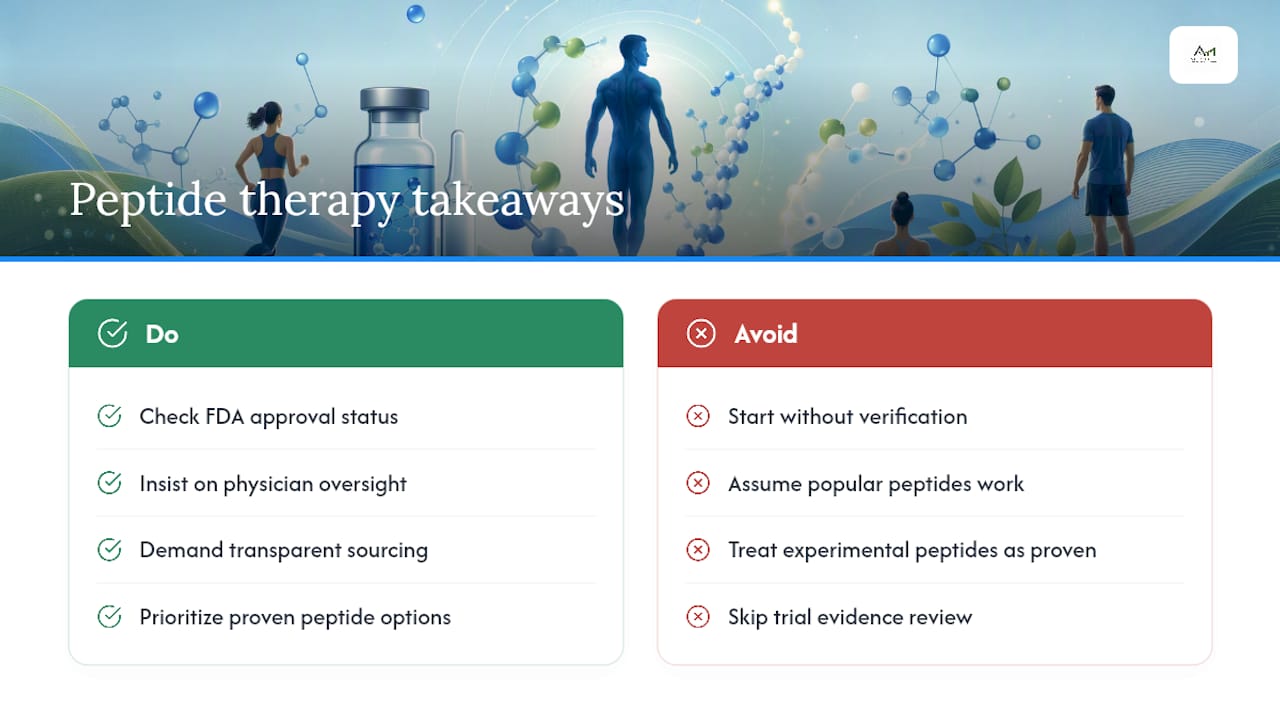
FDA-approved peptide drugs like GLP-1 agonists and insulin have the trial data to back real metabolic benefits. Most other injectable peptides, however popular, remain experimental. Before starting anything, check FDA status, insist on physician oversight, and demand sourcing transparency. Prioritize proven options for medical goals, and treat the rest as unproven until better trials exist.
A measured take on the peptide hype cycle
Peptide science is genuinely exciting, and the metabolic results from GLP-1 drugs are real. But the internet's enthusiasm for injectable peptides has outrun the clinical trials by years, not months. Curiosity is healthy. Blind trust in a forum-sourced vial is not. If a peptide sounds like it does everything, ask what trial proved it, and who's watching your labs while you take it.
— Organic
How Airmedfit approaches peptide therapy
Airmedfit treats peptide therapy the way the evidence demands: with a physician evaluation first, not a checkout cart first. Every plan starts with lab testing to establish your baseline, moves through FDA-regulated peptide options sourced from licensed US manufacturers, and continues with ongoing monitoring to track whether the therapy is actually delivering results.
That structure is the practical answer to everything covered above. Instead of guessing at dosing or hoping a research-only vial is what the label claims, you get a personalized plan built around your labs, your goals, and quality controls that unregulated sellers simply don't offer. If you're ready to find out what a supervised, evidence-based approach looks like for your own metabolic or wellness goals, schedule a consultation with Airmedfit and get a plan built around your actual bloodwork instead of a forum thread.
This article is general information, not a substitute for advice from a qualified doctor. Consult a qualified healthcare professional about your own circumstances before acting on anything here.
Sources
- Peptides: What they are, potential benefits, and safety concerns - Harvard Health
- PubMed entry discussing preclinical evidence for peptides such as BPC-157
- What doctors want patients to know about injectable peptides - AMA
- Therapeutic peptides in orthopaedics and regenerative medicine - PMC