
Semaglutide, used under medical supervision alongside diet and exercise, produces clinically meaningful weight loss for many adults with overweight or obesity. The STEP 1 trial published in the New England Journal of Medicine found a mean weight loss of 14.9% at 68 weeks with once-weekly subcutaneous semaglutide 2.4 mg, compared to 2.4% with placebo. That is not a modest effect.
Before you go further, here is what the evidence says you should do next:
- Confirm your BMI meets the threshold (≥30 kg/m², or ≥27 kg/m² with a weight-related condition like hypertension or type 2 diabetes).
- Talk to a clinician about your personal and family history, particularly any thyroid cancer or MEN2 history, which are absolute contraindications.
- Discuss baseline labs, a titration plan, and what lifestyle support you will pair with the medication.
- Ask your prescriber to check your insurance formulary and prior authorization requirements before the first prescription is written.
Semaglutide is not a shortcut. It is a prescription medication with a real side-effect profile and a clear requirement for clinical oversight. What it offers, when used correctly, is a level of weight reduction that diet and exercise alone rarely achieve for most people with obesity.
Key Takeaways
| Point | Details |
|---|---|
| Trial-proven efficacy | STEP 1 showed 14.9% mean weight loss at 68 weeks; STEP 5 confirmed 15.2% at 104 weeks. |
| Contraindications are absolute | Personal or family history of medullary thyroid carcinoma or MEN2 rules out semaglutide entirely. |
| Weight regain after stopping | Most patients regain substantial weight after discontinuation, making long-term planning essential. |
| Cost and coverage vary widely | Wegovy can exceed $1,300/month without insurance; prior authorization and manufacturer savings programs are key levers. |
| Airmedfit supervised access | Airmedfit offers physician-supervised GLP-1 programs with lab monitoring, titration support, and licensed U.S. medication sourcing. |
Table of Contents
- How semaglutide works on appetite and metabolism
- Dosing, administration, and the differences between Wegovy, Ozempic, and Rybelsus
- What clinical trials actually show about semaglutide effectiveness
- Side effects, serious risks, and who should not take semaglutide
- Who is a good candidate, and what monitoring looks like
- What to realistically expect, and what happens when you stop
- Cost, insurance coverage, and how to reduce out-of-pocket spending
- How semaglutide compares with other weight-loss medications
- What the evidence still does not answer
- A clinician's perspective on when semaglutide is the right call
- Airmedfit's physician-supervised GLP-1 program
- Sources
How semaglutide works on appetite and metabolism
Semaglutide is a GLP-1 receptor agonist, meaning it mimics glucagon-like peptide-1, a hormone your gut releases after eating. GLP-1 receptors sit in the hypothalamus, the brain region that governs hunger and satiety. When semaglutide activates those receptors, it dials down appetite signaling and reduces cravings, particularly for calorie-dense foods.
The peripheral effects matter just as much. Semaglutide slows gastric emptying, so food stays in the stomach longer and fullness arrives sooner. It also stimulates insulin secretion in response to glucose and suppresses glucagon, which together improve glycemic control. That dual action is why the drug was first developed for type 2 diabetes before its weight-loss potential became apparent.
The practical result is that most people on semaglutide eat less without feeling deprived in the same way a calorie-restricted diet alone produces. Hunger is genuinely lower, not just willpower-managed. That said, the drug does not replace the metabolic benefits of physical activity or the behavioral patterns that sustain weight loss long-term. Lifestyle support remains necessary because semaglutide reduces the drive to overeat; it does not teach the habits that prevent regain if the medication is later stopped.
Pro Tip: Start with small, low-fat meals during the first few weeks of treatment. GI side effects like nausea are most intense early in the titration phase, and eating slowly, avoiding high-fat or spicy foods, and staying upright after meals can meaningfully reduce discomfort without requiring a dose reduction.

Dosing, administration, and the differences between Wegovy, Ozempic, and Rybelsus
The Wegovy titration schedule
According to StatPearls, the standard approach for weight management starts at 0.25 mg subcutaneously once weekly for four weeks, then steps up approximately every four weeks: 0.5 mg, 1.0 mg, 1.7 mg, and finally the maintenance dose of 2.4 mg weekly. The slow escalation exists for one reason: GI side effects are dose-dependent, and rushing the titration is the most common reason patients stop early.
Brand differences that matter clinically
| Brand | Labeled indication | Route | Typical maintenance dose | Escalation schedule |
|---|---|---|---|---|
| Wegovy | Chronic weight management | Subcutaneous injection (weekly) | 2.4 mg/week | 0.25 mg → 2.4 mg over ~16–20 weeks |
| Ozempic | Type 2 diabetes | Subcutaneous injection (weekly) | 1.0–2.0 mg/week | 0.25 mg → 1.0 mg (or 2.0 mg) over 8–16 weeks |
| Rybelsus | Type 2 diabetes | Oral tablet (daily) | 14 mg/day | 3 mg → 7 mg → 14 mg over 8 weeks |
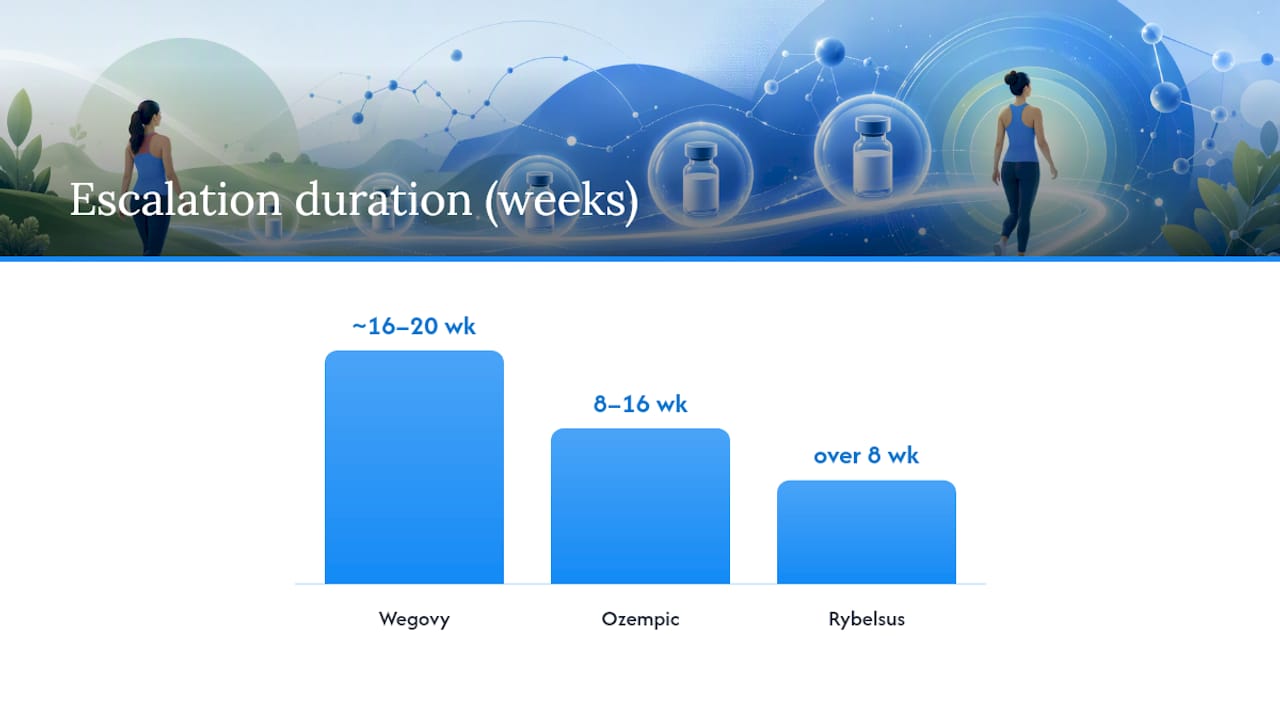
Wegovy is the only semaglutide product with FDA approval specifically for weight management. Ozempic carries a diabetes label and is frequently used off-label for weight loss, but the pen doses differ from Wegovy, the titration schedules are not identical, and insurance coverage diverges significantly. Rybelsus is oral and daily, which some patients prefer, but bioavailability is lower than the injectable form and it must be taken on an empty stomach with no more than 4 oz of plain water, at least 30 minutes before any food, drink, or other medication.
Injection technique, storage, and missed doses
- Injection sites: Abdomen, thigh, or upper arm. Rotate sites weekly to reduce local reactions.
- Storage: Unopened pens should be refrigerated (36°F–46°F). After first use, Wegovy pens can be stored at room temperature (up to 77°F) for up to 28 days.
- Disposal: Use a sharps container. Never recap needles or dispose of pens in household trash.
- Missed dose: If you miss a weekly dose and your next scheduled dose is more than 48 hours away, take it as soon as you remember. If the next dose is within 48 hours, skip the missed dose and resume your regular schedule. Never double up.
Pro Tip: The most common pen-handling error is not attaching the needle firmly before injecting, which leads to incomplete dosing. Always attach a new needle for each injection, prime the pen as instructed, and hold the pen in place for six seconds after pressing the button to confirm the full dose is delivered.
What clinical trials actually show about semaglutide effectiveness
The STEP program is the primary evidence base for semaglutide weight loss in adults without diabetes. The headline numbers are strong, and they held up across multiple trial designs.
STEP 1 enrolled 1,961 adults with a BMI of ≥30 kg/m² (or ≥27 kg/m² with a comorbidity) and no diabetes. At 68 weeks, the semaglutide group lost a mean of 14.9% of body weight versus 2.4% with placebo.
STEP 5 extended follow-up to 104 weeks. The Nature Medicine publication reported a mean weight loss of 15.2% with semaglutide versus 2.6% with placebo at two years, confirming that the effect is durable as long as treatment continues.
Key figure: In STEP 1, more than half of semaglutide participants lost at least 15% of their body weight at 68 weeks. That level of loss, sustained over more than a year, approaches outcomes historically associated with bariatric surgery in some patients.
A few limitations deserve mention. Most STEP participants were white women, which limits generalizability to other populations. All trials were industry-sponsored by Novo Nordisk. Oral semaglutide trials show meaningful but generally smaller weight loss than the injectable form at comparable durations.
Side effects, serious risks, and who should not take semaglutide
The most common adverse effects are gastrointestinal: nausea, vomiting, diarrhea, and constipation. These typically peak during dose escalation and improve over time for most patients.
Serious risks are less common but require clear communication before starting:
- Pancreatitis: Semaglutide carries a warning for acute pancreatitis. Patients with a history of pancreatitis should discuss the risk-benefit balance carefully with their clinician.
- Gallbladder disease: Rapid weight loss of any cause increases gallstone risk. Semaglutide trials showed higher rates of cholelithiasis and cholecystitis in the treatment group.
- Hypoglycemia: When combined with insulin or sulfonylureas, semaglutide raises hypoglycemia risk. Dose adjustments of those agents are often needed.
- Thyroid C-cell tumors: Rodent studies showed dose-dependent thyroid C-cell tumors with GLP-1 agonists. The relevance to humans is not established, but the signal prompted a black box warning.
Cleveland Clinic guidance is explicit: semaglutide is contraindicated in anyone with a personal or family history of medullary thyroid carcinoma or Multiple Endocrine Neoplasia syndrome type 2 (MEN2). This is a nonnegotiable screening step before prescribing.
Warning signs that require stopping semaglutide and seeking urgent evaluation: severe or persistent abdominal pain (possible pancreatitis), a lump or swelling in the neck, difficulty swallowing, or hoarseness (possible thyroid tumor signal), severe allergic reaction, or significant vision changes.
Additional cautions:
- Pregnancy: Semaglutide should be discontinued at least two months before a planned pregnancy. It is not recommended during pregnancy or breastfeeding.
- Severe GI disease: Patients with gastroparesis or inflammatory bowel disease require careful evaluation before starting.
- Pediatric use: Wegovy is FDA-approved for adolescents aged 12 and older with obesity, but adult trial data should not be extrapolated without clinician guidance.
Who is a good candidate, and what monitoring looks like
The FDA-approved indication for Wegovy covers adults with a BMI of ≥30 kg/m², or ≥27 kg/m² with at least one weight-related comorbidity such as hypertension, type 2 diabetes, or dyslipidemia. Meeting the BMI threshold is necessary but not sufficient. A complete clinical picture matters.
Baseline screening before starting
- Pregnancy test for women of childbearing potential (required before initiating)
- Personal and family history review for medullary thyroid carcinoma and MEN2
- Fasting glucose and HbA1c to establish glycemic baseline
- Comprehensive metabolic panel and lipid panel
- Review of current medications for interactions (insulin, sulfonylureas, oral contraceptives with altered absorption on Rybelsus)
- Thyroid function if clinically indicated
Ongoing monitoring
- Weight and BMI at each visit, typically monthly during titration
- GI tolerability assessment at every contact during escalation
- HbA1c and fasting glucose every 3–6 months if the patient has diabetes or prediabetes
- Medication interaction review if other prescriptions change
- Gallbladder symptom inquiry, particularly in patients losing weight rapidly
Candidates who need extra thought
Patients with a history of bariatric surgery may have altered GI anatomy that changes drug absorption and side-effect risk. Those with active or poorly controlled psychiatric illness, including eating disorders, require behavioral health coordination before starting. A history of substance misuse does not automatically exclude someone, but it warrants a more structured monitoring plan. Semaglutide is not appropriate as a cosmetic weight-loss tool for people who do not meet clinical criteria.
What to realistically expect, and what happens when you stop
The timeline
Most patients notice reduced appetite within the first two to four weeks, but measurable weight loss typically becomes consistent around weeks 4–12. The STEP trial curves show a steep early descent that gradually levels off, reaching a nadir around week 60. After that, weight tends to plateau rather than continue falling.

For a practical example: a 200-pound person losing at the STEP 1 mean rate would lose roughly 10–15 pounds by the two-month mark, though individual variation is wide. By six months, that same person might be down 20–25 pounds. At the 12–18 month mark, losses consistent with the trial mean would put them at roughly 28–30 pounds below their starting weight.
| Timepoint | What to expect |
|---|---|
| Start (week 0) | Begin 0.25 mg; appetite changes may be subtle |
| Week 4 | First dose increase; GI effects often peak here |
| Week 12 | Consistent weight loss underway for most patients |
| Month 6 | Roughly half of total expected loss achieved |
| Month 12–18 | Weight loss plateau approaches; near-maximum effect |
| Post-stop | Substantial regain common within months for many patients |
Weight regain after stopping
This is the part most people underestimate. The PMC clinical review documents that discontinuation is associated with significant weight regain in many patients, a finding consistent with the biology: semaglutide suppresses appetite while you take it, and when you stop, the underlying drivers of weight gain return. STEP extension data showed that participants who discontinued semaglutide regained a substantial portion of their lost weight within one year. This is not a failure of willpower. It reflects the chronic nature of obesity as a disease, which is precisely why long-term therapy or a robust behavioral program is part of any responsible treatment plan.
Cost, insurance coverage, and how to reduce out-of-pocket spending
Wegovy's list price in the U.S. has been reported at over $1,300 per month without insurance, though actual out-of-pocket costs vary by plan and pharmacy. That price point makes access a real barrier for many patients.
Why coverage is inconsistent
Insurance coverage for Wegovy is limited and often denied because many commercial plans and Medicare Part D explicitly exclude coverage for weight-loss medications, treating obesity as a lifestyle issue rather than a chronic disease. The Treat and Reduce Obesity Act, if passed, would change Medicare coverage, but as of 2026 that remains unresolved. Medicaid coverage varies by state.
Ozempic, labeled for diabetes, is more commonly covered by insurance for patients with a type 2 diabetes diagnosis. Off-label use for weight loss without a diabetes diagnosis is frequently denied, and the pen doses differ from Wegovy, requiring clinician adjustment.
Practical cost-reduction steps
- Novo Nordisk savings programs: The manufacturer offers a savings card for commercially insured patients that can reduce monthly costs significantly. Eligibility requirements apply.
- Patient assistance programs: Novo Nordisk's patient assistance program provides free medication to qualifying uninsured or underinsured patients based on income thresholds.
- Prior authorization documentation: Ask your clinician to document all weight-related comorbidities in the prior authorization request. Hypertension, sleep apnea, and prediabetes all strengthen the medical necessity argument.
- Formulary check early: Before the first prescription, have your clinic check your specific plan's formulary. Some plans cover Wegovy under specific tiers with step therapy requirements.
- Compounded semaglutide: During periods of shortage, compounded versions have been available, but the FDA has flagged quality and safety concerns. Discuss any compounded option carefully with your prescriber.
How semaglutide compares with other weight-loss medications
Semaglutide tends to produce larger mean percent weight loss than older anti-obesity medications, but the comparison is not one-dimensional. Different drug classes carry different side-effect profiles, routes, and access realities.
| Drug category | Indication | Route | Approximate trial weight loss range | Typical side effects | Access/cost |
|---|---|---|---|---|---|
| GLP-1 agonists (weight management) | Chronic weight management (BMI ≥30 or ≥27 + comorbidity) | Weekly injection | 10–15%+ mean at 1–2 years | GI (nausea, vomiting, diarrhea), gallbladder | High list price; variable coverage |
| GLP-1 agonists (diabetes label, off-label use) | Type 2 diabetes; off-label for weight | Weekly injection | 5–10% mean (diabetes populations) | Similar GI profile | Better covered for T2D; off-label often denied |
| Oral GLP-1 agonist | Type 2 diabetes | Daily oral tablet | Meaningful but generally less than injectable | GI; strict administration requirements | Similar coverage constraints |
| Older centrally acting agents | Short-term weight management | Oral (daily) | 3–7% mean | Cardiovascular, psychiatric, dependency risk | Lower cost; limited long-term use |
| Combination agents (naltrexone/bupropion class) | Chronic weight management | Oral (daily) | 4–8% mean | Nausea, headache, psychiatric contraindications | Moderate cost; broader coverage |
| Lipase inhibitors | Chronic weight management | Oral (with meals) | 3–5% mean | GI (oily stools, fecal urgency) | Lower cost; OTC available |
Emerging agents, including dual GIP/GLP-1 agonists, have shown even larger weight loss in trials than semaglutide alone. Research into higher semaglutide doses is also active: UT Southwestern reported in 2025 that tripling the standard dose produced greater weight loss and metabolic benefits in a recent trial, though that work is preliminary. The pharmacologic landscape for obesity is moving fast, and what is the ceiling today may not be in two years.
What the evidence still does not answer
Semaglutide's two-year trial data are robust. Beyond that window, the picture gets murkier. The Cochrane systematic review concluded that semaglutide increases weight loss versus placebo at 6–24 months but that its effects on quality of life and major cardiovascular outcomes remain uncertain. That is an honest summary of where the science stands.
Specific gaps that matter:
- Long-term cardiovascular outcomes: The SELECT trial showed cardiovascular event reduction in patients with established cardiovascular disease, but mortality data and long-term hard outcomes in the broader obesity population are still accumulating.
- Durability beyond two years: Most trial participants were on structured programs. Real-world adherence and outcomes beyond the trial window are less well characterized.
- Underrepresented populations: STEP trials skewed toward white women. Data in Black, Hispanic, and Asian populations, as well as men, are thinner and may not fully reflect differential responses.
- Independent safety data: The majority of published trial data is Novo Nordisk-sponsored. Post-market independent surveillance is ongoing but not yet comprehensive.
- Quality of life: The Cochrane review flagged uncertain effects on QoL, which matters for a medication patients may take indefinitely.
The most important thing a clinician can tell a patient considering semaglutide is this: the two-year weight-loss data are among the strongest ever seen for a non-surgical obesity intervention, but we are still learning what that means for long-term health, and the decision to start should include a plan for what happens if you need to stop.
Ongoing trials and dose-escalation research will sharpen these answers over the next several years. For now, the evidence supports use in appropriate candidates with proper monitoring, not as a permanent solution whose long-term profile is fully understood.
A clinician's perspective on when semaglutide is the right call
Semaglutide is appropriate when the clinical criteria are met and when a structured follow-up plan is in place. That second condition is where many people stumble. The medication works. The infrastructure around it determines whether the outcome lasts.
Who benefits most: adults who meet BMI criteria, have at least one metabolic comorbidity, have not responded adequately to sustained lifestyle intervention alone, and are committed to concurrent dietary and behavioral support. Patients who expect the drug to do all the work tend to see less durable results.
A few things worth stating plainly:
- Monitoring priorities should include GI tolerability, glycemic control if the patient has diabetes or prediabetes, and gallbladder symptoms, especially in the first six months.
- Coordinating with a registered dietitian during the titration phase meaningfully improves adherence and reduces the risk of nutritional deficiencies from reduced intake.
- Behavioral support, whether through a structured program or regular check-ins, addresses the habits that determine what happens if medication is eventually tapered.
- For patients who do not meet criteria, or who have contraindications, alternative strategies (other approved anti-obesity medications, intensive lifestyle programs, or bariatric evaluation) are legitimate and sometimes better-suited paths.
The supervised program model matters because semaglutide is not a medication you start and forget. Dose escalation, side-effect management, lab monitoring, and medication interaction review require ongoing clinical contact. A program that provides all of that in one place reduces the friction that causes people to stop prematurely.
Airmedfit's physician-supervised GLP-1 program
Physician oversight is what separates a safe semaglutide course from a risky one. Airmedfit provides exactly that: a structured, physician-supervised program built around FDA-regulated GLP-1 therapies sourced from licensed U.S. manufacturers, with individualized titration plans, lab monitoring, and ongoing clinical support.
Here is what the program includes: an initial physician consultation to assess eligibility and contraindications, baseline lab panels, a personalized titration schedule, injection training, and scheduled follow-up visits to track progress and adjust the plan. Medications are sourced from licensed U.S. manufacturers, not compounding operations with variable quality controls.
The path is straightforward: request a consultation, complete a medical evaluation, and receive a prescription paired with a lab and monitoring plan. Every step happens under physician oversight, which is the standard of care for a medication with this side-effect profile and these monitoring requirements.
If you are ready to find out whether you qualify, start with Airmedfit and request your initial consultation today.
Sources
The following primary sources and major health-system references underlie the clinical claims in this article:
- Once-Weekly Semaglutide in Adults with Overweight or Obesity | New England Journal of Medicine
- Once-Weekly Semaglutide for Weight Management - PMC - NIH
- Is semaglutide an effective weight-loss treatment for adults living with obesity and does it cause unwanted effects? | Cochrane
- Semaglutide (Wegovy): How It Works & Side Effects
- Semaglutide - StatPearls - NCBI Bookshelf
This article is general information, not a substitute for advice from a qualified doctor. Consult a qualified healthcare professional about your own circumstances before acting on anything here.