
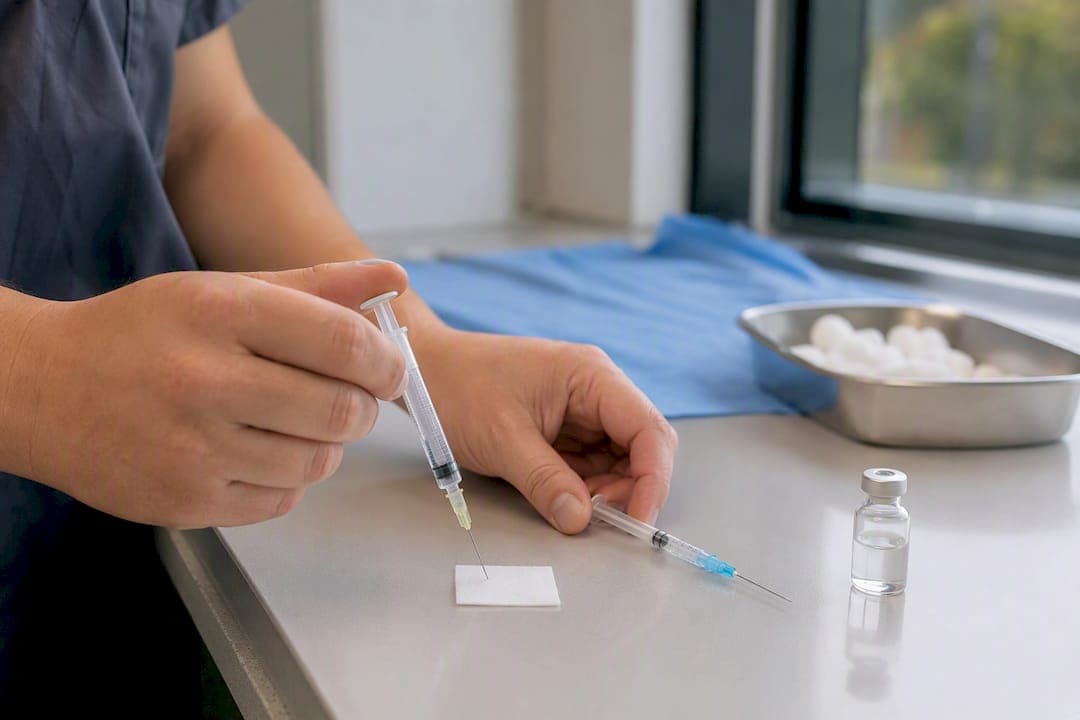
Choose intramuscular (IM) when a medication needs fast absorption or comes in a larger volume, like an oil-based testosterone ester. Choose subcutaneous (SubQ) when you want slower, steadier absorption and an easier route to self-administer, like insulin or most fertility injections. The choice usually isn't yours to make on the fly.
- IM: faster absorption, higher volume capacity, common for vaccines and hormone esters.
- SubQ: slower and steadier absorption, smaller volume, easier for daily self-injection.
- Follow CDC and manufacturer-labeled techniques and your prescriber's specified route.
Pro Tip: Never switch a medication's injection route on your own, even if you've read that "the other way" is easier. Ask your prescriber first. Airmedfit's supervised HRT/TRT patients get that answer from a clinician, not a guess.
Key Takeaways
Choosing between subcutaneous and intramuscular injection comes down to the medication's formulation, required absorption speed, and your prescriber's specific instructions.
| Point | Details |
|---|---|
| Route follows formulation | Oil-based and larger-volume medications typically need IM; low-volume, water-based drugs often go SubQ. |
| Needle length prevents errors | Using an inadequately long needle for intramuscular injections can result in medication being deposited in subcutaneous fat, which may alter absorption patterns. |
| Rotation prevents complications | Rotating injection sites reduces lipohypertrophy risk with SubQ and hematoma risk with IM. |
| TRT needs monitoring | Injectable testosterone carries higher erythrocytosis risk, making routine hematocrit checks essential. |
| Supervised care fills the gap | Airmedfit pairs physician-supervised HRT/TRT with lab monitoring and prescription supplies for safer self-injection. |
This article is general information, not a substitute for advice from a qualified doctor. Consult a qualified healthcare professional about your own circumstances before acting on anything here.
Table of Contents
- Subcutaneous vs Intramuscular: A Side-by-Side Comparison
- Why Do SubQ and IM Injections Absorb Differently?
- Which Medications Use SubQ vs IM, and Why?
- What Needle, Volume, and Site Should You Use?
- What Are the Risks of Each Injection Route?
- How Do Clinicians Decide Which Route to Use?
- How Do You Safely Self-Inject at Home?
- What Does the Evidence Say About TRT and Fertility Injections?
- When Is Each Injection Route Contraindicated?
- Does Injection Route Change How Well a Medication Works?
- How Do You Handle Reactions at the Injection Site?
- How Should You Respond to Adverse Effects After Injecting?
- What Should Special Populations Know About Injection Route?
- Publisher Note From Airmedfit
- Get Supervised Care, Supplies, and Lab Monitoring
- Sources
Subcutaneous vs Intramuscular: A Side-by-Side Comparison
The two routes differ enough that mixing them up changes how a drug behaves in your body. Here's how they stack up across the factors that actually matter when you're deciding, or when you're trying to understand why your prescriber picked one over the other.
| Factor | Subcutaneous (SubQ) | Intramuscular (IM) |
|---|---|---|
| Absorption & onset | Slow, steady release from fatty tissue | Faster, due to rich muscle blood supply |
| Typical needle gauge/length | 25–31G, 1/2"–5/8" | 18–25G, 1/2"–1.5" |
| Typical/max volume | Up to about 1 mL for adults with smaller volumes used in infants | Adults accommodate a higher volume suitable for muscle injection; children receive smaller doses |
| Common sites | Abdomen, outer thigh, upper arm, upper buttock | Ventrogluteal, vastus lateralis, deltoid |
| Comfort & self-injection | Generally easier and less painful to self-administer | Deeper, often needs more confidence or training |
| Common medications | Insulin, most fertility drugs, some biologics | Vaccines, testosterone esters, larger-volume drugs |
| Risks | Lipohypertrophy, local irritation | Nerve injury, deeper hematoma, infection |
Viscous, oil-based medications like injectable testosterone almost always require IM delivery according to clinical procedure guidance, while fertility drugs and insulin formulations are built for the SubQ layer.
Why Do SubQ and IM Injections Absorb Differently?
Intramuscular injections reach muscle tissue, which has heavy blood flow and pulls medication into circulation quickly. Subcutaneous injections stay in the fatty layer just under the skin, where blood supply is lighter and absorption stretches out over hours instead of minutes.
The needle has to cross the right layers to land in the right place:
- Epidermis (outer skin)
- Dermis (deeper skin layer)
- Subcutis (fat layer, the SubQ target)
- Muscle (the IM target)
Nursing procedural guidance sets SubQ needles at 25 to 31 gauge and half an inch to five-eighths of an inch long, while IM needles run 18 to 25 gauge and up to an inch and a half, long enough to clear fat and reach muscle in most adults. A needle that's too short for an IM injection can end up depositing medication in fat instead of muscle, which throws off the absorption profile the prescription was written for.
Which Medications Use SubQ vs IM, and Why?
Most insulins are SubQ because a slow, predictable release keeps blood sugar stable rather than spiking it. The same logic applies to low-volume fertility injections and many biologics, where steady serum levels beat a quick surge.
Common SubQ medications:
- Most insulin formulations
- Fertility drugs like FSH and hCG triggers
- Some biologics and anticoagulants (such as low molecular weight heparin)
Common IM medications:
- Many vaccines
- Oil-based testosterone esters
- Larger-volume medications that fat tissue can't absorb efficiently
Formulation dictates route more than convenience does. A drug suspended in oil needs muscle's blood flow to disperse it; a water-based drug at low volume often doesn't. Always follow what's printed on the label and what your prescriber specifies, since some medications have exceptions that don't fit the general pattern.
What Needle, Volume, and Site Should You Use?
Getting the mechanics right matters as much as picking the right route in the first place. For SubQ injections, nursing guidance recommends 25 to 31 gauge needles, half an inch to five-eighths of an inch long, topping out around 1 mL for adults (0.5 mL for infants). IM injections typically use 18 to 25 gauge needles, up to an inch and a half long, with adults accommodating 2 to 5 mL depending on the site.
Preferred sites:
- IM: ventrogluteal (often favored for oily or irritating solutions since it avoids major nerves and vessels), vastus lateralis, deltoid
- SubQ: abdomen (at least two inches from the navel), outer thigh, upper arm, upper buttock
Technique differs by route, too. Vaccine administration guidance calls for a 90-degree insertion for IM with no routine aspiration, while many SubQ injections use a pinch-up technique at 45 degrees, though some SubQ sites with more fat allow a straight 90-degree angle. Inject slowly, hold the needle steady, and drop used needles straight into a sharps container, never a regular trash bin.
Pro Tip: If you're heavier-set or have more subcutaneous fat, a "standard" IM needle length might not actually reach muscle. Talk to your prescriber about needle length before you assume the default works for your body.
What Are the Risks of Each Injection Route?
Both routes carry real, manageable risks. Infection, bleeding, and bruising can happen with either, but the deeper reach of IM injections raises the stakes for nerve injury and larger hematomas if the site is chosen poorly. Repeated SubQ injections in the same spot cause lipohypertrophy, a lumpy buildup of fat tissue that also slows and distorts absorption over time.
- Rotate injection sites every time, for both routes.
- Prep skin properly and let alcohol dry before inserting the needle.
- Watch for spreading redness, fever, or increasing pain, and call your prescriber if they appear.
- Dispose of needles in an FDA-cleared sharps container, never loose in household trash.
Injectable testosterone carries a specific risk worth flagging: a retrospective clinical review found higher rates of erythrocytosis, or elevated hematocrit, in patients on injectable testosterone compared with transdermal or pellet forms. That's a reason TRT patients need regular bloodwork, not a reason to panic. If you're on testosterone therapy and notice headaches, dizziness, or unusual fatigue, get your hematocrit checked.
How Do Clinicians Decide Which Route to Use?
Route selection comes down to a handful of concrete factors, not guesswork. A prescriber weighs the medication's formulation (aqueous versus oil-based), how fast it needs to act, the volume required, and your body habitus, since more subcutaneous fat can change which needle length actually reaches muscle.
- Medication formulation and required absorption speed
- Injection volume and viscosity
- Patient body habitus, age, and any coagulopathy
- Your comfort with needles and ability to self-inject at home
- Monitoring needs, like routine hematocrit checks for TRT patients
Bring targeted questions to your appointment: "Why this route for this medication?" "What needle length fits my body type?" "What lab monitoring will I need?" A clinician who can answer those clearly is doing their job well.
How Do You Safely Self-Inject at Home?
Only follow this sequence once your prescriber has trained you on your specific medication and route. This isn't a substitute for that training.
- Gather supplies: syringe, correct needle, alcohol swab, sharps container.
- Wash your hands and prep the site with an alcohol swab, letting it air dry.
- For SubQ, pinch the skin; for IM, stretch it flat over the muscle.
- Insert at the angle your training specified (45° or 90° depending on route and site).
- Inject at a steady, unhurried pace, then withdraw and apply gentle pressure.
- Drop the needle directly into a sharps container.
Pro Tip: A too-short needle on an IM injection is one of the most common self-injection mistakes, since it can leave medication sitting in fat instead of muscle. When in doubt, confirm needle length with your prescriber rather than eyeballing it.
What Does the Evidence Say About TRT and Fertility Injections?
Clinical reviews consistently link injectable testosterone to higher rates of erythrocytosis compared with transdermal routes, a pattern documented in retrospective analyses of testosterone therapy patients. Injectable forms also tend to produce higher peaks and more pronounced level swings than gels, which trade a steadier profile for skin transference risk according to reporting on testosterone delivery methods.
Most of this evidence comes from observational or retrospective data, where dosing frequency and individual metabolism muddy direct comparisons. Still, the clinical pattern is consistent enough to matter: some clinicians report smoother testosterone levels when patients switch to SubQ administration or split IM doses into more frequent, smaller injections. That's a conversation for your prescriber, not a DIY adjustment.
When Is Each Injection Route Contraindicated?
IM injections carry specific precautions. Anyone with a bleeding disorder or on blood thinners faces a higher risk of hematoma or prolonged bleeding at an IM site, since the needle passes through more vascular tissue. Severe muscle wasting or very low muscle mass, common in some elderly or chronically ill patients, can make standard IM sites unsafe or unreliable for absorption. The ventrogluteal site is often preferred in these cases precisely because it avoids major nerves and vessels.
SubQ injections have their own limits. Patients with significant lipodystrophy, scar tissue, or very little subcutaneous fat may not absorb medication predictably from standard SubQ sites. Repeated injections into the same spot cause lipohypertrophy, which further impairs absorption and is itself a reason to avoid that site until it heals. Certain medications, particularly some biologics, list specific SubQ site restrictions on their labeling, such as avoiding areas near a stoma or areas with active skin conditions like psoriasis or dermatitis.
Both routes require caution in patients on anticoagulants, where a slower, gentler injection technique and firm post-injection pressure reduce bruising risk. Neither route should be used at a site with active infection, inflammation, or scarring, and rotating sites is a precaution that applies universally, not just a comfort measure. Anyone with a latex allergy needs syringe and vial stopper materials checked in advance, since some pre-filled products still use latex components.
Does Injection Route Change How Well a Medication Works?
Onset speed gets most of the attention, but route also shapes how long a drug's effect lasts and how much of it your body actually uses. IM injections tend to produce a faster spike followed by a quicker decline for many drugs, while SubQ injections spread absorption over a longer window, which can mean a flatter, more sustained effect curve for the same total dose.
Bioavailability, or how much of the drug actually reaches circulation, isn't automatically better with one route. Some medications are formulated specifically for one route's absorption pattern and lose effectiveness if given the other way. Oil-based testosterone esters depend on muscle's blood supply to slowly release the compound over one to two weeks; giving that same oil-based formulation SubQ isn't standard practice and isn't supported by the same body of evidence.
For fertility medications, timing precision often matters more than raw bioavailability. A trigger shot's whole purpose depends on predictable timing to hit ovulation windows correctly, which is why these drugs are formulated and dosed specifically for SubQ delivery rather than IM. Switching a fertility drug's route without explicit direction from a reproductive endocrinologist risks throwing off a carefully timed cycle.
Duration of effect also depends on frequency and route together. Splitting an IM testosterone dose into smaller, more frequent injections, or moving to SubQ, can smooth out the peak-and-trough pattern that comes with less frequent, larger IM doses, according to clinician-reported outcomes on TRT dosing adjustments.
How Do You Handle Reactions at the Injection Site?
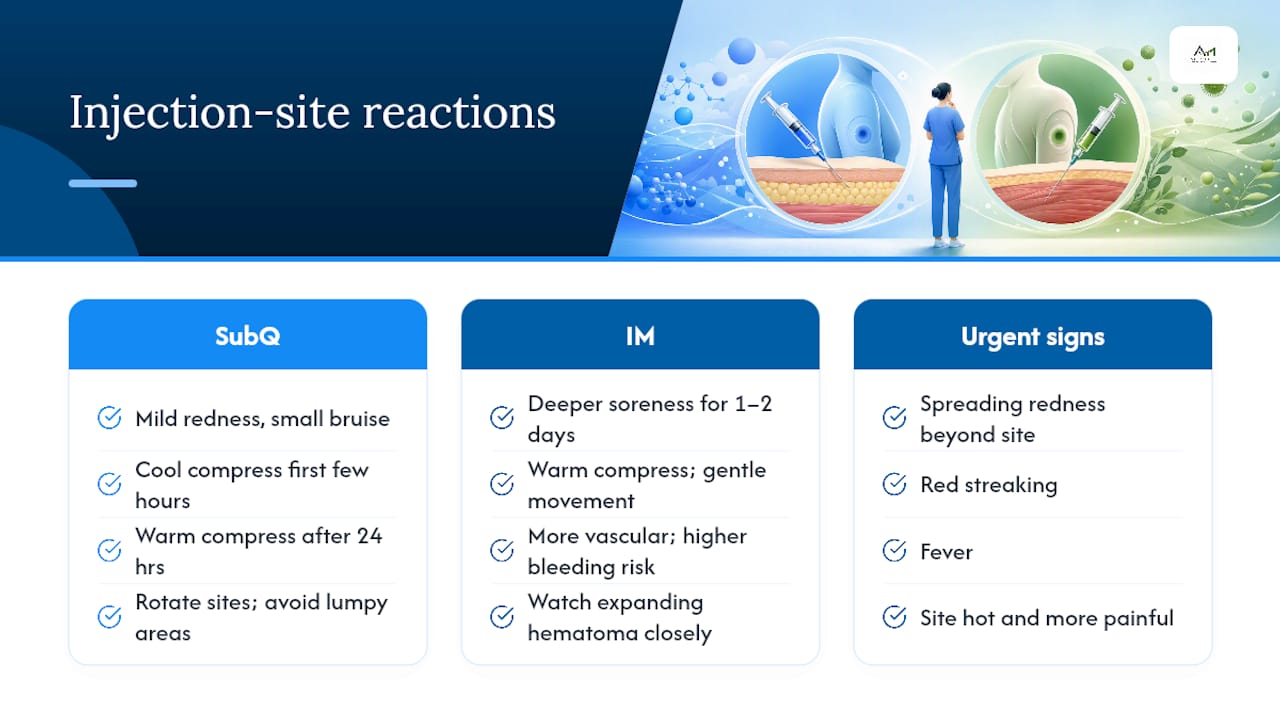
Mild redness, slight swelling, or a small bruise in the first day or two is common with both routes and usually resolves on its own. What you do next depends on which route you used.
For SubQ site reactions, a cool compress in the first few hours reduces swelling, followed by a warm compress after 24 hours if bruising persists. Rotating sites prevents lipohypertrophy, the lumpy fat buildup that develops from repeated injections in the same spot; once it appears, avoid that area for several weeks and let it soften before reusing it. Persistent itching or a hard, tender lump that doesn't fade after a week deserves a call to your prescriber, since it can signal a localized allergic response or improper technique.
For IM site reactions, deeper soreness is normal for a day or two, especially with larger volumes or oil-based medications. A warm compress and gentle movement of the limb often ease stiffness. Because IM injections reach more vascular tissue, watch more closely for a hematoma that keeps expanding rather than settling, since deep muscle bleeding is a rare but real complication, particularly in patients on anticoagulants.
For either route, spreading redness beyond the injection site, red streaking, fever, or a site that becomes hot and increasingly painful over 24 to 48 hours is not a normal reaction; it needs medical attention. Document your injection sites and reactions in a simple log or app so you and your prescriber can spot patterns, particularly if you're rotating between four or more sites weekly on a fertility or TRT protocol.
How Should You Respond to Adverse Effects After Injecting?
Knowing what's normal versus what's not takes the guesswork out of self-injection. Expect mild soreness, small bruising, or slight redness for the first 24 to 48 hours with either route; that's your body's ordinary response to the needle, not a complication.
Watch for these signals that go beyond normal post-injection soreness:
- Fever, chills, or flu-like symptoms starting within a day of injecting
- Redness that spreads or grows rather than staying contained
- Swelling that worsens after 48 hours instead of improving
- Numbness, tingling, or weakness near an IM site, which can suggest nerve involvement
- Shortness of breath, chest pain, or severe headache in TRT patients, which warrants urgent evaluation for hematocrit-related complications
Keeping a basic injection log, noting date, site, dose, and how you felt afterward, makes it far easier to describe a problem accurately to your prescriber instead of relying on memory days later. For anyone on a fertility or TRT protocol involving multiple weekly injections, this habit turns a vague "something felt off" into specific, actionable information a clinician can act on quickly.
What Should Special Populations Know About Injection Route?
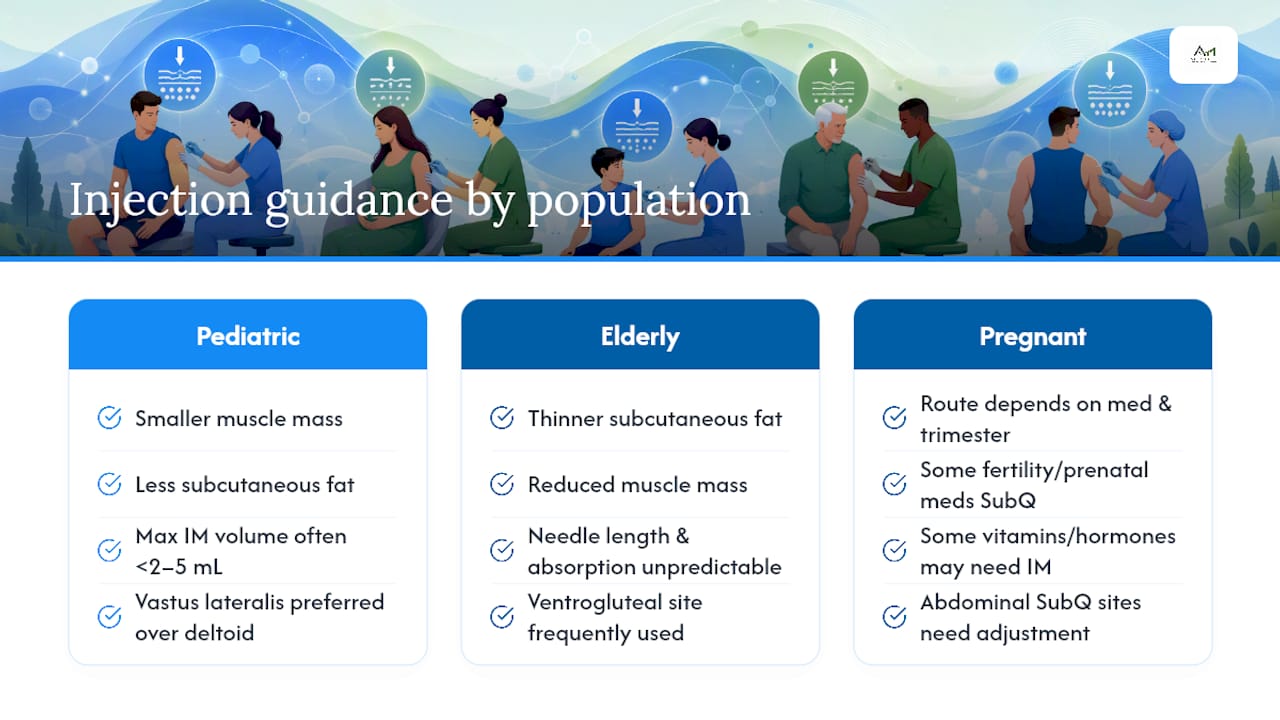
Pediatric patients need route and site choices adjusted for smaller muscle mass and less subcutaneous fat than adults. Nursing guidance recommends smaller maximum volumes for children, often well under the 2 to 5 mL adult IM range, and vastus lateralis is frequently preferred over deltoid in infants and toddlers because that muscle is better developed at younger ages.
Elderly patients often have thinner subcutaneous fat and reduced muscle mass, which changes both needle length needs and absorption predictability. A needle sized for an average adult might land differently in an elderly patient with significant muscle wasting, another reason the ventrogluteal site sees frequent use in this population. Skin also thins with age, raising bruising risk at both SubQ and IM sites.
Pregnant patients require route decisions tied closely to the specific medication and trimester. Certain fertility and prenatal medications are SubQ by design for steady absorption, while others, like some prenatal vitamin injections or specific hormone support, may call for IM depending on formulation. Any pregnant patient on injectable medication should coordinate route and site closely with their OB or fertility specialist, since abdominal SubQ sites, common outside pregnancy, often need adjustment as pregnancy progresses.
Across all these groups, the underlying rule stays consistent: body composition changes what a "standard" needle length and site actually deliver, which is exactly why route and technique decisions belong with a clinician who can account for your specific anatomy.
Publisher Note From Airmedfit
Airmedfit's programs include physician-supervised HRT and TRT, lab monitoring for hematocrit and hormone levels, and prescription supplies for safe home injection.
Get Supervised Care, Supplies, and Lab Monitoring
Reading about needle gauges and injection angles only gets you so far when the medication itself, and the route it's given by, needs a physician's judgment behind it. That's where Airmedfit's model is built differently: physician-supervised HRT and TRT programs paired with the lab monitoring and prescription supplies you'd otherwise have to piece together yourself.
Clients on testosterone therapy through Airmedfit get routine hematocrit checks built into the program, not an afterthought, which matters given how injectable testosterone's erythrocytosis risk plays out over months of treatment. Fertility patients and anyone self-injecting biologics get the syringes, needles, and bacteriostatic water sourced from licensed US manufacturers, with a physician available to answer the exact route and technique questions this article can only cover generally.
If you're weighing whether your current protocol has the right route, dose, or monitoring schedule, start a consultation with Airmedfit and get a physician's read on your specific case.
Sources
- Chapter 18 Administration of Parenteral Medications - Nursing Skills - NCBI Bookshelf
- How to Administer Intramuscular and Subcutaneous Vaccine Injections
- Pmc
- Intramuscular vs subcutaneous injection comparison (Nottingham nursing resource)