
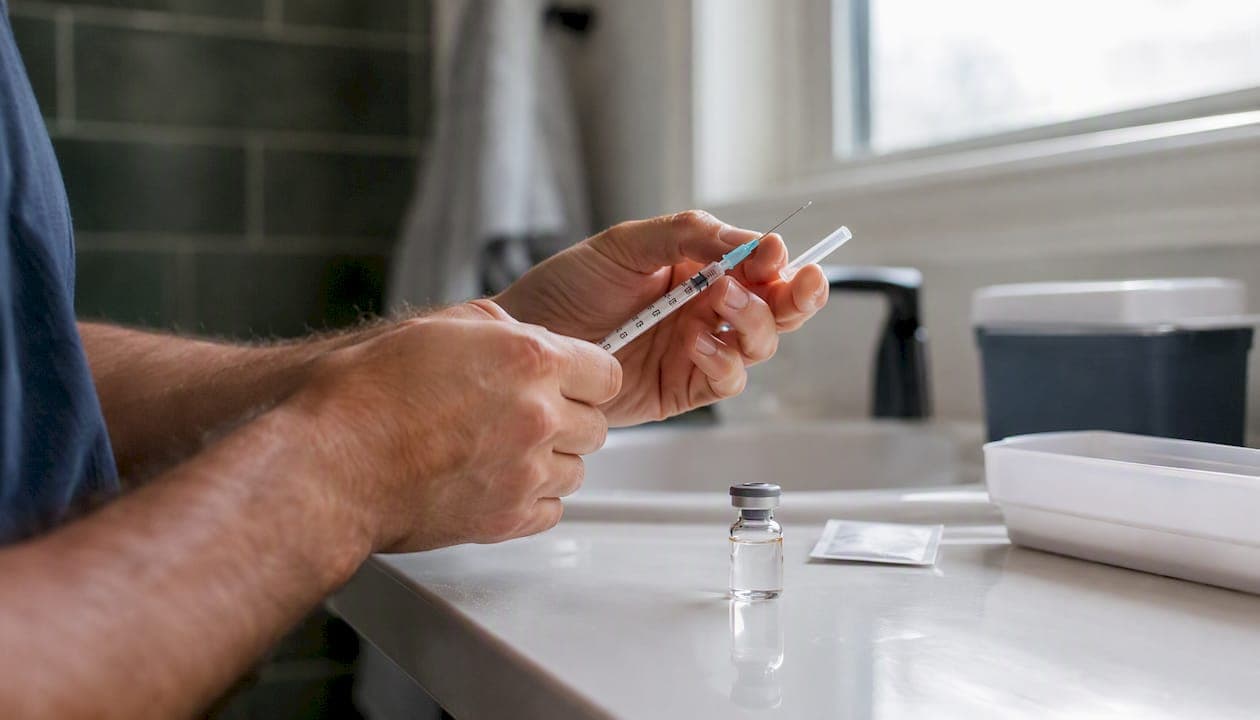
Yes, you can do physician-supervised TRT at home, and for most men with confirmed low testosterone, it works as well as an in-office program when it's run correctly. The catch is in that qualifier: "correctly" means a licensed clinician confirms low testosterone through bloodwork, rules out contraindications, and stays involved for the life of your treatment. It doesn't mean ordering testosterone off a website with no labs and no follow-up.
A handful of conditions separate legitimate at-home TRT from something risky. You need baseline labs before the first dose, an actual clinician relationship (not just a form you fill out), compliance with your state's telemedicine rules, and monitoring that continues for as long as you're on therapy. The FDA regulates the medications themselves, and the Endocrine Society has published clear guidance on how testosterone therapy should be managed and monitored. Providers like Airmedfit build their entire model around that guidance rather than around speed alone.
Here's what actually has to happen for at-home TRT to be safe:
- Baseline labs first. Total and free testosterone, hematocrit, and PSA get checked before you ever touch a syringe.
- A real clinician relationship. A licensed prescriber reviews your labs and symptoms, not an algorithm.
- State-compliant telemedicine. Prescribing rules vary, and a legitimate provider will confirm your state allows the service before enrolling you.
- Ongoing monitoring, not a one-time script. Expect follow-up labs roughly every 90 days while your dose is being adjusted.
- Hematocrit and PSA checks specifically. These catch the two most serious risks of TRT early enough to act.
If a provider skips any of those, that's your answer on whether to trust them.
Key Takeaways
Physician-supervised TRT at home is safe and effective when baseline labs, licensed clinician oversight, and roughly 90-day monitoring are all built into the program from day one.
| Point | Details |
|---|---|
| At-home TRT is conditional, not automatic | It requires confirmed low testosterone, a licensed clinician, and ongoing lab monitoring, not just a prescription request. |
| Labs are non-negotiable | Baseline and follow-up testing for testosterone, hematocrit, PSA, and estradiol catch problems before they become dangerous. |
| Fertility needs a conversation upfront | Exogenous testosterone suppresses sperm production, so discuss preservation options before starting if it matters to you. |
| Bundled memberships often simplify budgeting | All-inclusive plans covering labs, visits, and medication tend to be more predictable than paying for each piece separately. |
| Airmedfit builds monitoring into every step | Baseline labs, a clinician video visit, FDA-regulated medication shipping, and 90-day follow-ups define its at-home TRT program. |
Table of Contents
- How Does At-Home TRT Actually Work, Step by Step?
- At-Home Testing and Monitoring: Which Labs and How Often
- How Are TRT Treatments Administered at Home?
- Who Shouldn't Get TRT at Home?
- What Does At-Home TRT Cost?
- How Do You Choose a Safe At-Home TRT Provider?
- How Does Airmedfit Deliver Physician-Supervised TRT at Home?
- The Case for Convenience Without Cutting Corners
- Ready to Start Physician-Supervised TRT at Home?
- Sources
How Does At-Home TRT Actually Work, Step by Step?
At-home TRT follows a fairly consistent sequence regardless of which physician-supervised provider you choose. Understanding the order matters because skipping a step, or working with a company that skips one, is where things go wrong.
- Intake and symptom review. You'll complete a health history covering symptoms like fatigue, low libido, mood changes, and reduced muscle mass, along with any conditions that might rule out TRT.
- Baseline labs. Blood work gets drawn, usually through a local lab partner or an at-home draw kit, before any prescription decision is made.
- Clinician video visit. A licensed physician, physician assistant, or nurse practitioner reviews your labs and history with you directly, live, not through an automated approval screen.
- Prescription decision. If your total testosterone is low and no contraindications show up, the clinician prescribes a specific formulation and dose.
- Medication shipping. FDA-regulated testosterone, along with the supplies you need to administer it, ships to your door.
- Self-administration. You inject or apply the medication at home following the technique your clinician taught you.
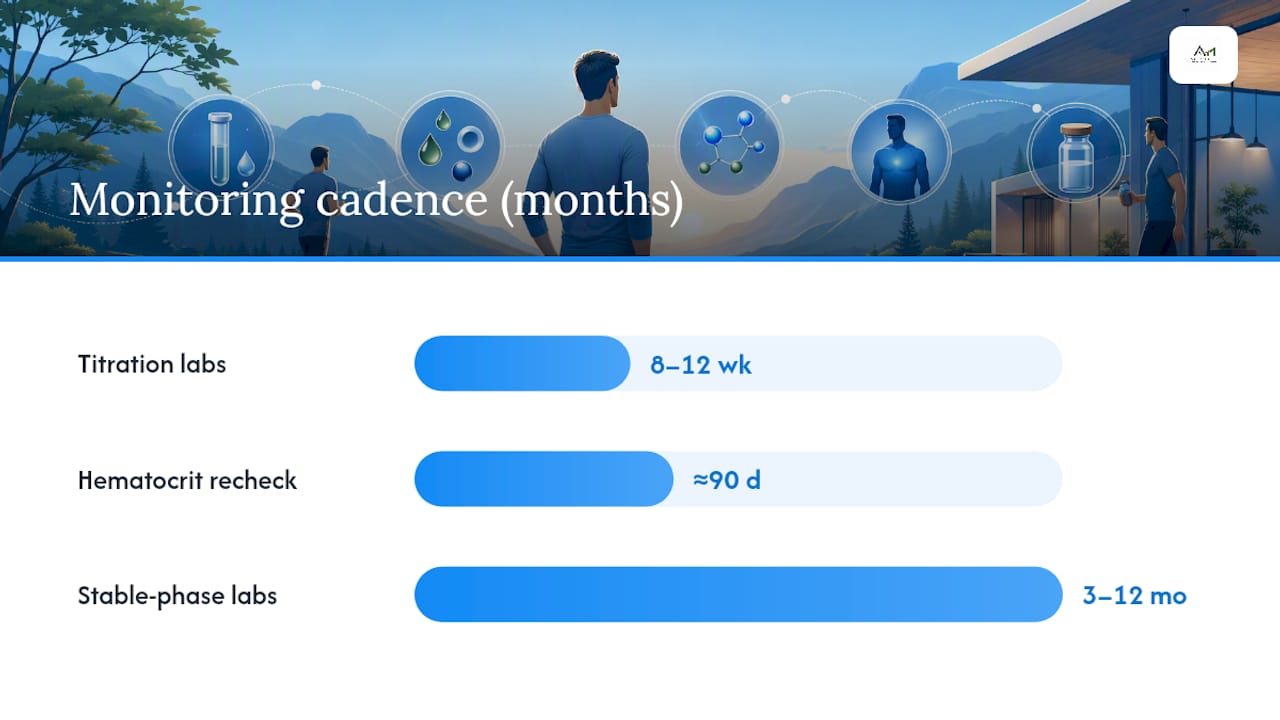
- Follow-up labs and dose adjustment. Around 8 to 12 weeks later, new labs check your response and your clinician adjusts the dose if needed.
A first consult typically happens within days of signing up, not weeks. Baseline labs almost always come before that first dose ships, and the first follow-up round lands around the 90-day mark, a cadence a clinical review in the Journal of Clinical Endocrinology & Metabolism identifies as standard practice during titration.
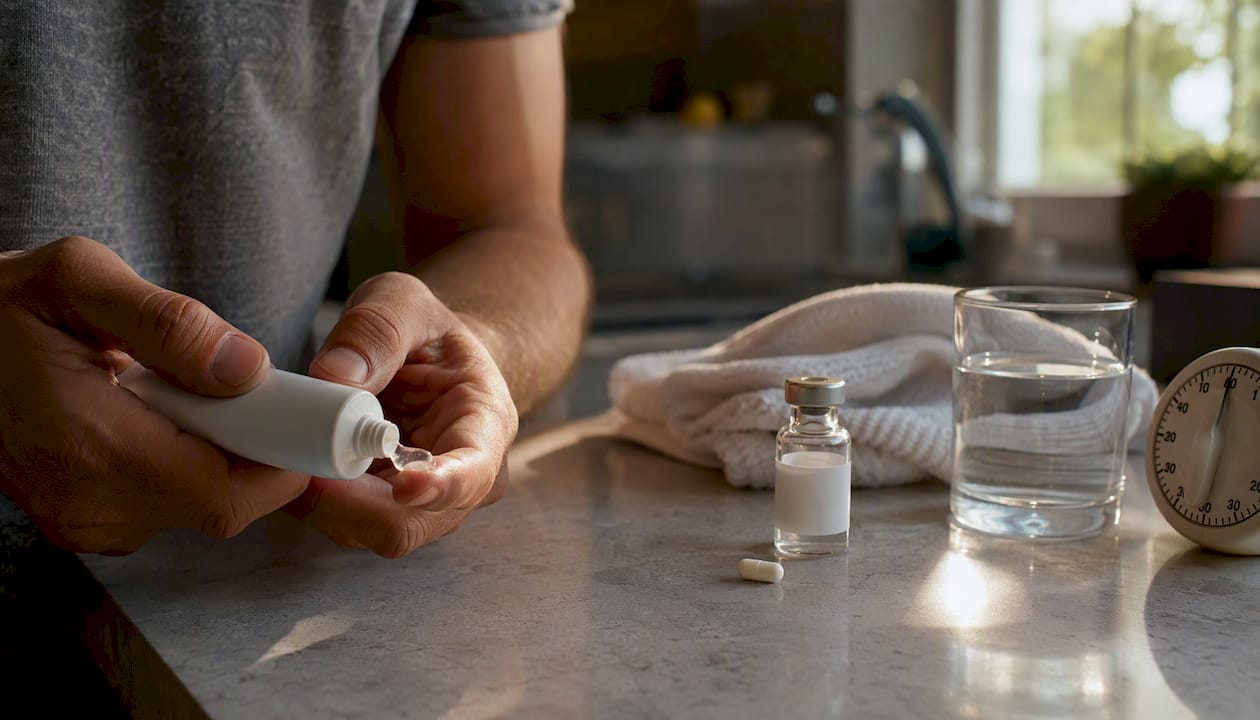
Not every formulation follows an identical path. Injectable testosterone is the most common at-home option and the one this guide focuses on, but topical gels and the FDA-approved oral testosterone capsule exist too. Gels carry a transfer risk to household members and require more careful hygiene counseling. Oral formulations need liver function checks worked into the monitoring plan that injections don't always require.
At-Home Testing and Monitoring: Which Labs and How Often
The labs matter more than the medication. A clinician can pick the right testosterone dose fairly easily; catching a problem before it becomes serious is what the monitoring schedule is actually for.
Your baseline panel should include total and free testosterone, a complete blood count with hematocrit, PSA, and estradiol. Depending on your history, a clinician may also order liver function tests and a fasting lipid and glucose panel. Blood draws happen in the morning, when testosterone levels are naturally highest and most representative of your true baseline.
| Test | What it checks | When it's ordered |
|---|---|---|
| Total and free testosterone | Confirms diagnosis and treatment response | Baseline, then each follow-up |
| Hematocrit (CBC) | Screens for polycythemia risk | Baseline, ~90 days, then periodically |
| PSA | Monitors prostate health | Baseline, then periodically per age/risk |
| Estradiol | Checks for excess conversion to estrogen | Baseline, then as symptoms indicate |
| Liver function tests | Relevant mainly for oral formulations | Baseline, then as clinically indicated |
After baseline, most providers order follow-up labs around every 8 to 12 weeks while your dose is being titrated, which lines up with the roughly 90-day cadence a clinical review recommends. Once your dose stabilizes and your numbers look steady, that interval usually stretches to every 3 to 12 months, depending on your clinician's judgment and your individual risk factors.
An elevated hematocrit is the single most common reason a clinician pauses or lowers a TRT dose. Research on testosterone therapy links it to increased red blood cell production in a meaningful subset of patients, which is exactly why hematocrit gets checked at every follow-up rather than left to symptoms alone. A rising PSA prompts a similar response, sometimes with a urology referral rather than just a dose change.
Pro Tip: Ask your provider whether they draw labs first thing in the morning. Testosterone follows a daily rhythm, and an afternoon draw can make a genuinely low level look borderline normal.
How Are TRT Treatments Administered at Home?
Most at-home TRT programs default to injectable testosterone, but it's not the only regulated option, and each route comes with real trade-offs worth understanding before you commit to one.
Intramuscular injection delivers testosterone directly into muscle tissue, typically the thigh or glute, and gives you the most predictable, well-studied dosing curve. Subcutaneous injection, into the fat layer just under the skin, uses a smaller needle and causes less discomfort for a lot of men, with research showing comparable absorption for many formulations. Topical gels avoid needles entirely but carry a real transfer risk to a partner or child through skin contact, and daily application makes consistent dosing harder to track. Oral testosterone, approved by the FDA for certain forms of hypogonadism, skips needles too, but it needs liver monitoring folded into your lab schedule.
A typical injectable at-home kit includes:
- Pre-filled syringes or vials with the prescribed dose
- Sterile needles and syringes sized to the injection route
- Alcohol swabs for site cleaning
- A sharps container for safe disposal
- Sometimes bacteriostatic water for reconstituting certain formulations
Shipping is discreet, arriving in unmarked packaging with no external indication of contents.
Your clinician or a nurse educator will walk you through injection technique before your first dose, and the process usually looks like this:
- Wash your hands and clean the injection site with an alcohol swab.
- Let the alcohol dry completely before inserting the needle to reduce sting.
- Insert the needle at the angle appropriate to your route, typically 90 degrees for intramuscular and 45 degrees for subcutaneous.
- Inject slowly and steadily, then withdraw the needle at the same angle you inserted it.
- Apply light pressure with a clean swab if there's any bleeding.
- Dispose of the needle immediately in a sharps container, never in household trash.
- Rotate injection sites each time to avoid tissue scarring or irritation buildup.
Who Shouldn't Get TRT at Home?
TRT isn't right for every man with a low number on a lab report, and a responsible provider will screen you out before treatment starts, not after something goes wrong.
Absolute contraindications generally include known or suspected prostate cancer, untreated severe sleep apnea, and significantly elevated baseline hematocrit. Relative contraindications, meaning conditions that need careful evaluation rather than an automatic no, include recent cardiovascular events, uncontrolled heart failure, and a strong family history of blood clots. Reviews of TRT's cardiovascular and metabolic effects continue to inform how clinicians weigh these risks case by case rather than applying a blanket rule.
Common side effects run from mild to serious. Acne, mood shifts, and fluid retention show up early and often resolve with a dose adjustment. Polycythemia and, less commonly, worsening sleep apnea or gynecomastia are the concerns that require active monitoring rather than a wait-and-see approach.
If your baseline hematocrit already sits near the upper limit of normal, or you have a personal or family history of blood clots, that's not a minor detail to mention in passing. It's a red flag that should trigger a more cautious workup before your first dose, not after your first follow-up labs come back abnormal.
Fertility is the piece men underestimate most. Exogenous testosterone suppresses your body's own signal to produce sperm, and research on testosterone's effect on spermatogenesis shows this suppression can be substantial, sometimes to the point of infertility while on therapy. If having biological children is on the table now or later, this is a conversation to have before you start, not after.
Pro Tip: If fertility matters to you, ask your clinician about sperm banking before you begin TRT, or discuss alternative agents that stimulate your own testosterone production rather than replacing it outright.
What Does At-Home TRT Cost?
Pricing for at-home TRT breaks down into a handful of predictable components, and understanding them upfront keeps you from getting surprised by a bill three months in.
- Initial consult fee. Covers your intake review and clinician video visit.
- Baseline lab fees. Sometimes bundled into the consult, sometimes billed separately.
- Monthly medication cost. Varies by formulation and dose; injectable testosterone tends to run lower than gels or the oral capsule.
- Shipping. Usually included, but confirm whether it's a flat fee or built into the medication price.
- Supplies. Syringes, alcohol swabs, and sharps containers are often bundled with injectable prescriptions.
- Ongoing labs and visits. Follow-up testing and clinician check-ins may be billed per visit or included in a membership.
Two pricing models dominate the market. Med-only plans charge for the prescription and supplies separately from labs and visits, which can look cheaper upfront but adds up once you factor in every follow-up. All-inclusive memberships bundle labs, clinician visits, medication, and supplies into one recurring fee, which tends to work out more predictable for men who know they're committing to months of treatment rather than a single trial run.
Before signing up anywhere, check for a few transparency markers: a clear refund policy if labs disqualify you after payment, upfront clarity on whether lab costs are billed to insurance or paid out of pocket, and explicit confirmation that the provider is licensed to treat patients in your state.
How Do You Choose a Safe At-Home TRT Provider?
The gap between a legitimate telehealth TRT program and a risky one usually shows up in the details a company either advertises proudly or buries in the fine print.
Run any provider through this checklist before enrolling:
- Licensed prescribers. An MD, DO, or NP should review your case, not just an intake form.
- Mandatory baseline labs. No legitimate provider prescribes testosterone without seeing your numbers first.
- A defined monitoring cadence. Look for explicit follow-up labs, not a vague "we'll check in."
- Emergency and refill protocols. You should know exactly how to reach a clinician if something feels wrong.
- State licensing and telemedicine compliance. Confirm the provider is authorized to treat patients in your specific state.
- Transparent pricing. All fees should be listed clearly before you commit.
Ask a provider directly: How often do you order labs? Who reviews and adjusts my dose? Do you ship discreetly? Do you maintain and share my medical records? A provider that answers these clearly and specifically is worth trusting more than one that deflects with marketing language.
Red flags are just as telling. Walk away from any service that skips labs entirely, issues a prescription without a real clinician review, won't name the credentials of the person prescribing, has no defined monitoring plan, or relies on compounded, non-FDA-regulated hormone products. The Endocrine Society specifically warns against compounded bioidentical hormone therapies precisely because they lack the quality controls and dosing consistency that regulated pharmaceutical testosterone carries.
How Does Airmedfit Deliver Physician-Supervised TRT at Home?
Airmedfit built its at-home TRT program around the checklist above rather than around shortcuts, because the entire point of physician-supervised therapy is that a clinician, not a checkout page, is making the medical calls.
Enrollment starts with baseline labs, either through a local draw or an at-home kit, followed by a one-time video visit with a licensed prescriber who reviews your results and history before any prescription is written. From there, FDA-regulated testosterone and the supplies needed to administer it ship directly to your door, and ongoing communication runs through a secure, HIPAA-compliant messaging platform for questions, refills, and dose concerns.
The monitoring protocol mirrors what the Journal of Clinical Endocrinology & Metabolism describes as standard during titration: baseline labs, a follow-up round around the 90-day mark, and periodic maintenance checks after your dose stabilizes. Hematocrit and PSA trends are watched at every step, with clear triggers built in for a dose change or a referral if something needs a closer look.
A few trust markers define the program specifically:
- Licensed prescribers oversee every dosing decision, not an automated intake system.
- Medications and supplies are sourced from licensed U.S. manufacturers under FDA regulation.
- The platform is HIPAA-compliant, and shipping arrives in discreet, unmarked packaging.
- Clients report improved energy and confidence as therapy stabilizes, alongside the structured lab monitoring that makes those results sustainable rather than short-lived.
The Case for Convenience Without Cutting Corners
At-home TRT gets marketed almost entirely on convenience, and that's fair. Not driving to a clinic every few weeks is a genuine improvement in quality of life for a lot of men managing symptoms of low testosterone. But convenience is the easy part to sell and the easy part to fake. Any company can ship a vial to your door.
What separates a legitimate program from a risky one is whether a clinician is actually making decisions, not just approving a form. The labs, the 90-day check-ins, the hematocrit thresholds, none of that is bureaucratic friction. It's the mechanism that catches a problem while it's still a footnote instead of an emergency room visit. A provider that treats monitoring as optional isn't offering you a faster path to the same outcome. It's offering you a cheaper version of the risk.
Airmedfit's approach reflects a simple premise: access and safety aren't competing goals. You can get your labs drawn, talk to a clinician on video, and have medication at your door within days, and still have every safeguard a brick-and-mortar clinic would apply. The two aren't in tension when the process is built correctly from the start.
Ready to Start Physician-Supervised TRT at Home?
Ordering testosterone online with no labs and no clinician isn't TRT, it's a gamble with a prescription label on it. Airmedfit takes a different route: baseline labs, a real video visit with a licensed prescriber, FDA-regulated medication shipped to your door, and monitoring that actually continues after your first dose instead of stopping there.
The enrollment flow is built to be fast without skipping the parts that keep you safe. You complete an intake form, get baseline labs ordered, and meet with a clinician who reviews your results before writing anything. Follow-up labs, discreet supply shipments, and secure messaging for refills or dose questions all continue as part of the same relationship, not a one-time transaction. State availability gets confirmed as part of sign-up, so you know upfront whether the program can serve you.
If you've been dealing with fatigue, low libido, or other symptoms that point to low testosterone, check your eligibility with Airmed Fit and see what a physician-supervised intake looks like for your specific labs and history.
Sources
This article is general information, not a substitute for advice from a qualified doctor. Consult a qualified healthcare professional about your own circumstances before acting on anything here.