

Testosterone replacement therapy typically runs $150–$500 per month out of pocket for uninsured patients in the U.S., or $1,800–$6,000 annually when you factor in medication, labs, and provider visits. With insurance covering the medication, that monthly figure can drop to $25–$100 in copays, though labs, consults, and supplies often stay on your tab regardless. The biggest variables are how testosterone is delivered, whether you use a telehealth subscription or a traditional clinic, and how often your provider orders monitoring labs.
| Scenario | Monthly range | Annual estimate |
|---|---|---|
| Insured (medication copay + in-network labs) | modest copays | moderate annual cost |
| Cash-pay / uninsured (all-in) | higher monthly cost | higher annual cost |
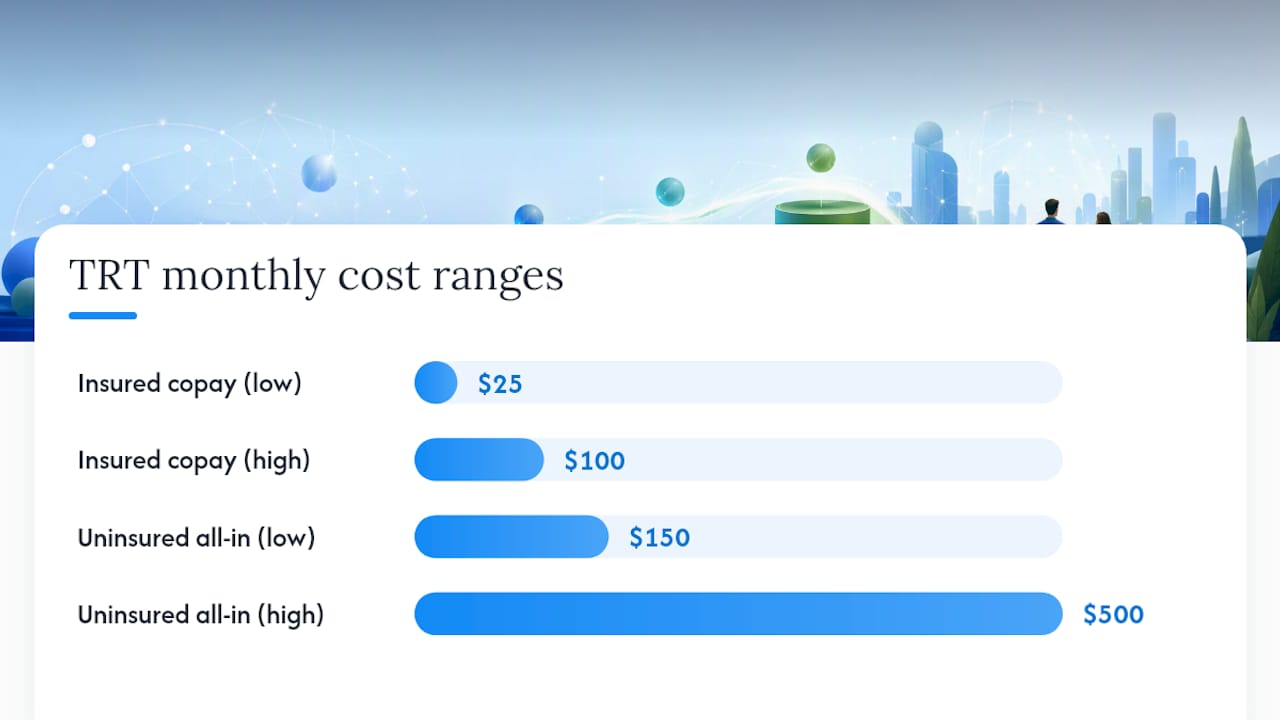
According to Medical News Today, medication cost alone understates what most patients actually spend, because labs and follow-up visits add hundreds of dollars per year that rarely appear in headline price quotes.
Key Takeaways
TRT costs vary most by delivery method and whether insurance covers the medication, but the first year is always the most expensive regardless of which model you choose.
| Point | Details |
|---|---|
| Monthly cost range | Cash-pay runs $150–$500/month; insured copays typically fall to $25–$150/month. |
| Annual all-in budget | Expect $1,800–$6,000 uninsured; $300–$1,800 with insurance covering medication and in-network labs. |
| Biggest cost driver | Delivery method matters most: generic injectable cypionate is the lowest-cost option by a wide margin. |
| Year-one vs. maintenance | Year one costs more due to quarterly labs; stable patients typically drop to biannual monitoring and lower annual totals. |
| Airmedfit option | Airmedfit offers bundled physician-supervised TRT memberships with transparent pricing, lab panels, and prescription supplies. |
Table of Contents
- What drives TRT price differences
- Cost estimates by delivery method
- How insurance typically affects TRT cost
- Cash pricing, telehealth models, and out-of-pocket expectations
- Other costs to expect beyond the medication
- Practical ways to reduce what you pay for TRT
- How often you'll pay: dosing schedules and annual cost patterns
- Key evidence, regulatory, and coding sources
- A note on transparent pricing and what it actually means
- Airmedfit's physician-supervised TRT membership
- Sources
What drives TRT price differences
The sticker price you see advertised rarely reflects what you'll pay by month 12. Several concrete variables move the number up or down, and knowing them lets you map any quote to your actual situation.
- Delivery method. Injectable testosterone cypionate (generic) is the cheapest option. Gels, patches, and pellets cost significantly more, sometimes 5–10 times as much per month.
- Brand vs. generic vs. compounded. Generic testosterone cypionate can cost under $30 for a 10 mL vial at retail pharmacies. Brand-name gels like AndroGel run $400–$500/month without insurance. Compounded formulations sit somewhere in between but carry variable pricing and regulatory complexity.
- Dose and frequency. Higher weekly doses consume vials faster. A patient using 200 mg/week burns through a 10 mL vial of 200 mg/mL concentration in roughly five weeks; one using 100 mg/week stretches the same vial to ten weeks.
- Provider model. A primary care physician billing through insurance is usually the lowest-cost route for the visit itself. Direct-to-consumer (DTC) telehealth subscriptions bundle the consult and medication but charge a flat monthly fee that insurers typically won't reimburse. Concierge and men's health clinics charge the most.
- Geography and pharmacy choice. The same generic testosterone cypionate prescription can range from $28 at a big-box pharmacy with a GoodRx coupon to over $120 at an independent pharmacy without one.
- Monitoring cadence. Year one typically requires labs every three months; stable patients often move to every six months. Each draw (total testosterone, free testosterone, estradiol, CBC, PSA, CMP) can cost $80–$300 without insurance.
- ICD-10 coding. Insurers commonly require the diagnosis code E29.1 (testicular hypofunction) on the prescription and lab orders for coverage to apply. Without it, even a covered drug can be rejected at the pharmacy counter.
Pro Tip: The most common hidden cost is lab cadence, not medication. A patient who orders labs every three months instead of every six pays for two extra draws per year, which can add $200–$600 annually before a single pill or injection is counted.
Cost estimates by delivery method
Each delivery method has a different cost structure, and the cheapest monthly medication price doesn't always mean the lowest annual total.
Three sample cost scenarios:
- Generic cypionate via telehealth DTC: Medication ~$40/month + $99/month subscription fee + $150 in labs twice per year = roughly $1,800–$2,100 annually.
- Brand gel (AndroGel) out-of-pocket: $450/month medication + $200 in labs twice per year = roughly $5,800 annually. Switching to generic or compounded cream cuts this substantially.
- Pellet therapy at a private clinic: Two insertion cycles per year at $600–$800 each + $300 in labs + $200 in consults = roughly $1,700–$2,300 annually for medication/procedure alone, before any membership fees.
Pellets look expensive per cycle but can be cost-competitive annually because there are no monthly refills. The catch is that most insurers won't cover the insertion procedure, so the full amount lands on you.
How insurance typically affects TRT cost
Insurance can cut your medication bill dramatically, but coverage is conditional, and the conditions matter.
What insurers commonly require for coverage:
Most private insurers and Medicare Part D plans will cover FDA-approved testosterone formulations when a patient has documented hypogonadism. That typically means two morning testosterone draws (collected before 10 AM on separate days) showing levels below the lab's reference range, plus a diagnosis coded as E29.1. The AUA testosterone deficiency guideline and FDA testosterone guidance both inform how insurers define medical necessity, and many payers cite these standards directly in their coverage policies.
What insurance typically will and won't cover:
- Usually covered: Generic testosterone cypionate or enanthate (injectable), brand-name topical gels on preferred formularies, monitoring labs ordered by an in-network provider
- Usually not covered: DTC/telehealth subscription fees, compounded testosterone formulations, pellet insertion procedures, hCG, anastrozole (unless separately diagnosed), out-of-network lab draws
Typical patient cost-shares for covered generic testosterone:
A patient with a standard commercial plan might pay $5–$30/month for generic injectable testosterone on a Tier 1 formulary. Brand gels on Tier 3 can run $80–$150/month even with coverage. Medicare Part D copays for generic testosterone cypionate commonly fall in the $10–$40/month range depending on the plan.
Prior authorization is common for brand-name formulations and sometimes for any testosterone product. Approval usually requires the two-lab documentation above plus a letter of medical necessity from the prescribing physician.
What to ask when you call member services:
- Is testosterone covered for ICD-10 E29.1 (testicular hypofunction)?
- What formulary tier is generic testosterone cypionate, and what is the copay?
- Are testosterone monitoring labs (CPT codes 84403, 82670, 85025, 84153) covered when ordered by my in-network provider?
- Is prior authorization required, and what documentation does it need?
- If denied, what is the appeal process and timeline?
- Are telehealth provider fees reimbursable, or only the medication?
Getting clear answers to all six questions before your first prescription is filled can save you from a surprise bill at the pharmacy.
Cash pricing, telehealth models, and out-of-pocket expectations
Market analysis of TRT pricing identifies three dominant care models: DTC/telehealth subscriptions with moderate yearly costs, concierge men's health clinics with higher annual costs, and insurance-billed traditional care with lower medication copays but additional out-of-pocket expenses for labs and visits. Each has a different bundling logic.
DTC/telehealth subscription model:
Most DTC platforms charge a flat monthly fee that bundles the physician consult, prescription, and sometimes medication shipping. Labs are either included, billed separately, or ordered through a partner lab at a negotiated rate. The predictability is the appeal. The limitation is that insurance rarely reimburses the subscription fee itself, even if the underlying medication would be covered under a traditional model.
Three 12-month cash-pay budget examples:
- Budget DTC (injectable cypionate, basic plan): $99–$149/month subscription + $30–$50/month medication (if billed separately) + $150–$300/year in labs = $1,500–$2,100 total
- Mid-tier bundled plan (includes labs, medication, consults): $150–$250/month all-in = $1,800–$3,000 total
- Concierge men's health specialist (in-person, comprehensive): $300–$450/month = $3,600–$5,400 total
What's typically bundled vs. billed separately:
- Bundled in most DTC plans: physician consult, prescription, sometimes shipping
- Billed separately: baseline labs, follow-up labs, syringes and supplies, adjunct medications (anastrozole, hCG)
- Never bundled: specialist referrals, imaging, emergency visits
A practical cost breakdown from PeakedLabs notes that startup fees and lab cadence are often the second-largest cost after medication, a point that catches many patients off guard when they compare a $99/month headline price to their actual year-end total.
Other costs to expect beyond the medication
The medication line item is only part of the budget. These ancillary costs are predictable enough to plan for.
Startup costs (year one only):
- Initial intake consult: $100–$300 (often waived or bundled in DTC plans)
- Baseline lab panel (two morning draws): $150–$400 without insurance; $20–$80 with in-network coverage
- Cardiac workup or imaging (if ordered): $200–$800, rarely routine but possible for patients over 50 or with cardiovascular risk factors
Recurring monitoring costs:
A 2022 open-access review on testosterone therapy monitoring documents the standard panel: total testosterone, free testosterone, estradiol, CBC, comprehensive metabolic panel (CMP), and PSA. Expect to pay for this panel two to four times per year, especially in year one.
- Full monitoring panel (cash-pay): $80–$300 per draw
- Individual tests (in-network copay): $10–$50 per draw
- PSA test (if ordered separately): $30–$100 cash-pay
Adjunct medications:
- Anastrozole (aromatase inhibitor, to manage estrogen): $15–$40/month generic
- hCG (to preserve fertility/testicular function): $50–$150/month; rarely covered by insurance
- Enclomiphene (alternative to hCG): $50–$120/month; coverage varies
Supplies:
- Syringes (1 mL, 23–25 gauge): $10–$20 per box of 100
- Alcohol swabs: $5–$10 per box
- Bacteriostatic water (for reconstitution, if applicable): $10–$20 per vial
The most common expensive surprises:
Out-of-network lab draws are the biggest one. A patient who uses a DTC telehealth service but gets labs drawn at an out-of-network facility can face a $300–$600 bill for a single panel that would cost $20 in-network. Pellet insertion fees are the second: the procedure itself is typically $200–$500 per session and almost never covered by insurance, making pellets more expensive in practice than their per-cycle price suggests.
Practical ways to reduce what you pay for TRT
Cutting TRT cost doesn't mean cutting corners on monitoring. These steps reduce spend while keeping the clinical picture intact.
- Verify insurance benefits before your first appointment. Call member services with the six questions listed above. Knowing your formulary tier and prior auth requirements before the prescription is written prevents denials and delays.
- Use generic testosterone cypionate or enanthate. The clinical outcome is identical to brand-name products for most patients. With a GoodRx coupon at a major retail pharmacy, a 10 mL vial of 200 mg/mL testosterone cypionate often costs under $35.
- Compare bundled DTC plans to pay-as-you-go. If your insurance covers the medication, a DTC subscription may cost more than just using your PCP and in-network pharmacy. Model the 12-month total for both paths before enrolling.
- Consolidate labs to in-network providers. Ask your prescribing physician to order labs through your insurance network. This single step can save $200–$500 per year.
- Request a medical necessity letter for prior authorization. If your insurer requires prior auth for a brand-name product, ask your physician to write a letter and submit it proactively. For a brand-to-generic switch, the same letter can accelerate formulary approval.
- Ask for a superbill from telehealth providers. A superbill is an itemized receipt with procedure and diagnosis codes that you can submit to your insurer for partial reimbursement. Not all plans honor them, but many PPOs do.
- Model 12-month totals, not monthly sticker prices. A $99/month DTC plan with $400 in labs and $200 in supplies costs $1,788 annually. A $150/month plan that bundles labs and supplies costs $1,800. The difference is negligible, but the bundled plan is simpler to manage.
Pro Tip: Watch for offers under $50/month that don't include lab testing or a documented diagnostic workup. Legitimate TRT requires baseline labs and ongoing monitoring. A plan that skips those steps isn't cheaper — it's incomplete, and it may not meet the documentation standard insurers require if you ever want to switch to a covered model.
How often you'll pay: dosing schedules and annual cost patterns
Dosing frequency determines how often you refill, how often you inject or apply, and when monitoring labs recur. Understanding the cadence turns a monthly estimate into an accurate annual budget.
Standard dosing frequencies:
- Weekly IM/SQ injections (most common): 100–200 mg testosterone cypionate per week. A 10 mL vial at 200 mg/mL contains 2,000 mg total, lasting 10–20 weeks depending on dose. At 150 mg/week, one vial lasts roughly 13 weeks, meaning you need about four vials per year at $30–$40 each, or $120–$160 annually in medication alone.
- Biweekly injections: 200–300 mg every two weeks. Slightly less stable blood levels but fewer injections. Same vial math applies; cost is identical to weekly at equivalent total dose.
- Daily topical gel or cream: Applied every morning. No vial math needed, but daily use means no missed doses and a consistent monthly refill cycle.
- Pellet implant every 3–6 months: Two to four procedures per year. No daily or weekly administration, but each procedure is a discrete cost event.
Year one vs. maintenance year monitoring:
- Year one: Labs typically every 3 months (four draws). At $80–$300 per draw cash-pay, that's $320–$1,200 in labs alone.
- Year two onward (stable patients): Labs every 6 months (two draws). Lab cost drops to $160–$600 annually.
The clinical monitoring review on PMC supports a more frequent schedule in the first year, when dose adjustments are most likely. Once levels stabilize, the monitoring burden, and its cost, drops meaningfully.
Year-one vs. maintenance cost comparison:
- Year one all-in (injectable, cash-pay): $1,800–$3,500
- Maintenance year all-in (injectable, cash-pay): $1,200–$2,200
That gap is worth knowing before you start. The first year is always the most expensive.
Key evidence, regulatory, and coding sources
The clinical and regulatory framework behind TRT coverage decisions rests on a small set of authoritative sources. Knowing them helps when you're talking to an insurer or a new provider.
- FDA testosterone information page: Covers postmarket safety, monitoring recommendations, and oversight of testosterone products. Insurers and prescribers reference this for risk documentation. Testosterone information | FDA
- AUA testosterone deficiency guideline: The clinical standard most U.S. urologists and many insurers use to define appropriate diagnosis and monitoring. Includes diagnostic thresholds and recommended lab panels. AUA guideline
- PMC9006970 (2022 open-access review): Documents baseline and periodic monitoring elements (total/free T, estradiol, CBC, CMP, PSA) and their clinical rationale. Useful for budgeting lab costs. Full review
- FDA compounding FAQ: Explains regulatory oversight of compounding pharmacies, relevant for patients considering compounded testosterone creams or pellets. Compounding FAQ | FDA
The endocrinology review on PMC3188848 provides the evidence base for the two-morning-draw requirement that most insurers now encode into their prior authorization criteria. Showing this source to a skeptical insurer or a new provider can accelerate the documentation process.
A note on transparent pricing and what it actually means
Most TRT pricing conversations focus on the medication line because it's the easiest number to quote. At Airmedfit, the approach is different: pricing is structured to reflect the full clinical picture, including physician oversight, lab monitoring, and prescription supplies, so patients aren't surprised by a $400 lab bill six weeks into a $99/month plan.
Monitoring isn't optional overhead. The FDA's testosterone guidance and the AUA guideline both make clear that testosterone therapy carries real cardiovascular, hematologic, and endocrine considerations that require ongoing clinical oversight. A plan that skips labs to hit a low headline price isn't a deal. It's a liability.
This article is for general informational purposes only and does not constitute medical advice. Consult a licensed clinician before making any treatment decisions.
Airmedfit's physician-supervised TRT membership
Patients who've read through the cost scenarios above often ask the same question: where can I find a provider that bundles everything transparently?
Airmedfit offers physician-supervised TRT memberships that include the intake consultation, ongoing medical oversight, prescription management, and access to lab panels and prescription supplies, all structured so you can see what you're paying for before you commit. Medication options include injectable testosterone and other FDA-regulated formulations sourced through licensed U.S. manufacturers, with pricing designed to be compared directly against the DTC and concierge models described above.
For patients who want to skip the guesswork of piecing together a provider, a pharmacy, and a lab network separately, Airmedfit's bundled model is worth reviewing. Visit Airmedfit to review current membership pricing and book an intake consultation.
Sources
These sources are worth bookmarking before you speak with an insurer or a new provider. Each one carries the kind of institutional authority that can move a coverage conversation forward.
- Testosterone information | FDA
- Testosterone deficiency guideline | AUA
- Open-access review on testosterone therapy safety and monitoring (PMC9006970)
- Testosterone replacement therapy (TRT) | Medical News Today
This article is general information, not a substitute for advice from a qualified doctor. Consult a qualified healthcare professional about your own circumstances before acting on anything here.