
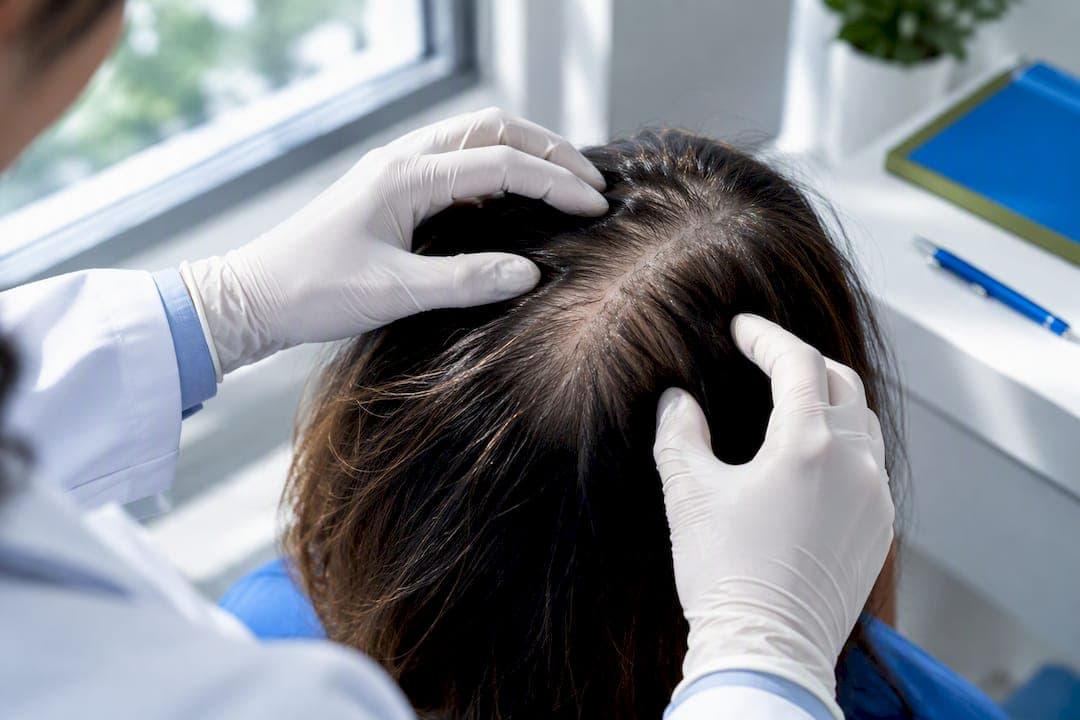
Short answer: GHK-Cu is biologically plausible and shows promise in early research, but it is not proven as a standalone hair regrowth treatment in large human trials. The strongest human data comes from a combination product, not GHK-Cu alone, and most supporting evidence is cell, tissue or animal work. If you are considering it, talk to a dermatologist or clinician about formulation quality and realistic expectations before you spend money.
TL;DR:
- Human evidence for GHK-Cu alone is limited and mostly based on animal and cell studies, with only one combination-product trial showing a modest six-month hair count increase.
- Delivery formulation plays a critical role, as most topical peptides struggle to penetrate the scalp skin barrier without specialized carriers or techniques like microneedling.
- The only significant human trial combined GHK with 5-ALA, making it impossible to determine GHK-Cu's effectiveness independently, and real results may take four to six months to appear.
- Topical GHK-Cu products are generally safe but may cause mild irritation, while systemic copper therapies for other diseases involve different safety and dosing considerations unrelated to hair treatment.
- When choosing a product, verify ingredient specifics, concentration, batch testing, and delivery technology, and consult a clinician for personalized guidance rather than relying on marketing claims.
Table of Contents
- Quick take: what the existing evidence actually shows
- How GHK-Cu affects hair follicles: mechanisms and their limits
- What the human clinical trials actually show
- Why delivery method may matter more than the ingredient list
- Safety, side effects and where the regulatory record gets confusing
- How to evaluate a GHK-Cu product before you buy it
- Timeline and realistic expectations for anyone trying this
- What supervised peptide access actually looks like
- Separating promising science from consumer hype
- Airmed Fit: a clinician-supervised path for people who want monitored peptide access
- Sources
- FAQ
Quick take: what the existing evidence actually shows
Research on GHK-Cu for hair falls into three tiers, and they are not interchangeable. The most basic tier, cell and ex-vivo tissue work, shows the peptide complex interacting with hair follicle biology in a lab dish or isolated tissue sample. The next tier, animal studies, shows effects in mice under controlled formulation conditions. The top tier, human clinical trials, is the thinnest and the most complicated to interpret.
The closest thing to direct human evidence is the ALAVAX trial, a randomized, double-blind study that tested a topical complex combining 5-aminolevulinic acid (5-ALA) with the GHK peptide in men with pattern hair loss. Over six months, the treatment arms showed a statistically significant increase in hair count compared to placebo. That is a genuinely encouraging result, but the product tested was a combination formula, so the trial cannot isolate how much of the benefit came from GHK-Cu itself versus the 5-ALA component.
Supporting the biological case, an ex-vivo study using AHK-Cu, a related tripeptide-copper complex, found it stimulated hair follicle elongation and dermal papilla cell proliferation in isolated human tissue. Separately, a mouse study testing a specialized ionic-liquid microemulsion delivery system reported faster entry into the anagen (growth) phase and higher hair density than controls, a result driven as much by the delivery formulation as by the peptide itself.
Here is how the evidence stacks up by type:
- Cell and ex-vivo studies: show GHK-Cu related peptides can stimulate follicle cells directly, establishing biological plausibility.
- Animal formulation studies: demonstrate that delivery method dramatically changes how much peptide reaches the follicle.
- Human trials: limited to one well-designed combination-product study, not a standalone GHK-Cu trial.
None of this adds up to proof that a GHK-Cu serum, on its own, will regrow hair in a person. It adds up to a legitimate reason to keep studying it.
How GHK-Cu affects hair follicles: mechanisms and their limits
GHK-Cu's appeal comes from a handful of biological pathways that overlap with what dermatologists know about hair growth. The peptide complex has been linked to activation of Wnt/beta-catenin signaling, a pathway that governs whether a hair follicle stem cell commits to growing a new hair. It has also been associated with increased VEGF activity, which supports the blood vessel growth that feeds an active follicle, and with proliferation of dermal papilla cells, the small cluster of cells at the base of the follicle that regulates the hair growth cycle.
Beyond growth signaling, GHK-Cu is also described in the broader peptide literature as having anti-inflammatory and anti-fibrotic properties, which matters because chronic scalp inflammation and fibrosis are both implicated in progressive hair thinning.
GHK-Cu's biological reach extends well beyond hair. A review of GHK biology documents its presence in human plasma and its established role in wound healing and tissue remodeling, but notes that hair-specific clinical evidence remains considerably narrower than its general regenerative reputation suggests.
It is worth being precise about naming here. Some of the most compelling ex-vivo follicle data used AHK-Cu, a related but distinct tripeptide-copper complex, not GHK-Cu itself. The two are structurally similar and often discussed together, but they are not identical molecules, and effective concentrations reported in lab studies (in the picomolar to nanomolar range) do not automatically translate across formulations or into consumer products labeled simply as "copper peptide."
The pathways described here explain why researchers keep investigating copper peptides for hair. They do not, on their own, mean a topical product will produce visible regrowth in a real scalp. A cell responding to a peptide in a petri dish under ideal exposure conditions is a different situation than a follicle buried under skin, sebum and hair shafts on a living human scalp, where the peptide has to physically reach its target before any of that signaling can happen. Mechanism is a reason to study something. It is not a substitute for the clinical trial that shows the mechanism actually changes outcomes in people.
- Wnt/beta-catenin activation: linked to hair follicle stem cells committing to the growth phase.
- VEGF and angiogenesis: supports blood supply to active follicles.
- Dermal papilla proliferation: targets the cell cluster that regulates the hair cycle.
- Anti-inflammatory and anti-fibrotic activity: may address underlying scalp conditions tied to thinning.
What the human clinical trials actually show
The ALAVAX trial is the reference point most researchers cite when discussing GHK-related hair evidence in humans, and it is worth understanding its design in detail rather than just its headline result. The randomized, double-blind trial enrolled 43 men with pattern hair loss and tested a topical complex of 5-ALA and GHK peptide at two concentrations, 100 mg/mL and 50 mg/mL, against a placebo arm. Investigators tracked standardized frontal scalp hair counts over six months, and the treatment arms showed a statistically significant increase in hair count compared to placebo, with no serious adverse events reported in any study group.
That is a real signal, and it is the strongest piece of human evidence available for a GHK-related hair product. But three limitations matter for anyone weighing what it means for a standalone GHK-Cu serum:
- It tested a combination product. The formula paired GHK peptide with 5-ALA, a compound with its own separate biological activity, so the trial cannot separate how much of the hair count improvement is attributable to GHK versus 5-ALA versus their interaction.
- The endpoint was hair count, not density or thickness. An increase in counted hairs is meaningful, but it is a different measurement than terminal hair thickness or a shift from fine vellus hairs to thicker terminal hairs, which is what most people picture when they imagine visible regrowth.
- There is no head-to-head data against established treatments. No large randomized trial has directly compared GHK-Cu alone to minoxidil or finasteride, the two treatments with the deepest body of clinical evidence for pattern hair loss, so there is no basis for claiming GHK-Cu matches or exceeds either.
Finasteride is FDA-indicated for men only. Women who are or may become pregnant must not handle crushed or broken finasteride tablets, due to the risk of harm to a male fetus. It can also cause sexual side effects (reduced libido, erectile dysfunction) in a minority of men, which usually resolve after stopping treatment. Discuss these risks with a physician before starting.
Clinical evidence timelines are also worth noting on their own. The ALAVAX trial measured outcomes at the six-month mark, and that window lines up with a general pattern in hair research: measurable differences in hair count or early follicle activity tend to show up somewhere in the three to six month range of consistent treatment, not in weeks. Anyone expecting a fast result from a copper peptide serum is working from a timeline the research does not support.
Put together, the human data gives a real but narrow answer: a GHK-containing combination product produced a measurable hair count benefit over six months in a small trial of men with pattern hair loss. That is not the same as GHK-Cu alone being a proven hair regrowth treatment, and it is not the same as evidence that any given retail serum will replicate that result.
Why delivery method may matter more than the ingredient list
A peptide's biological potential means little if it never reaches the follicle. Skin, especially scalp skin covered in sebum and hair shafts, is built to keep large molecules out, and peptides like GHK-Cu are exactly the kind of molecule that struggles to penetrate the stratum corneum in meaningful amounts through a basic topical application. This is arguably the single biggest gap between what a copper peptide can do in a lab and what it can do sitting in a bottle on a bathroom shelf.

A 2023 formulation study offers a useful preview of how much delivery technology can change outcomes. Researchers developed a thermodynamically stable ionic liquid microemulsion designed to carry copper peptides through the skin barrier more efficiently, and in mice it increased local delivery to follicle regions roughly threefold compared to standard formulations. Those are striking numbers, but they come from mouse skin under laboratory conditions, and animal follicle cycle timelines cannot be assumed to translate directly to a human scalp, where hair cycles run on a much longer clock.
The practical takeaway is that formulation, not just the ingredient name on the label, likely determines how much of a topical GHK-Cu product ever reaches the follicle. Some clinics pair topical peptide protocols with microneedling, a technique that creates temporary micro-channels in the skin to improve penetration of topical actives and is independently studied as a hair growth stimulus in its own right. That combination approach reflects the same logic the microemulsion research points to: getting the molecule where it needs to go is at least as important as which molecule you choose.
- Skin barrier limits: intact scalp skin restricts how much of a topical peptide reaches follicle-level tissue.
- Formulation science: specialized delivery systems like ionic liquid microemulsions can multiply effective delivery in animal models.
- Microneedling: used clinically as a penetration enhancer and as an independent growth stimulus.
- Retail variability: two products listing "GHK-Cu" on the label can differ enormously in how much peptide actually reaches a follicle.
Pro Tip: A product listing GHK-Cu as an ingredient tells you almost nothing about delivery; ask what formulation technology, if any, is behind it before assuming it will perform like the peptide in a lab study.
Safety, side effects and where the regulatory record gets confusing
Topical copper peptide products are generally reported as well tolerated in the studies available, with the ALAVAX trial noting no serious adverse events in any arm, though mild skin irritation is a plausible reaction with any active topical, especially at higher concentrations or with frequent use. Anyone who develops persistent redness, itching or a rash should stop use and check in with a dermatologist rather than pushing through it.
Where things get genuinely confusing is the regulatory landscape around copper-based medicines more broadly. The FDA has reviewed and approved copper histidinate, marketed as Zycubo, as a treatment for Menkes disease, a rare pediatric copper metabolism disorder. **FDA review documents for Zycubo describe careful dosing and monitoring protocols for systemic copper replacement therapy., reflecting real toxicity concerns tied to injectable copper compounds in that specific clinical context, according to the integrated review materials.
That approval has nothing to do with cosmetic GHK-Cu hair products. Copper histidinate for Menkes disease is a distinct compound used at distinct doses to correct a systemic metabolic disorder in children, monitored by physicians tracking copper levels in blood. It is not evidence that a topical GHK-Cu serum is safe or effective for hair loss, and no marketing claim should imply otherwise. If you see a copper peptide product referencing FDA approval for legitimacy, that approval almost certainly belongs to a different compound in a different clinical context, not to the hair product in front of you.
- Common topical reactions: mild irritation or redness is possible, particularly at higher concentrations.
- Systemic copper risk: documented in the context of injectable copper replacement therapy for a rare disease, not topical cosmetic use.
- Regulatory mismatch: an FDA approval for copper histidinate in Menkes disease does not validate cosmetic GHK-Cu hair claims.
- When to stop: persistent irritation, rash or scalp discomfort warrants stopping and consulting a clinician.
How to evaluate a GHK-Cu product before you buy it
Given the gap between promising research and proven consumer products, the practical question shifts from "does GHK-Cu work" to "does this specific product have any chance of working." A short checklist helps separate serious formulations from marketing dressed up in scientific language.
- Check the exact ingredient name. Confirm the label says GHK-Cu specifically, not a vague "copper peptide complex" that could be a different or less-studied molecule like AHK-Cu.
- Look for a stated concentration. A product that does not disclose how much GHK-Cu it contains gives you no way to compare it to anything used in research.
- Ask for batch testing or a certificate of analysis. A legitimate supplier or clinic should be able to confirm identity and purity, not just list an ingredient name.
- Read the labeling for cosmetic versus investigational status. A product marketed as "for research use only" but sold directly to consumers for personal use is a red flag, not a technicality.
- Consider the delivery method. A plain aqueous serum is working against the same skin barrier problems described in the formulation research; ask whether the product uses any enhanced delivery system.
- Vet the supplier or clinician channel. A licensed clinician sourcing from a regulated pharmacy is a fundamentally different risk profile than an unregulated online seller.
Watch specifically for dramatic before-and-after marketing claims unaccompanied by any study data, missing concentration information, or products that lean heavily on the word "peptide" without naming which one. If you are talking to a clinician or seller, ask directly: what concentration is in this product, where is it manufactured, and can you show me batch testing.
Pro Tip: If a seller cannot tell you the exact concentration of GHK-Cu in their product, treat that as a bigger red flag than any claim on the packaging.
Timeline and realistic expectations for anyone trying this
Patience matters more than most marketing suggests. The clinical and preclinical research reviewed here points to a consistent pattern: measurable change, when it appears at all, tends to show up around the four to six month mark in human studies, not within the first few weeks of use. The ALAVAX trial's six-month endpoint reflects that same window.
It is also worth being precise about what "change" meant in that trial. The result was an increase in hair count, a specific and countable metric, not necessarily a visible shift in hair thickness or a conversion of thin vellus hairs into thicker terminal ones, which is the change most people actually hope to see in the mirror.
If you decide to try a GHK-Cu product, plan on a minimum of four to six months of consistent use before drawing any conclusion, and pair that trial period with a baseline photo and, ideally, a dermatologist evaluation at the start so you have something concrete to compare against later. Stopping after a few weeks because nothing visible has changed is consistent with what the research would predict, not a sign the product has already failed.
What supervised peptide access actually looks like
Some hair loss situations call for more than an over-the-counter serum, particularly when injectable peptides, compounded formulations, or more complex hair loss patterns are involved. In those cases, working with a clinician rather than self-directing treatment gives you medical oversight that a retail purchase does not.
A supervised program typically starts with a consultation to review your history and goals, followed by baseline lab work to rule out underlying causes of thinning such as thyroid or hormonal imbalances. From there, a clinician can build a monitored plan and schedule follow-up to track progress and adjust course if needed.
Airmed Fit offers physician-supervised access to this kind of pathway, including doctor consultations and home lab testing that can establish a baseline before starting any peptide or hormone-related protocol. For readers who want a deeper look at how peptide evidence tiers apply beyond hair specifically, Airmed Fit's overview of what's proven in peptide therapy is a useful next stop.
Separating promising science from consumer hype
GHK-Cu's biology is genuinely interesting, and the mechanisms researchers have identified give real reason to keep studying it. But biological plausibility is not clinical proof, and the gap between the two is where most marketing lives. The most honest reading of this research is not "GHK-Cu works" or "GHK-Cu doesn't work." It is that better delivery formulations and properly controlled human trials, ideally testing GHK-Cu alone against established treatments, are the next steps that would actually settle the question. Until those trials exist, evidence-first skepticism paired with clinician input is the more useful path than betting on a bottle.
— Organic
Airmed Fit: a clinician-supervised path for people who want monitored peptide access
If you are drawn to the science behind copper peptides but want a second set of eyes before spending money or trying something injectable, working with a clinician is the more measured route. Certain services provide physician-supervised consultations and lab testing that let you review candidacy and rule out underlying causes of hair thinning before committing to any protocol.
This is not a claim that Airmed Fit's approach outperforms other options for hair specifically. It is a transparent, supervised alternative to guessing on your own with an unregulated product.
- Doctor's consultations: async and sync options available to discuss your history and goals.
- Home lab panels: baseline testing to check for underlying hormonal or metabolic factors tied to hair thinning.
- Physician-guided planning: any peptide or hormone-related protocol is reviewed and monitored by a clinician rather than self-directed.
If you want to talk through your options with a physician, you can book a consultation to review your history and decide whether further testing or a supervised protocol makes sense for you.
Sources
- Efficacy of a Complex of 5‑Aminolevulinic Acid and Glycyl‑Histidyl‑Lysine Peptide on Hair Growth - PMC
- The effect of tripeptide‑copper complex on human hair growth in vitro - PubMed
- GHK and tissue remodeling review - PubMed
- FDA integrated review for ZYCUBO (copper histidinate)
FAQ
Does GHK-Cu grow hair?
Early research suggests GHK-Cu related peptides can stimulate biological activity linked to hair growth, and a human trial combining GHK with 5-ALA showed a statistically significant increase in hair count over six months. That trial tested a combination product, though, so it does not prove GHK-Cu alone regrows hair in people.
How long does GHK-Cu take to work on hair?
If it works at all, change is unlikely to show up quickly. Human trial data measured outcomes at the six-month mark, and researchers generally look for effects somewhere in the four to six month range of consistent use.
What did Elon Musk use to regrow his hair?
There is no credible, sourced information confirming what treatment, if any, a specific public figure used for hair regrowth, and this article does not make claims about individual cases. If you are curious about your own options, a dermatologist can walk you through treatments with actual clinical evidence behind them.
What are the negative side effects of GHK-Cu?
Topical GHK-related products in available trials have generally been well tolerated, with mild skin irritation being the most plausible reaction. Systemic copper toxicity concerns are documented for injectable copper replacement medicines used in rare disease treatment, a different context from topical cosmetic use, according to FDA review materials for copper histidinate.
Does GHK-Cu help with thinning hair specifically, or just hair loss in general?
Most available evidence, including the ALAVAX trial, focused on men with pattern hair loss rather than thinning from other causes like telogen effluvium or nutrient deficiency. Anyone experiencing thinning hair should get an evaluation to identify the underlying cause before assuming a copper peptide product is the right fit.