
Yes. Peer-reviewed evidence shows low-dose hCG added to TRT commonly preserves intratesticular testosterone and testicular volume, and can maintain sperm production in many men. Standard prevention dosing runs 250 to 500 IU every other day, while recovery protocols use higher, specialist-managed doses. If fertility matters to you, get baseline labs and a semen analysis, then talk to a physician before self-prescribing anything.
TL;DR:
- Adding low-dose hCG at 250 to 500 IU every other day can preserve intratesticular testosterone and testicular volume during TRT by mimicking natural LH.
- Higher recovery doses, often 1,500 to 3,000 IU every other day, require medical supervision and are used to restore fertility after prolonged TRT suppression.
- Successful outcomes depend on baseline labs and careful monitoring of estradiol, testicular size, and sperm parameters, especially for men prioritizing fertility.
- Combining hCG with TRT is most effective when started early and managed by a clinician, with regular hormonal and semen testing to adjust dosing.
- HCG helps prevent testicular atrophy in most men if used correctly from the start but may be less effective in longstanding or primary testicular failure cases.
Table of Contents
- HCG With TRT: How the Two Actually Work Together
- HCG Dosage for TRT: Prevention vs. Recovery Protocols
- What HCG With TRT Actually Delivers: Benefits and Outcomes
- Who Should Consider Adding HCG to TRT?
- Monitoring Labs and Managing Side Effects on HCG
- Continuing TRT With HCG vs. Stopping TRT to Recover
- Enclomiphene, FSH, and SERMs: Where They Fit Alongside HCG
- What Physician-Supervised Care Looks Like
- Manage HCG and TRT the Right Way With Airmedfit
- Primary Sources on HCG and TRT
- Sources
- FAQ
HCG With TRT: How the Two Actually Work Together
TRT raises testosterone levels in your bloodstream, but it does something else at the same time: it shuts down the signal your brain sends to your testicles. That signal is luteinizing hormone (LH), released by the pituitary gland to tell the Leydig cells inside your testes to produce testosterone locally. Once your brain detects enough testosterone circulating from an injection or gel, it stops sending LH. No LH means the Leydig cells go quiet, and intratesticular testosterone (ITT), the concentration inside the testes that actually drives sperm production, collapses even while your blood levels look great on paper.
This is the gap most men on TRT never hear explained clearly: serum testosterone and intratesticular testosterone are not the same number, and TRT only fixes one of them.
HCG closes that gap because its molecular structure mimics LH closely enough to bind the same Leydig cell receptors. Add hCG with TRT and you're essentially replacing the signal your pituitary stopped sending, keeping the testes active despite the external testosterone.
- HCG binds LH receptors on Leydig cells, restoring local testosterone production shut down by TRT-induced pituitary suppression.
- Dose-finding work by Coviello and colleagues found that 250 to 500 IU preserved intratesticular testosterone during TRT, while doses around 125 IU often fell short.
- Clinicians sometimes track 17-hydroxyprogesterone (17-OHP) as a surrogate marker, since it rises in a dose-dependent way with increasing hCG and offers an indirect window into testicular activity.
- The Human Chorionic Gonadotropin mechanism has been documented for decades, which is why hCG remains the default gonadotropin choice for this purpose.
HCG Dosage for TRT: Prevention vs. Recovery Protocols
The dose that keeps your testicles functioning while you're on TRT is nowhere near the dose used to restart sperm production after you've been suppressed for years. Confusing the two is the most common mistake men make when they start researching this on their own.
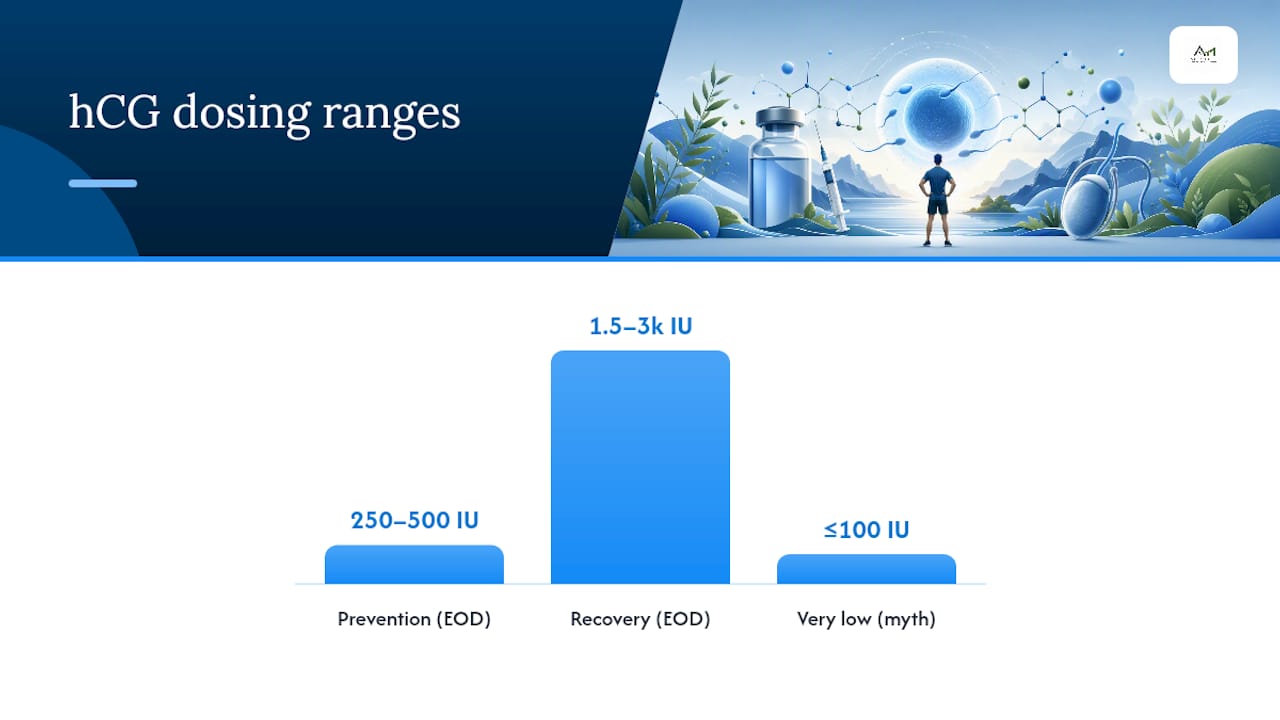
Prevention dosing, used by men who want to stay fertile while continuing TRT, typically lands at 250 to 500 IU every other day. This range comes directly from dose-response research showing it's enough to maintain intratesticular testosterone without pushing estradiol into problem territory. Some clinics use a twice-weekly equivalent instead of strict alternate days, which tends to work about as well if total weekly dosing stays consistent.
Recovery or restart protocols look different. Men trying to reverse testicular atrophy or restore fertility after stopping TRT often need 1,500 to 3,000 IU every other day, frequently paired with a SERM (a selective estrogen receptor modulator like clomiphene) or recombinant FSH. These higher doses require closer supervision because the estradiol response scales with dose.
- Start with baseline labs before the first injection, not after.
- Use the lower end of the prevention range (250 IU EOD) if this is your first time adding hCG, then adjust based on estradiol and symptom response.
- Recheck sensitive estradiol around six weeks in before assuming the dose is right.
- Track semen parameters if fertility is the actual goal, not just testicular size or how you feel.
- Move to recovery-level dosing only under a clinician's direction, never by extrapolating from a prevention protocol.
Pro Tip: Inject hCG on the same days you take your TRT dose. Monday and Thursday works well for most alternate-day schedules, and pairing the two makes it far less likely you'll forget one or the other.
Very low doses, think 100 IU or less every other day, are popular in online forums as a "just in case" starter dose. They're often sub-therapeutic and unlikely to maintain intratesticular testosterone in any meaningful way, so treat that number as a myth rather than a shortcut.
What HCG With TRT Actually Delivers: Benefits and Outcomes
The clinical case for adding hCG to TRT rests on outcomes, not theory. A retrospective case series following 49 men with testosterone-related infertility found that combination therapy restored spermatogenesis or improved sperm counts in 95.9% of men, with an average recovery time of 4.6 months and a mean first sperm density of 22.6 million per milliliter once recovery began.
That statistic matters because it sets realistic expectations. Most men don't see improvement in week two. They see it show up on a semen analysis somewhere in the three to six month window, which is roughly how long a full cycle of sperm production takes from start to finish.
- Concurrent low-dose hCG prevents or meaningfully reduces testicular atrophy in the majority of men who use it correctly from the start of TRT.
- Testicular volume, not just sperm count, tends to hold steadier when hCG is added early rather than as an afterthought.
- Clinicians typically track total testosterone, sperm concentration, and testicular size together rather than relying on any single metric.
Outcomes aren't universal, though. Older age, a long stretch of unprotected TRT use before starting hCG, and pre-existing testicular damage from other causes all reduce the odds of full recovery. A man who's been on TRT for eight years without any gonadotropin support is a different case than one who added hCG from day one, and both deserve honest expectations rather than a one-size-fits-all promise.
Who Should Consider Adding HCG to TRT?
Adding hCG isn't automatic for every man on testosterone therapy. It makes the most sense for a specific set of circumstances, and it's worth being honest with yourself about which category you fall into before starting another injection.
- You have active fertility goals within the next two to five years, whether that means trying now or keeping the option open.
- You've noticed or are worried about testicular shrinkage since starting TRT.
- You're willing to commit to an additional injection schedule and periodic lab monitoring, not just testosterone alone.
- You started TRT recently, since beginning hCG at initiation tends to preserve volume and sperm production more reliably than adding it years later, though a later start still helps.
HCG is less likely to help if your low testosterone stems from primary testicular failure rather than a pituitary signaling problem, since the testes may not respond to the LH-like signal regardless of dose. In that case, or when semen parameters stay poor despite a well-run protocol, referral to a fertility specialist or reproductive urologist is the appropriate next step rather than escalating hCG dosing indefinitely.
Monitoring Labs and Managing Side Effects on HCG
Adding hCG to your TRT regimen without a monitoring plan is asking for a surprise on your next lab report, usually in the form of estradiol you didn't see coming.
A responsible baseline panel before starting includes total and free testosterone, LH, FSH, sensitive estradiol, hematocrit, and a semen analysis if fertility is the actual priority. From there, most clinics follow a predictable rhythm:
- Recheck sensitive estradiol around six weeks after starting hCG, since this is when the response typically stabilizes.
- Repeat full hormone labs every three months thereafter to catch drift before it becomes symptomatic.
- Run a semen analysis at roughly three months and again at six months if fertility recovery is being tracked.
- Adjust the hCG dose, not just the TRT dose, if estradiol climbs faster than testosterone does.
The most common side effects trace back to estradiol: water retention, nipple tenderness, and mood shifts that feel a lot like premenstrual symptoms if you've ever heard a partner describe them. Clinicians usually manage this by lowering the hCG dose first and reserving an aromatase inhibitor for cases where dose reduction alone doesn't resolve it, since over-suppressing estradiol carries its own risks to bone and lipid health.
Pro Tip: If your nipples get tender within the first two weeks of starting hCG, don't panic and don't self-medicate with an aromatase inhibitor you found online. Get estradiol checked first. Sometimes the sensitivity fades on its own within a month as your body adjusts.
Red flags that warrant an urgent call to your clinician include sudden gynecomastia, significant mood changes, or a hematocrit climbing into unsafe territory alongside your testosterone. Regular follow-up through a program like structured TRT monitoring catches most of these trends before they become a problem you can feel.
Continuing TRT With HCG vs. Stopping TRT to Recover
For years, the conventional advice was blunt: stop testosterone entirely if you want your fertility back. Newer research complicates that picture in a useful way.
A recent clinical analysis found that testosterone and total sperm count improved with hCG regardless of whether adjunctive TRT was continued, which means some men can keep the symptom relief that TRT provides while still working toward sperm recovery. That's a meaningfully different trade-off than the old stop-everything approach, especially for men who don't want to go through weeks of low-testosterone symptoms during a restart.
- Continuing TRT alongside hCG avoids the fatigue, low libido, and mood crash that often accompany a full testosterone washout.
- High-dose recovery regimens, typically 1,500 to 3,000 IU EOD paired with FSH or a SERM, remain the standard for men prioritizing the fastest possible sperm recovery.
- Some clinicians still prefer stopping TRT temporarily in cases of severe suppression or when initial hCG-only response is poor, since removing exogenous testosterone gives the HPT axis one less signal to fight against.
- Expect the continued-TRT approach to take a similar timeline to standalone recovery protocols; the difference is mainly in how you feel along the way, not necessarily how fast sperm parameters improve.
The right choice depends on how urgently you need fertility results versus how much you value staying symptom-free during the process, and that's a conversation worth having directly with whoever manages your protocol.
Enclomiphene, FSH, and SERMs: Where They Fit Alongside HCG
HCG isn't the only tool available, and sometimes it isn't the right one on its own.
- Enclomiphene stimulates your own HPT axis directly and can preserve fertility in some men with secondary hypogonadism without introducing exogenous testosterone at all.
- Recombinant FSH or hMG gets added when a man's Sertoli cells (the ones that actually nurse developing sperm) need more direct stimulation than LH-mimicking hCG alone provides, often in poor responders.
- SERMs like clomiphene work by blocking estrogen's negative feedback on the pituitary, indirectly boosting LH and FSH output.
Combining these agents can improve outcomes, but stacking hormones without professional oversight is how men end up with estradiol swings and side effects nobody predicted. Individualized care from someone reviewing your labs in real time isn't optional here.
What Physician-Supervised Care Looks Like
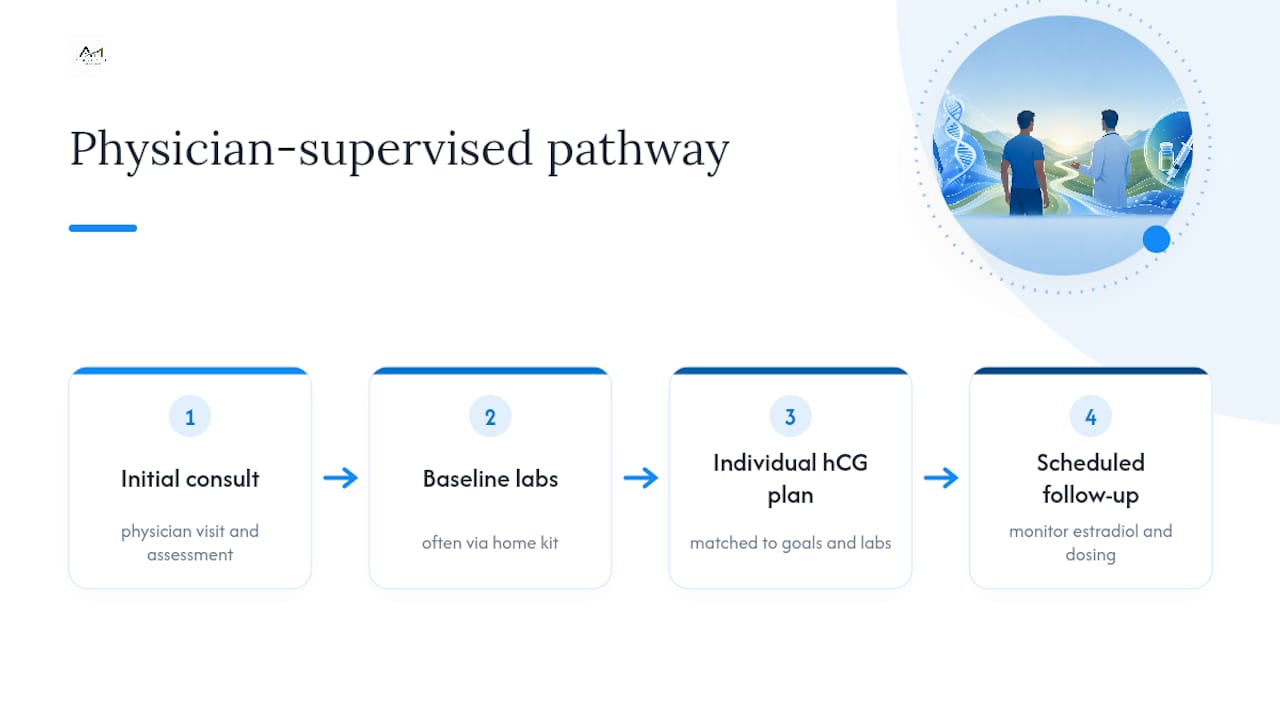
TRT and hCG protocols are ideally built around physician oversight from the first consultation, not just a prescription and a goodbye. That starts with baseline labs, often through a home kit, before any hCG dose gets set. A standard supervised pathway includes an initial consult, baseline testing, an individualized hCG plan matched to your fertility goals and lab values, and scheduled follow-up to catch estradiol drift or dosing issues early. That structure is what separates a managed protocol from guesswork.
Manage HCG and TRT the Right Way With Airmedfit
Getting hCG dosing wrong, whether that's an ineffective 100 IU "insurance" dose or an unmonitored recovery protocol, is how men end up disappointed with results or blind sided by estradiol side effects. Building hCG into TRT protocols under physician supervision, starting with baseline testing rather than a guess, helps optimize treatment outcomes.
The TruLab TRT home kit gives you the baseline hormone panel you need before adding hCG, without a clinic visit. From there, the Signature TRT Membership provides ongoing physician management, so your hCG dose gets adjusted based on real lab trends instead of a forum post. If you're not ready for a full membership, an async doctor's consult for $49 lets you get a clinician's read on your current protocol before you change anything. Book your baseline labs first, then schedule a consult to build an hCG plan around your actual numbers.
Primary Sources on HCG and TRT
These peer-reviewed sources back the dosing, mechanism, and outcome data covered above: a 49-patient recovery case series, a clinical review of hCG indications, and concurrent TRT and hCG outcome data.
This article is general information, not a substitute for advice from a qualified doctor. Consult a qualified healthcare professional about your own circumstances before acting on anything here.
Sources
- The Use of HCG-Based Combination Therapy for Recovery of Spermatogenesis after Testosterone Use
- Indications for the use of human chorionic gonadotropic hormone for the management of infertility in hypogonadal men
- The Continued Use of Testosterone Does Not Interfere with Human Chorionic Gonadotropin-Mediated Return of Spermatogenesis
FAQ
How Fast Does HCG Work in TRT?
Detectable changes in intratesticular testosterone and testicular volume can begin within weeks, but sperm production follows a slower timeline. Semen parameter improvements in a documented case series took an average of 4.6 months to appear, so patience matters more than speed here.
How Much HCG Do I Take With Testosterone?
Standard prevention dosing is 250 to 500 IU every other day, a range supported by dose-finding research showing this level maintains intratesticular testosterone. Recovery protocols use higher doses, often 1,500 to 3,000 IU EOD, but only under specialist supervision.
Will HCG Bring Back Testicle Size?
In most men, yes, concurrent low-dose hCG prevents or reverses much of the testicular atrophy that TRT alone causes by restoring the LH-like signal to the Leydig cells. Results vary based on how long you were on TRT without gonadotropin support before starting.
Do Bodybuilders Take HCG?
Yes, hCG is widely used in bodybuilding circles both during and after testosterone cycles to prevent testicular shrinkage and support a faster hormonal recovery. The medical rationale is the same one that applies to TRT patients: hCG replaces the LH signal exogenous testosterone suppresses, which is why a physician-guided protocol like the ones Airmedfit builds around baseline labs produces more predictable results than an unsupervised cycle.
Is HCG Necessary With TRT?
It's not required for every man on testosterone therapy, but it becomes important if you care about fertility or testicular volume. Men with no interest in future fertility and no concern about testicular size can often skip it, while anyone in the opposite camp benefits from adding it early.