
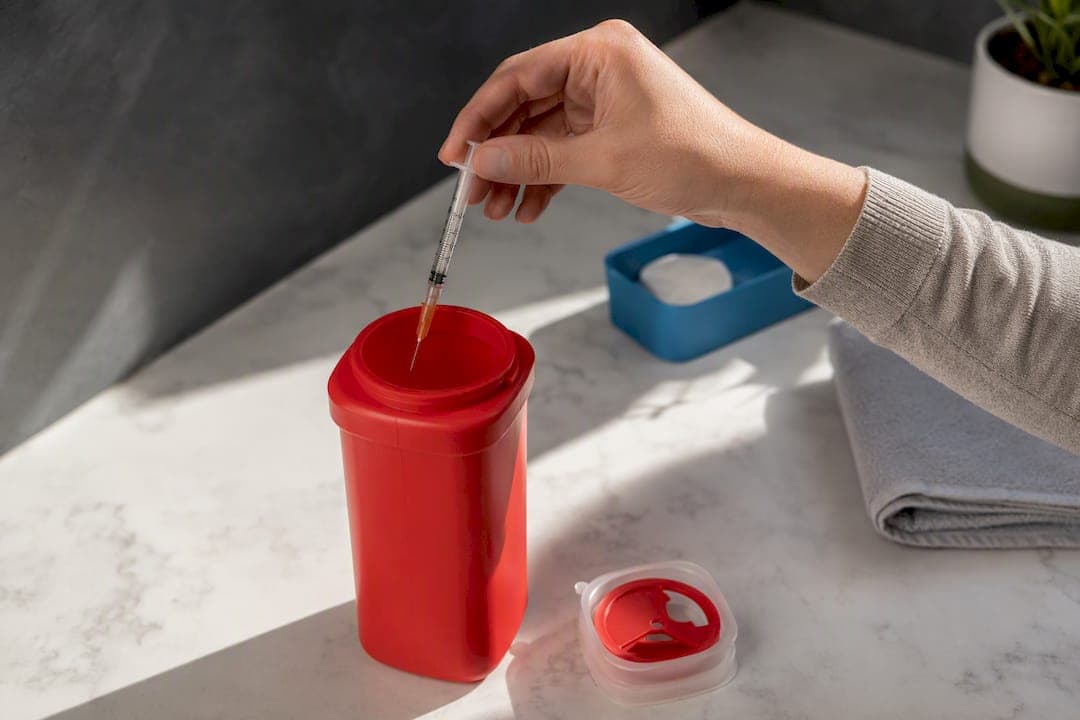
The safest immediate action after using a needle or lancet is to drop it point-first into a puncture-resistant container, right away, without recapping or handling it further. Once that container is sealed, you follow your community's disposal rules, whether that means a pharmacy drop-off, a household hazardous waste site, or a mail-back program. Everything else is detail.
TL;DR:
- Always drop the needle point-first into a puncture-resistant container immediately after use without recapping or handling it further.
- Use an FDA-cleared sharps container or a heavy-duty household container that is puncture-resistant, opaque, and has a secure lid for safe disposal.
- Stop filling the container before it is full, seal the lid tightly, reinforce with tape, and label it clearly with "SHARPS, do not recycle" before disposal.
- Dispose of the sealed container via local drop-off sites, household hazardous waste programs, mail-back options, or scheduled pickups, depending on local regulations.
- Never put loose sharps in trash or recycling, flush needles, or try to disassemble devices to prevent community and worker exposure risks.
Table of Contents
- What to do with a needle the moment you finish using it
- How to pick an FDA-cleared sharps container or a safe household alternative
- When to stop filling and how to seal, tape, and label the container
- Practical disposal routes: how to choose where the container goes
- Clear do-not-do rules and common dangerous misconceptions
- How to locate programs and examples of municipal initiatives
- How to dispose of lancets, auto-injectors, and other non-needle sharps
- The real risks behind improper sharps disposal
- Legal rules for home sharps disposal vary by where you live
- Why consistent home habits matter more than perfect equipment
- Managing injections at home with medical support
- Sources
- FAQ
What to do with a needle the moment you finish using it
The window right after an injection is when most needlestick injuries happen, so the goal is to get the sharp out of your hand and into a container in one motion.
- Drop the entire needle-and-syringe assembly point-first into your sharps container immediately after use, without setting it down first.
- Keep the container upright at all times and store it on a stable, flat surface away from the edge of a counter or table.
- Place it somewhere out of reach for children and pets, ideally a cabinet with a latch or a high shelf.
- Never recap, bend, break, or try to remove the needle from the syringe. Treat every used sharp as contaminated waste.
Pro Tip: Keep the container in the same spot every time you inject. A consistent habit removes the moment of hesitation where accidents tend to happen.
The FDA recommends a two-step process for exactly this reason: contain immediately, then dispose according to local rules. If you inject regularly as part of a prescribed program, this two-step habit becomes as routine as the injection itself. Readers who want more detail on safe injection technique can check our guide to subcutaneous injection sites for the mechanics that come before disposal.
How to pick an FDA-cleared sharps container or a safe household alternative
An FDA-cleared sharps container is the first choice because it is built to specific puncture-resistance and closure standards. When one is not on hand, certain heavy-duty household containers can substitute.
- Look for a container that is puncture-resistant, stays upright on its own, and has a lid that closes securely and stays closed.
- Choose opaque plastic, never glass or clear plastic, so the contents are not visible and cannot shatter.
- A heavy-duty laundry detergent bottle or bleach bottle with a screw-top lid works as a substitute when nothing else is available.
- Call a local pharmacy or clinic first. Some carry FDA-cleared containers for sale or give them out, and some product manufacturers supply them directly.
The CDC and NIOSH outline these same criteria for periods when commercial containers are scarce: closable, puncture-resistant, and leakproof on the sides and bottom. A container that meets those points, even an improvised one, does the job.
When to stop filling and how to seal, tape, and label the container
Stop before the container is full. Fill up to the manufacturer's marked line or stop well before the container is full to reduce risk of injury.
- Check the fill line every time you add a sharp, not just when the container looks nearly full.
- Screw the lid down tightly, then reinforce it with heavy-duty tape around the seam.
- Write "SHARPS, do not recycle" directly on the container in permanent marker before it leaves your house.
Overfilling a sharps container significantly increases the risk of accidental needlestick injuries during disposal, according to the FDA.
For transport, keep the container upright in the car or bag, and slip it into a sealed plastic bag for an extra layer of protection if you are carrying it any distance. If the receiving site asks you to register or call ahead, do that before you leave the house.
Practical disposal routes: how to choose where the container goes
Once your container is sealed, you have four realistic paths, and which one fits depends on where you live and how often you generate sharps waste.
- Drop-off sites: hospitals, health clinics, some pharmacies, and police or fire stations often accept sealed containers, but acceptance varies by location, so call ahead before making a trip.
- Household hazardous waste collection: many municipalities run these programs, often for free, and they are built to handle sharps alongside other regulated household waste.
- Mail-back programs: a good fit if you live somewhere rural or would rather not visit a public drop-off; these are typically fee-based and require you to follow specific labeling and shipping rules.
- Residential special waste pickup: some waste haulers or health departments will schedule a pickup or send a trained handler, though this service is not universal.
The FDA notes that mail-back programs work especially well for people who cannot easily reach a local drop-off point, even though they usually carry a cost that varies with container size. Municipal household hazardous waste programs, by contrast, are frequently free but only run on certain days or seasons, so timing matters.
Pro Tip: When you call a pharmacy or health department, ask three things in order: do you accept sharps containers, is there a fee, and what container types you take. That one call saves a wasted trip.
A simple phone script covers it: "Hi, I have a sealed sharps container I need to dispose of. Do you accept these, is there a cost, and do you have any requirements for the container itself?" For readers outside a major city or dealing with limited local options, resources like Bulky Waste's guidance on healthcare waste disposal walk through mail-back and municipal collection models that apply when a nearby drop-off simply is not an option.
Clear do-not-do rules and common dangerous misconceptions
A handful of behaviors show up repeatedly in unsafe sharps handling, and each one carries a specific, avoidable risk.
- Never put loose needles in household trash or recycling bins. Sanitation workers and recycling sorters handle bags by hand and cannot see what's inside.
- Never flush sharps down a toilet. It risks plumbing damage and can introduce contaminated material into wastewater systems.
- Never recap, bend, break, or attempt to remove a needle from a syringe after use.
- Never reuse a syringe, even on yourself, once it has touched skin.
Recycling sorting processes expose workers to puncture risk from loose sharps hidden in household recycling streams.
That risk described in research on home sharps injuries extends beyond sorters to sanitation crews and, in households with kids, to children who find loose needles in the trash. The same research found that home sharps practices vary widely from one household to the next, and that variability itself is a big part of the community exposure problem.
How to locate programs and examples of municipal initiatives
Finding your specific local option takes about five minutes if you know where to look.
- Start with SafeNeedleDisposal.org or your county or city health department for state-specific rules and nearby drop-off locations.
- EPA guidance for local governments points to search tools like Earth911 for municipal collection programs near you.
- Some cities run drop-box kiosks at fire stations, others pilot mail-back kits through the health department, and some fold sharps into scheduled hazardous-waste pickup routes.
Whichever option you find, call ahead to confirm current fees and which container types they accept before you make the trip.
How to dispose of lancets, auto-injectors, and other non-needle sharps
Needles get most of the attention, but lancets from blood glucose testing and used auto-injectors like EpiPens carry the same puncture risk and follow the same rules.
Lancets are small, but they are just as capable of causing a needlestick injury as a syringe needle, so they go into the same puncture-resistant container, never loose in a pocket or wrapped in tissue. Auto-injectors are bulkier and some have a retractable needle mechanism, but the used needle tip is still exposed at the base. Drop the entire device into your sharps container rather than trying to disassemble it or remove the needle first.
If you use an auto-injector occasionally rather than daily, a smaller container makes sense, since a full-size sharps container might sit for months. The same three-quarters fill rule and sealing steps apply regardless of what's inside the container. If your pharmacy or clinic accepts sharps containers, confirm with them that lancets and auto-injectors are included, since a small number of programs only take needles and syringes. When in doubt, treat every device that pierces skin as a sharp and dispose of it the same way.
The real risks behind improper sharps disposal
Loose sharps in household trash or recycling are not a hypothetical hazard. They puncture the people who handle waste for a living.
Sanitation workers, recycling sorters, and janitorial staff face direct needlestick risk from sharps that end up mixed into regular trash bags or recycling bins, since these materials are handled by hand at multiple points before they reach a facility. Children are also at risk when sharps end up in an open trash can or are flushed and later surface in ways that make them visible. Beyond puncture injuries, there's the added concern of exposure to bloodborne pathogens, which is why home healthcare research treats inconsistent home disposal practices as a genuine community health issue rather than just a household inconvenience.
The same research found that programs offering free containers and convenient drop-off locations measurably increase safe disposal behavior. That's a strong argument for making the container step as frictionless as possible in your own household: buy or improvise the container before you need it, not after.
Legal rules for home sharps disposal vary by where you live
There is no single national rule for how sharps must leave a household. Requirements are set at the state or local level, and they differ enough that a method that's fine in one city can be against the rules in another.
Some states explicitly prohibit putting sharps in household trash, while others allow it if the sharps are contained properly first, according to the FDA. Because these rules vary by jurisdiction, the only reliable way to know what applies to you is to check with your local health department or waste authority before you decide on a disposal method. Mail-back programs typically come with their own labeling and shipping requirements set by postal and shipping regulations, and skipping those steps can mean a rejected package rather than a fine, but it still delays proper disposal. If you're unsure whether your municipality restricts household trash disposal for sharps, treat drop-off or mail-back as the default safer choice until you confirm otherwise.
Why consistent home habits matter more than perfect equipment
The research on home sharps practices makes one thing clear: it's not the absence of guidance that causes unsafe disposal, it's inconsistency. Households that have a container ready before they need it, and a known drop-off point already identified, dispose of sharps safely far more often than households improvising each time.
A short checklist covers the whole process:
- Contain the sharp immediately, point-first, no exceptions.
- Stop filling at three-quarters full.
- Seal the lid, tape it, and label the container.
- Use whichever local disposal option you confirmed ahead of time.
None of this requires special skill. It requires having the container in place before the first injection, which is the one step people most often skip.
— Organic
Managing injections at home with medical support
If you're managing a prescribed injection routine at home, whether that's testosterone, hormone therapy, or a metabolic treatment, having a doctor available to answer technique and safety questions makes the whole process less stressful. Physician-supervised care including FDA-regulated GLP-1s and peptides sourced from licensed US manufacturers is available for ongoing injection routines.
Whether you need a one-time check-in or ongoing supervision, an Async Doctor's Consult is available for $49 and a Sync Doctor's Consult for $120, both useful if you want a provider to walk through injection technique, storage, or disposal questions specific to your prescription. For those already on a hormone protocol, the Signature TRT Membership and Signature HRT Membership build ongoing physician oversight into the routine itself, so the safety questions around sharps and technique get answered as part of the program rather than left to guesswork. If you're ready to talk to a provider about your injection routine, you can book a consultation directly.

This article is general information, not a substitute for advice from a qualified doctor. Consult a qualified healthcare professional about your own circumstances before acting on anything here.
Sources
- Best Way to Get Rid of Used Needles and Other Sharps | FDA
- Sharps disposal containers during shortages | CDC/NIOSH
- Understanding sharps injuries in home healthcare: The Safe Home Care qualitative methods study
- Medical waste guidance for local governments | EPA (extract)
FAQ
Does CVS Pharmacy accept sharps containers?
Acceptance varies by store and location, so the only reliable way to know is to call your local branch directly and ask before making a trip. Many pharmacies participate in take-back programs, but policies differ enough that you shouldn't assume without confirming.
Does Walgreens dispose of used needles?
Some Walgreens locations participate in sharps take-back programs, but this is not guaranteed at every store. Call ahead to confirm whether your local branch accepts sealed sharps containers and whether any fee applies.
What do you do with a sharps container when it's full?
Stop adding sharps once the container reaches its fill line or is about three-quarters full, then seal the lid tightly and reinforce it with heavy-duty tape, according to the FDA. From there, take it to a local drop-off site, a household hazardous waste collection, or use a mail-back program depending on what's available where you live.
How do you dispose of sharp needles at home?
Place the used needle point-first into a puncture-resistant container immediately after use, never recapping or handling it further. Once the container is about three-quarters full, seal it, label it, and take it to an approved local disposal route such as a pharmacy drop-off, hazardous waste site, or mail-back program.