
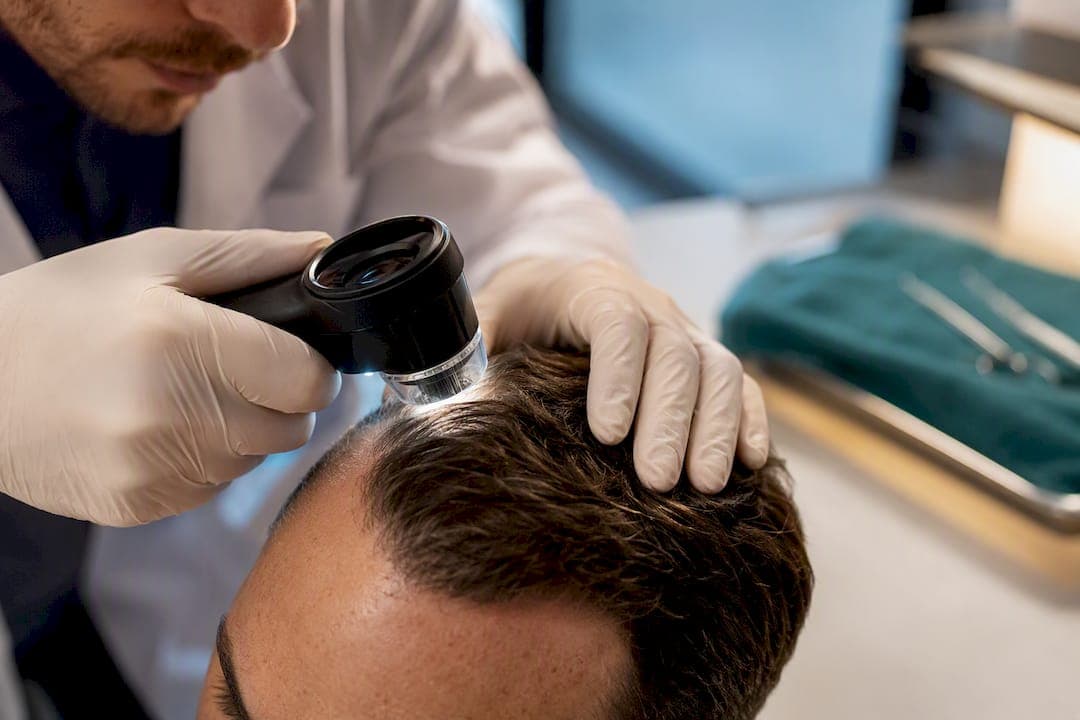
Testosterone replacement therapy does not create male-pattern baldness out of nowhere, but it can speed up hair loss in people whose genes already make them sensitive to DHT. DHT is the hormone doing the damage at the follicle level, and formulation and dose both influence how much of it your body produces. If you're starting or already on TRT, get baseline hormone labs and bring up hair loss risk with your prescriber before it becomes a visible problem.
TL;DR:
- Men with a family history of male-pattern baldness or early signs should measure baseline hair and hormone levels before starting TRT.
- Transdermal formulations and infrequent injections can cause higher local DHT spikes, possibly increasing hair-loss risk in predisposed individuals.
- Using DHT-blocking medications like finasteride or dutasteride alongside minoxidil can be more effective than either alone in slowing genetic hair loss.
- Monitoring progress through regular photo documentation and hormone testing helps identify early signs of miniaturization and adjust treatment proactively.
- Physician-supervised TRT with integrated hair loss risk assessment and management provides a safer, more effective approach than self-directed protocols.
Table of Contents
- How TRT Affects Hair: The Biology Behind TRT Hair Loss
- Who Is Most at Risk for Hair Loss on TRT?
- Does TRT Formulation or Dosing Change Your Hair-Loss Risk?
- What Prevention and Treatment Options Actually Work?
- How Should You Monitor Hair Health While on TRT?
- Is Hair Loss From TRT Reversible?
- How Physician-Supervised Care Coordinates TRT and Hair Preservation
- Why Most TRT Hair Loss Advice Misses the Point
- Get Physician-Supervised TRT That Watches Your Hair, Not Just Your T Levels
- Sources
How TRT Affects Hair: The Biology Behind TRT Hair Loss
The mechanism starts with an enzyme called 5-alpha reductase, which converts a portion of circulating testosterone into dihydrotestosterone, or DHT. DHT binds to androgen receptors far more aggressively than testosterone itself, and scalp follicles in the temples, frontal hairline, and crown carry a dense concentration of those receptors. That's not a coincidence. It's the same biological wiring behind male-pattern baldness in men who never touch a hormone prescription.
When DHT attaches to a genetically susceptible follicle, it shortens the growth phase of the hair cycle and shrinks the follicle itself over repeated cycles. This process, called miniaturization, turns thick terminal hairs into fine, short vellus hairs before the follicle eventually stops producing visible hair altogether. It's gradual, not sudden, which is part of why people often don't notice until the thinning is already well underway.
Raising testosterone through TRT gives 5-alpha reductase more raw material to convert. Some clinical reviews report DHT levels climbing to roughly 2 to 3 times baseline depending on dose and delivery method. That's a meaningful shift, but it doesn't mean everyone on TRT loses hair. A narrative review of testosterone use in men found the strongest links between hair changes and supraphysiologic or performance-level androgen doses, not carefully monitored therapeutic TRT. Correlation between higher DHT and hair thinning is well documented; a clean, universal cause-and-effect line is still harder to draw, especially at standard replacement doses.
There's a wrinkle worth knowing about too. In androgen-deficient women, testosterone therapy has in some cases improved scalp hair growth rather than triggering loss. Hormonal effects on hair are dose and context dependent, not a one-way street toward thinning for everyone.
Who Is Most at Risk for Hair Loss on TRT?
Genetics decide almost everything here. If male-pattern baldness runs in your family, especially on your mother's side, your follicles are likely carrying androgen receptors that are already primed to respond to extra DHT. TRT in that case acts less like a trigger and more like an accelerant on a fire that was already going to start eventually.
A quick self-check can tell you a lot before you ever order labs. Look for these early markers:
- Gradual widening or recession at the temples compared to old photos
- A frontal hairline that looks less dense or slightly higher than five years ago
- Visible scalp showing through at the crown under bright, direct light
- Hair that feels noticeably finer or softer than it did in your twenties
- A father, grandfather, or uncle with a receded or bald crown pattern
Take a well-lit photo of your hairline, temples, and crown before starting TRT, and repeat it every few months under the same lighting. This costs nothing and gives you an objective record instead of relying on memory, which tends to lie to people about their own hairlines.
If any of those markers are already present, get baseline testosterone and DHT testing before you start, and consider a dermatology consult early rather than waiting for visible change. Waiting rarely helps with androgenetic hair loss.
Does TRT Formulation or Dosing Change Your Hair-Loss Risk?
Yes, and this is one of the more actionable levers patients rarely ask about. Transdermal delivery, gels and patches applied to skin, can produce higher local and temporal DHT spikes than a well-managed injection schedule, partly because skin tissue itself has 5-alpha reductase activity that converts testosterone locally before it even reaches systemic circulation.
Intramuscular injections behave differently depending on the ester and frequency. A large dose injected every two or three weeks creates a pharmacokinetic curve with a sharp peak in the first few days followed by a slow decline. That peak is when DHT conversion runs hottest. Splitting the same weekly dose into two or three smaller injections flattens that curve considerably, which may reduce the size of DHT spikes compared with infrequent, larger doses.
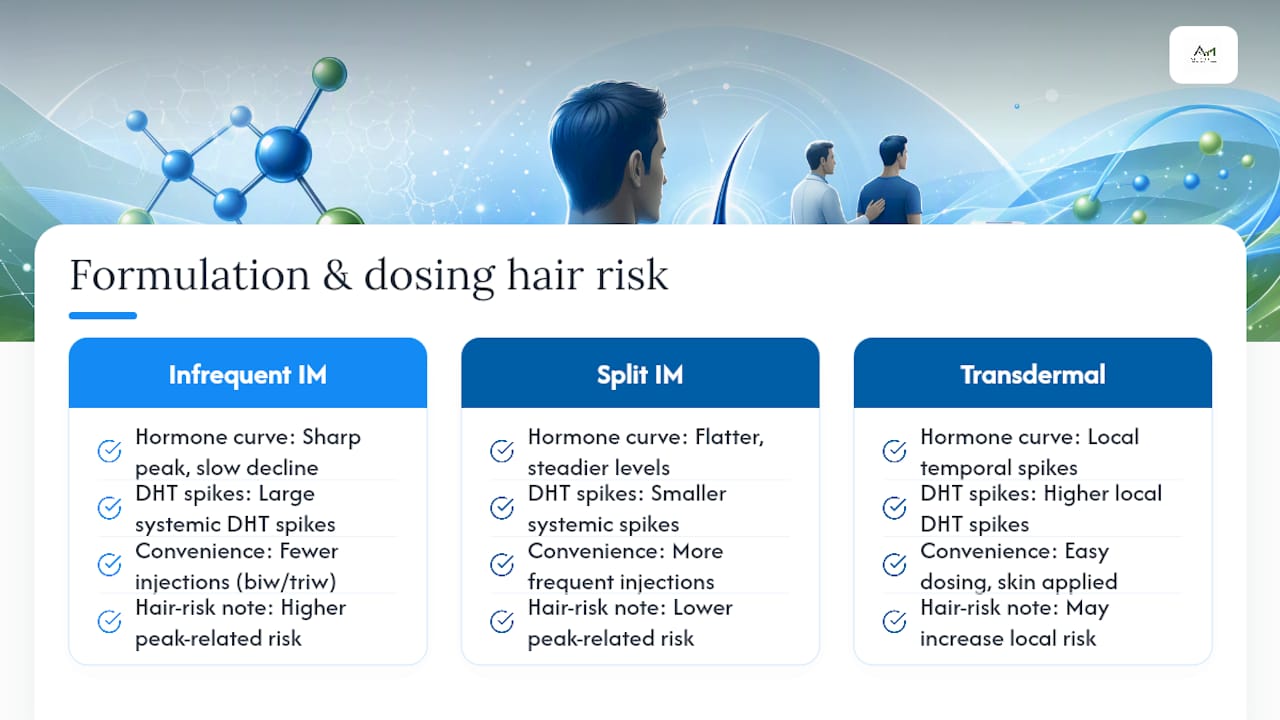
None of this means switching formulations automatically protects your hairline, and it's not a reason to skip a protocol that's controlling your symptoms well. The real trade-off is between smoother hormone levels and practical convenience. Weekly injections are easier to manage than three shots a week, and for many patients the difference in hair risk is small enough not to matter. But if you're already showing early signs of miniaturization, this is exactly the kind of detail worth raising with your prescriber rather than assuming your current protocol is fixed and unchangeable.
What Prevention and Treatment Options Actually Work?
You have more control over this than most people realize, and the options split cleanly into three categories: medical therapy, procedures, and supportive habits that make the medical stuff work better.
1. Topical or oral minoxidil. Minoxidil doesn't touch DHT directly. It widens blood vessels around the follicle and extends the growth phase of the hair cycle, which is why it works even on androgen-driven thinning. Topical minoxidil solution at typical concentrations is the standard over-the-counter option; oral low-dose minoxidil has gained traction as an alternative for people who find the topical foam impractical.
Low-dose oral minoxidil requires medical supervision: it can cause fluid retention, a faster heart rate, and lowered blood pressure, so clinicians typically monitor blood pressure and ask about heart conditions before prescribing. It is not recommended during pregnancy or breastfeeding. Discuss these risks with a physician before starting.
2. Finasteride or dutasteride. These are 5-alpha reductase inhibitors, meaning they block the exact enzyme responsible for converting testosterone into DHT. The American Academy of Dermatology lists both among the standard medical options for slowing androgenetic alopecia, and dutasteride blocks a broader range of 5-alpha reductase activity than finasteride. Side effects can include reduced libido or mood changes in a minority of patients, which is exactly why this decision belongs in a conversation with your prescriber, not a solo Google search.
Finasteride is FDA-indicated for men only. Women who are or may become pregnant must not handle crushed or broken finasteride tablets, due to the risk of harm to a male fetus. It can also cause sexual side effects (reduced libido, erectile dysfunction) in a minority of men, which usually resolve after stopping treatment. Discuss these risks with a physician before starting.
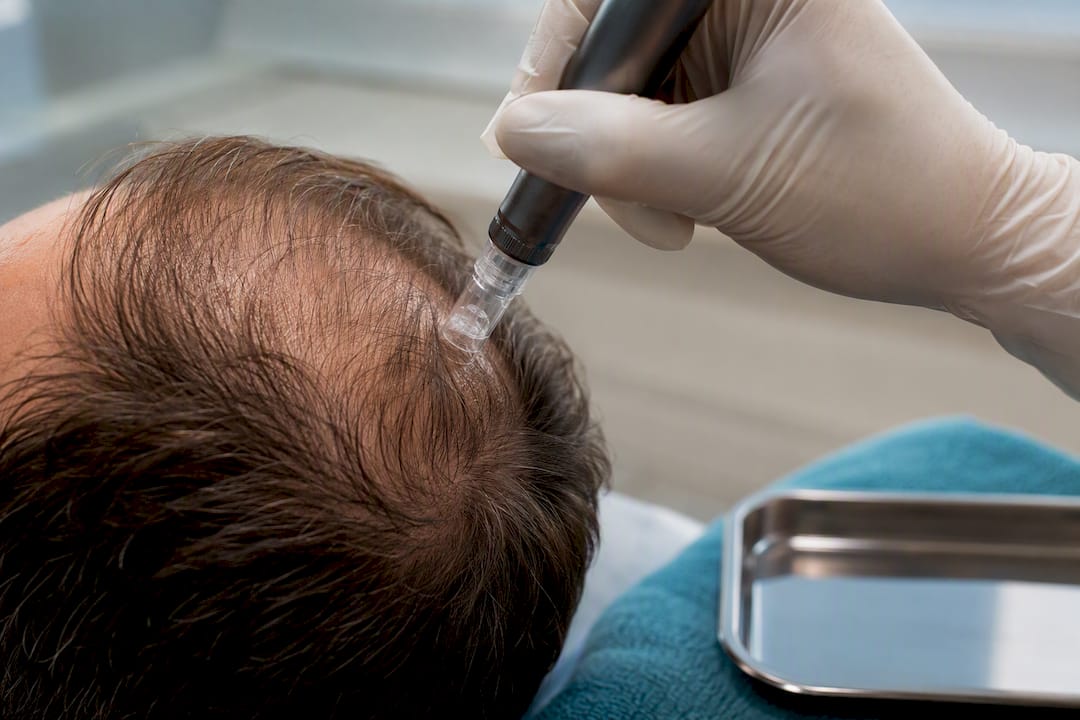
3. Procedural options. PRP injections use your own platelet-rich plasma to stimulate follicle activity, microneedling creates controlled micro-injury that triggers a healing and growth response, and red-light therapy is a lower-intensity adjunct with a growing but still modest evidence base. Hair transplants remain viable for patients on TRT, but outcomes depend heavily on stabilizing the surrounding native hair first, usually with a DHT-blocking medication, since transplanted grafts can still miniaturize if the underlying hormonal environment isn't addressed.
4. Combination therapy. Pairing finasteride with minoxidil tends to outperform either one alone, since they work through completely different mechanisms. But adding a DHT blocker to an existing TRT regimen isn't something to decide independently. Coordinating with the prescribing clinician matters because a 5-alpha reductase inhibitor changes your scalp's androgen exposure while potentially shifting other treatment goals you started TRT for in the first place.
5. Supportive habits. Adequate protein and iron intake, minimizing harsh chemical treatments or tight hairstyles that add mechanical stress, and managing chronic stress all support whatever medical therapy you're using. None of these will stop genetically driven hair loss on their own, but they remove variables that make things worse.
Pro Tip: Start a low dose of minoxidil at the same time you start TRT if you already have a family history of baldness. Prevention is far easier than trying to regrow hair that's already gone.
How Should You Monitor Hair Health While on TRT?
Monitoring only works if you have a baseline to measure against. Before starting or changing a TRT protocol, get:
- Total and free testosterone levels
- DHT levels, where your clinic offers this test
- Photographic scalp mapping of the hairline, temples, and crown under consistent lighting
From there, a reasonable check-in schedule looks like this: a follow-up two to three months after starting or adjusting your regimen, another check at six to twelve months, and annual monitoring after that once things look stable. That timeline lines up with how long it takes miniaturization to become visually detectable. Testing too early usually just shows normal hormonal fluctuation with no real signal yet.
If you notice rapid shedding, visible thinning between check-ins, or you're simply unsettled by what you're seeing, don't wait for the next scheduled appointment. A dermatology referral for targeted evaluation is the right move, and catching a shift early gives every treatment option, from minoxidil to finasteride, more room to work.
Is Hair Loss From TRT Reversible?
Timelines vary quite a bit from person to person. Some clinic-based observations report noticeable hair changes emerging within the first year for a minority of patients, while others go years without any visible shift at all.
The honest answer on reversibility depends on what stage the follicle is in. Follicles that are miniaturizing but still alive typically respond well to minoxidil and DHT blockers. Hair can thicken back up, though rarely to its original density. Follicles that have gone fully dormant for an extended period are much harder to bring back, and that's the scenario where a transplant becomes the more realistic option, usually after DHT blockers stabilize the surrounding hair first.
The pattern holds across nearly every case worth discussing: earlier intervention preserves more. Waiting to "see if it gets worse" is the single most common mistake, and it's the one that's easiest to avoid with a baseline test and a five-minute conversation with your clinician.
How Physician-Supervised Care Coordinates TRT and Hair Preservation
A coordinated approach follows a fairly simple sequence: baseline hair exam and hormone labs, a shared decision on TRT formulation and dosing, a preventive hair plan if risk markers show up early, and scheduled follow-up with specialist referral when needed.
That structure matters because FDA safety communications on testosterone products consistently point back to one thing: medical oversight and ongoing monitoring, not self-directed dosing.
A physician-supervised program typically includes:
- Doctor consultations to review symptoms, goals, and hair-loss risk factors before treatment starts
- Baseline and follow-up lab panels covering testosterone and related hormone markers
- A monitored membership structure so dosing adjustments happen with clinical input, not guesswork
Airmed Fit's model builds around this kind of physician-supervised TRT framework, with lab-based monitoring built into ongoing care rather than treated as a one-time step at intake.
Why Most TRT Hair Loss Advice Misses the Point
Most of what circulates online treats TRT and hair loss as a binary: either it's a myth, or it's an inevitable trade-off you have to accept. Neither framing holds up against the actual evidence. The honest picture is that DHT sensitivity, which is almost entirely genetic, decides the outcome far more than the testosterone dose itself does.
The advice that gets underrated is the boring stuff: baseline labs before you start, a photo taken under the same light every few months, and a conversation with your prescriber before switching formulations on your own. None of that is exciting, but it's the difference between catching miniaturization at month four instead of month eighteen.
What the reader should prioritize first isn't a supplement or a specific drug. It's establishing where you stand genetically and hormonally before treatment begins, then building a monitoring habit around that baseline. Everything else, minoxidil, finasteride, PRP, works better and faster when it starts early instead of playing catch up on hair that's already gone.
— Organic
Get Physician-Supervised TRT That Watches Your Hair, Not Just Your T Levels
Most TRT providers hand you a prescription and a refill schedule, then leave hair loss risk entirely off the table until you bring it up yourself, usually after it's already visible. Baseline testosterone and DHT testing can be part of the intake process to help flag hair-risk factors before the first dose.

That means your formulation, dosing frequency, and monitoring schedule get planned with your hairline in mind from the start, not bolted on as damage control later. If you're weighing TRT and want a clear picture of what the first few months look like, or you're already on therapy and want your hormone levels and hair risk reviewed properly, book a consultation with Airmedfit and get a monitoring plan built around your actual labs, not a generic protocol.
This article is general information, not a substitute for advice from a qualified doctor. Consult a qualified healthcare professional about your own circumstances before acting on anything here.
Sources
The Baylor College of Medicine explainer offers a clinician's grounded read on DHT and TRT. The narrative review on androgen use and hair loss digs into the peer-reviewed evidence base and its limits. The American Academy of Dermatology's patient guidance rounds it out with standard-of-care treatment information written for patients, not researchers.
- Does testosterone replacement therapy cause hair loss? - Baylor College of Medicine Blog Network
- Hair loss in athletic testosterone use in males: a narrative review
- American Academy of Dermatology — hair loss