

A GLP-1 plateau means several weeks with no scale movement despite steady medication use, and it's usually a maintenance phase rather than treatment failure. Start by confirming you're on a stable maintenance dose, log your food and protein intake for two weeks, and add resistance training twice a week. If you notice rapid regain, severe GI symptoms, or other new health changes, call your clinician rather than waiting it out.
TL;DR:
- Body weight stabilization after significant loss is typical and usually reflects the body's natural resistance, such as reduced energy expenditure and appetite feedback.
- Common avoidable causes of stalled progress include missed doses, calorie or portion creep, low protein intake, decreased activity, and underlying health issues like hypothyroidism or sleep apnea.
- Addressing a plateau effectively requires an honest behavioral audit, emphasizing protein intake, resistance training, and activity adjustments before increasing medication doses.
- A physician-supervised program provides lab monitoring, medication management, and personalized guidance, helping distinguish true medication failure from behavioral or medical factors.
Table of Contents
- What a GLP-1 Plateau Looks Like and When It Typically Happens
- Why Your Body Fights Back Against Continued Loss
- Common, Fixable Reasons Your Progress Stalled
- How to Break Through or Manage the Plateau
- Making Protein and Strength Training Work With a Suppressed Appetite
- When a Plateau Needs a Clinician's Eye
- How a Physician-Supervised Program Approaches a Stall
- A Clinician's View on What a Plateau Really Means
- Get Clinician-Guided Support for Your Weight Loss Plateau
- Where the Research on GLP-1 Plateaus Comes From
- Sources
What a GLP-1 Plateau Looks Like and When It Typically Happens
Most people define a plateau as three or more weeks without a change in body weight while still taking their medication as prescribed. That's the working clinical threshold, and it matters because normal week-to-week fluctuation from water retention or sodium intake gets mistaken for a stall constantly.
Trial data gives a clearer picture of timing than guesswork does. Deceleration in weight loss commonly starts somewhere between months four and twelve of treatment, and many semaglutide and tirzepatide trials show the loss curve flattening between months twelve and twenty-four. Semaglutide in the STEP-1 trial averaged around 15% total body weight loss, with the curve leveling off by roughly week 60 to 68.
Three distinct situations get lumped together under "plateau," and separating them changes what you do next:
- True plateau: weight has stabilized after meaningful loss, and the medication is still working as intended.
- Non-response: minimal loss from the start, often under 5%, suggesting the drug or dose isn't producing the expected effect for that person.
- Pharmacologic tolerance: a rarer pattern where appetite suppression fades over time even at a stable dose.
Why Your Body Fights Back Against Continued Loss
Weight loss slows because your body actively resists it, not because the drug stops working overnight. Resting energy expenditure drops as you lose weight. A lighter body simply burns fewer calories at rest, so the same intake that once produced a deficit now barely holds you steady.
GLP-1 medications work partly by dulling appetite feedback signals that normally drive hunger after weight loss. That's a real mechanism, but it's not absolute. Modeling research on semaglutide and tirzepatide shows these drugs delay the biological pushback that would otherwise stall progress with diet alone, predicting plateaus often around the two-year mark in simulations, though the exact timing varies a lot person to person.
Statistic Callout: Around 10 to 15% of trial participants lose less than the clinically meaningful 5% threshold, according to clinical guidance on GLP-1 non-response. Most plateaus fall outside that group and reflect the drug doing its job at a new equilibrium, not failing.
Semaglutide and tirzepatide don't plateau identically. A network meta-analysis of GLP-1 receptor agonists found tirzepatide, which also activates the GIP receptor, tends to produce greater average weight loss at comparable doses, and its plateau point often sits later or higher on the curve than semaglutide's. Higher doses of either drug generally push the plateau further out, but they also raise the odds of GI side effects.
Two physical mechanisms explain a lot of this:
- Slowed gastric emptying keeps food in the stomach longer, extending fullness after meals.
- Central satiety signaling in the brain reduces the drive to eat again soon after finishing a meal.
Both effects are real and measurable, but neither is permanent proof against a body that's adapting to lower energy needs.
Common, Fixable Reasons Your Progress Stalled
Before assuming the medication has stopped working, run through the list of everyday culprits that quietly derail progress. Most plateaus trace back to one or two of these.
- Dose and adherence gaps. A missed weekly injection, a slower-than-planned titration schedule, or an insurance disruption that delayed a refill can all flatten your curve without you noticing the connection.
- Calorie drift. Grazing throughout the day, choosing more energy-dense foods, or letting portions creep upward adds up fast, even when appetite feels suppressed.
- Low protein intake. Appetite suppression makes it genuinely harder to hit protein targets, and inadequate protein accelerates lean muscle loss, which lowers your metabolic rate further.
- Shrinking activity levels. Skipping resistance training or losing incidental movement, like walking less because you feel full and low-energy, cuts into your total daily burn.
- Undiagnosed medical interference. Hypothyroidism, untreated sleep apnea, corticosteroid use, and certain antidepressants can all work against weight loss regardless of what your GLP-1 dose is doing.
Pro Tip: Keep a simple two-week log of what you eat, when you inject, and how many steps you take. Patterns that feel invisible day to day usually jump out once you see two weeks side by side.
How to Break Through or Manage the Plateau
Fixing a stall starts with an honest audit, not a bigger dose. Track your food intake and activity for two weeks before changing anything. Most people find the obvious drift the moment they write it down: an extra snack here, a skipped gym session there, portions that grew without anyone deciding they should.
Nutrition adjustments come next, and protein is the lever that matters most. Clinical guidance on GLP-1 therapy recommends pushing protein intake toward 1.0 to 1.6 grams per kilogram of body weight daily where it's practical to do so. When appetite is too suppressed to eat full meals, protein shakes, Greek yogurt, and protein-first plating, where you eat the protein source before touching carbs or vegetables, help close the gap without forcing volume you can't tolerate.
Resistance training deserves equal weight. Adding structured strength work two to three times weekly protects the muscle mass that's otherwise the first thing lost alongside fat during rapid weight loss. Simple progression rules work: add reps before adding weight, and add weight before adding sets.
- Increase daily steps gradually rather than jumping straight to intense cardio.
- Layer in structured cardio sessions without cutting into strength training days.
- Protect sleep and manage stress, since both directly affect appetite hormones and recovery.
- Keep meals on a consistent schedule rather than skipping and overcompensating later.
Statistic Callout: Discontinuation trials on GLP-1 agents consistently show weight regain after stopping the medication, reinforcing that maintenance almost always requires continued treatment rather than a temporary course.
Medication changes belong last on this list, not first. Confirm you're at an evidence-based maintenance dose before considering a switch or dose increase, and only discuss escalation with your clinician after the behavioral audit is done. Jumping straight to a higher dose without addressing protein intake or training frequency often just adds side effects without solving the actual problem.
| Action | When to Do It | What It Targets |
|---|---|---|
| Two-week food and activity log | First step, before any other change | Identifies calorie drift and adherence gaps |
| Raise protein toward 1.0 to 1.6 g/kg | Alongside the audit | Preserves lean mass, supports satiety |
| Resistance training two to three times weekly | Ongoing, ideally within week one | Protects metabolic rate |
| Clinician review of dose and labs | If plateau persists past 4 weeks | Rules out medical and pharmacologic causes |
Making Protein and Strength Training Work With a Suppressed Appetite
Hitting protein targets while your appetite is muted takes a different strategy than it did before medication. Aim for 20 to 30 grams of protein at each meal, front loaded so it's the first thing you eat rather than an afterthought. Fortified snacks like protein bars, cottage cheese, or a scoop of whey in coffee can fill gaps on days when a full meal feels like too much.
A workable weekly strength plan doesn't need to be complicated:
- Day one: squats, seated rows, and an overhead press, three sets of eight to twelve reps each.
- Day two: deadlifts or hip hinges, chest press, and core work.
- Day three (optional): a repeat of day one or two with slightly higher weight or an added set.
Cardio still has a place, but it shouldn't crowd out strength work. Walking or light cycling on non-lifting days supports recovery and adds to your daily energy burn without interfering with muscle repair.
GI side effects, nausea, early fullness, and occasional constipation, can make hitting both food and water targets harder. Sip fluids steadily throughout the day rather than trying to drink large amounts at once, and if a specific food consistently triggers discomfort, swap it rather than forcing it.
Pro Tip: If solid food feels impossible some days, a protein shake plus a piece of fruit still counts as real progress. Consistency over weeks matters far more than any single meal.

When a Plateau Needs a Clinician's Eye
Certain signs move a plateau from "manage it yourself" to "call your doctor" territory. Rapid, unexplained weight regain, severe or persistent GI symptoms, signs of hypoglycemia, or any new symptom that feels out of the ordinary all warrant a review rather than a wait-and-see approach.
A thorough clinic visit for a stalled GLP-1 response typically checks:
- Adherence and dosing history, including any missed or delayed injections.
- Basic labs such as TSH, A1c, and a metabolic panel to rule out thyroid or blood sugar issues.
- Sleep quality, since undiagnosed sleep apnea commonly undermines weight loss efforts.
- Interactions with other medications, including steroids or certain psychiatric drugs.
Depending on what turns up, clinicians may treat a reversible cause, adjust the medication strategy, or refer you to obesity medicine or bariatric evaluation for a more intensive path forward.
How a Physician-Supervised Program Approaches a Stall
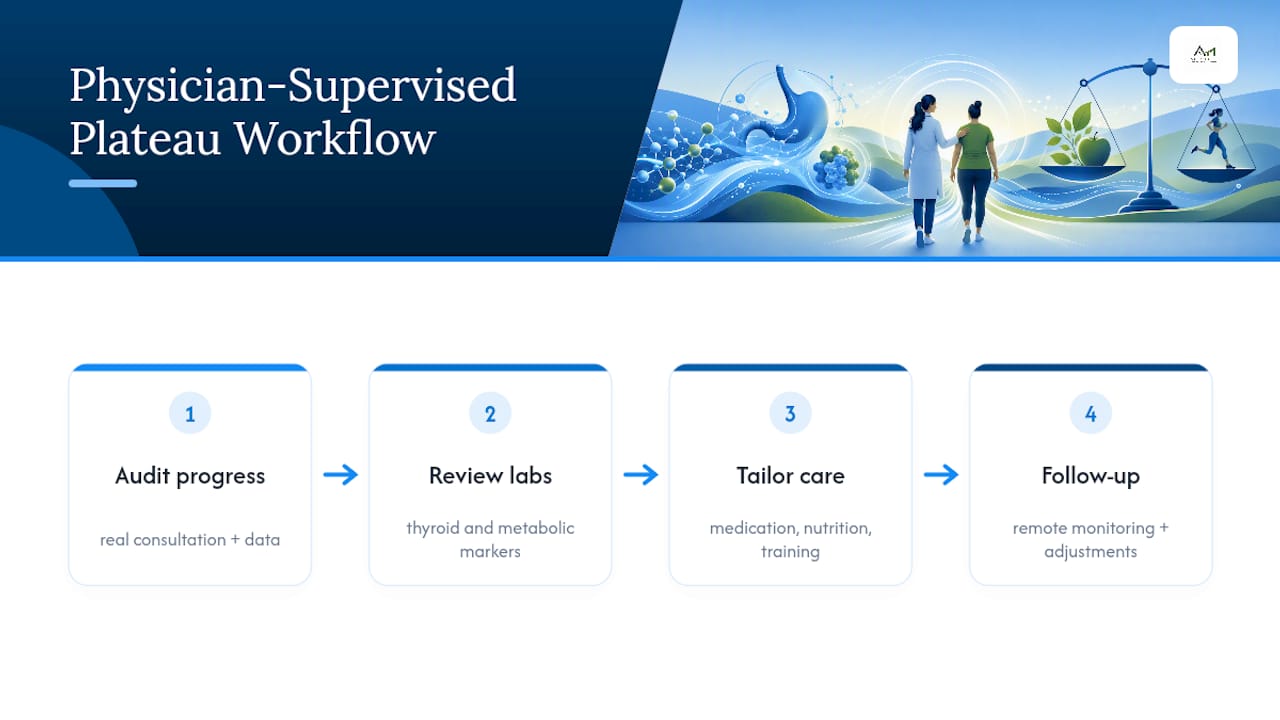
A structured, physician-supervised program treats a plateau as a data problem before it treats it as a dosing problem. That means a real consultation, lab monitoring to check thyroid function and metabolic markers, and access to FDA-regulated GLP-1 medications sourced from licensed US manufacturers rather than guessing at what's causing the stall.
Programs build around that same audit-first logic: medication management paired with nutrition guidance and training recommendations tailored to where you actually are in treatment, not a generic protocol. Ongoing follow-up and remote monitoring mean dose adjustments and lifestyle corrections happen based on your labs and progress, not on a fixed calendar.
A Clinician's View on What a Plateau Really Means
A plateau that holds steady after real loss is often the medication doing exactly what it's supposed to do. Preserving a 15% weight loss for a year is a legitimate clinical win, not a stall to panic over. The long-term picture for most people combines continued medication with muscle-preserving habits, not an exit strategy.
Stopping the drug to "see what happens" usually means regain, and that trade-off deserves an honest conversation with your prescriber before you make that call.
— Organic
Get Clinician-Guided Support for Your Weight Loss Plateau
Working through a plateau alone means guessing at labs you can't order and dose questions you can't safely answer on your own. Airmedfit gives you physician consultations, lab monitoring, and access to FDA-regulated GLP-1 medications sourced from licensed US manufacturers, all managed through ongoing telemedicine follow-up instead of a one-time prescription and silence.

An initial consult typically covers your current dose, recent labs if you have them, and the behavioral factors covered above, so you walk away with a specific plan rather than a generic tip sheet. That's the right fit whether you're troubleshooting a stall for the first time or you've been stuck for months and want a second set of eyes on your protocol. Schedule a consultation to review your current plan and figure out what's actually driving your plateau.
Where the Research on GLP-1 Plateaus Comes From
The clinical patterns and timelines referenced throughout this piece draw on a mix of trial data, modeling research, and physician-facing guidance:
- Weight Reduction with GLP-1 Agonists and Paths for Discontinuation While Maintaining Weight Loss, covering trial trajectories and regain after stopping treatment.
- Modeling weight-loss trajectories for semaglutide, tirzepatide, RYGB, and calorie restriction, on appetite-feedback mechanisms and plateau timing.
- Not Losing Weight on a GLP-1? Here's What Could Be Happening, on clinical thresholds and non-response.
- I Am Taking a GLP-1 Weight-Loss Medication, What Should I Know? in JAMA Internal Medicine, on protein and resistance training guidance.
- Glucagon-like peptide-1 (GLP-1) receptor agonists review in the New England Journal of Medicine, on mechanisms and safety.
This article is general information, not a substitute for advice from a qualified doctor. Consult a qualified healthcare professional about your own circumstances before acting on anything here.
Sources
- Not Losing Weight on a GLP‑1? Here’s What Could Be Happening
- Weight Reduction with GLP-1 Agonists and Paths for Discontinuation While Maintaining Weight Loss
- I Am Taking a GLP-1 Weight-Loss Medication—What Should I Know? | JAMA Internal Medicine