

Elevated hematocrit on TRT is common, dose-related, and almost always manageable without stopping treatment. If a recent panel came back high, the immediate move is simple: confirm the number with a repeat CBC and ferritin, skip any blood donation right before labs, and call your prescriber before making changes on your own. Most protocols intervene around a hematocrit of 54%, not at the first sign of a slight increase.
TL;DR:
- Most men on TRT will experience a hematocrit rise around 54 percent, with higher baseline risks for smokers, older men, or those with sleep apnea or cardiovascular issues.
- Regular monitoring should occur at six weeks, three months, and six months after starting TRT, with more frequent checks for those trending upward.
- Blood donation or phlebotomy can lower hematocrit temporarily, but must be carefully managed to avoid iron depletion and anemia.
- Protocol adjustments, such as lowering dose or switching delivery routes, address the cause and are preferable long-term to repeated blood removal.
- Individualized care, including physician supervision and risk assessment, is crucial to prevent complications linked to elevated hematocrit during TRT.
Table of Contents
- Why TRT Raises Hematocrit: Physiology and Risk Factors
- How to Know If Your Hematocrit Is High: Labs and Symptoms That Matter
- Management Options: Donation, Phlebotomy, Protocol Changes, and Lifestyle
- Monitoring Schedule and Action Thresholds Clinicians Use
- Iron, Ferritin, and the Donation Paradox
- Evidence, Controversies, and What the Literature Actually Shows
- When to Pause or Stop TRT and How to Restart Safely
- Hydration, Exercise, and Alcohol: The Overlooked Levers
- How Physician-Supervised Care Actually Handles This
- Get Physician-Supervised TRT and Hematocrit Monitoring
- Sources
Why TRT Raises Hematocrit: Physiology and Risk Factors
Testosterone pushes your bone marrow to make more red blood cells. It does this partly by stimulating erythropoietin (EPO), the hormone that signals marrow to ramp up red cell production, and partly by suppressing hepcidin, the protein that normally limits how much iron gets released for that production. Less hepcidin means more iron available, more iron means more red cells, and more red cells mean a higher hematocrit.
Delivery method changes how hard that mechanism gets pushed. Short-acting intramuscular injections spike testosterone to a peak within days, and those peaks drive a sharper erythropoietic response than steadier delivery methods do. Randomized comparisons of dosing schedules found that weekly injections raised hematocrit less than biweekly injections carrying the same total dose. Route matters as much as dose.
Certain patient factors amplify the effect. Smoking, obstructive sleep apnea, obesity, older age, and existing cardiovascular disease all push hematocrit higher independent of testosterone, so a man with any of these carries a lower margin before hitting an action threshold. This isn't rare. A cohort study of 108 men on TRT found 58% reached a hematocrit of 50% or higher at some point during follow-up, and 35% crossed 53%.
How to Know If Your Hematocrit Is High: Labs and Symptoms That Matter
Symptoms alone won't tell you what's happening inside your blood vessels. Headaches, flushed skin, or a feeling of pressure behind the eyes can accompany high hematocrit, but plenty of men with elevated numbers feel completely normal, and plenty of men with those symptoms have unrelated causes. Labs settle the question.
A useful TRT panel includes:
- CBC — the direct measure of hematocrit and hemoglobin
- Ferritin, serum iron, and transferrin saturation — to catch iron issues before or after any blood removal
- Total testosterone and estradiol — to confirm your dose is producing the intended levels
- A metabolic panel — for kidney and liver context, since both affect how you tolerate protocol changes
On timing, get a baseline panel before starting therapy. If you're on injectables, recheck at six weeks, since that's often when the erythropoietic response first shows up clearly. Follow with checks at three months and six months. After that, annual or semiannual testing is typical for men whose numbers have stayed stable, though anyone trending upward should test more often, not less.
Management Options: Donation, Phlebotomy, Protocol Changes, and Lifestyle
Once hematocrit crosses into action territory, you have four real levers, and they're not interchangeable. Each works on a different timeline and carries its own trade-off.
- Whole-blood donation. Removes roughly 450 to 500 milliliters of blood and can drop hematocrit by about three percentage points, but it's capped at once every 56 days in the U.S. The effect is real but temporary, and repeated donation strips iron along with red cells.
- Therapeutic phlebotomy. A physician-ordered blood draw, often at a clinic or blood center that accommodates men on prescribed TRT. Because it isn't bound by standard donor-eligibility rules, it can be scheduled more flexibly than a donation appointment and is generally the faster route when hematocrit needs correcting sooner rather than later.
- Protocol changes. Reducing total dose, switching to more frequent smaller injections, or moving to a subcutaneous or transdermal route lowers the peak testosterone levels that drive erythropoiesis in the first place. This tends to lower the long-term set point rather than just treating a single high reading.
- Lifestyle and comorbidity management. Quitting smoking, getting screened and treated for obstructive sleep apnea, and losing excess weight all reduce baseline hematocrit pressure independent of anything you do with your TRT dose.
Pro Tip: Don't treat phlebotomy as a free reset button. Pulling blood repeatedly without tracking ferritin can leave you technically anemic in iron while your hematocrit looks fine on paper, which creates a different set of symptoms that get mistaken for low testosterone.
Protocol changes address the cause; donation and phlebotomy address the symptom. Most men do best combining a dose or route adjustment with periodic monitoring, reserving phlebotomy for numbers that need correcting faster than a protocol change can achieve.
Monitoring Schedule and Action Thresholds Clinicians Use
Every reasonable TRT protocol starts with a baseline panel, before the first dose. That means CBC, ferritin, total testosterone, and a metabolic panel, all drawn before anyone's blood chemistry has moved.
From there, the schedule depends on delivery method. Injectables warrant an early check around six weeks, since that's when the peak-driven rise tends to show. Transdermal and other steady-state routes can usually wait until three months post-initiation or after any dose change. Everyone gets a check at six months, then at twelve, then every six to twelve months if the numbers hold steady. Anyone trending upward gets tested more frequently, not on the standard clock.
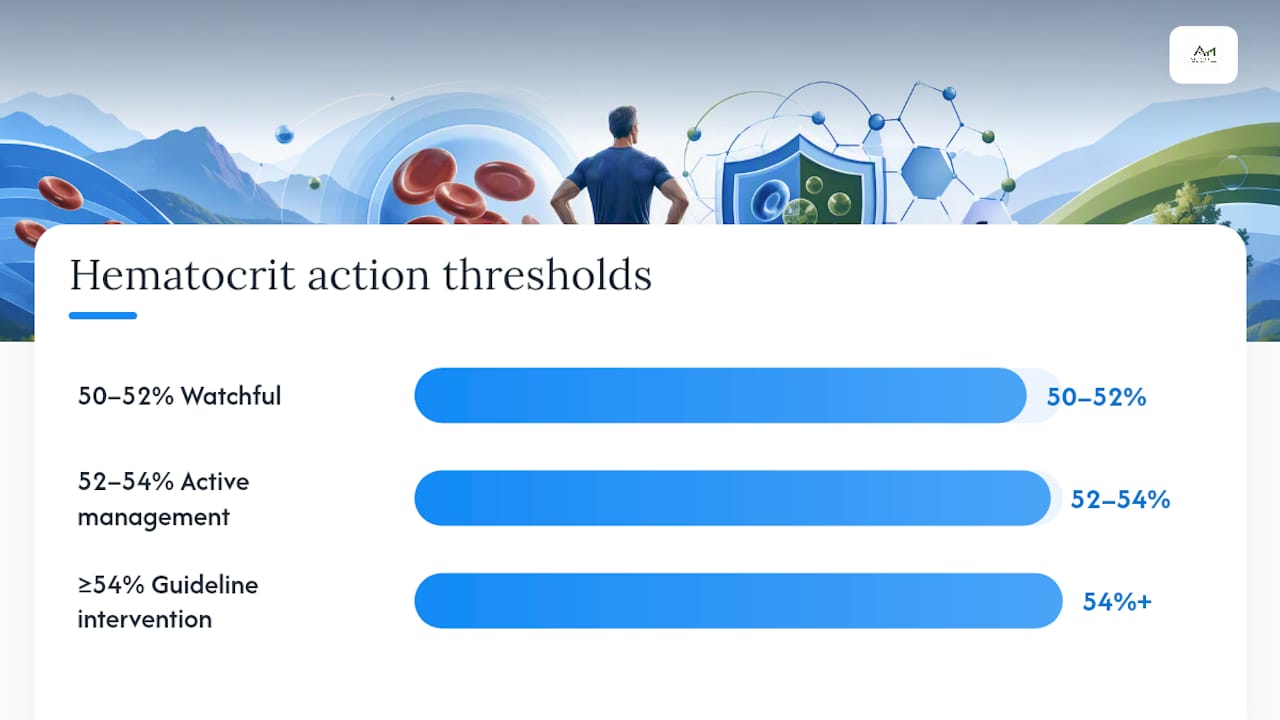
The numbers themselves guide the response. Hematocrit between 50 and 52% typically means watchful monitoring, nothing more. Between 52 and 54%, most clinicians start actively managing, whether through protocol adjustment or scheduling a phlebotomy session. At 54% and above, many published guidelines call for intervention.
Iron, Ferritin, and the Donation Paradox
Removing blood removes iron, and that's easy to forget when you're focused on the hematocrit number alone. TRT already suppresses hepcidin and increases how efficiently your body uses circulating iron, so layering repeated blood draws on top of that suppression can push a man toward the opposite problem: normal or even low hematocrit paired with genuinely depleted iron stores.
A single donation removes roughly 200 to 250 milligrams of iron, an amount that takes weeks to months to rebuild through diet alone. Do that every 56 days for a year and the deficit compounds fast.
A few practical rules keep this from becoming its own problem:
- Check ferritin before committing to a repeated donation or phlebotomy schedule, not after symptoms show up.
- Never donate blood immediately before a scheduled lab draw. It will artificially lower your hematocrit reading and mask what's actually happening.
- Only start iron repletion when ferritin is documented low. Supplementing preemptively can undo the benefit of the blood removal in the first place.
Evidence, Controversies, and What the Literature Actually Shows
The data on how often TRT raises hematocrit is fairly consistent. The controversy is over what to do about it, and how confident anyone should be that the standard fix actually prevents the outcome everyone's worried about.
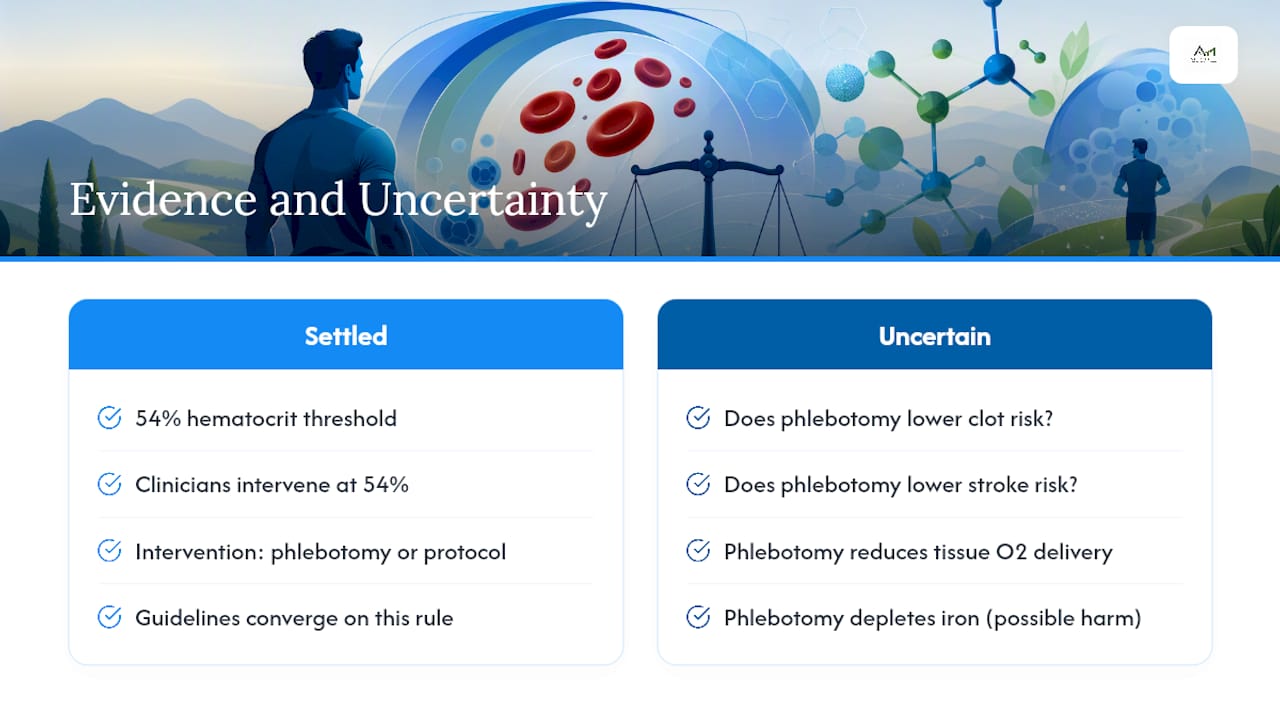
Guideline summaries converge on similar numbers. Multiple reviews cite a hematocrit threshold around 54% as the point where most clinicians intervene, whether through phlebotomy or protocol adjustment. That much is settled practice.
What's less settled: whether periodic phlebotomy actually lowers the rate of blood clots or strokes in men with TRT-induced erythrocytosis. A review examining this question directly points out that repeated phlebotomy reduces tissue oxygen delivery and depletes iron, which could theoretically shift thrombotic risk in either direction rather than simply improving it. Meanwhile, some retrospective analyses have found higher rates of major cardiovascular events among men whose hematocrit rose on TRT compared to those whose numbers stayed flat, which is exactly why the threshold exists in the first place.
Elevated hematocrit is treated aggressively not because every case leads to a clot, but because the downside of missing a genuinely dangerous case is severe enough that erring toward caution costs little. The honest gap in the evidence is whether the standard fix, phlebotomy, changes that risk at all, or just changes the number on the page.
That gap is exactly why individualized care matters more here than in most areas of TRT management.
— Organic
When to Pause or Stop TRT and How to Restart Safely
Full discontinuation is a last resort, reserved for specific triggers: symptomatic hyperviscosity, an actual thrombotic event like a DVT or stroke, or a hematocrit that stays above urgent thresholds despite dose changes and phlebotomy. Most elevated readings never reach this point.
Off testosterone, hematocrit typically normalizes over several weeks to a few months, since the erythropoietic stimulus disappears and red cell turnover brings the count back down on its own. Restarting after a pause usually means a lower dose or a different delivery route than what caused the problem the first time, with closer monitoring built into the first few months back.
Whatever the decision, document the reasoning. A clear record of why treatment paused and what changed before restarting protects continuity of care if you switch clinicians or need the history for future decisions.
Hydration, Exercise, and Alcohol: The Overlooked Levers
Smoking cessation and sleep apnea treatment get most of the attention in hematocrit management, but a few other habits move the number too, just less dramatically.
Chronic mild dehydration concentrates your blood, which can make a hematocrit reading look higher than your actual red cell mass would suggest. This matters practically: showing up to a lab draw dehydrated after a hard workout or a night of drinking can inflate the number enough to trigger a conversation that a same-day rehydration wouldn't have needed. It's worth drinking normally in the days before a scheduled panel rather than fasting or over-exercising right beforehand.
Alcohol has a more direct effect. Heavy or frequent drinking is linked to both dehydration and changes in red cell production, compounding whatever TRT is already doing to your hematocrit. Cutting back doesn't reverse erythrocytosis on its own, but it removes one more variable pushing in the wrong direction.
Exercise is genuinely mixed. Moderate aerobic activity supports cardiovascular health and can improve how well your body tolerates a given hematocrit level, but intense endurance training at altitude or extreme volume can itself raise red cell mass. For most men on TRT, regular moderate exercise helps overall risk management even if it doesn't move the hematocrit number directly. None of these lifestyle factors replace lab monitoring. They just make the number you get more accurate and slightly easier to keep in range.
How Physician-Supervised Care Actually Handles This
Airmedfit builds hematocrit monitoring into the TRT protocol from day one rather than treating it as an afterthought. That means a baseline panel before the first dose, an early recheck timed to your specific delivery method, and a physician reviewing trends, not just single numbers.
When hematocrit climbs, the response isn't automatic. A prescriber weighs your dose, route, ferritin status, and personal risk factors before deciding between a protocol adjustment and coordinating a phlebotomy pathway. That individualized judgment is the difference between reactive lab-chasing and actual management.
If you're managing this on your own right now, without anyone reviewing your trend line, that's worth changing.
Get Physician-Supervised TRT and Hematocrit Monitoring
Managing high hematocrit alone means guessing at thresholds and hoping your labs land on the right side of them. Airmedfit builds hematocrit tracking directly into its physician-supervised TRT program, so every dose decision accounts for where your numbers are heading, not just where they sit today.

The program includes telemedicine consults with prescribers who review your full panel, not just testosterone, lab ordering that covers CBC, ferritin, and iron studies alongside hormone levels, and individualized dosing built around your specific risk profile. If therapeutic phlebotomy becomes necessary, your prescriber coordinates that pathway directly instead of leaving you to figure out donation eligibility on your own. Men who've gone through starting TRT with a monitored protocol tend to catch hematocrit trends early, before they become urgent problems.
If your last hematocrit reading left you unsure what to do next, book a consult and get a prescriber looking at your actual numbers.
Sources
For the primary data behind this article's thresholds and frequency claims, the cohort study on erythrocytosis frequency during TRT lays out how often hematocrit crosses common action points. The narrative review on hematocrit management covers guideline positions in more depth, and the phlebotomy justification review is the clearest look at where the evidence on treatment actually stands.
This article is general information, not a substitute for advice from a qualified doctor. Consult a qualified healthcare professional about your own circumstances before acting on anything here.
- ODP412 High Frequency of Erythrocytosis in Hypogonadal Men on Testosterone Replacement Therapy
- Management of hematocrit levels for testosterone replacement patients, a narrative review
- Blood Donation on TRT: Frequency, Rules & Iron (2026) | TRT Catalog
- Comparison of hematocrit change by testosterone formulation — randomized evidence and trials (selected trial references)