
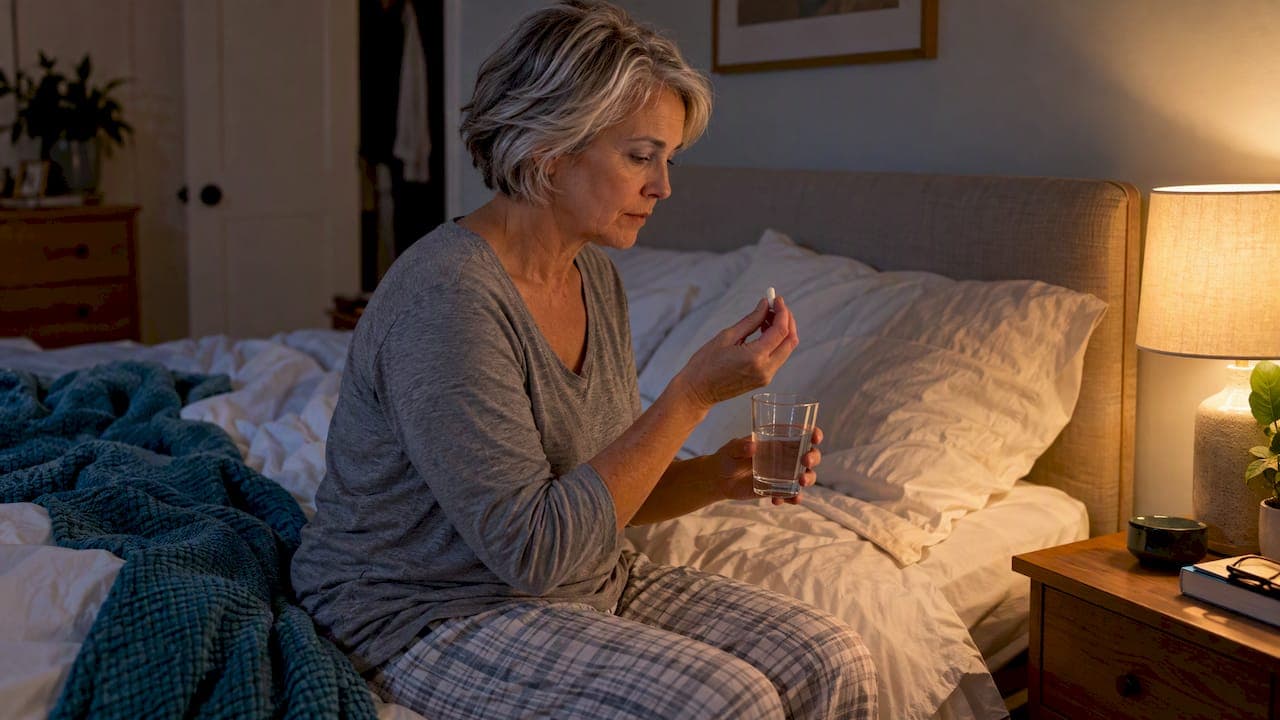
Progesterone may help some women sleep better, mostly women past menopause, but the evidence is narrower than many blog posts suggest. A systematic review and meta-analysis of randomized trials found that micronized progesterone improved several sleep outcomes, with most of the studies enrolling postmenopausal women. That is not the same as proof that it treats insomnia in every woman, and it is not a reason to start a hormone on your own.
This guide explains how progesterone is thought to affect sleep, what the trials found, which products are actually FDA-approved, what the side effects are, and how to prepare for a conversation with a clinician.
TL;DR
- Micronized progesterone, taken at bedtime, improved some sleep measures in randomized trials, mainly in postmenopausal women. Results on total sleep time are less consistent.
- The FDA-approved uses of oral progesterone capsules are protecting the uterine lining in women taking estrogen and treating secondary amenorrhea. Sleep is not a labeled use.
- Drowsiness and dizziness are labeled effects, and the capsules contain peanut oil. Certain histories (breast cancer, blood clots, liver disease) are contraindications.
- Creams, compounded products and over-the-counter "progesterone support" supplements are not the same thing as the tested capsule.
- Whether progesterone fits you is a decision for a qualified clinician who knows your uterus status, history and medications.
Table of Contents
- Why progesterone is linked to sleep at all
- What the clinical trials found
- What is FDA-approved, and what is not
- Does progesterone help in perimenopause?
- Progesterone and estrogen: do you need both?
- Side effects and who should not take it
- Is progesterone cream a shortcut?
- Questions to bring to a clinician
- Our perspective
- Talking to a clinician through AirMedFit
- FAQ
- Sources
Why progesterone is linked to sleep at all
Progesterone is not only a reproductive hormone. When oral micronized progesterone passes through the liver, it is converted into byproducts such as allopregnanolone. According to a drug reference summary, these byproducts reach the brain and interact with GABA receptors, the same calming system targeted by many sleep and anti-anxiety drugs. The meta-analysis authors describe the same mechanism: progesterone metabolites act as positive modulators of the GABA-A receptor, based on preclinical data.
That last point matters. The mechanism comes from lab and animal work. It makes the idea plausible. It does not by itself show that a given dose helps a given person sleep.
The oral route is also part of the story. Taken by mouth, progesterone is heavily metabolized, so the sedating byproducts are produced in meaningful amounts. Creams and other routes skip much of that first pass, which is one reason they cannot be assumed to behave like the capsule.
What the clinical trials found
The 2021 meta-analysis
The most useful single source is the 2021 systematic review and meta-analysis in the Journal of Clinical Endocrinology & Metabolism. Its conclusion, in plain terms: micronized progesterone improved various sleep outcomes in randomized controlled trials, and those trials predominantly enrolled postmenopausal women.
Two cautions follow from that sentence:
- "Various outcomes" is not "every outcome." Reviewers have noted that results on sleep onset are more consistent than results on total sleep time, which is a different measure from how long it takes to fall asleep.
- "Predominantly postmenopausal" means the evidence is thin for premenopausal women, for perimenopausal women with still-irregular cycles, and for men.
The 2011 bedtime-dosing trial
A frequently cited randomized, double-blind trial published in 2011 gave postmenopausal women 300 mg of progesterone at 11:00 PM. Compared with placebo, wake time after sleep onset fell by 53%, and slow-wave (deep) sleep increased by nearly 50%.
Those are real, striking numbers, and they are why the topic gets attention. Read them with care, though:
- It was a controlled research setting, not a prescription recommendation. A trial dose is not a dose for you.
- The participants were postmenopausal women, so the finding does not transfer automatically to a 44-year-old in perimenopause.
- One trial is one trial. The wider literature is more mixed, which is why the meta-analysis matters more than any single result.
What the evidence does not show
No source we reviewed shows that progesterone cures chronic insomnia, replaces behavioral treatment, or works for everyone. A physician writing about the topic has noted that the 2025-era insomnia medication guideline from the American Academy of Sleep Medicine does not list progesterone among its medication options. Progesterone is best understood as a hormone with a possible sleep benefit, not as a sleep drug.
What is FDA-approved, and what is not
This is where many popular articles blur important lines. Here are the categories, kept separate.
| Category | What it means | Sleep claim |
|---|---|---|
| FDA-approved oral micronized progesterone capsules | Approved for specific uses after FDA review | Not a labeled use |
| Compounded progesterone (capsules, creams, troches) | Made by a pharmacy for an individual prescription; not FDA-approved as a finished product | None approved |
| Over-the-counter creams and "progesterone support" supplements | Sold without a prescription, often as cosmetics or supplements | None approved |
| Synthetic progestins | Chemically different molecules | Not the same effect as micronized progesterone |
The current drug label for oral progesterone capsules lists two indications: preventing endometrial hyperplasia in postmenopausal women with a uterus who take conjugated estrogens, and treating secondary amenorrhea. Sleep is not on that list. Prescribing for sleep is therefore off-label, which is legal and common in medicine but means the clinician is weighing the evidence rather than following a labeled indication.
A related point: a pharmacy being registered with the FDA is not the same as the product being FDA-approved. If a seller talks about facility registration, ask what they are actually claiming about the product itself.
We cover the difference between plant-derived and synthetic hormones in more depth in our guide to bioidentical vs synthetic hormones and five questions to ask your prescriber.
Does progesterone help in perimenopause?
This is the question behind several searches, including progesterone-only approaches and cyclical use.
Perimenopause is the hardest group to give a clean answer for. Cycles are irregular, hormone levels swing, and sleep problems can come from night sweats, anxiety, pain, sleep apnea, thyroid problems or ordinary life stress. The trial evidence we found is mostly in postmenopausal women, so it supports the idea more than it settles it for this stage.
Two patterns clinicians discuss:
- Cyclical progesterone: taken for part of each month, usually for women who still have periods or a uterus and are using estrogen. The labeling for the UK product, for example, describes bedtime use for twelve days in the second half of each cycle as part of estrogen-based HRT. That is a UK label and an illustration of how cyclical use is structured, not guidance for you.
- Continuous progesterone: taken daily, often in postmenopausal women on estrogen.
Progesterone alone, without estrogen, is not an established menopause treatment for hot flashes. If your sleep is broken by night sweats, the underlying problem may be vasomotor symptoms, and the right treatment may be different. Our overview of guideline-backed HRT for women walks through timing and physician care.
Progesterone and estrogen: do you need both?
It depends on whether you have a uterus. Estrogen alone can overstimulate the uterine lining. Clinicians at Baylor College of Medicine explain that if you take hormones and have a uterus, progesterone must be added to prevent excess buildup of the lining and an increased risk of uterine cancer. Without a uterus, estrogen alone is typically used.

A menopause specialist interviewed in a clinical journal put it the same way: any woman with a uterus needs a progestogen alongside estrogen, with a possible exception for low-dose vaginal estrogen.
This is why "progesterone for sleep" is often really a conversation about the whole hormone plan. If you already take estrogen and have a uterus, you may need progesterone for uterine protection, and a possible sleep benefit is a bonus rather than the goal. If you do not take estrogen and are considering progesterone only for sleep, that is a different and less well-supported situation. Our comparison of estrogen vs progesterone explains how the two differ.
Sleep also changes with other hormones. A separate line of research looks at melatonin in postmenopausal women, which shows how many overlapping factors sit behind midlife sleep complaints.
Side effects and who should not take it
The labeling is direct about the issues most relevant to nighttime use. The FDA label for Prometrium, an older version that may not be the latest approved, states:
- The capsules can cause transient dizziness and drowsiness, and are taken at bedtime because some women become very drowsy or dizzy.
- In a small percentage, effects can include blurred vision, difficulty speaking or walking.
- The capsules contain peanut oil and must never be used by people with a peanut allergy.
- Contraindications include undiagnosed abnormal genital bleeding, known or suspected breast cancer, active or past blood clots, stroke or heart attack, known liver disease, and pregnancy.
- Common, less serious effects include headache, breast pain, irregular bleeding or spotting, bloating, nausea and fluid retention.
The label's warning signs, including chest pain, shortness of breath, leg pain, vision changes and severe headache, call for prompt medical attention. Do not wait for a routine appointment.
Two practical points follow. Because of the drowsiness, do not drive or do anything needing alertness after a bedtime dose until a clinician has told you how it affects you. And because the same label carries a boxed warning, the full current version on DailyMed is worth reading with your prescriber.
For broader context on risk factors, including how the route of estrogen affects clot risk, see our piece on personalizing HRT side-effect care.
Is progesterone cream a shortcut?
Not on the evidence we found. The research on sleep benefits centers on oral micronized progesterone. Cream products are often sold as cosmetics or compounded, and their absorption varies. A symptom-checker article on the topic notes that prescription oral micronized progesterone has stronger clinical evidence than cream, but we could not verify that claim against a primary source, so we treat it as an open question and not a fact. The practical advice is the same: if a product is not what the trials tested, do not assume it will do what the trials found.
Also be wary of saliva tests and "balancing" kits that claim to measure low progesterone and promise better sleep. Blood testing ordered and interpreted by a clinician is the better route, and timing in the cycle matters for interpretation.
Questions to bring to a clinician
A good appointment is built on specifics. Before you go, write down:
- Your sleep pattern. Trouble falling asleep, waking at 3 a.m., or waking with night sweats point to different causes. A one-to-two-week diary helps.
- Your cycle status. Still having periods, irregular periods, or none for 12 months or more.
- Whether you have a uterus. This changes whether progesterone is needed alongside estrogen.
- Everything you take. Prescriptions, supplements, alcohol, cannabis, and any sleep aids, since sedating drugs can add to the drowsiness.
- Your history. Breast cancer, blood clots, stroke, liver disease, migraine with aura, peanut allergy, and family history.
- Other causes of poor sleep. Ask whether sleep apnea, thyroid disease, depression, anxiety or restless legs should be checked first.
Then ask:
- Is progesterone for sleep supported for someone like me, or is this off-label with limited evidence?
- Which product would you consider: an FDA-approved capsule, or a compounded one, and why?
- How will we decide whether it is working, and when would we stop?
- Would behavioral treatment for insomnia, such as CBT-I, be a better first step?
- What follow-up and lab monitoring would you want?
Note that none of these questions assumes a prescription. A clinician may decide progesterone is not right for you, and that is a legitimate outcome of a good visit.
Our perspective
We publish educational material, and we think the honest summary of progesterone for sleep is this: there is a credible mechanism and some encouraging randomized data, mostly in postmenopausal women, and there is no guarantee that it will work for you.
What we would want any reader to take away is a way of sorting claims. Ask whether a product is approved, compounded or something else. Ask whether the evidence was in people like you. Ask who is supervising, and how follow-up works. Treat marketing language about "natural sleep aids" with the same scrutiny, whoever is saying it.
We also think sleep deserves a full workup before a hormone is blamed. Hormones are sometimes the cause, and sometimes just the most visible suspect. Decisions about treatment belong with a qualified clinician who can examine your history and monitor you.
— AirMedFit
Talking to a clinician through AirMedFit
If you want to take these questions to a clinician online, our site lists a Doctor's Consultation page with details. Our product listings show an Async Doctor's Consult at 49 USD (one-off) and a Sync Doctor's Consult at 120 USD (one-off); see the consultation listings for the current scope and how each works. Whether a consultation results in any treatment is the clinician's decision, and we cannot promise a prescription.
If lab work would help the conversation, the medical services collection includes a Women's Essential lab panel with a home kit at 139 USD (one-off). Confirm what it measures before ordering, since it may not include every hormone you want to discuss.
FAQ
Does progesterone help you sleep?
It can, according to randomized trials, mostly in postmenopausal women taking oral micronized progesterone at bedtime. The 2021 meta-analysis found improvements in several sleep outcomes, though not every measure improved consistently. It is not a labeled sleep treatment, so use for sleep is off-label.
What are the side effects of taking progesterone at night?
The label describes transient dizziness and drowsiness, which is why capsules are taken at bedtime. Headache, breast pain, bloating, spotting and fluid retention are also listed in the FDA label. Chest pain, shortness of breath, leg pain or vision changes need prompt medical attention.
What happens if you take progesterone without estrogen?
For a woman with a uterus, estrogen without progesterone raises the risk of uterine lining overgrowth, which is why progesterone is added. Progesterone alone is not an established treatment for hot flashes. A clinician should decide whether progesterone alone makes sense for you.
How much progesterone should you take for insomnia?
We do not give self-treatment doses. Trial doses were set by researchers under controlled conditions, and a safe dose depends on your product, history and other medications. A prescriber who knows your situation should set it and review it.
Sources
- Efficacy of Micronized Progesterone for Sleep: systematic review and meta-analysis (PubMed)
- Efficacy of Micronized Progesterone for Sleep (Journal of Clinical Endocrinology & Metabolism, 2021)
- Progesterone prevents sleep disturbances and modulates GH, TSH, and melatonin secretion in postmenopausal women (2011)
- Progesterone Micronized drug reference
- Progesterone capsules drug label (DailyMed)
- Prometrium label (FDA)
- Progesterone 100 mg capsules, Summary of Product Characteristics (UK)
- Hormone Replacement Therapy and Disability (Baylor College of Medicine)
- Focus on menopause (OBG Management, 2022)
- Sleepless in Perimenopause (The Vajenda)
Recommended
- Clinician Supervised Progesterone Therapy: FDA Dosing and Safety
- Estrogen vs Progesterone: Key Differences That Matter
This article provides general educational information and is not personalized medical advice. A licensed clinician should assess treatment suitability, risks, and options.