

Most people on hormone replacement therapy get mild, short-lived side effects like breast tenderness, nausea, or spotting. Serious complications, including blood clots, stroke, and certain cancer risks, are uncommon and hinge on factors like the route of delivery, your age, how long you've been on it, and your personal health history. That's why HRT decisions belong in a conversation with a clinician, not a checklist. Expect a safety review around 3 months and then annual follow-up for as long as you stay on treatment.
TL;DR:
- Oral estrogen increases blood clot risks more than transdermal delivery, especially in women with a personal or family history of clotting disorders.
- Estrogen-only therapy generally causes milder side effects, while adding progestogen, especially synthetic types, can lead to mood swings, fluid retention, and breast tenderness.
- Serious health risks such as breast cancer and venous thromboembolism are rare, but risk varies based on age, route of delivery, and individual health factors.
- Most mild side effects like nausea, breast tenderness, and irregular spotting typically resolve within three to six months under regular medical review.
- Personalized HRT plans, including route, dose, and formulation, significantly reduce side effects and safety risks when guided by a healthcare professional.
Table of Contents
- What Are the Most Common HRT Side Effects?
- Do Side Effects Differ by Hormone Type and Delivery Method?
- How Serious Are the Risks of Blood Clots, Stroke, and Cancer?
- Is Vaginal Bleeding on HRT Normal, and When Should You Get It Checked?
- Does HRT Cause Weight Gain, or Is That Menopause?
- How Do Doctors Personalize HRT to Reduce Side Effects?
- What Can You Do to Manage or Reduce HRT Side Effects?
- When Should You Seek Immediate Medical Help?
- Can HRT Side Effects Affect Mood or Memory?
- Do Side Effects Vary by Age, Ethnicity, or Health History?
- A Clinician-Guided View: Balancing Relief and Safety
- Get Physician-Supervised HRT Built Around Your Risk Profile
- Where This Information Comes From
- Sources
- FAQ
What Are the Most Common HRT Side Effects?
Headache, breast tenderness, nausea, bloating, mood swings, and irregular spotting top the list of complaints in the first few weeks of hormone therapy. These are the effects the NHS and Cleveland Clinic both flag as the ones most people notice first, and most improve within weeks to a few months as your body adjusts to a new hormone level.
Here's what typically shows up, and roughly when:
- Headache and nausea: often within the first weeks, usually easing within about a month.
- Breast tenderness: common early on and generally fading within a few months.
- Bloating and fluid retention: tends to track with dose changes and can persist longer with oral formulations.
- Mood swings: frequently reported early on, though they often stabilize as levels even out.
- Spotting or breakthrough bleeding: common in the first months, especially with continuous combined regimens.
Most of these settle down within the first few months, which is why clinicians build an early checkpoint into the plan. Simple timing fixes often help before anyone reaches for a prescription change: taking the dose at night if nausea is an issue, pairing it with food, or wearing a supportive garment for breast tenderness. If a symptom is still disruptive at 3 months, that's your cue to call your prescriber rather than just white knuckling it.
Pro Tip: Keep a simple log, even three lines a day, noting the symptom, its severity, and when you took your dose. Bring it to your follow-up visit. Clinicians can adjust dose or timing far more precisely when they have a pattern to look at instead of a vague memory of "some bad days."
Do Side Effects Differ by Hormone Type and Delivery Method?
Yes, significantly, and this is where a lot of the confusion around HRT side effects actually clears up once you separate the hormone from the delivery method.
Estrogen-only therapy, typically prescribed after a hysterectomy, tends to cause milder side effects overall: some breast tenderness, occasional headache, and leg cramps in a subset of users. Because there's no uterus to protect, there's no need for progestogen, which removes an entire category of side effects.
Progestogen, added specifically to protect the uterine lining in women who still have one, is where mood changes, fluid retention, and in some formulations acne or breast tenderness tend to concentrate. Micronized (body-identical) progesterone is generally better tolerated than older synthetic progestins, which is part of why it's become a preferred option in many modern regimens.
Combined HRT carries a mix of both profiles, so side effects can be broader but also more manageable through formulation tweaks, since a clinician can often swap the progestogen component without changing the estrogen dose.
Tibolone, a synthetic steroid with estrogen, progestogen, and mild androgenic activity, has its own side effect signature: it can cause irregular bleeding, weight changes, and in some cases changes in liver enzymes, distinct enough from standard combined HRT that it's typically reserved for specific cases.
Then there's the delivery route, which may matter as much as the hormone itself:
- Oral estrogen passes through the liver first, which raises clotting factors and triglycerides more than other routes.
- Transdermal estrogen (patches, gels) skips that liver pass, and research on transdermal estradiol shows it doesn't raise VTE risk to the same degree as oral forms.
- Local/vaginal estrogen stays largely confined to tissue, with minimal systemic absorption and side effects.
Understanding estrogen versus progesterone side by side makes it easier to see why two people on "the same HRT" can report completely different experiences.
How Serious Are the Risks of Blood Clots, Stroke, and Cancer?
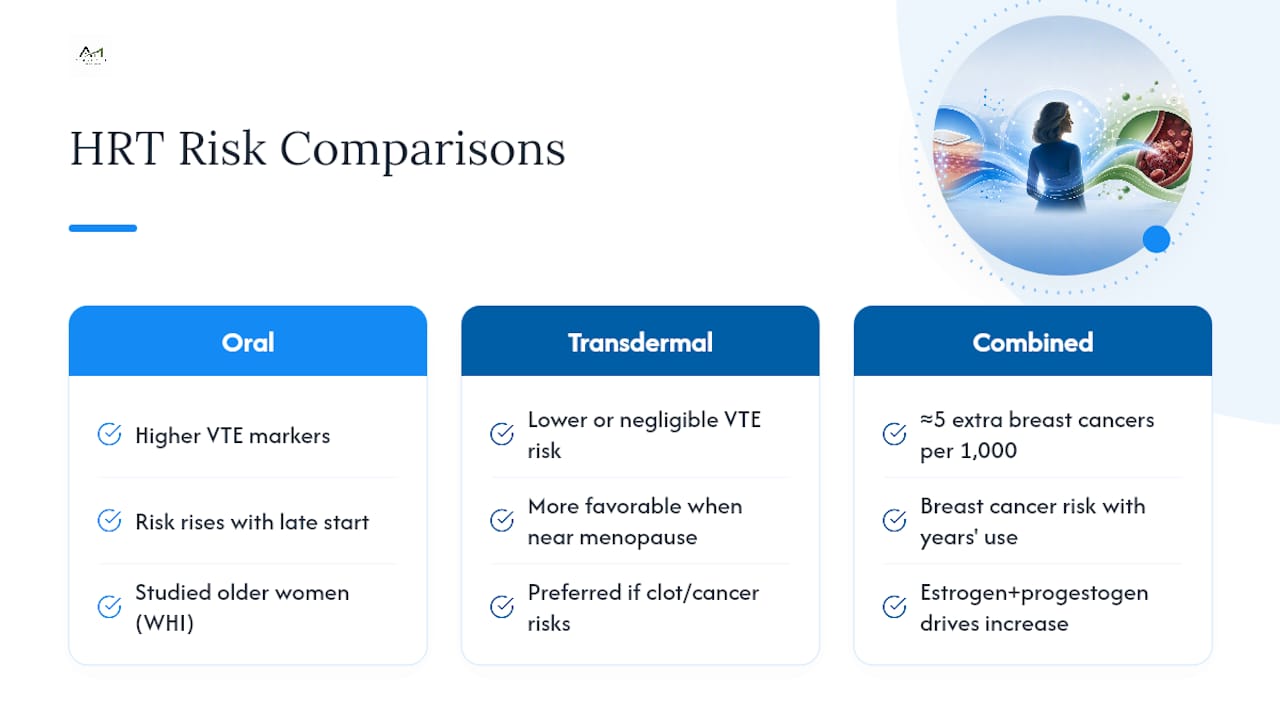
Serious risks exist, but they're uncommon, and the absolute numbers matter more than the scary-sounding relative ones you see in headlines. The NHS cites roughly 5 extra breast cancer cases per 1,000 women taking combined HRT for 5 years, an example that puts the risk in real-world terms rather than a scary-sounding percentage jump.
By the numbers: The NHS estimates about 5 additional breast cancer cases per 1,000 women who take combined HRT for 5 years, a small increase layered on top of each woman's existing baseline risk.
Venous thromboembolism (VTE) is the risk most tied to delivery route. Oral estrogen raises clotting markers because it's processed through the liver first, and multiple studies point to transdermal estradiol carrying a lower, sometimes negligible, added VTE risk compared to oral forms. For someone with a personal or family history of clots, that route distinction can be the deciding factor in treatment choice.
Breast cancer risk tracks mainly with combined regimens (estrogen plus progestogen) used over several years. Estrogen-only therapy, generally used after hysterectomy, shows a different pattern and in some analyses hasn't shown the same increase.
Cardiovascular events and stroke are where timing matters most. Much of the public anxiety around HRT traces back to the Women's Health Initiative trials from the early 2000s, which studied older women on oral hormones. Modern reviews have since refined those findings, showing that age at initiation and route both change the risk equation considerably. Starting low-dose transdermal estradiol closer to menopause onset, generally within 10 years or under age 60, tends to carry a more favorable benefit to risk balance than starting oral hormones a decade or more after menopause.
Personal factors that raise risk regardless of formulation include smoking, obesity, a prior VTE, a strong family or personal cancer history, uncontrolled hypertension, and starting HRT well past age 60. None of these automatically rule out HRT, but they shift the conversation toward transdermal routes, lower doses, or closer monitoring.
Is Vaginal Bleeding on HRT Normal, and When Should You Get It Checked?
Breakthrough bleeding is common in the first few months and usually isn't a red flag on its own. Here's how to read the pattern:
- Continuous combined regimens (daily estrogen and progestogen together) often cause irregular spotting for the first 4 to 6 months as your uterine lining adjusts, then typically settle into no bleeding at all.
- Sequential regimens (progestogen taken only part of the cycle) are designed to produce a monthly withdrawal bleed, similar to a light period, timed to when the progestogen phase ends.
- Bleeding that's heavy, that starts after months of no bleeding at all, or that continues past 6 months needs clinical evaluation rather than a wait-and-see approach.
- Bleeding accompanied by pelvic pain should be reported sooner rather than at the next scheduled visit.
Persistent or unusual bleeding typically triggers a pelvic ultrasound or endometrial assessment to rule out other causes. This is exactly the kind of pattern a 3-month review is designed to catch early, before it becomes a bigger workup. If bleeding is still irregular at that checkpoint, your clinician may adjust the progestogen dose, switch the regimen type, or investigate further depending on your specific pattern.
Does HRT Cause Weight Gain, or Is That Menopause?
Menopause itself, not HRT, is usually the bigger driver of weight and shape changes around this life stage. Declining estrogen slows resting metabolic rate and shifts fat storage toward the abdomen, which is why so many women notice a changing shape even without eating differently.
The evidence doesn't support the popular assumption that HRT reliably causes weight gain. Mayo Clinic notes that hormone therapy is the most effective treatment for hot flashes and night sweats, and in some regimens it may actually help prevent the central fat redistribution that menopause tends to cause on its own. Fear of weight gain is also a major reason women stop HRT prematurely, even when the drug itself isn't the cause.
Practical steps that matter more than the prescription:
- Prioritize strength training to counter the metabolic slowdown menopause brings.
- Set realistic expectations. Some redistribution of fat is a menopause effect, not necessarily a treatment side effect.
- Talk to your provider about obesity-focused medications if weight is a significant, standalone concern separate from hormone therapy.
For a deeper look at the metabolic side of this, Airmedfit's guide to HRT and weight breaks down what the research actually shows.
How Do Doctors Personalize HRT to Reduce Side Effects?
Personalization starts with a risk profile, not a prescription pad. Before writing anything, clinicians typically assess age, how many years since your last period, personal or family history of VTE or cancer, and cardiovascular risk factors like blood pressure and cholesterol.
That assessment usually shapes three decisions:
- Route selection: many clinicians lean toward transdermal estradiol for patients with obesity, a VTE history, or elevated triglycerides, since it bypasses the liver's first-pass effect that raises clotting risk with oral forms.
- Progestogen choice: micronized progesterone is often favored for its gentler side effect profile, though some patients use a levonorgestrel-releasing IUD as an alternative way to protect the endometrium without a daily pill.
- Dose and timing: starting at the lowest effective dose, and starting closer to menopause onset rather than years later, generally supports a better safety margin.
Follow-up isn't optional. A 3-month review checks how side effects, bleeding patterns, and adherence are tracking, and gives your clinician a chance to adjust dose or route early. After that, an annual review, including a breast assessment and reassessment of ongoing risk factors, becomes the standard rhythm for as long as you stay on therapy.
Pro Tip: If you're between routes, ask specifically why your clinician is recommending oral versus transdermal for your situation. The answer should reference your personal risk factors, not just habit or convenience. If you're curious how a structured monitoring schedule works in practice, Airmedfit's guide to starting hormone therapy walks through what week-by-week follow-up typically looks like.
What Can You Do to Manage or Reduce HRT Side Effects?
Most side effects respond to fairly small adjustments rather than stopping treatment altogether:
- Adjust the medication itself. Lowering the dose, switching progestogen type, or moving from oral to transdermal delivery resolves a large share of complaints.
- Target the specific symptom. Nausea often responds to taking the dose with food or at bedtime; insomnia benefits from consistent sleep timing; breast tenderness sometimes eases with a well-fitted supportive bra or a short-term dose reduction.
- Consider non-hormonal options for vasomotor symptoms if HRT isn't suitable or side effects don't resolve. SSRIs/SNRIs, gabapentin, and clonidine are established categories used for hot flashes when hormone therapy is contraindicated or not tolerated.
- Taper, don't stop cold. If you and your clinician decide to discontinue, a gradual taper over several weeks tends to reduce the chance of symptoms rebounding hard.
Pro Tip: Never adjust dose or stop HRT on your own based on an internet forum post. Side effects that feel alarming are often the easiest to fix with a small tweak, but stopping abruptly can trigger a symptom rebound that's worse than what you started with.
When Should You Seek Immediate Medical Help?
Certain symptoms need urgent attention, not a wait-for-the-next-appointment approach. Call emergency services or go to an ER for:
- Sudden, severe headache unlike any you've had before.
- Chest pain or shortness of breath.
- Sudden swelling, warmth, or pain in one leg (a possible clot sign).
- Sudden vision loss, slurred speech, or weakness on one side of the body.
- Yellowing of the skin or eyes (jaundice).
- Signs of a severe allergic reaction, such as facial swelling or difficulty breathing.
If a symptom feels serious but isn't a 911 emergency, notify your prescriber as soon as possible; they may tell you to pause the medication. MedlinePlus recommends reporting significant side effects, and you can also file a report directly with FDA MedWatch, the federal system for tracking adverse drug events. Reporting doesn't just protect you; it feeds the safety data that helps refine guidance for everyone on hormone therapy.
Can HRT Side Effects Affect Mood or Memory?
Mood and cognitive symptoms are among the more misunderstood side effects, partly because menopause itself causes irritability, anxiety, and brain fog independent of any treatment. When HRT is involved, it can cut either direction: some women find that stabilizing estrogen levels improves mood and mental clarity that had been disrupted by fluctuating hormones, while others notice new irritability or low mood, especially in the early adjustment weeks or when a particular progestogen doesn't agree with them.
Synthetic progestins are more often linked to mood-related complaints than micronized progesterone, which is one reason clinicians increasingly favor the body-identical version when mood sensitivity is a concern. Sleep quality plays a hidden role here too. Night sweats disrupted sleep long before HRT entered the picture, and once those symptoms ease, mood and concentration frequently improve as a side benefit rather than a direct hormonal effect.
Cognitive complaints, the classic "brain fog," tend to improve for many women once vasomotor symptoms and sleep disruption resolve. That said, if new or worsening depression, anxiety, or memory issues show up after starting HRT, that's worth flagging at your next review rather than assuming it will pass. Mood changes that arrive within the first month often settle as your body adjusts, but persistent symptoms deserve a formulation change, a dose adjustment, or an evaluation for causes unrelated to hormone therapy entirely.
Do Side Effects Vary by Age, Ethnicity, or Health History?
Yes, and this is part of why "personalized" isn't just a marketing word in this context. Age at initiation is one of the strongest modifiers: women who start HRT closer to menopause onset, generally under 60 or within 10 years of their final period, tend to tolerate it better and carry a more favorable cardiovascular risk profile than those who start a decade or more later.
Ethnicity influences some risk patterns too, though data here is less complete than for age. Certain populations show differing baseline rates of clotting disorders, cardiovascular disease, and breast cancer, which is one more reason a personal and family history review matters more than a generic risk chart. A woman with a strong family history of breast cancer faces a different calculation than one without it, regardless of what regimen "most people" tolerate well.
Prior health history reshapes the picture further. Someone with a history of migraines with aura, uncontrolled hypertension, or a previous clot is generally steered toward transdermal routes or away from systemic HRT altogether in favor of local or non-hormonal options. Someone with a hysterectomy skips progestogen entirely, sidestepping an entire category of possible side effects. None of this fits neatly into a one-size checklist, which is precisely why the initial consultation and risk assessment carries more weight than the brand or formulation you've heard is popular.
A Clinician-Guided View: Balancing Relief and Safety
The loudest voices in the HRT conversation tend to sit at extremes: either dismissing every risk or treating hormone therapy as inherently dangerous. Neither view holds up against the evidence. Most side effects are minor and temporary, the serious risks are real but uncommon, and they shift substantially based on route, dose, timing, and your personal history.
What actually protects patients is unglamorous: a proper baseline assessment, choosing route and dose deliberately rather than by default, and sticking to the 3-month and annual review schedule instead of treating HRT as a set-it-and-forget-it prescription. A physician-supervised model exists for exactly that reason, individualized decisions beat generic protocols every time. If you're weighing HRT, bring your specific history to a clinician rather than a forum thread.
— Organic
Get Physician-Supervised HRT Built Around Your Risk Profile
Reading about side effects only gets you so far. What actually reduces risk is a clinician who reviews your history, picks the route and dose suited to your body, and stays on top of monitoring instead of leaving you to guess whether a symptom is normal. Telemedicine consultations pair you with a physician who builds your HRT plan around your personal risk factors, orders the lab panels needed to track it, and schedules the follow-up checkpoints, including that critical 3-month review, this article keeps coming back to.
Typical plans include a doctor visit, baseline and follow-up lab monitoring, and a regimen chosen for your route, dose, and health history rather than a generic template. If you're ready to move past general information and get a plan built for you specifically, book a consultation and start with a real risk assessment instead of another article.
Where This Information Comes From
The clinical claims in this article draw on established medical references rather than opinion or marketing material.
- NHS: Side effects of hormone replacement therapy (HRT)
- StatPearls/NCBI Bookshelf: Hormone Replacement Therapy
- Cleveland Clinic: Hormone Therapy for Menopause Symptoms
- MedlinePlus: Drug information for HRT
- Mayo Clinic: Hormone therapy overview
- FDA MedWatch: Adverse event reporting
These sources shape the risk framing, symptom timelines, and monitoring recommendations throughout this article.
This article is general information, not a substitute for advice from a qualified doctor. Consult a qualified healthcare professional about your own circumstances before acting on anything here.
Sources
- Hormone Replacement Therapy - StatPearls - NCBI Bookshelf
- Side effects of hormone replacement therapy (HRT) - NHS
- Hormone Therapy for Menopause Symptoms - Cleveland Clinic
- MedlinePlus drug information for HRT
- Mayo Clinic: Hormone therapy overview
FAQ
What Are the Negative Effects of Taking HRT?
Most people experience mild, temporary effects like breast tenderness, nausea, headache, and irregular bleeding. Less common but serious risks include blood clots, stroke, and a small increased breast cancer risk with some combined regimens, and these depend heavily on route, dose, and personal health history.
Is It Better to Go Through Menopause Without HRT?
Not necessarily. For many women under 60 or within 10 years of menopause onset, low-dose transdermal HRT offers a favorable benefit to risk balance for symptom relief, though some people with specific risk factors or a preference to avoid hormones may do well with non-hormonal alternatives instead.
Who Should Not Take HRT for Menopause?
People with a history of certain cancers, unexplained vaginal bleeding, active blood clots, or uncontrolled liver disease are generally steered away from standard HRT. Those with elevated cardiovascular or clotting risk may still be candidates for transdermal routes under close supervision rather than being excluded outright.
When Should You Stop HRT?
There's no fixed universal stopping point. Many clinicians reassess the need for continued therapy at each annual review, weighing ongoing symptoms against current risk factors, and any discontinuation should involve a gradual taper guided by your prescriber rather than stopping abruptly.
How Long Do HRT Side Effects Usually Last?
Most side effects like nausea, headache, and breast tenderness improve within a few weeks and often resolve by the 3-month mark. Breakthrough bleeding can persist longer, typically settling by 4 to 6 months on continuous combined regimens.