
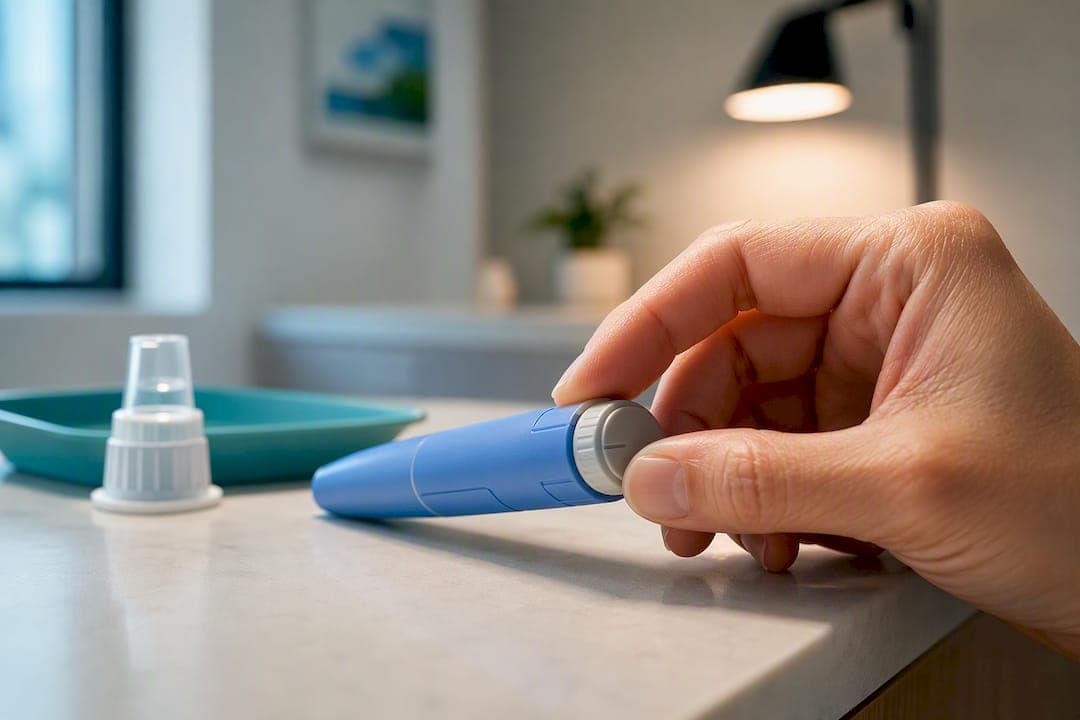
Semaglutide dosing starts at 0.25 mg injected once weekly for four weeks, then rises every four weeks (0.5 mg, 1.0 mg, 1.7 mg) toward a maintenance dose of 1.7 mg or 2.4 mg for weight loss. Diabetes dosing tops out lower, typically at 2.0 mg weekly. A higher option, Wegovy HD at 7.2 mg weekly, exists for patients who tolerate 2.4 mg for at least four weeks and need further weight loss.
TL;DR:
- Patients should plan for a gradual four-week dose escalation, as rapid increases often cause severe nausea leading to discontinuation.
- The standard titration sequence starts at 0.25 mg weekly, then increases to 0.5 mg, 1.0 mg, and 1.7 mg before reaching maintenance doses.
- If nausea persists beyond two weeks at a dose, patients are advised to delay escalation and consult their prescriber rather than pushing forward.
- Higher doses like Wegovy HD at 7.2 mg weekly are only for patients who tolerate 2.4 mg for at least four weeks and still need further weight loss.
- Switching between oral and injectable semaglutide requires clinical guidance, as the formulations are not directly interchangeable on a milligram basis.
Table of Contents
- What Is the Standard Semaglutide Dosing Schedule?
- What Does an Injectable Semaglutide Titration Chart Look Like?
- How Is Oral Semaglutide Dosed Differently From Injections?
- How Should You Inject Semaglutide Correctly?
- What If You Miss a Weekly Semaglutide Dose?
- When Should You Adjust or Stop Semaglutide Treatment?
- What Are the Main Side Effects and Contraindications?
- How Should Dosing Change in Special Populations?
- How Do Semaglutide Concentration and Dose Conversions Work?
- Why Personalized Titration Under Physician Supervision Matters
- What Clinicians Wish Patients Knew About Titration
- Start Semaglutide Dosing With Physician Oversight
- Where to Verify These Dosing Details Yourself
- Sources
What Is the Standard Semaglutide Dosing Schedule?
Semaglutide's dosing schedule was built around one problem: the drug works, but the gut needs time to adjust to it. Jump straight to an effective dose and most patients get hit with nausea severe enough to quit. That's why every approved semaglutide product, injectable or oral, escalates gradually instead of starting at the target dose.
The injectable weight-management schedule runs on four-week blocks. Each step doubles or nearly doubles the previous dose, giving the gut time to adapt before the next increase:
- Weeks 1 to 4: 0.25 mg once weekly (tolerance-building, not a treatment dose)
- Weeks 5 to 8: 0.5 mg once weekly
- Weeks 9 to 12: 1.0 mg once weekly
- Weeks 13 to 16: 1.7 mg once weekly
- Week 17 onward: maintenance, commonly 1.7 mg or 2.4 mg depending on response and tolerability
That escalation pattern comes directly from the clinical trial data behind semaglutide's weight-management approval, and it's the backbone of every titration chart you'll see from a prescriber.
Diabetes dosing follows a similar shape but a lower ceiling. Ozempic starts at 0.25 mg weekly for four weeks (again, purely for tolerability), moves to 0.5 mg for glycemic control, and can escalate to 1.0 mg and then 2.0 mg weekly if blood sugar targets aren't met. The Ozempic prescribing information treats 2.0 mg as the practical ceiling for most patients, well below the 2.4 mg weight-loss maintenance dose.
Wegovy's higher-dose option changes the picture for weight loss specifically. Patients already stable on 2.4 mg for four or more weeks, who still need additional weight loss, may qualify for Wegovy HD at 7.2 mg weekly. According to the Wegovy prescribing information, that 7.2 mg dose can be given as a single injection or split into three 2.4 mg injections, a detail that matters for anyone managing injection volume or site rotation.
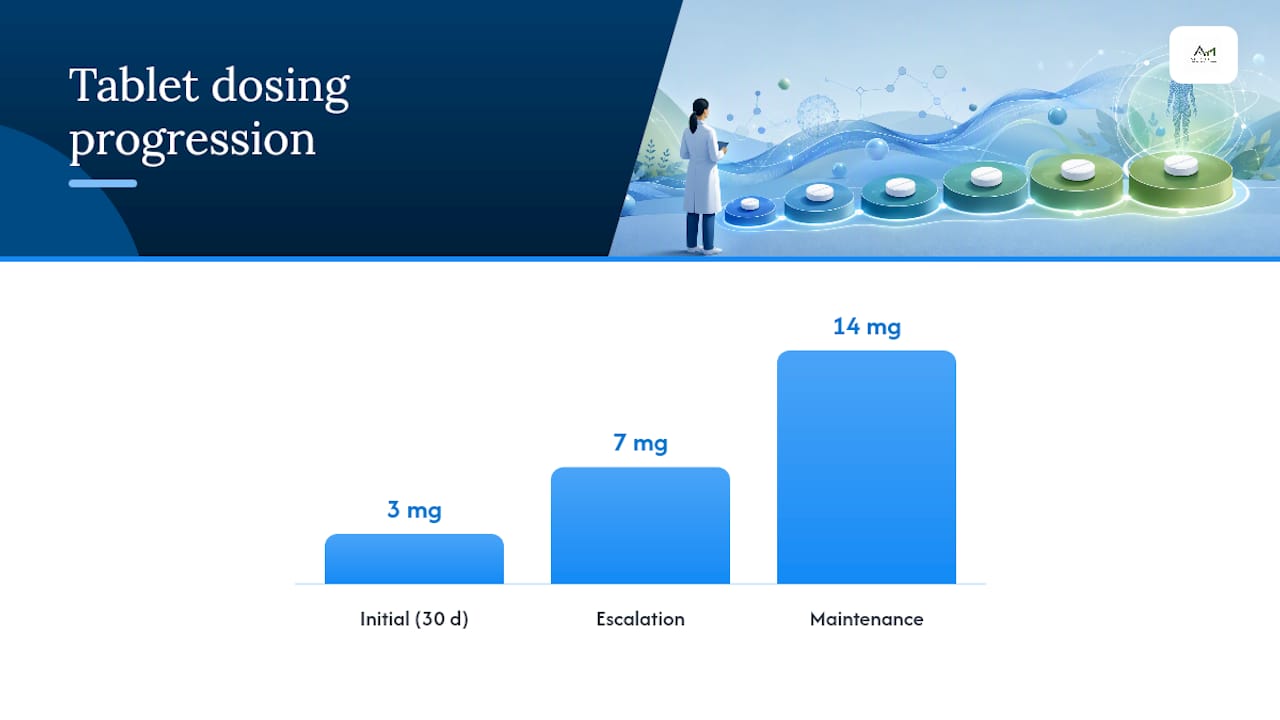
Oral semaglutide (tablets) escalates on a similar four-week rhythm but at different milestone doses, typically 3 mg, then 7 mg, then 14 mg. It's a different molecule delivery system with its own absorption rules, which is why the numbers don't map one-to-one against the injectable doses. Don't try to convert tablet milligrams into injectable milligrams; they're not equivalent by weight.
What Does an Injectable Semaglutide Titration Chart Look Like?
Here's the injectable schedule in table form, the version most clinics hand patients on day one:
| Weeks on therapy | Weekly dose | Purpose |
|---|---|---|
| 1 to 4 | 0.25 mg | Tolerance building only |
| 5 to 8 | 0.5 mg | Early therapeutic dose |
| 9 to 12 | 1.0 mg | Escalating therapeutic dose |
| 13 to 16 | 1.7 mg | Near-maintenance dose |
| 17+ | 1.7 mg to 2.4 mg | Maintenance (weight loss) |
| Selected patients | 7.2 mg (Wegovy HD) | High-dose option after 2.4 mg tolerance |
That first 0.25 mg step confuses a lot of new patients because it barely moves the needle on weight or blood sugar. It isn't supposed to. The dose exists to let the body adjust to GLP-1 receptor activity, primarily the slowed gastric emptying that causes most early nausea, before asking it to do any real metabolic work. Clinical reviewers are explicit about this: the starting dose is a tolerability bridge, not a therapeutic one.
Semaglutide's four-week titration interval isn't arbitrary. Trial data consistently shows that GI side effects peak in the days right after a dose increase and then fade within roughly two to three weeks. Four weeks gives that adaptation window room to finish before the next step up.
What if a patient hits week 5 and still feels sick from 0.25 mg? The same clinical review supports what most prescribers already do in practice: stay at the current dose for another four weeks rather than pushing forward on schedule. Escalating through unresolved nausea rarely fixes it and often makes patients quit the medication altogether. Holding steady, then trying the next step once symptoms settle, preserves both comfort and long-term adherence.
Pro Tip: If you're two weeks into a new dose and still nauseated most days, don't wait for your next scheduled increase to say something. Call your prescriber. Delaying escalation by even one cycle is a normal, expected adjustment, not a treatment failure.
There's no single universal rule for when to abandon a dose increase entirely and drop back down, but the general principle holds across GLP-1 therapies: if a dose causes persistent vomiting, an inability to keep food or fluids down, or signs of dehydration, that's a signal to reduce rather than push through. A prescriber managing the titration can decide whether to hold, drop back a step, or extend the interval between increases.
How Is Oral Semaglutide Dosed Differently From Injections?
Oral semaglutide (tablet form) works through the same GLP-1 mechanism but demands a completely different administration ritual, because stomach absorption of the tablet is fragile.
The tablet schedule typically starts at 3 mg daily for 30 days (again, a tolerance-building dose with minimal therapeutic effect), then rises to 7 mg daily, and finally to 14 mg daily as a maintenance dose for many patients. Some regimens escalate further under clinical guidance, but 14 mg is the common ceiling for most people on the tablet.
Timing is where oral semaglutide gets strict. Prescribing guidance calls for taking the tablet after at least 8 hours of fasting, with plain water only, then waiting at least 30 minutes before eating, drinking anything else, or taking other oral medications. Miss that window and absorption drops sharply. That sensitivity to food and liquid intake is well documented, and it's one reason oral dosing counseling matters as much as the dose itself: a patient who takes the tablet with coffee, or waits only 10 minutes before breakfast, may absorb far less drug than the dose on the label implies.
Practical rules for the tablet:
- Take it first thing in the morning, before anything else touches your stomach.
- Swallow it whole with up to 4 ounces of plain water. No other liquids.
- Wait a full 30 minutes before food, drinks, or other pills.
- Skip a missed dose entirely if you remember it after your 30-minute food window has already passed for the day; don't try to fix it retroactively.
Switching between oral and injectable semaglutide isn't a same-day swap. Prescribers generally treat the two formulations as separate titration tracks, restarting or adjusting the schedule based on the dose and duration already completed on the prior form. If you're moving from tablets to injections or the reverse, that transition needs direct clinical guidance rather than a guess based on milligram equivalence, since the two aren't dosed on a comparable scale.
How Should You Inject Semaglutide Correctly?
Getting the dose right matters less than getting the injection right if the injection itself is done poorly. Semaglutide is injected subcutaneously, meaning into the fatty layer just under the skin, never into muscle or a vein.
- Choose your site. The approved injection sites are the abdomen, the front of the thigh, and the upper arm. All three work equally well; pick based on comfort and reach.
- Rotate every week. Using the same exact spot repeatedly causes lumps, scar tissue, and uneven absorption over time. A simple rotation, left abdomen one week, right abdomen the next, thigh the week after, keeps tissue healthy.
- Inspect the pen before use. Check the liquid is clear and colorless. Cloudy, discolored, or particle-containing solution should never be injected.
- Never share a pen, even with a new needle attached. Pens are single-patient devices, and residual medication can transfer between uses.
- Pinch the skin, insert at the instructed angle, and hold for the full count specified in your pen's instructions before withdrawing.
Storage matters just as much as technique. Unused pens generally need refrigeration. Once a pen is in use, most products allow room-temperature storage for a limited window, commonly around a month, but you should always confirm the exact number against your specific product's labeling rather than assuming. Never freeze semaglutide, and never use a pen that has been frozen.
Pro Tip: Keep a small sharps container near wherever you store your pen. The single biggest cause of missed doses isn't forgetting, it's not having a clean needle and disposal setup ready when the reminder goes off.
For a deeper walkthrough of exact injection angles and depth by body site, a site-by-site subcutaneous injection guide covers the mechanics in more detail than a dosing article can.
What If You Miss a Weekly Semaglutide Dose?
Missed doses happen, and the fix depends on how much time has passed. Product labeling gives a defined window rather than a one-size-fits-all rule.
- If it's been 5 days or less since your missed dose, take it as soon as you remember, then resume your normal weekly schedule from that point.
- If more than 5 days have passed, skip the missed dose entirely and wait for your next regularly scheduled day.
- Never take two doses close together to "catch up." Doubling up raises side-effect risk without adding benefit, and it isn't supported by the prescribing information.
- If you miss doses often enough that your schedule keeps sliding, mention it at your next follow-up. Repeated missed doses can distort your titration timeline and confuse whether a side effect is from a new dose or a delayed one.
Switching between oral and injectable formulations should happen on a clinician's timeline, not a self-adjusted one, since the two products aren't interchangeable milligram for milligram.
When Should You Adjust or Stop Semaglutide Treatment?
Semaglutide dosing isn't a "set it and forget it" schedule. Prescribers track specific benchmarks to decide whether to keep escalating, hold at the current maintenance dose, or reconsider the treatment altogether.
The most widely used checkpoint is the six-month, 5% weight-loss benchmark. If a patient hasn't lost at least 5% of starting body weight after roughly six months on a stable maintenance dose, that's generally treated as a sign to re-evaluate, whether that means increasing toward 2.4 mg, considering the 7.2 mg high-dose option, or exploring a different approach entirely.
Only a subset of patients on 2.4 mg maintenance dosing go on to need the 7.2 mg option, and it's reserved for those who've already tolerated 2.4 mg for at least four weeks and still have a documented clinical need for further loss.
For diabetes management, the benchmark isn't weight, it's glycemic control. If A1C targets aren't met at a given dose, and the patient tolerates the medication well, escalation toward the 2.0 mg diabetes ceiling is the standard next step. Patients using insulin or a sulfonylurea alongside semaglutide often need those doses adjusted downward as semaglutide starts working, since the combined effect can otherwise push blood sugar too low.
Deciding between a 1.7 mg and 2.4 mg maintenance dose usually comes down to two things: how much additional weight loss the patient still needs, and how well they've tolerated the climb so far. The Wegovy prescribing information treats this as an individualized decision rather than a fixed rule, some patients plateau comfortably at 1.7 mg with meaningful results, while others need the full 2.4 mg to reach their goals. For a broader look at how weight-loss outcomes vary by dose and patient profile, see what the evidence shows on semaglutide for weight loss.
What Are the Main Side Effects and Contraindications?
Gastrointestinal side effects are the most common reason patients struggle with semaglutide, and they're almost always dose-related. Nausea, vomiting, diarrhea, constipation, and abdominal discomfort tend to spike right after a dose increase, then settle within a couple of weeks. The Mayo Clinic drug monograph lists these as expected, manageable effects for most patients, not automatic reasons to discontinue.
Management usually follows a simple stepwise approach:
- Eat smaller meals and stop eating before you feel full.
- Avoid high-fat, greasy, or heavily fried foods, which slow digestion further and worsen nausea.
- Stay ahead of dehydration, especially if diarrhea or vomiting occurs.
- If symptoms are severe or persistent, the next move is usually to hold the current dose rather than push forward, not to tough it out through an increase.
Beyond routine GI effects, semaglutide carries several warnings that matter more than a queasy stomach. Pancreatitis is a recognized risk, and severe, persistent abdominal pain, especially radiating to the back, warrants urgent medical evaluation. Acute kidney injury has been reported, usually tied to volume depletion from severe vomiting or diarrhea, which is another reason dehydration during titration isn't something to ignore.
The most serious warning is a boxed one: in rodent studies, semaglutide caused thyroid C-cell tumors. It's not established whether this occurs in humans, but out of caution, semaglutide is contraindicated in anyone with a personal or family history of medullary thyroid carcinoma (MTC) or Multiple Endocrine Neoplasia syndrome type 2 (MEN 2). Anyone with either history should not start this medication.
Seek urgent care for symptoms like severe abdominal pain, signs of an allergic reaction (swelling, difficulty breathing, rash), or vision changes suggestive of diabetic retinopathy complications. Routine nausea rarely needs an ER visit; these specific red flags do.
How Should Dosing Change in Special Populations?
Dosing recommendations shift, sometimes subtly, for certain patient groups, and prescribers should factor these in before setting a titration plan.
Renal impairment: There's often no specific dose adjustment listed on the label for mild to moderate kidney impairment, but patients in this group need closer monitoring for volume depletion, since dehydration from GI side effects hits impaired kidneys harder. Severe renal impairment warrants extra caution and closer lab follow-up.
Hepatic impairment: Data here is limited. Clinical guidance generally recommends caution rather than a specific dose change, meaning slower titration and closer symptom tracking rather than a fixed reduced dose.
Pregnancy and breastfeeding: Semaglutide is generally not recommended during pregnancy, and most manufacturer guidance advises discontinuing it well before a planned pregnancy given the drug's long half-life. Breastfeeding guidance leans toward caution as well, given limited human data.
Pediatric use: Some semaglutide products are approved for adolescents 12 and older for specific indications, using adjusted schedules that a pediatric specialist should manage directly rather than adult titration charts.
Older adults: No blanket dose reduction is required based on age alone, but elderly patients are more susceptible to dehydration and GI side effects, so slower escalation and closer check-ins tend to work better in this group.
None of these categories come with a one-size-fits-all number, which is exactly why individualized supervision matters more here than in a straightforward, healthy adult case.
How Do Semaglutide Concentration and Dose Conversions Work?
Semaglutide pens come in different concentrations, and confusing concentration with dose is one of the most common (and dangerous) dosing errors outside of a properly filled prescription.
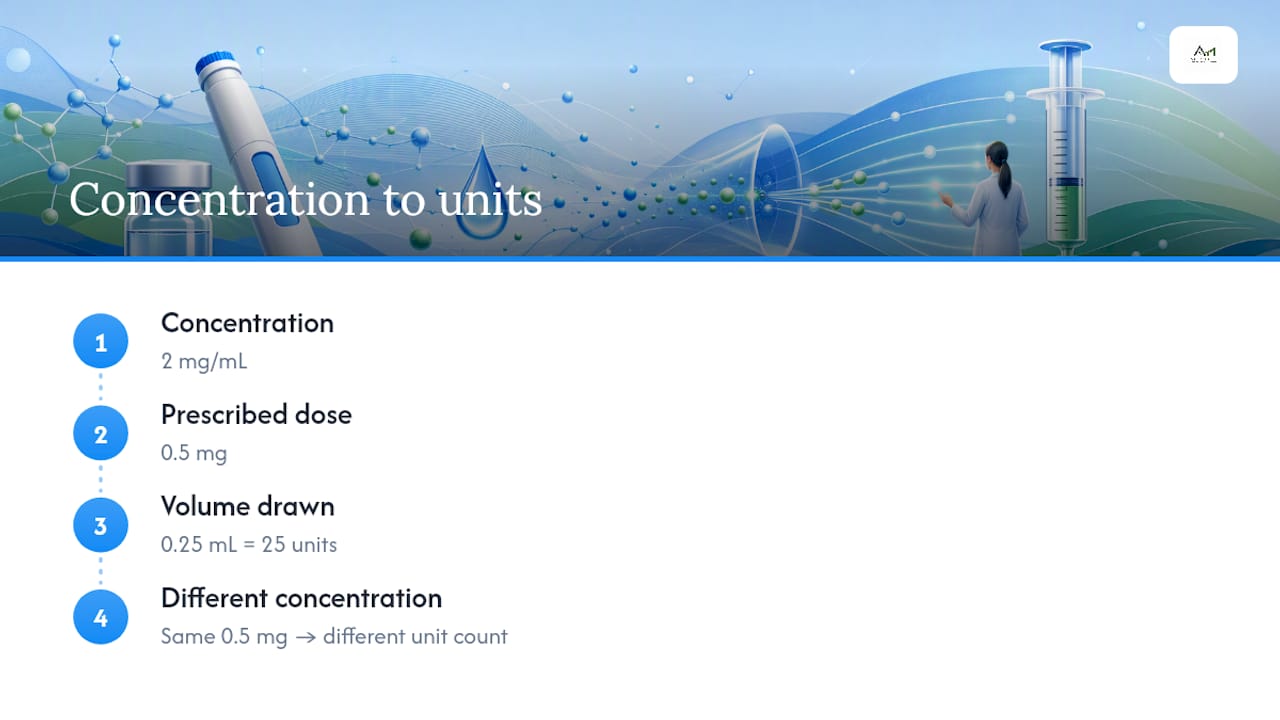
Concentration is measured in milligrams per milliliter (mg/mL), and the number of units you'd draw up depends entirely on that concentration. For example, if a vial is labeled at 2 mg/mL, delivering a 0.5 mg dose requires drawing 0.25 mL, which on a standard insulin syringe marked in units translates to 25 units. Change the concentration, and that unit count changes completely, even though the milligram dose stayed the same. This is exactly why concentration labeling has to be verified every single time, never assumed from memory or a previous fill.
This is also where compounded semaglutide becomes a real safety concern. The FDA has issued direct alerts about dosing errors tied to compounded semaglutide products, where inconsistent concentrations and unclear labeling led patients to draw up far more, or less, than intended. Compounded products also fall outside the FDA's standard approval and manufacturing oversight process. Sticking with licensed, FDA-regulated formulations from properly sourced manufacturers avoids this risk entirely and keeps the dose on the pen matching the dose in the syringe.
Why Personalized Titration Under Physician Supervision Matters
A titration chart gives you the default path. It doesn't account for the patient who feels awful at 0.5 mg but sails through 1.0 mg, or the one whose kidney function needs closer watching before any increase. That's the gap between a printed schedule and actual care.
Physician-supervised models start with a real consult, not a form. A baseline lab panel establishes where a patient's metabolic and kidney function stand before the first dose ever gets prescribed, which matters given how volume depletion and renal risk factor into escalation decisions. From there, a licensed provider builds an individualized titration plan rather than defaulting every patient to the identical four-week clock, adjusting pace based on tolerability, lab results, and response.
Follow-ups aren't an afterthought. Scheduled check-ins track weight trend, side-effect burden, and lab values over time, the same benchmarks that determine whether a patient stays at 1.7 mg, moves to 2.4 mg, or needs a slower path altogether. That ongoing oversight is the difference between guessing your way through a chart and having someone catch a problem before it becomes one. You can start that process directly through a telemedicine consult.
What Clinicians Wish Patients Knew About Titration
The biggest mistake I see in how people approach semaglutide dosing is treating the titration chart like a countdown clock instead of a flexible guide. It isn't a race. Staying at 0.5 mg for eight weeks instead of four because your stomach needs the extra time isn't falling behind, it's the system working as intended.
Hydration and meal timing do more heavy lifting than most people expect. Small, bland meals in the days after a dose increase, paired with steady water intake, blunt a good chunk of the nausea that would otherwise derail someone's motivation to continue. Taking your injection on a day when you can eat lightly for the next 24 hours, rather than right before a big dinner, makes a noticeable difference.
Know the difference between calling your clinic and riding it out. Mild nausea for a day or two: manageable at home. Persistent vomiting, inability to keep fluids down, or severe abdominal pain: call immediately, don't wait for your next scheduled appointment.
— Organic
Start Semaglutide Dosing With Physician Oversight
Getting the titration schedule right on paper is one thing. Getting it right for your body, your labs, and your tolerance is another, and that's the gap a printed chart can't close on its own. Airmedfit's telemedicine model puts a licensed physician between you and every dosing decision, starting with a real consultation, baseline lab work to check kidney and metabolic function before the first injection, and a prescription plan built around your actual response rather than a generic four-week clock.
Follow-up visits track your progress against real benchmarks, weight trend, side-effect pattern, lab values, so escalation decisions get made with data instead of guesswork, and any interaction with other medications gets caught early rather than after the fact. Airmedfit sources its GLP-1 medications from licensed US manufacturers, which matters given how often compounded, unregulated versions show up with inconsistent concentrations and dosing errors.
If you're ready to start semaglutide under actual medical supervision rather than piecing together a schedule from a chart online, book a telemedicine consult and bring a list of your current medications and any recent labs you have on hand. That's the fastest way to walk out with a titration plan built for you, not for the average patient in a clinical trial.
Where to Verify These Dosing Details Yourself
Any dosing chart is only as good as its source. For the full prescribing details behind everything covered here, go directly to the primary documents:
- The FDA announcement on higher-dose semaglutide covers the 7.2 mg Wegovy HD approval and its eligibility conditions.
- Ozempic's full prescribing information on DailyMed lays out diabetes-specific dosing, injection sites, and missed-dose rules in exact regulatory language.
- The clinical review of once-weekly semaglutide for weight management breaks down trial data behind the standard titration schedule.
- The Mayo Clinic drug monograph offers a patient-friendly reference for dosing and safety basics.
This article is general information, not a substitute for advice from a qualified doctor. Consult a qualified healthcare professional about your own circumstances before acting on anything here.
Sources
- FDA press announcement — higher-dose semaglutide
- Once-Weekly Semaglutide for Weight Management: A Clinical Review (PMC)
- DailyMed — OZEMPIC prescribing information
- Mayo Clinic — semaglutide (subcutaneous route)