

Appetite changes typically show up within the first week, but the scale moves on a slower clock. Full dose effects take about four to five weeks per titration step, and measurable weight loss builds over months, averaging close to 15% of body weight by week 68 in trial data. Individual results vary widely, and dose, diet, and physician-guided titration all shape where you land. The rest of this guide breaks down what happens week by week, with the medical supervision piece explained further down.
TL;DR:
- Most people see appetite suppression within the first week, but consistent, meaningful weight loss typically requires four to five weeks per dose increase.
- The average weight loss reaches about 15% of body weight by week 68, but results vary based on dose, diet, adherence, and individual response.
- Semaglutide works on three timescales: immediate appetite signaling within days, steady state in four to five weeks, and gradual fat loss over months.
- Dose escalation follows a four-week interval to allow the drug to reach full concentration and minimize side effects, with nausea being the most common adjustment challenge.
- Personal results depend heavily on starting BMI, diet quality, activity level, consistency with dosing, and genetic factors, making personalized medical supervision essential.
Table of Contents
- Semaglutide Weight Loss Timeline: A Week-By-Week Snapshot
- The Science Behind the Pace: Three Different Timescales
- Month-By-Month Results: What the Trials Actually Showed
- How Dose Titration Shapes Your Results Timeline
- What Actually Changes Your Personal Timeline
- When to Contact Your Prescriber About Your Progress
- A Physician-Supervised Approach to a Trial-Backed Timeline
- Getting Started With Supervised Semaglutide Treatment
- Where This Data Comes From
- Sources
Semaglutide Weight Loss Timeline: A Week-By-Week Snapshot
Here's roughly how the process unfolds for someone starting at the lowest dose and titrating upward on a standard schedule.
- Days 1 to 7: Appetite shifts start almost immediately for many people. Some notice less interest in food, smaller portions feeling satisfying, or fewer cravings between meals. Mild nausea is common as the body adjusts to the first dose.
- Weeks 2 to 4: The starter dose reaches its full effect. Weight change during this window is usually modest, often just a few pounds, since the body is still adapting rather than running at a therapeutic dose.
- Weeks 4 to 12: This is mid-titration territory. The scale typically starts moving more consistently, and by week 12 many patients are somewhere in the 5 to 10 percent range of total body weight lost, depending on starting dose and individual response.
- Weeks 12 to 24: Most patients are approaching or holding at a maintenance dose here, and this stretch tends to show the steepest average weight loss of the entire timeline.
- Months 6 to 12 and beyond: Loss continues but slows. By 12 to 18 months, results generally approach the plateau seen in clinical trials.
Pro Tip: Track appetite changes and portion sizes in a simple notes app during the first month. Scale weight can lag behind real physiological change, and having a written record helps you and your prescriber tell the difference between "not working" and "working, just slower than expected."
The Science Behind the Pace: Three Different Timescales
Semaglutide doesn't work on one clock. It works on three, and understanding them explains why your appetite can change in days while your jeans still fit the same way weeks later.
- Immediate signaling (hours to days): Semaglutide acts on GLP-1 receptors in the brain and gut almost right away, slowing gastric emptying and dampening the drive to eat. This is the fastest-acting layer and the one patients notice first.
- Pharmacokinetic steady state (about 4 to 5 weeks per dose): Because of the drug's long half-life, each dose increase needs roughly four to five weeks to reach full concentration in the body. That's also why the FDA-approved titration schedule spaces dose increases four weeks apart. Bumping the dose sooner doesn't speed things up; it just increases side effect risk without added benefit.
- Weight accumulation (months): Fat loss is a downstream, cumulative effect. It shows up only after appetite suppression has been sustained long enough to create a real caloric deficit over time.
What you feel in week one (less hunger) and what you see on a scale in month three (measurable loss) are two different biological processes running on two different schedules.
Month-By-Month Results: What the Trials Actually Showed
The most detailed data on semaglutide's timeline comes from the STEP-1 trial, a randomized, double-blind, placebo-controlled study that followed participants for 68 weeks. The averages below are trial benchmarks, not guarantees, but they're the most reliable numbers available for setting realistic expectations.
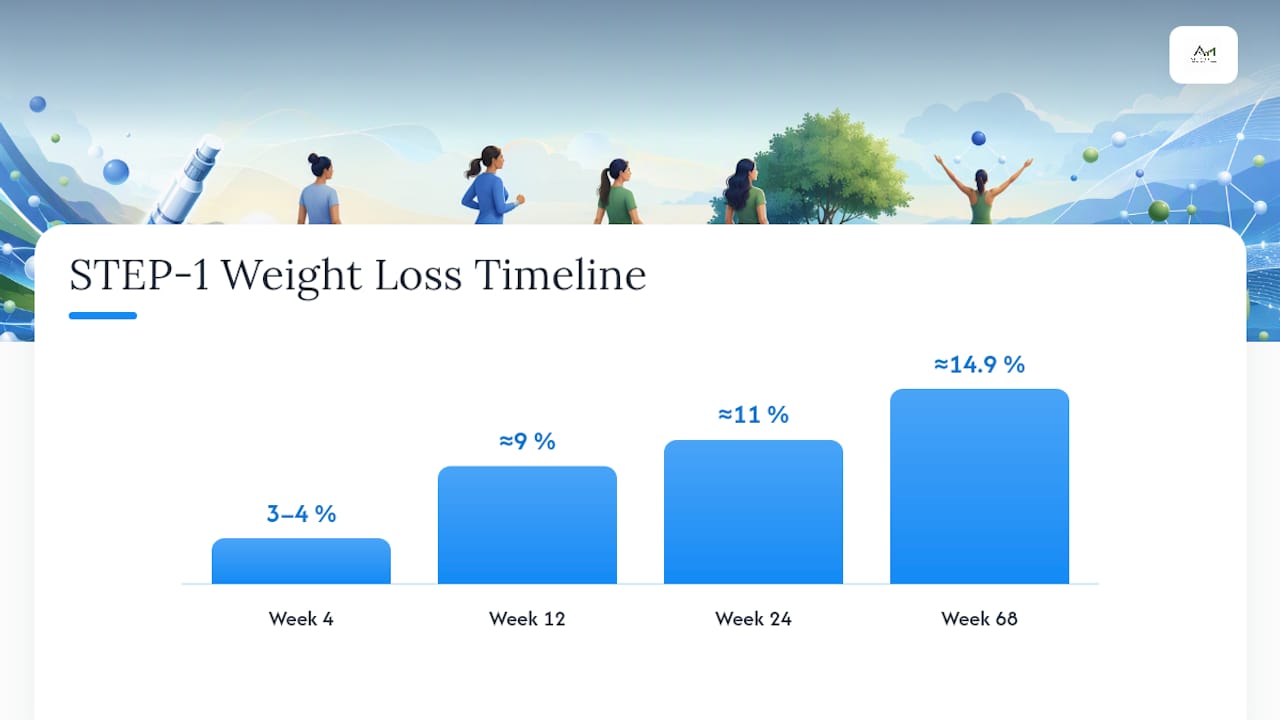
By week 4, most participants had lost around 3 to 4 percent of starting body weight, mostly reflecting early appetite suppression rather than deep fat loss. By weeks 12 to 24, average losses climbed to roughly 9 to 11 percent, the window where dose has usually reached or is nearing maintenance. By the 52 to 68 week mark, the trial's mean result was approximately 14.9 percent with semaglutide, compared with about 2.4 percent in the placebo group.
Translated into pounds, the pattern looks like this for three different starting weights:
| Starting Weight | ~Week 12 (≈9%) | ~Week 24 (≈11%) | ~Week 68 (≈15%) |
|---|---|---|---|
| 140 lb | 14 lb | 15 lb | 21 lb |
| 190 lb | 18 lb | 21 lb | 28 lb |
| 230 lb | 21 lb | 26 lb | 35 lb |
These are illustrative midpoints based on trial averages, not individual predictions. The trial also reported responder rates, and they matter more than the mean for setting personal expectations:
- A large majority of participants lost at least 5 percent of body weight by the trial endpoint.
- A substantial share lost 10 percent or more.
- A smaller but still meaningful group lost 20 percent or more.
That spread is the real story. The 14.9 percent average is a midpoint, not a ceiling or a promise, and where you land on that curve depends heavily on adherence, diet quality, and how your body responds to GLP-1 signaling specifically. Two patients starting the same week, on the same dose, can see meaningfully different results by month six.
How Dose Titration Shapes Your Results Timeline
The standard titration ladder starts low and increases roughly every four weeks, following the FDA prescribing information for semaglutide. That four-week spacing isn't arbitrary. It gives the body time to reach steady state at each dose before stepping up, which is also the main strategy for keeping side effects manageable.
- Weeks 1 to 4: Starter dose. Appetite changes begin; nausea, if it happens, tends to peak here.
- Weeks 5 to 8: First step-up. Mild GI symptoms can resurface briefly before settling.
- Weeks 9 to 16: Continued escalation toward the target maintenance dose, with GI side effects most commonly reported during this stretch.
- Week 16 onward: Most patients reach maintenance dose and settle into a steadier pattern of appetite control and weight loss.
Nausea, constipation, and occasional diarrhea are the most frequently reported issues, and they usually ease as the body adjusts to each dose. Smaller, protein-forward meals and avoiding greasy or very rich food during titration weeks tend to reduce symptom severity.
Pro Tip: If nausea is significant after a dose increase, don't tough it out alone. Slower titration, staying at a dose an extra few weeks, or a temporary reduction are all standard clinical tools. They may push your results timeline back slightly, but they keep you on the medication long enough to reach maintenance, which matters far more than shaving a few weeks off the schedule.
What Actually Changes Your Personal Timeline
Trial averages describe a population. Your timeline depends on a shorter list of variables that are worth discussing directly with your prescriber.
- Starting BMI and metabolic health: Higher starting weight often means larger absolute pound losses, even when percentage loss is similar.
- Diet composition: Meals built around protein and fiber help preserve lean muscle and tend to amplify fat loss relative to total weight lost.
- Activity level: Resistance training in particular helps protect muscle mass during a caloric deficit.
- Adherence: Skipped or delayed doses slow steady-state buildup and stretch out the whole timeline.
- Concurrent medications and genetics: Some medications and individual metabolic differences affect how strongly GLP-1 receptor activity translates into appetite suppression.
Bring all five of these into your consult conversations. They're the actual levers, not the trial average.
When to Contact Your Prescriber About Your Progress
Certain signals mean it's time to check in rather than wait it out.
- Severe or persistent abdominal pain, especially radiating to the back, which can signal pancreatitis and needs prompt evaluation.
- No measurable weight change after 12 to 16 weeks at a stable maintenance dose.
- Vomiting or diarrhea severe enough to cause dehydration.
- Plans for pregnancy, since semaglutide is generally discontinued well before conception.
A typical clinical response includes reviewing labs (A1C, liver function), checking adherence and diet patterns, and adjusting titration pace before considering a therapy change. A stall around week 16 is common and usually temporary. It's rarely a sign the medication has stopped working.
A Physician-Supervised Approach to a Trial-Backed Timeline

Trial data gives you the averages. What it can't give you is a plan built around your labs, your side effect tolerance, and your specific metabolic starting point. That's the gap physician-supervised care is meant to close.
The treatment model structures GLP-1 therapy around telemedicine consults, individualized titration schedules, and lab monitoring rather than a one-size-fits-all dosing calendar. Aligning trial-benchmarked expectations with a patient's actual bloodwork and response pattern is what turns a population average into a realistic personal plan. Eligibility and outcomes vary by individual, and any decision to start treatment should follow a full clinical evaluation. For long-term maintenance considerations, that same supervision matters even after the initial titration period ends.
— Organic
Getting Started With Supervised Semaglutide Treatment
If the timeline above sounds like what you're after, the next step is a proper eligibility check, not guesswork with a dosing chart you found online. The process starts with a telemedicine consult, includes lab work to confirm safety, and builds an individualized titration plan rather than a generic four-week ladder applied blindly.
Where a lot of self-directed approaches fall short is the lack of a physician actually watching your bloodwork and adjusting the plan when side effects or plateaus show up. This model keeps a licensed clinician in the loop from the first dose through maintenance, using FDA-regulated medications sourced from licensed US manufacturers. Outcomes still vary by individual and depend on adherence and baseline health, so nothing here is a promise of a specific result. If you want to see whether you qualify, book a consultation and get a titration plan built around your own labs rather than a population average. You can also review the full treatment overview before scheduling.
Where This Data Comes From
- STEP-1 trial efficacy review: mean weight loss and responder-rate data at trial endpoint.
- NCT03548935 trial record: design and duration of the pivotal STEP-1 study.
- Mayo Clinic Diet: early appetite-change timing and mid-range expectations.
- Cleveland Clinic: long-term therapy and discontinuation guidance.
This article is general information, not a substitute for advice from a qualified doctor. Consult a qualified healthcare professional about your own circumstances before acting on anything here.
Sources
- Semaglutide 2.4 mg efficacy and safety review (PMCID PMC9272494)
- NCT03548935 — Semaglutide for weight management (STEP-1)
- How fast does semaglutide kick in? — Mayo Clinic Diet
- How long to take GLP-1 for weight loss — Cleveland Clinic