

TB-500 has real mechanistic plausibility for wound and tissue repair, backed by animal and in vitro data, but no Phase 2 or Phase 3 human trials confirm it accelerates musculoskeletal recovery in people. Treat it, at best, as an unproven adjunct to consider only under physician supervision. Competitive athletes should also know it sits on WADA's banned list. If you're weighing a supervised cycle, the dosing, safety, and monitoring sections below spell out what that actually looks like.
TL;DR:
- Human evidence for TB-500's effectiveness in injury recovery is limited to preclinical animal and cell studies; no rigorous Phase 2 or 3 trials in humans confirm benefits.
- Dosing practices are community-driven, typically involving 2 to 2.5 mg twice weekly during initial weeks, then once every one to two weeks, with no regulatory approval or standardized protocols.
- TB-500 is prohibited in competitive sports by WADA, and unsupervised use risks safety and sourcing issues due to lack of official regulation or proven efficacy data.
- Side effects are generally mild but include injection site reactions and potential concerns about angiogenesis, which could theoretically support tumor growth if undiagnosed cancer exists.
- A physician-supervised program with lab monitoring and licensed peptide sourcing provides the safest way to consider TB-500 for injury or recovery purposes.
Table of Contents
- What Is TB-500 and How Does It Relate to Thymosin Beta-4?
- What Does the Research Actually Show?
- What Dosing Protocols and Timelines Do People Actually Use?
- How Is TB-500 Reconstituted and Administered Safely?
- What Are the Side Effects and Warning Signs to Watch For?
- How Does the BPC-157 Stack (the "Wolverine Stack") Work?
- Is TB-500 Legal and What Is Its Regulatory Status?
- How Do You Decide If a Supervised TB-500 Trial Makes Sense?
- What Does Airmed Fit's Supervised Model Bring to This Conversation?
- Ready for a Supervised Consult?
- Sources
- FAQ
What Is TB-500 and How Does It Relate to Thymosin Beta-4?
TB-500 is a synthetic peptide fragment modeled on thymosin beta-4 (Tβ4), a naturally occurring protein your body produces during wound healing. It is not the full protein. It is a shortened, lab-made piece designed to mimic part of Tβ4's activity, which is why you will sometimes see it listed under the chemical shorthand TB4 Frag or thymosin beta-4 fragment.
The mechanism researchers point to is actin regulation. Actin is a structural protein inside cells that controls shape and movement, and Tβ4 binds to it in a way that appears to help cells migrate toward damaged tissue. In practical terms, that migration effect is what drives the two processes most associated with TB-500's healing reputation:
- Re-epithelialization — skin and soft tissue cells moving in to close a wound faster.
- Angiogenesis — the formation of new small blood vessels that feed healing tissue with oxygen and nutrients.
Here is the distinction that gets lost in most marketing copy: the strongest human-relevant data comes from studies on full-length Tβ4, not the fragment sold as TB-500. Preclinical work shows TB-500 fragments interact with actin pathways and demonstrate wound-healing activity in vitro and in animal models, but that is a different molecule tested in different conditions than what most human trials of Tβ4 have used. Reviewers writing for orthopaedic and sports medicine audiences have flagged this gap directly, noting that fragment-specific human efficacy data for TB-500 remains largely absent even as animal evidence for the parent protein looks solid. That difference matters more than most sellers admit, and it's the reason a genuine TB-500 dosage guide should always separate "what Tβ4 does in a lab" from "what TB-500 does in a person."
What Does the Research Actually Show?
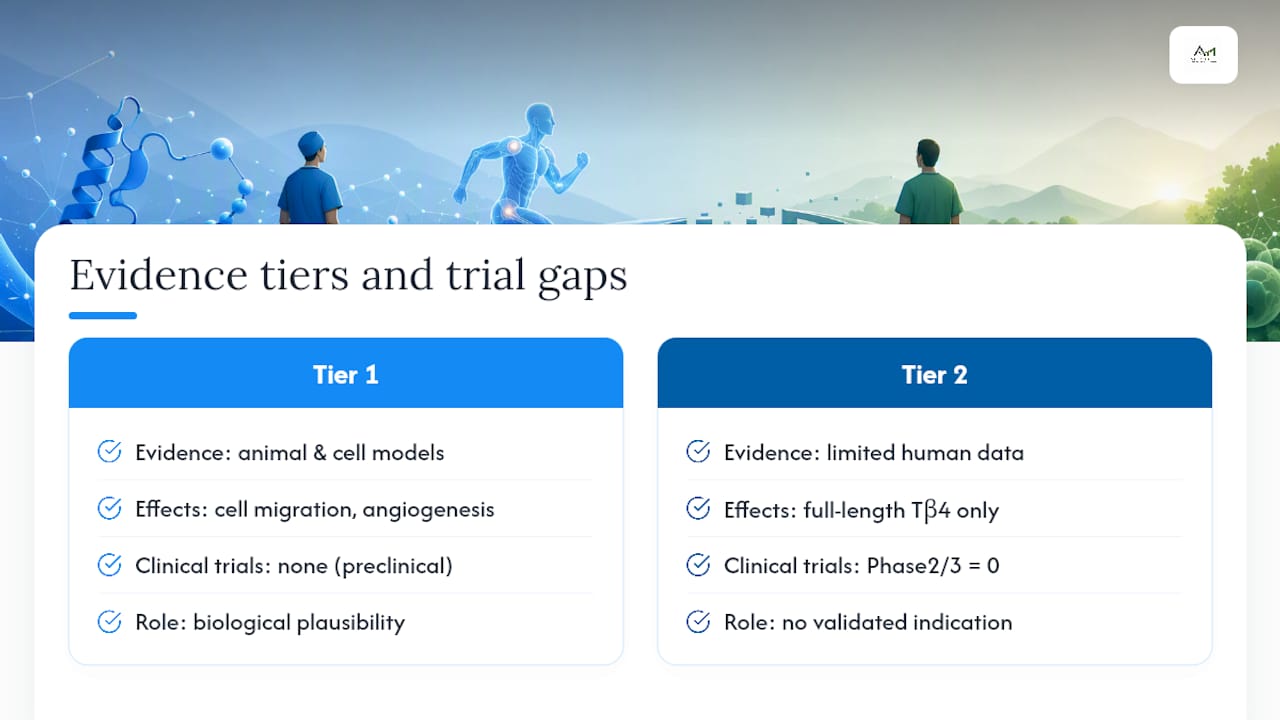
The evidence for TB-500 breaks into two tiers, and conflating them is where most online claims go wrong.
Tier one is preclinical: animal models and cell cultures showing Tβ4 and TB-500 fragments promote cell migration, reduce inflammation markers, and support new vessel growth around injury sites. This work is genuinely useful for understanding biological plausibility. It is not the same as proving a therapy works in a human knee, tendon, or surgical incision.
Tier two is where the trail goes cold. As of now, no Phase 2 or Phase 3 randomized controlled trials of the TB-500 fragment exist for tendon, ligament, or muscle injuries. Whatever human data does exist tends to come from studies of full-length thymosin beta-4, tested for different conditions like corneal healing or cardiac tissue, not injectable TB-500 for sports or post-surgical recovery.
By the Numbers: Zero. That is the current count of completed Phase 2 or Phase 3 human trials evaluating injectable TB-500 for orthopaedic or muscular injury recovery. Every dosing protocol circulating online is built on preclinical inference and community reporting, not controlled clinical results.
Regulatory bodies have taken notice of that gap. The FDA has published guidance materials and held advisory sessions on compounded peptides, and TB-500 sits among the substances flagged for insufficient safety data. A pharmacy compounding advisory committee meeting scheduled for 2026 reflects that ongoing scrutiny. Meanwhile, WADA lists thymosin beta-4 and TB-500 as prohibited substances in competitive sport, which has nothing to do with proven efficacy and everything to do with anabolic and healing-agent classifications.
Narrative reviews aimed at orthopaedic providers land on a consistent message: understand the mechanism, but do not mistake it for a validated clinical indication. Dosing standards, in particular, remain undefined by any regulatory or peer-reviewed clinical body.
What Dosing Protocols and Timelines Do People Actually Use?
No governing body has approved a TB-500 dosing schedule, so what circulates online reflects community and clinician-reported practice patterns, not prescribing information. Here is the structure most commonly described:
- Loading phase (weeks 1 through 4 to 6): Roughly 2 to 2.5 mg injected subcutaneously, twice weekly. The idea behind front-loading is to saturate tissue faster during the window when inflammation and cell migration are most active.
- Maintenance phase: Once loading concludes, dosing typically drops to about 2 to 2.5 mg once every one to two weeks, continued for as long as the recovery goal requires.
- Total weekly load: During loading, that works out to roughly 4 to 5 mg per week; some higher-intensity community protocols report doses toward the upper end of that range for more severe injuries, though nothing in the clinical literature validates a "more is better" relationship.
- Cycle length: Reported cycles generally span multiple weeks, often between one to three months, combining loading and maintenance phases, though this varies by injury severity and individual response.
One detail worth knowing if you are also researching other peptides: TB-500 is handled differently than microgram-dosed options like BPC-157. It runs on milligram-scale dosing, less frequent injections, and a systemic rather than localized injection approach, which changes both the syringe math and the injection routine compared to peptides dosed at the injury site.
Realistic assessment checkpoints matter more than the calendar. Rather than judging progress purely by weeks elapsed, track functional milestones: pain scores at rest and under load, range of motion measured at set intervals, and specific return-to-activity markers like walking without a limp or resuming a sport-specific movement pattern. Set those checkpoints at the two-week, four-week, and eight-week marks so you're not relying on subjective "feels better" impressions alone.
How Is TB-500 Reconstituted and Administered Safely?
Reconstitution math is where a lot of confusion (and dosing errors) happen, so getting the ratio right matters before anything else.
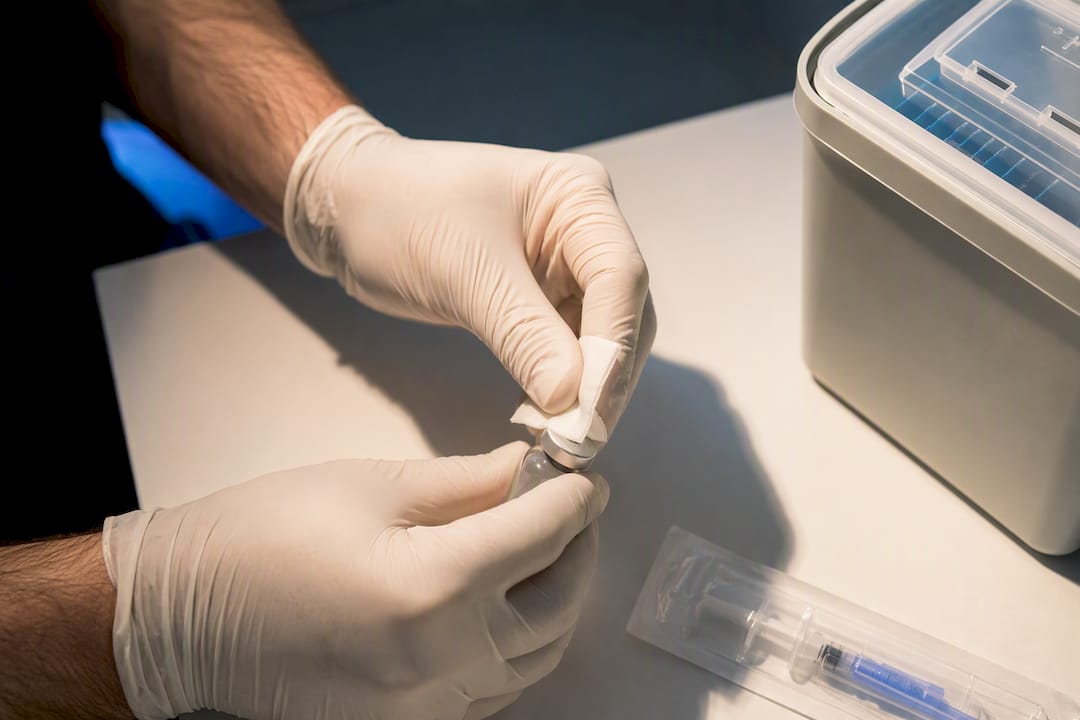
A commonly cited example: a 10 mg vial reconstituted with 2.0 mL of bacteriostatic water yields a concentration of 5 mg/mL. At that concentration, a 2.5 mg dose equals 0.5 mL, or 50 units on a standard insulin syringe marked in 100-unit increments. Get the vial size or dilution volume wrong, and that unit count shifts substantially, which is exactly why clinician oversight on reconstitution isn't optional.
Storage matters just as much as the initial math:
- Refrigerate reconstituted solution and use it within a 2 to 4 week window based on common clinic and community practice guidance.
- Avoid freezing, which can degrade peptide structure.
- Keep the vial away from light and check for cloudiness or discoloration before each draw.
- Administer subcutaneously, typically in the abdomen, using a fresh needle for each injection.
- Rotate injection sites to avoid tissue irritation with repeated use.
None of this stability guidance comes from an FDA-approved product label. It reflects practice patterns reported by clinics and peptide communities, which is a meaningfully lower bar than validated pharmaceutical stability data.
Pro Tip: Log every injection: date, site, dose, and any reaction, no matter how minor. That log becomes essential if a clinician needs to troubleshoot a side effect or gauge whether the protocol is actually producing functional improvement.
Sterile technique is non-negotiable regardless of what the peptide is. Wipe the vial top and injection site with alcohol before each draw, never reuse needles, and dispose of sharps in a proper container rather than household trash.
What Are the Side Effects and Warning Signs to Watch For?
Short-term side effects reported with TB-500 use tend to be mild but worth tracking closely:
- Injection-site redness, swelling, or mild soreness lasting a day or two.
- Transient fatigue, particularly after the first few doses of a loading phase.
- Head pressure or mild headache, reported anecdotally but not well characterized in controlled studies.
- Occasional lightheadedness shortly after injection.
The theoretical concern that deserves more attention than it usually gets is angiogenesis. Because TB-500's proposed mechanism includes promoting new blood vessel formation, there is a plausible biological argument that the same pathway could, in theory, support tumor growth in someone with existing or undiagnosed cancer. No clinical trial has confirmed this risk in humans, and no trial has ruled it out either. That uncertainty is precisely why a personal or family history of cancer should be disclosed and weighed carefully before starting any Tβ4-related peptide, and why unsupervised self-sourcing skips a safeguard that actually matters.
A basic monitoring framework should include:
- Baseline screening covering personal and family cancer history, current medications, and any pre-existing vascular conditions.
- Functional checkpoints every two to four weeks tracking pain, mobility, and activity tolerance.
- Labs or imaging if indicated, particularly if new or unexplained symptoms appear during the cycle.
- Clear stop criteria: discontinue and contact a physician immediately for unexplained lumps, rapid swelling, unusual bruising patterns, or any symptom that doesn't track with normal post-injury healing.
How Does the BPC-157 Stack (the "Wolverine Stack") Work?
The combination of TB-500 with BPC-157, sometimes nicknamed the "Wolverine stack" after the fictional healer, is popular in recovery communities because the two peptides target overlapping but distinct repair pathways. BPC-157 is dosed at the microgram level, often injected near the injury site, while TB-500 works systemically at milligram doses. The theory is that pairing localized and systemic action covers more of the healing process than either peptide alone.
The problem is that no randomized controlled trial has tested the combination in humans, so any claimed synergy is speculative rather than demonstrated. Stacking also compounds the unknowns rather than simply adding them:
- Cumulative angiogenesis exposure — two peptides working on related vascular pathways raises the same theoretical cancer-risk question, only doubled.
- Dosing rhythm mismatches — BPC-157's more frequent, lower-dose schedule doesn't line up neatly with TB-500's spaced, higher-dose pattern, complicating monitoring.
- Compounded side-effect attribution — if a reaction occurs, isolating which peptide caused it becomes harder with two variables in play.
A clinician supervising a stacked protocol should track both peptides' injection logs separately and treat side effects as attributable to either agent until proven otherwise.
Is TB-500 Legal and What Is Its Regulatory Status?
TB-500 is not FDA-approved for any human therapeutic use as of the latest FDA communications, and it carries no approved indication for injury or post-surgical recovery. It's typically sold under research-use-only labeling, which legally restricts its marketing for human consumption even though it circulates widely in fitness and recovery circles.
Practical points worth knowing:
- Sporting consequences: WADA's prohibited list includes thymosin beta-4 and TB-500, meaning any tested athlete risks a positive result and sanctions regardless of intent.
- Sourcing risk: Research-grade peptides sold without pharmaceutical manufacturing oversight carry unknown purity and contamination risk, a concern the FDA has raised repeatedly around compounded and unregulated peptides.
- Clinician responsibility: A physician recommending or overseeing off-label peptide use carries the burden of documenting informed consent, weighing risk against evidence, and sourcing from a licensed, traceable supply chain.
How Do You Decide If a Supervised TB-500 Trial Makes Sense?
Before anyone starts a TB-500 cycle, a physician should work through a structured screening and goal-setting process rather than jumping straight to a dosing schedule.
- Screen for contraindications first. Review personal and family cancer history, current pregnancy or plans for pregnancy, and any medications that affect clotting or vascular function.
- Define the specific recovery goal. Is this post-surgical tissue repair, a soft-tissue sports injury, or general recovery support? Vague goals make it impossible to judge whether the peptide is doing anything.
- Set measurable functional milestones. Track pain scores on a consistent scale, document range of motion with actual measurements, and define what "return to activity" looks like for that specific injury.
- Establish documentation habits from day one. Every dose, site, and symptom gets logged, not remembered.
- Plan the endpoint in advance. Decide upfront what "no improvement" looks like at the four- and eight-week marks, and agree on when to stop the peptide and pursue diagnostic imaging or a different treatment path instead.
What Does Airmed Fit's Supervised Model Bring to This Conversation?
Airmed Fit runs peptide programs through a telemedicine and lab-monitoring workflow rather than leaving dosing decisions to guesswork or unverified sourcing. Every consult sits under physician oversight, and the peptide catalog draws from licensed US manufacturers rather than unregulated research-chemical vendors.
If you're evaluating any supervised peptide program, not just this one, three things matter most: does a physician actually review your history before prescribing, does the program include lab monitoring to catch problems early, and can the provider verify where the peptide came from? Programs that skip any of those three may involve more risk than the evidence justifies.
Ready for a Supervised Consult?
If everything above tells you one thing, it's that TB-500 recovery protocols only make sense with a physician actively managing the process, not a forum thread. A telemedicine model can provide oversight without requiring an in-person visit to get started: a licensed physician may review your medical history and recovery goals, order baseline labs where appropriate, and discuss realistic expectations before any prescription decision gets made.
To be clear about scope: TB-500 is not FDA-approved for human therapeutic use, and no clinician worth trusting will tell you otherwise. Some programs offer a structured way to weigh the actual risks and benefits with someone qualified to interpret your labs and history, sourcing peptides through licensed manufacturers rather than unverified research-chemical channels. If a supervised approach to recovery sounds like the right next step, you can schedule a telemedicine consultation and get a physician's read on whether peptide-assisted recovery fits your situation.
Sources
- Injectable Peptide Therapy: A Primer for Orthopaedic and Sports Medicine Physicians
- TB-500 Dosing Guide: Protocol, Reconstitution & Safety (2026)
- Simultaneous quantification of TB‑500 and its metabolites... (Journal of Chromatography B, 2024)
This article is general information, not a substitute for advice from a qualified doctor. Consult a qualified healthcare professional about your own circumstances before acting on anything here.
FAQ
How Long Does It Take TB-500 to Work?
Community-reported timelines suggest some people notice changes in soreness or mobility within two to three weeks of starting a loading phase, but no controlled human trial has established a validated onset timeline for TB-500 specifically.
How Long Can You Stay on TB-500?
Most reported cycles run 4 to 12 weeks combining loading and maintenance phases, though there's no clinically validated maximum duration since human trial data doesn't exist to establish one.
Does TB-500 Raise Testosterone?
No credible evidence supports TB-500 affecting testosterone levels. Its proposed mechanism centers on actin regulation, cell migration, and angiogenesis, none of which involve the hormonal pathways that govern testosterone production.
Is It Okay to Take TB-500 Daily?
Reported protocols use twice-weekly loading doses rather than daily injections, and no dosing standard supports daily administration; a physician should determine frequency based on individual monitoring, not a fixed community template.
Is TB-500 Safe to Use Without a Doctor?
Unsupervised use skips baseline cancer screening, sourcing verification, and monitoring for theoretical angiogenesis risk, which is why a physician-supervised program like the consult process at Airmedfit is the safer route for anyone considering it.