

Testosterone replacement therapy tends to produce modest reductions in total cholesterol and LDL, along with a small drop in HDL that alarms a lot of patients more than it should. The largest randomized trial to date, TRAVERSE, found monitored transdermal testosterone was noninferior to placebo for major cardiac events, though it flagged higher rates of atrial fibrillation, blood clots, and kidney injury. The practical takeaway: treat lipids as part of an ongoing risk conversation on TRT, not as a reason to start or avoid it in the first place.
TL;DR:
- Men with elevated triglycerides or insulin resistance tend to see larger lipid improvements on TRT, especially in triglycerides and HDL.
- Switching from oral to transdermal or injectable formulations reduces the impact on HDL, with dosage and timing influencing lipid changes over time.
- A comprehensive lipid panel, including apoB or non-HDL cholesterol, is essential for proper monitoring, rather than focusing solely on HDL levels.
- Long-term safety data like TRAVERSE shows no significant increase in major cardiac events for monitored men, but warnings about atrial fibrillation and kidney injury persist.
- Lifestyle interventions and standard lipid therapies remain primary strategies for managing lipid changes during TRT, with dose adjustments or therapy pauses for serious adverse lab findings.
Table of Contents
- How Does TRT Affect Cholesterol Levels?
- Why Does HDL Drop on TRT, and Should You Worry?
- Does the Formulation or Dose You Use Change the Lipid Effect?
- What Do TRAVERSE, Meta-Analyses, and Regulators Actually Say?
- What Labs Should You Get, and How Often, While on TRT?
- What If Your Lipids Get Worse on TRT? Management Options
- How Airmedfit Structures Physician-Supervised TRT and Lipid Monitoring
- Clinical Perspective: Weighing Symptom Relief Against Metabolic Risk
- Get Physician-Supervised TRT With Built-In Lipid Monitoring
- Sources
- FAQ
How Does TRT Affect Cholesterol Levels?
The honest answer is: it depends on the study, the dose, and the person. But a pattern shows up across the literature often enough to call it typical.
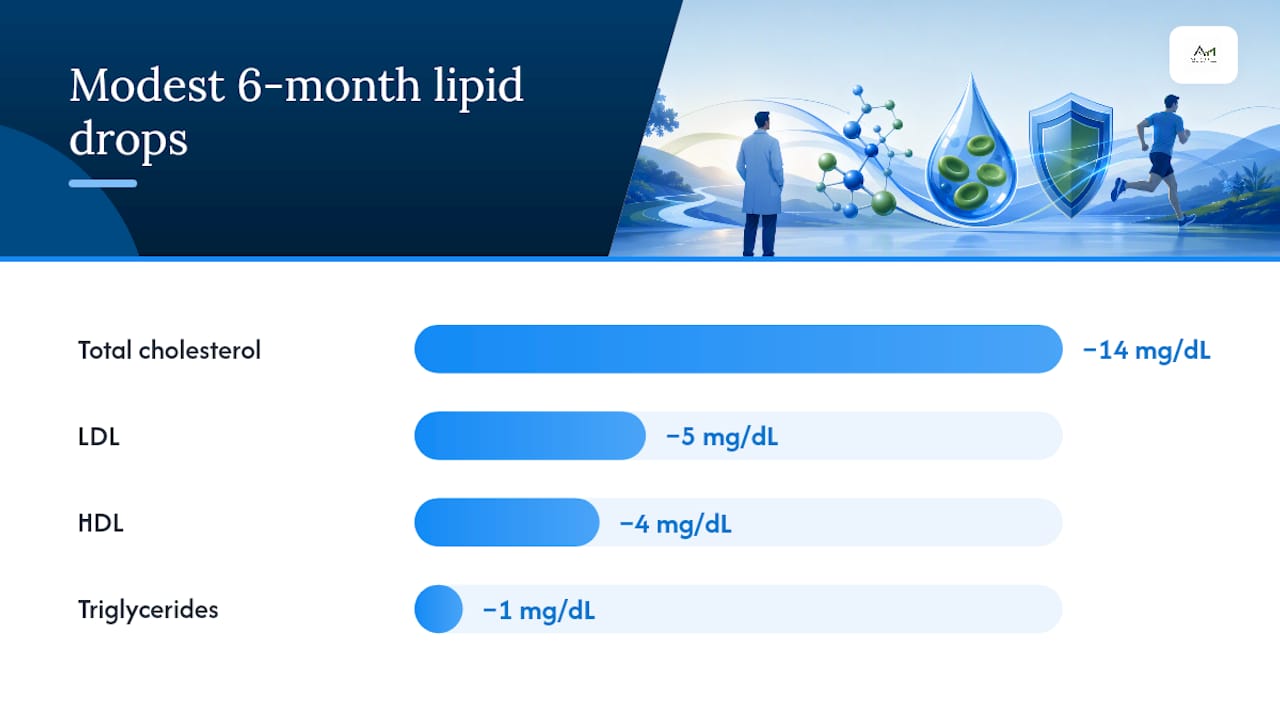
A widely cited meta-analysis of intramuscular testosterone reported mean changes over roughly six months of −14 mg/dL in total cholesterol, −5 mg/dL in LDL, −4 mg/dL in HDL, and −1 mg/dL in triglycerides, based on pooled data from an analysis of testosterone effects on lipid profiles. Those aren't dramatic swings. They're the kind of shift you'd expect from a moderate diet change, not a drug with major lipid claims attached to it.
Triglycerides tell a more interesting story. A cohort of 4,307 men tracked over 12 months showed average relative changes of −7.20% in total cholesterol, −11.38% in HDL, and −28.37% in triglycerides, according to cohort data on TRT and metabolic markers. The triglyceride drop was substantially larger in men who started with elevated baseline levels, which suggests the benefit is concentrated in people with metabolic dysfunction rather than spread evenly across every patient.
Why the numbers bounce around so much:
- Baseline metabolic health matters. Men with insulin resistance or high starting triglycerides tend to see bigger improvements than men with normal metabolic markers.
- Concurrent statin use dampens the apparent effect of testosterone on LDL, since the statin is already doing the heavy lifting.
- Study duration varies widely, from a few months to multi-year follow-up, and lipid effects can shift over time as the body adapts.
- Route and dose (covered in more depth below) change the magnitude and even the direction of some lipid shifts.
Here's the statistic worth sitting with: in the TRAVERSE study of symptomatic, hypogonadal men aged 45 to 80, cardiovascular event rates were comparable between testosterone and placebo groups during an average follow-up period of nearly three years. That's reassuring for the population it studied. It says nothing definitive about men outside that population, men on supraphysiologic doses, or men with uncontrolled cardiovascular disease at baseline.
The clinical reality is that TRT is not a lipid-lowering therapy. It sometimes produces lipid changes that look favorable on paper, but no major guideline recommends prescribing it for that purpose. Cholesterol management on TRT is a monitoring exercise, not a treatment goal.
Why Does HDL Drop on TRT, and Should You Worry?
The HDL question is where most patients get anxious, and honestly, where a lot of clinicians oversimplify things too.
Testosterone appears to increase hepatic lipase activity, an enzyme that breaks down HDL particles faster than normal. It may also shift HDL particle composition and could influence how reverse cholesterol transport, the process that moves cholesterol out of tissue and back to the liver, operates. None of these mechanisms are fully mapped, but they explain why a falling HDL number on TRT doesn't necessarily mean the cardiovascular protection HDL is supposed to represent is falling with it.
This matters because HDL concentration has a documented history of misleading researchers. The torcetrapib trial (ILLUMINATE) raised HDL substantially in study participants and cardiovascular events went up anyway, a finding detailed in a review on testosterone, HDL, and cardiovascular risk. HDL particle function and cholesterol efflux capacity, essentially how well HDL does its job rather than how much of it is floating around, may matter more than the number on the lab report.
What this means for interpreting your own labs:
- A modest HDL decline alongside a falling LDL and total cholesterol is a very different picture than an isolated HDL drop with everything else rising.
- Non-HDL cholesterol and apoB, when available, give a more complete read on atherogenic particle burden than HDL alone.
- Triglycerides and the triglyceride to HDL ratio often carry more clinically useful information than HDL by itself.
- A single low HDL reading is not, on its own, a reason to stop therapy.
Pro Tip: Ask your provider to run an apoB or non-HDL cholesterol panel alongside your standard lipids. A falling HDL next to a falling LDL and apoB is a far less concerning picture than a falling HDL next to rising everything else.
The clinical guidance here is consistent: don't chase the HDL number. Look at the whole lipid picture, and weigh it against your actual cardiovascular risk factors, not a single data point pulled out of context.
Does the Formulation or Dose You Use Change the Lipid Effect?
Yes, significantly, and this is one of the more underappreciated parts of the TRT and cholesterol conversation.
Oral androgens, particularly older 17-alpha-alkylated formulations rarely used today, produce far more aggressive HDL suppression than transdermal gels or injectable esters. That's a dose and first-pass liver metabolism issue, not a testosterone-in-general issue. Physiologic replacement, dosing that restores testosterone to a normal range rather than pushing well past it, produces the modest lipid shifts described in the meta-analyses above. Supraphysiologic dosing, the kind seen in performance-enhancement use rather than medical replacement, is associated with more pronounced and less predictable lipid derangement.
Injectable testosterone introduces another wrinkle: peak-trough variation. Levels spike shortly after an injection and decline until the next dose, and a lipid panel drawn during that peak can look different from one drawn near the trough. Clinical guidance on lab timing and interpretation during TRT recommends drawing labs at a consistent point in the dosing cycle every time, so you're comparing apples to apples across visits.
Factors that predict a larger or smaller lipid response:
- Route: Transdermal and injectable formulations at physiologic doses show the mildest lipid effects; oral androgens show the most pronounced HDL suppression.
- Baseline triglycerides: Men starting with elevated triglycerides tend to see the biggest improvements, per the cohort analysis referenced earlier.
- Age and metabolic status: Older men and men with obesity or type 2 diabetes often show different lipid trajectories than younger, metabolically healthy men.
- Concurrent statin therapy: A statin already controlling LDL will mute how much additional change TRT appears to add.
- Consistency of dosing schedule: Erratic dosing intervals make lab trends harder to interpret and can exaggerate apparent swings that are really just timing artifacts.
If you're switching between injection routes, it's worth understanding the pharmacokinetic differences before assuming a lipid change is caused by the hormone itself rather than the delivery method. A comparison of subcutaneous versus intramuscular injection breaks down how absorption patterns differ between the two.
What Do TRAVERSE, Meta-Analyses, and Regulators Actually Say?
Three bodies of evidence carry the most weight in this conversation, and they largely point in the same direction: cautious reassurance with real monitoring obligations attached.
TRAVERSE, published as the cardiovascular safety of testosterone replacement therapy, remains the most rigorous data available. It enrolled 5,246 symptomatic, hypogonadal men aged 45 to 80 and randomized them to transdermal testosterone gel or placebo. The primary composite cardiovascular endpoint hit noninferiority: A similar proportion of men in both the testosterone and placebo groups experienced major adverse cardiac events (HR 0.96, 95% CI 0.78 to 1.17), over a mean follow-up of 33 months. That's the headline. The fine print matters just as much: testosterone was associated with higher rates of atrial fibrillation, acute kidney injury, and pulmonary embolism, with pulmonary embolism occurring somewhat more frequently in the testosterone group compared to placebo in detailed reporting.
Systematic reviews and meta-analyses of lipid outcomes echo the same theme of modest, inconsistent change rather than dramatic risk reduction or dramatic harm. The heterogeneity across studies, different doses, routes, follow-up durations, and baseline populations, explains why one trial reports a meaningful LDL drop and another reports almost nothing.
What the two governing bodies require:
- The Endocrine Society clinical practice guideline restricts TRT to men with consistent symptoms and unequivocally low testosterone, and lists contraindications including recent MI or stroke within six months, uncontrolled heart failure, thrombophilia, and untreated severe sleep apnea.
- The guideline specifies hematocrit surveillance as a core monitoring parameter, with older guidance flagging a threshold around 54% as grounds to hold or adjust injectable dosing.
- The FDA's class-wide labeling update instructs clinicians to monitor blood pressure, hematocrit, and lipid profiles after initiation or any dose increase.
- FDA labeling cites a small a small difference in systolic blood pressure seen in TRAVERSE, with slight increases in the testosterone group compared to placebo.
Put together, the trial data, the meta-analyses, and the regulatory guidance converge on one message: TRT for a properly diagnosed, symptomatic, hypogonadal man is not the cardiovascular hazard it was once assumed to be, but it is not risk-free either. The adverse-event signals in TRAVERSE are real enough that monitoring isn't optional paperwork. It's the mechanism that turns "probably safe" into "safe for this specific patient."
What Labs Should You Get, and How Often, While on TRT?
A monitoring schedule only works if it's specific enough to actually follow. Here's a practical version drawn from guideline and labeling recommendations.
Baseline panel, before starting or restarting therapy:
- Full lipid panel (total cholesterol, LDL, HDL, triglycerides), plus apoB or non-HDL cholesterol if your provider offers it.
- Hematocrit and hemoglobin.
- Blood pressure, measured properly, not a rushed office reading.
- HbA1c, especially relevant given testosterone's metabolic interactions.
- A sleep apnea screen if symptoms or risk factors are present, since untreated severe sleep apnea is a contraindication.
- A full medication review, checking for interactions with anticoagulants, antihypertensives, or existing lipid therapy.
Follow-up timing: Repeat labs at three to six months after starting therapy or after any dose change, then move to annual monitoring once levels and symptoms have stabilized. Draw blood at a consistent point in the dosing cycle every time, ideally the same number of days post-injection or post-application, so trend lines actually mean something.
Action thresholds that should prompt a conversation, not panic:
- Hematocrit climbing above 54% warrants a dose review or a temporary hold, consistent with Endocrine Society guidance.
- A significant LDL rise or persistently uncontrolled blood pressure should trigger reevaluation and, where appropriate, a cardiology referral.
- New atrial fibrillation symptoms, unexplained shortness of breath, or leg swelling deserve urgent evaluation given the clotting and arrhythmia signals seen in TRAVERSE.
Pro Tip: If you're on injectable testosterone, write down the exact day of your last injection before every lab draw. A lipid panel drawn on day two of a cycle can look meaningfully different from one drawn on day twelve, and that gap has nothing to do with whether your treatment is working.
Men considering TRT for the first time often underestimate how much this monitoring rhythm resembles managing any other chronic condition. A week-by-week overview of starting TRT walks through what that early monitoring period typically looks like in practice.
What If Your Lipids Get Worse on TRT? Management Options
An unfavorable lipid shift on TRT is not automatically a reason to quit therapy, but it is a reason to act, and the right action depends on what's actually happening.
Lifestyle measures worth prioritizing first:
- A Mediterranean-style eating pattern, heavy on olive oil, fish, vegetables, and legumes, has among the strongest evidence bases for improving lipid profiles independent of any medication.
- Consistent aerobic and resistance training, ideally most days of the week, improves both triglycerides and HDL function over time.
- Weight loss, even modest amounts in men carrying excess visceral fat, tends to move triglycerides and HDL in the right direction faster than almost any other intervention.
- Smoking cessation and moderating alcohol intake both directly affect HDL and triglyceride levels, and both compound whatever effect TRT itself is having.
When lifestyle isn't enough: If LDL or overall atherosclerotic risk warrants it, standard lipid therapy, meaning statins or other guideline-directed medications, should be started or intensified according to normal cardiovascular guidelines. TRT is not a substitute for indicated lipid-lowering treatment, and a clinical review of TRT and lipid management is explicit that standard therapy should proceed on its own merits rather than waiting to see if testosterone helps first.
When to change or pause TRT itself: A dose reduction, a formulation switch, or a temporary hold becomes appropriate when hematocrit climbs past the action threshold, blood pressure stays uncontrolled despite treatment, or a thrombotic event like a DVT or pulmonary embolism occurs. Those situations call for coordination between whoever manages your TRT and whoever manages your cardiovascular risk, not a unilateral decision made in isolation.
How Airmedfit Structures Physician-Supervised TRT and Lipid Monitoring
A monitoring plan is only as good as the system built to actually run it, and this is where a lot of self-managed or loosely supervised TRT falls apart.
One model starts with a physician consultation to confirm the diagnosis and screen for contraindications before any prescription is written. Ongoing care may include home kits for baseline and follow-up bloodwork, including lipids and hematocrit, without a clinic visit. There are membership programs that wrap consults, prescribing, and lab review into one ongoing relationship instead of a series of disconnected transactions.
The point of that structure is coordination. When a lipid panel comes back with a concerning LDL trend or hematocrit creeping toward the action threshold, the physician managing the TRT is the same person reviewing the labs, which shortens the gap between a flagged result and an actual dose adjustment or referral to a primary care physician or cardiologist. are the kind of specifics that would strengthen this further as they become available.
Clinical Perspective: Weighing Symptom Relief Against Metabolic Risk
TRT exists to treat confirmed hypogonadism, not to manage a lipid panel. That distinction gets lost constantly in online discussions, where people frame cholesterol changes as a reason to start or avoid therapy altogether. Neither framing holds up. TRAVERSE gives conditional reassurance for monitored, properly diagnosed men, but its signals for atrial fibrillation, kidney injury, and pulmonary embolism are not footnotes to explain away. They're the reason monitoring exists in the first place. Shared decision-making means being honest about what the evidence actually supports: real symptom relief for the right patient, paired with real obligations around hematocrit, blood pressure, and standard lipid management that don't disappear just because testosterone levels normalized.
— Organic
Get Physician-Supervised TRT With Built-In Lipid Monitoring
Most men trying to manage TRT and cholesterol on their own end up guessing at lab timing, skipping follow-up panels, or not knowing which numbers actually warrant a call to their doctor. Airmedfit's model closes that gap by pairing physician oversight with scheduled lab work from day one, so lipid and hematocrit trends get caught early instead of discovered by accident months later.

Start with a doctor's consultation to review your history and confirm whether TRT is appropriate, then use the TruLab TRT home kit to establish a baseline lipid and hematocrit panel before your first dose. Bring your existing cardiovascular and lipid history to that first visit and ask directly how lab timing will work around your dosing schedule. For ongoing care, the Signature TRT Membership keeps consults, prescribing, and lab review under one coordinated plan instead of scattered across separate providers. Book your consultation today and get a monitoring plan built around your actual risk profile, not a generic protocol.
Sources
- Cardiovascular Safety of Testosterone-Replacement Therapy
- Meta-analysis of testosterone effects on lipid profiles (representative)
- FDA issues class-wide labeling changes for testosterone products
- Endocrine Society clinical practice guideline: Testosterone therapy in men with hypogonadism
FAQ
Does TRT Cause Plaque Buildup in Arteries?
There's no direct evidence that physiologic TRT accelerates arterial plaque buildup in properly diagnosed, monitored men. TRAVERSE found noninferior cardiovascular event rates against placebo, though it did flag higher rates of atrial fibrillation, blood clots, and kidney injury that warrant ongoing monitoring rather than dismissal.
How Do You Raise Good Cholesterol While on TRT?
HDL often drops modestly on TRT, but aerobic exercise, weight loss, and reducing alcohol and saturated fat intake all support healthier HDL levels independent of testosterone therapy. Rather than chasing the HDL number specifically, focus on overall lipid balance, including LDL, triglycerides, and apoB when available, since HDL concentration alone is an imperfect risk marker.
Which Hormone Causes High Cholesterol?
No single hormone is solely responsible for high cholesterol, but low testosterone itself is associated with unfavorable lipid patterns in some men, which is part of why TRT sometimes modestly improves total cholesterol and LDL. Thyroid hormone deficiency and insulin resistance also strongly influence cholesterol levels and should be ruled out during any lipid workup.
Is Two Eggs a Day Too Much Cholesterol?
For most healthy adults, two eggs a day is not considered excessive and fits within a typical Mediterranean-style eating pattern that supports healthy lipids. Men on TRT with elevated LDL or existing cardiovascular risk factors should still discuss individual dietary cholesterol limits with their provider, since tolerance varies by overall metabolic health.
Does TRT Cost More If You Need Extra Lipid Monitoring?
Lab monitoring is typically priced separately from the therapy itself. Airmedfit's Men's Essential Lab Panel, which includes a home kit, is available for $129 one time, giving patients a way to track lipids and other key markers alongside their TRT plan.