

BLUF: 503A compounding pharmacies make patient-specific medications under state board oversight; 503B outsourcing facilities register with the FDA and follow CGMP so they can produce larger batches for office use and ship across state lines. If you're writing a prescription for one named patient, you need 503A. If you're stocking a clinic or hospital with ready-to-administer supplies, you need 503B.
TL;DR:
- 503A pharmacies are licensed to compound medications for specific patients under prescriptions, with oversight mainly from state boards and guidance from USP standards.
- 503B outsourcing facilities can produce large batches for offices and ship across state lines, with FDA registration and CGMP compliance, suitable for ready-to-administer sterile products.
- Moving from 503A to 503B requires building a formal quality management system, valid test methods, and extended validation work that can take months to implement.
- Both types cannot legally replicate commercial drugs for convenience unless shortages or specific clinical differences are documented and justified.
- Confirming proper licensing, validated testing, environmental monitoring, and documentation is essential for safe sourcing from either 503A or 503B vendors.
Table of Contents
- 503A vs 503B: The Core Regulatory Split
- Regulatory Differences That Actually Matter in Practice
- When Clinicians Should Choose 503A vs 503B
- A Compliance Checklist for Pharmacists and Procurement Teams
- Why Moving From 503A to 503B Is Harder Than It Looks
- A Different Route: Coordinated Prescribing and Follow-Up
- Where to Find the Official Rules
- Sources
- FAQ
503A vs 503B: The Core Regulatory Split
The fastest way to tell these apart is to ask who's getting the medication. A 503A pharmacy compounds for a specific, identified patient based on a valid prescription from a licensed prescriber. A 503B outsourcing facility can compound in bulk, without a patient's name attached to each unit, because it operates under a different section of the Federal Food, Drug, and Cosmetic Act.
What is a 503A compounding pharmacy?
A 503A pharmacy is a state-licensed pharmacy or federal facility where a licensed pharmacist or physician compounds a drug for an individual patient. The FDA's own guidance on pharmacy compounding under section 503A lays out the conditions a pharmacy must meet to qualify for exemptions from certain FD&C Act provisions, including sections that would otherwise require new drug approval.
State boards of pharmacy, not the FDA, handle the routine oversight here. Instead of federal CGMP, 503A pharmacies typically follow USP compounding standards, especially USP <795> for nonsterile preparations and USP <797> for sterile ones.
Common 503A scenarios include:
- A pediatric patient who needs a liquid formulation of a drug only available as a tablet
- A patient with a documented allergy to a dye or preservative in a commercial product
- Dose titration outside standard commercial strengths, ordered for one named patient
What is a 503B outsourcing facility?
A 503B outsourcing facility is a compounder that has registered with the FDA under the framework created by the 2013 Drug Quality and Security Act. That registration comes with real obligations: outsourcing facilities must comply with Current Good Manufacturing Practice under 21 CFR parts 210 and 211, the same framework that governs conventional drug manufacturing.
That CGMP burden is the trade for a real advantage: 503B facilities can compound without a patient-specific prescription, supply office-use stock, and ship interstate under federal registration.
Hospitals and clinics lean on 503B facilities for:
- Ready-to-administer sterile products (pre-filled syringes, IV bags) that don't require in-house sterile compounding
- Larger batch runs when a single-patient pharmacy can't scale
- Backup supply during drug shortages, when commercial manufacturing can't keep up
Regulatory Differences That Actually Matter in Practice
The gap between 503A pharmacy guidelines and 503B compounding standards isn't academic. It determines who inspects your supplier, what paperwork you should expect, and whether a product can legally cross a state line.
Oversight and inspections. State boards of pharmacy inspect and license 503A pharmacies, with the FDA stepping in mainly when practices drift into manufacturing-scale activity or create safety risks. 503B facilities face FDA risk-based inspections as registered entities, similar in spirit to how a drug manufacturer is inspected.
Quality frameworks. 503A compounders lean on USP <795> and <797> plus state-specific rules. 503B facilities must build a CGMP-compliant quality system under 21 CFR parts 210/211, covering everything from environmental monitoring to batch records.
Prescriptions and distribution. A 503A order requires a prescription tied to a named patient, and interstate distribution is generally constrained by state licensing arrangements. A 503B facility's federal registration lets it ship compounded medications across state lines and supply office-stock without a patient's name on the order.
"Essentially a copy" and shortage exceptions. Neither type of compounder can simply recreate a commercially available drug for convenience or cost reasons. FDA guidance describes the "essentially a copy" prohibition in detail, but it carves out exceptions when a drug is on the FDA's shortage list or when a prescriber documents a genuine clinical difference the commercial product can't meet. That documentation has to be explicit and kept on file. It's not a formality a pharmacist can skip when a prescriber's rationale is thin.
Labeling and reporting. 503B facilities carry adverse-event reporting obligations similar to manufacturers, along with labeling requirements that flag the product as compounded. 503A pharmacies follow state labeling rules, which vary but generally require similar transparency.
When Clinicians Should Choose 503A vs 503B
- Route to a 503A pharmacy when the need is patient-specific: an unusual strength, a flavor change for a pediatric patient, a preservative-free version for someone with a documented sensitivity, or any low-volume, individualized order.
- Contract a 503B outsourcing facility when you need ready-to-administer sterile products at scale, when a health system operates across multiple sites and needs consistent supply, or when a commercial drug is on shortage and a hospital pharmacy can't compound enough in-house.
- Factor in beyond-use dating (BUD) and stability data before choosing either route. A 503A product's shorter BUD may work fine for immediate patient use but won't support a hospital's inventory cycle the way a stability-tested 503B product can.
- Multi-state health systems need a distribution plan, not just a supplier. Confirm whether your 503A source has the state licenses or memoranda of understanding needed for cross-border patient care, and confirm a 503B vendor's FDA registration is current before signing a supply contract.
A Compliance Checklist for Pharmacists and Procurement Teams
- Confirm licensing status: state pharmacy license and good standing for 503A vendors; active FDA registration for 503B facilities.
- Request certificates of analysis (COAs) and verify they reflect validated test methods, not just a boilerplate template.
- Review stability and beyond-use dating rationale for each product category you're sourcing.
- Check environmental monitoring records for sterile compounding, whether the source is 503A or 503B.
- Qualify vendors formally: document supplier audits, lot testing history, and any FDA warning letters or state board actions.
- Confirm shipping and cold-chain controls, especially for temperature-sensitive peptides and injectables covered in guidance on bacteriostatic vs sterile water handling.
- Keep an adverse-event reporting contact and recall protocol on file for every active compounding vendor.
Pro Tip: Don't just collect COAs. Spot-check them against the actual lot numbers on the product you received. Mismatched paperwork is one of the most common findings in FDA warning letters to outsourcing facilities.
Why Moving From 503A to 503B Is Harder Than It Looks
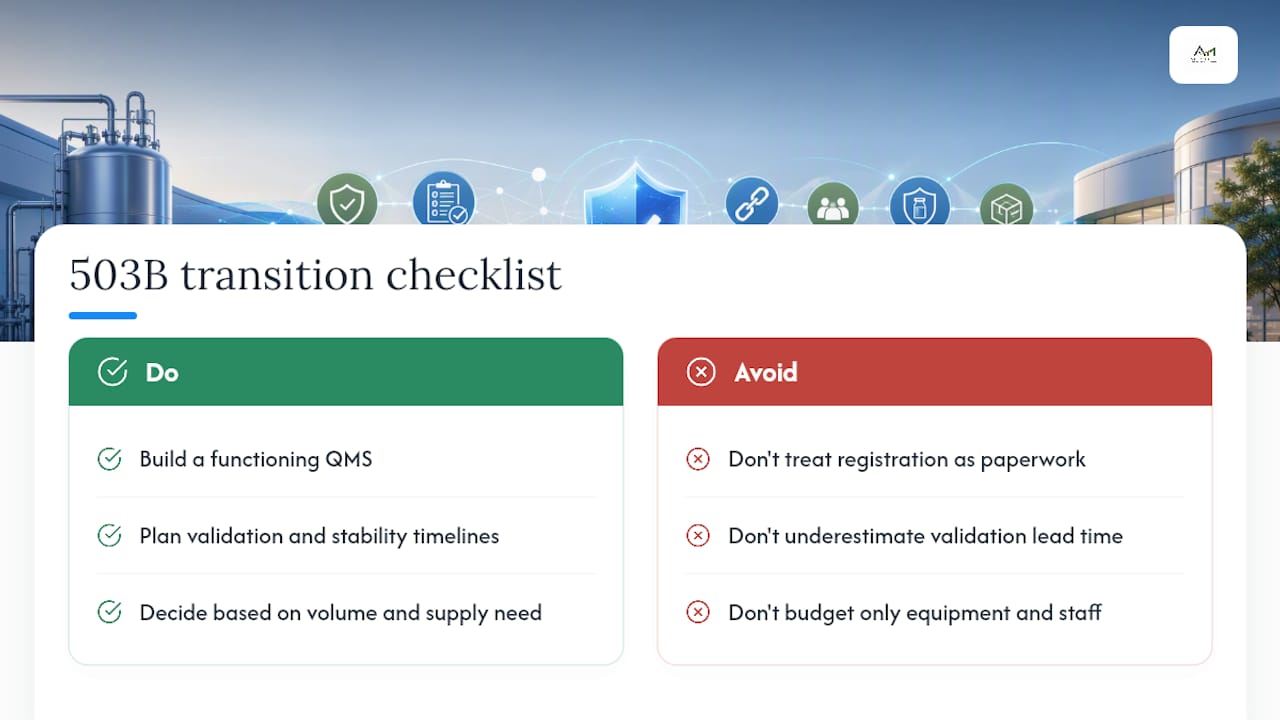
Registering as a 503B outsourcing facility isn't a paperwork upgrade. It's a different business. You're now on the hook for a functioning quality management system, validated test methods, and environmental monitoring programs that most retail compounding shops never had to build. The ISPE guidance for 503B compounding treats the QMS as the real barrier, and that tracks with what plays out in practice.
The most common mistake is underestimating the lead time for method validation and stability testing. Facilities budget for equipment and staff, then get blindsided by months of validation work before they can legally ship a single unit. The decision to make that leap should hinge on volume and supply-chain need, not ambition alone.
— Organic
A Different Route: Coordinated Prescribing and Follow-Up
Compounding pharmacies and outsourcing facilities solve the sourcing side of the equation. They don't solve the friction that often shows up before that: getting a patient in front of a licensed prescriber quickly, then keeping follow-up consistent. That's a separate problem, and it's the one Airmedfit is built around.
A service runs physician-supervised telemedicine consultations for hormone replacement therapy, weight management, and peptide therapy, pairing patients with a prescriber without the wait times common at brick-and-mortar clinics. This isn't a compounding provider, and it doesn't replace either a 503A pharmacy or a 503B facility. It's the prescribing and follow-up layer that sits upstream of those choices. Clinicians and practice managers evaluating how to streamline patient intake can review the consultation scheduling page or browse product and prescription details to see how the workflow fits alongside existing compounding relationships. If your practice is weighing how to connect patients faster with a licensed prescriber, start with a telemedicine consult.
Where to Find the Official Rules
For statutory language, go straight to the FDA's human drug compounding laws page. For manufacturing practice detail, use the FDA's 503B outsourcing facility guidance. For sterile and nonsterile compounding standards, USP's <795> chapter is the reference point state boards cite most.
This article is general information, not a substitute for advice from a qualified doctor. Consult a qualified healthcare professional about your own circumstances before acting on anything here.
FAQ
Which is safer, a 503A or 503B pharmacy?
Neither is inherently safer; they're built for different risk profiles. 503B facilities carry stricter CGMP oversight suited to large-batch sterile production, while a well-run 503A pharmacy following USP <795>/<797> is appropriate for individualized, lower-volume orders.
What is the difference between a 503A and a 503B facility?
A 503A pharmacy compounds patient-specific prescriptions under state board oversight and USP standards, while a 503B outsourcing facility registers with the FDA, follows CGMP under 21 CFR parts 210/211, and can produce office-use stock shipped across state lines.
Is a 503A or 503B pharmacy better?
Neither is universally better. The right choice depends on whether you need an individualized order for one patient (503A) or a large-volume, ready-to-administer supply for a clinic or hospital (503B).
Which pharmacies are 503A?
Any state-licensed pharmacy that compounds drugs for identified patients under a valid prescription, following USP guidance and state board rules, operates as a 503A pharmacy. This includes most independent and hospital compounding pharmacies serving individual patient prescriptions rather than bulk office-use stock.