
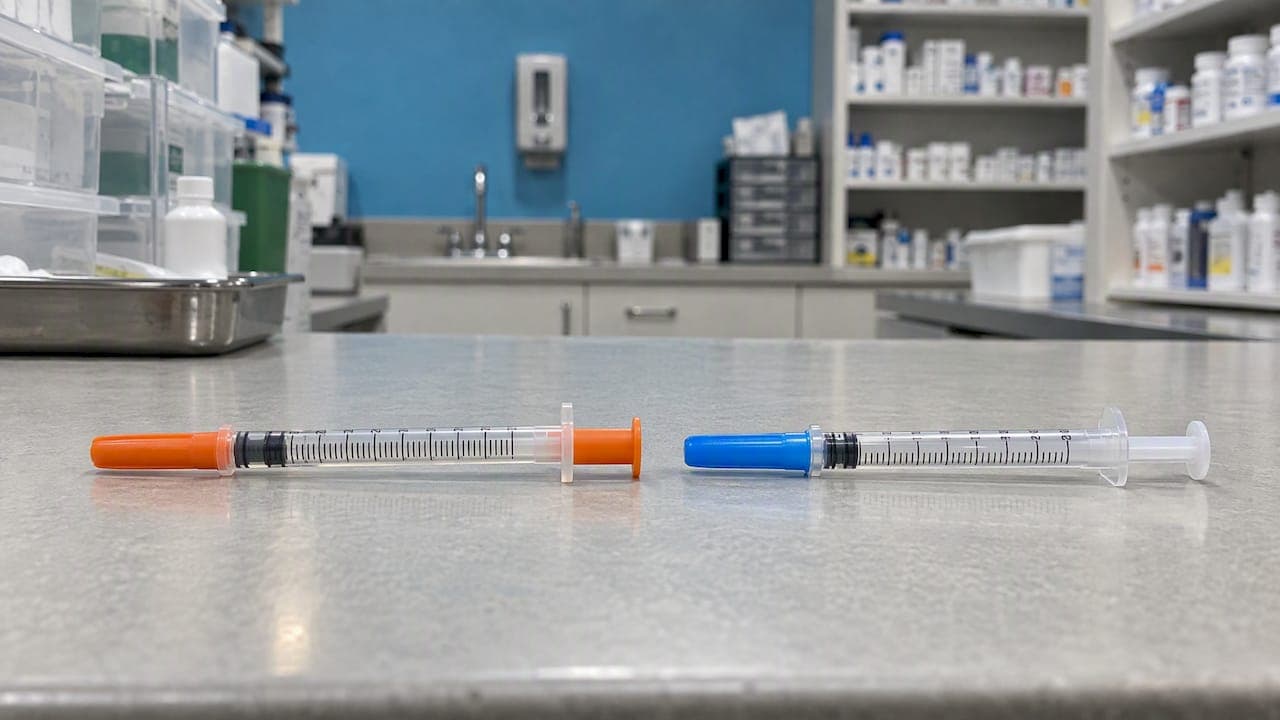
An insulin syringe and a tuberculin (TB) syringe look almost alike, but they are marked differently. Insulin syringes are calibrated in units. Tuberculin syringes are calibrated in milliliters (mL). Nursing skills references describe the same split. That difference in markings, not the barrel size or the needle, is what matters most. Reading one scale as if it were the other can lead to a serious dosing error.
This guide explains how the two syringes differ, what each was designed to do, and why safety groups warn against swapping them. It is general education. It is not dosing advice, and it does not tell you which syringe to use for your medication. Your prescriber or pharmacist decides that.
TL;DR
- Insulin syringes are marked in units for insulin. Tuberculin syringes are marked in mL and hold up to 1 mL.
- A units scale and an mL scale are not interchangeable. Units depend on the concentration of the product being drawn up.
- The Institute for Safe Medication Practices (ISMP) advises against preparing insulin in tuberculin syringes unless absolutely necessary.
- "1 cc" and "1 mL" are the same volume, but a 1 mL tuberculin syringe is not the same product as a 1 mL insulin syringe.
- Use the syringe your prescriber or pharmacist specified, and ask them to show you how to read it.
Table of Contents
- The core difference: units versus milliliters
- Why the difference matters
- Can a tuberculin syringe be used for insulin?
- Is a tuberculin syringe the same as a 1 cc syringe?
- How to compare the two before you use either
- Syringes beyond insulin and TB tests
- Perspective: why we explain syringes at all
- Safe handling after you have chosen the right syringe
- Talk to a clinician before you buy supplies
- Questions to bring to your appointment or pharmacy
- FAQ
- Sources
The core difference: units versus milliliters
Both devices are small, narrow syringes built for subcutaneous or intradermal work. What separates them is the scale printed on the barrel.
| Feature | Insulin syringe | Tuberculin (TB) syringe |
|---|---|---|
| Scale | Units, built for insulin | Milliliters (mL), commonly in 0.01 mL steps |
| Designed for | Measuring insulin at a set concentration | Small liquid volumes, including skin test injections |
| Typical capacity | Often 0.3 mL, 0.5 mL or 1 mL barrels | Up to 1 mL |
| What the lines mean | A number of insulin units, if the insulin matches the syringe | A volume of liquid, whatever the drug is |
| Main risk | Using it with a product that is not the concentration it was built for | Reading mL marks as units, or misreading a scale without leading zeros |
Barrel sizes and needle lengths vary by brand and by model, so check the packaging of the product you are actually holding rather than relying on a general chart.
How an insulin syringe is built
An insulin syringe is made so that a person can draw up a number of units without doing any math. The scale assumes a specific concentration. The most common concentration in the US is U-100, meaning 100 units in each milliliter. The ISMP insulin guideline gives an example of why this matters: 200 units of U-500 insulin would be measured as 40 "syringe units" on a U-100 syringe, and confusion of this kind can lead to five-fold dosing errors.
In other words, the line on an insulin syringe is a promise that holds only for the product it was designed around.
How a tuberculin syringe is built
A tuberculin syringe is a volume tool. Per Drugs.com patient guidance, a tuberculin syringe holds up to 1 mL and is marked every 0.1 mL on its main scale, and many models add finer lines in between. Its original purpose was the skin test for tuberculosis. The CDC describes the Mantoux test as an intradermal injection of 0.1 mL containing 5 tuberculin units of PPD solution. That is a small, exact volume, which is why the syringe is so finely graduated.
A tuberculin syringe has no idea what is in it. The marks say how much liquid is in the barrel, nothing else.
Why the difference matters
It is easy to assume that a small syringe is a small syringe. Safety organizations have documented that this assumption causes harm.
Look-alike products
The Pennsylvania Patient Safety Authority reviewed overdoses tied to confusion between the two syringes. It reported that similar appearance, packaging and color coding, such as orange plunger tips or caps, contributed to accidental substitution between some brands of insulin and tuberculin syringes. The same advisory warns that some manufacturers leave the leading zero off the tuberculin scale (.5 mL instead of 0.5 mL), which makes volumes easier to misread.
Insulin is a high-alert drug
AHRQ's patient safety network notes that ISMP classifies insulin as a high-alert medication and that insulin has been linked to more medication errors than any other drug type or class. A units-versus-mL slip is one of the ways those errors happen. A clinical reminder published in a peer-reviewed journal adds that insulin doses measured in mL instead of units can cause errors, and that misunderstanding "U-100" as 100 units per vial has led to 10-fold overdoses.
A worked example of the confusion
Imagine a person reads a line on a tuberculin syringe that says 0.5 and thinks "50 units." On a U-100 product, 0.5 mL does equal 50 units, so that happens to work. Now imagine the product is a different concentration. The same 0.5 mL contains a very different amount of drug, and the number the person has in their head is wrong. The syringe is not the problem. The missing link between volume and amount is.
The same logic applies to any medicine that comes with a mg strength per mL. A common reader question is whether 2.5 mg equals 25 units on an insulin syringe. There is no universal answer. Units on an insulin syringe are a measure of volume that was designed for U-100 insulin, and how many milliliters hold a given number of milligrams depends on how that specific vial was prepared or compounded. Only the prescriber's written instructions and the pharmacy label for your vial can tell you what to draw up. Do not convert on your own.
Can a tuberculin syringe be used for insulin?
The short, careful answer is: only if a clinician has told you to, and ideally not at all. The Pennsylvania Patient Safety Authority summarizes ISMP's position: insulin should not be prepared in tuberculin syringes unless absolutely necessary, and where it is unavoidable the practice carries risks that call for strict supervision.
Two more points from the safety literature:
- Before a U-500 insulin syringe existed, practitioners measured U-500 doses with U-100 or tuberculin syringes, and five-fold dosing errors followed. Purpose-built devices were created to remove that step.
- In care settings, experts including ISMP recommend removing tuberculin syringes from patient-care areas where they are not routinely needed, so they cannot be grabbed for insulin by mistake.
If a pharmacy runs short of insulin syringes, ask the pharmacist what to do. Do not improvise a substitution at home and guess at the conversion.
Is a tuberculin syringe the same as a 1 cc syringe?
Partly. A cubic centimeter (cc) and a milliliter are the same volume, so a 1 cc syringe and a 1 mL syringe have the same capacity. But "1 cc" describes capacity only. It does not tell you the scale, the needle length, the gauge or the tip type. A 1 mL tuberculin syringe has fine mL graduations and a slip or Luer tip with a needle. A 1 mL insulin syringe has a units scale and usually a permanently attached short needle. A general-purpose 1 mL syringe may have coarser markings and a different needle fitting again.
When you shop or read a prescription, treat "1 cc" as the capacity and look for the scale words on the package: units, U-100, mL.

How to compare the two before you use either
When a prescriber gives you a medication and a syringe, run through these checks.
- Read the scale. Does the barrel say units or mL? Match it to the unit your instructions use.
- Read the vial label. For insulin, note the concentration (for example U-100). For any other injectable, note the strength per mL.
- Check the syringe size. A smaller barrel gives more space between lines, which makes small amounts easier to read. A larger barrel packs more lines closer together.
- Look for leading zeros. Confirm that 0.5 mL is printed as 0.5, not .5.
- Do not rely on color. Orange caps and plungers appear on both syringe types in some brands.
- Ask for a demonstration. A pharmacist or nurse can show you what a mark looks like on your actual syringe.
- Write it down. Keep the instruction in the same units as the syringe, so you never convert at the moment of injection.
For related technique questions, our guides cover where to give a subcutaneous injection and how subcutaneous and intramuscular routes differ. Syringe choice and injection route are connected, since a shallow subcutaneous injection and a deeper muscle injection call for different needles.
Syringes beyond insulin and TB tests
Many people searching this question are not managing diabetes or getting a skin test. They have been prescribed another injectable, such as a weekly weight-management medicine, or they are comparing the supplies listed in a prescription. The same rules apply. The medication, its concentration and the scale on the syringe must line up, and the instructions must come from the prescriber and pharmacy label for that product.
This is especially important with compounded products. Concentrations can differ between pharmacies and between batches, so a unit count that worked for one vial may be wrong for another. Our article on safety questions to ask about compounded semaglutide lists what to confirm with your clinician. Product pages and forums are not a substitute: the label on your own vial and your clinician's written directions are.
For general background on how injectable weight-management options compare in format, this comparison of GLP-1 pills and injections puts the delivery methods side by side. We do not give self-treatment doses or injection instructions for investigational peptides, and we do not recommend using any syringe for a product that has not been prescribed to you.

Perspective: why we explain syringes at all
We publish educational content about consultations, hormone questions and weight management, and the same question keeps arriving in a different form: "which syringe, and how many units?" We think the honest answer is that the syringe is the smallest part of the decision. The more important parts are what is in the vial, who prescribed it, and whether the written directions use the same measurement as the device in your hand.
We also think readers deserve a clear line between approved, compounded and investigational products. A facility being registered is not the same as a product being approved. If a source cannot tell you which category a product falls into, take that question to a clinician before you buy supplies for it.
We do not tell readers how much of anything to inject. That belongs in a conversation with a licensed clinician who knows your history, and in the pharmacy label that comes with your medication.
— AirMedFit
Safe handling after you have chosen the right syringe
Once the right device is in hand, a few practical points keep the rest of the process safe:
- Single use. Syringes and needles are for one injection, then they go in a sharps container. See our guide to safe sharps disposal at home.
- Travel. Carrying syringes through an airport raises its own questions about labels and paperwork. Our travel guide for syringes covers TSA rules and packing.
- Diluents. If your medicine is reconstituted, the diluent and its time limit matter as much as the syringe. Read about bacteriostatic water shelf life before you plan supplies.
Talk to a clinician before you buy supplies
If you are exploring hormone therapy, weight management or other treatments and are unsure what supplies your plan would involve, a consultation is the right first step. AirMedFit lists doctor's consultation options, including an async consult at 49 USD and a sync consult at 120 USD, each one-off. Confirm current availability, scope and follow-up on the site before booking. A consultation does not guarantee a prescription, and any treatment decision rests with the clinician who evaluates you.
You can also see the consultation page or start from the AirMedFit home page to see current categories.
Questions to bring to your appointment or pharmacy
- Which syringe should I use for this exact product, and in what scale (units or mL)?
- What is the concentration of my vial, and is it written on the label?
- Is this product FDA-approved, compounded or investigational?
- If a pharmacy substitutes a different syringe, who can confirm the conversion?
- Can someone watch me draw up the first dose and check that I read the line correctly?
FAQ
Can a tuberculin syringe be used for insulin?
Safety groups say it should be avoided. ISMP advises that insulin not be prepared in tuberculin syringes unless absolutely necessary, and then only with strict supervision. The mL scale does not show units, so conversion errors become likely. If you cannot get insulin syringes, ask your pharmacist or prescriber what to do.
Is a tuberculin syringe the same as a 1 cc syringe?
Not exactly. A cc and an mL are the same volume, so a 1 cc syringe holds 1 mL. However, a tuberculin syringe is defined by its fine mL markings and intended use, not just its capacity. A generic 1 mL syringe may have different graduations and needle fittings.
Is 2.5 mg the same as 25 units on an insulin syringe?
No rule makes them equal. Units on an insulin syringe describe volume built for U-100 insulin, while milligrams describe the amount of drug, which depends on how concentrated your vial is. Use only the conversion written by your prescriber or on your pharmacy label for that vial.
What is the difference between insulin and TB syringes?
Insulin syringes are marked in units, designed for insulin at a set concentration. Tuberculin syringes are marked in milliliters and hold up to 1 mL. They can look nearly identical, so read the scale on the barrel every time.
Sources
- 18.2: Basic Concepts, Medicine LibreTexts
- 2017 ISMP Guidelines for Optimizing Safe Subcutaneous Insulin Use
- Overdoses Caused by Confusion Between Insulin and Tuberculin Syringes, Pennsylvania Patient Safety Authority
- A Clinical Reminder About The Safe Use of Insulin Vials
- It's All in the Syringe, AHRQ PSNet
- Latent Tuberculosis Infection: A Guide for Primary Health Care Providers, CDC
- How To Give A Subcutaneous Injection, Drugs.com
Recommended
- Subcutaneous vs Intramuscular: Which Injection Route Is Right?
- Travel With Syringes: TSA Rules, Packing and Paperwork
- Where to Give a Subcutaneous Injection: A Site-by-Site Guide
- Contain Sharps Now, 4 Safe Disposal Routes at Home
This article provides general educational information and is not personalized medical advice. A licensed clinician should assess treatment suitability, risks, and options.