
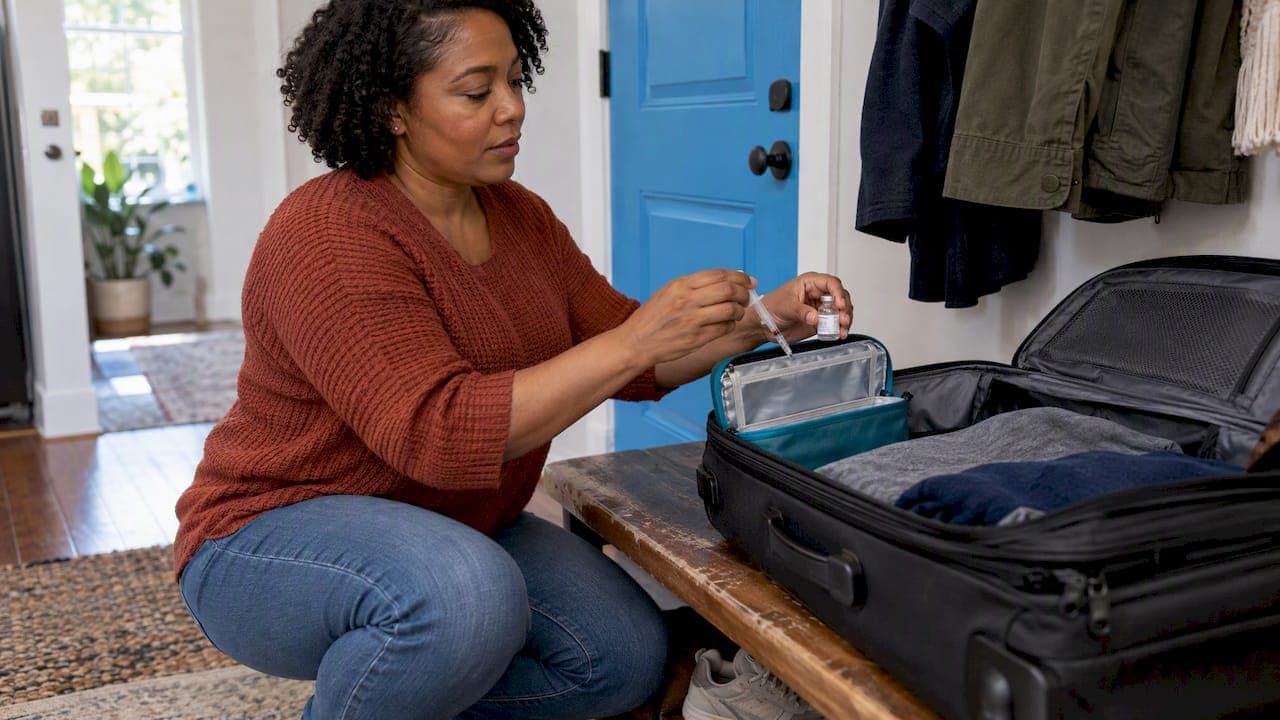
Yes, you can fly with syringes in the US. TSA allows unused syringes in carry-on and checked bags when they are accompanied by the injectable medication they are used with, and you must declare them to the officer at the checkpoint. The rest is preparation: pack in your carry-on, keep everything labeled and together, tell the officer before screening starts, and carry a little more than you need.
This guide covers domestic flights first, then refrigerated medication, paperwork, international trips and a packing checklist. It is general education, not medical advice. Your prescriber or pharmacist decides how your medication should be stored and handled.
TL;DR
- Unused syringes are allowed in carry-on and checked bags with the injectable medication, and you must declare them at the checkpoint.
- Keep medication and syringes in your carry-on, in one clear bag, separate from toiletries.
- Medically necessary liquids are not held to the 3.4-ounce limit, but expect extra screening and arrive early.
- A prescription copy and a short letter from your prescriber are not required by TSA, but they can help if an officer has questions.
- Rules for syringes and controlled medications differ by country, so check destination and transit countries weeks ahead.
Table of Contents
- What TSA Says About Syringes and Injectables
- Carry-On or Checked Bag?
- How to Pack Syringes and Injectable Medication
- Liquids, Vials and the 3.4-Ounce Rule
- Refrigerated Medication and Ice Packs
- Paperwork: What Helps and What Is Optional
- What Is Different on International Trips
- What Happens at the Checkpoint
- Packing Checklist
- Our Perspective: Treat Travel as Part of Your Treatment Plan
- If You Need a Clinician Before You Travel
- FAQ
- Sources
What TSA Says About Syringes and Injectables
TSA's own page on unused syringes lists them as allowed in carry-on bags with special instructions, and allowed in checked bags. Two conditions matter. The syringes must be accompanied by injectable medication, and you must declare them to security officers at the checkpoint for inspection. TSA recommends, but does not require, that medications be labeled to speed things up.
In practice, "declare" means saying it out loud at the start: "I have injectable medication and syringes." Do not wait for the X-ray to flag them. Officers can then direct you to the right bin or lane and screen the items without surprise.
The same logic covers pens, vials, and pre-filled syringes. The common thread is that supplies travel with the medication they are used for. Loose syringes with no medication are the situation most likely to draw questions.
Do syringes count against your carry-on limit?
No. According to the American Diabetes Association's summary of U.S. Department of Transportation rules, airlines must allow medication and medical devices as carry-on items that do not count toward your standard carry-on limit. That page is written for people with diabetes, but the carry-on principle applies to medically necessary supplies in general. If an overhead bin is full or a bag is gate-checked, take your medication out first. United Airlines gives the same advice: never put medication in a checked bag, even if you will not need it in flight.
Carry-On or Checked Bag?
Carry-on, almost always. Technically TSA permits both, but there are three practical reasons to keep injectables with you:
- Access. If your checked bag is lost or delayed, your supplies are not.
- Temperature. Checked luggage can face temperature swings and pressure changes. The ADA guidance recommends keeping medication in the carry-on for this reason. Check your product's label or ask your pharmacist for its storage limits.
- Inspection. Items in a checked bag can be opened and inspected without you there to explain them.
How to Pack Syringes and Injectable Medication
The goal is to make your supplies easy to identify at a glance. The ADA recommends a clear, dedicated bag for medical liquids, syringes and supplies, kept apart from non-medical liquids. A few habits make the checkpoint faster:
- Keep original packaging and pharmacy labels. Vials and pens with the dispensing label showing your name and the drug name remove most doubt. TSA recommends labels but does not require them.
- Cap needles. Keep needle guards or caps in place so nobody gets stuck during a bag search. If you use a travel sharps case, pack it with your supplies.
- Use one clear pouch. Medication, syringes, alcohol swabs and any cold packs go together. Toiletries go elsewhere.
- Put the pouch on top. You should be able to lift it out in seconds, without unpacking your bag in line.
- Bring spares. The CDC notes that travelers should pack more medicine than the trip requires, since delays and lost luggage happen and emergency refills abroad can be hard.
Used syringes and sharps
The TSA page above covers unused syringes. Plan for what happens after you inject: carry a small sharps container, or a rigid container, so used needles are not loose in your bag. At home, our guide to safe sharps disposal routes walks through the options. Check the disposal rules at your destination if you are staying more than a night or two, since they vary locally.

Liquids, Vials and the 3.4-Ounce Rule
Medically necessary liquids are an exception to the usual carry-on liquid limit. TSA's medical items page is the place to confirm current wording. The practical steps are:
- Separate liquid medication from your regular toiletries before you reach the belt.
- Tell the officer you have medically necessary liquids.
- Put them in a bin for separate screening.
- Expect that an officer may inspect or test the container.
This applies to vials, pens and bottles of injectable medication. It does not cover bacteriostatic water or other diluents unless they are medically necessary for your prescribed regimen and you can show that. If your clinician has prescribed a product that needs mixing, ask them how to label and carry the components. For background on why those two waters are not interchangeable, see our explainer on bacteriostatic versus sterile water. We do not give mixing or dosing instructions here, and nothing in this article is a substitute for what your prescriber and pharmacist told you.
Refrigerated Medication and Ice Packs
Some injectables must stay cold. Others must not freeze. Which one yours is, and how long it can sit at room temperature, is on the label and in the package insert, and your pharmacist can confirm. Do not guess.
For cold medication, TSA says ice packs used to keep medication cool go through the checkpoint if you declare them, and they may be subject to separate inspection or testing if they alarm. Build in extra time.
Tips that follow from this:
- Use an insulated medication travel case with gel packs, and know in advance how many hours it holds temperature.
- Pack the case in your carry-on, never in a checked bag.
- Ask the airline or hotel about refrigerator access before you travel, and confirm it.
- If a gate agent asks to check your carry-on, take the cold case out first and keep it with you.
If your medication has strict temperature limits and your trip is long, talk to your pharmacist about what is safe before you leave. That conversation is better than discovering a problem at the destination.
Paperwork: What Helps and What Is Optional
TSA does not require a doctor's note for medical supplies. Still, many experienced travelers carry one, and it makes sense:
| Document | Required by TSA? | Why carry it |
|---|---|---|
| Original pharmacy label on each medication | No, but recommended | Shows your name, the drug and the prescriber |
| Copy of prescription | No | Useful if an officer or airline asks, or you need a refill |
| Letter from your prescriber on letterhead | No | Lists the condition, medication, and why supplies are needed |
| Medication list on your phone | No | Backup if paper is lost |
The letter does not need to be long. Ask your prescriber to list your condition, the medication name, and the supplies you need to carry. If you are going abroad, ask for a longer letter and a generic drug name as well as the brand name.
TSA Cares
If the process makes you nervous, TSA Cares is a helpline for travelers with disabilities and medical conditions. TSA suggests contacting it about 72 hours before your flight so someone can answer your specific questions about screening.
What Is Different on International Trips
The U.S. rules above apply to TSA checkpoints. Other countries set their own. The CDC states that each country has its own laws about medicines, and some medicines that are common in the U.S. may be restricted or controlled elsewhere. Its advice is to check the embassy website of your destination and any transit country well before you leave, to confirm that your medication and quantity are allowed.
A few points matter more abroad:
- Controlled substances. Some hormones and other prescription drugs are controlled in certain countries. Do not assume that a U.S. prescription settles it.
- Quantities. Large quantities may need extra documentation. The UK Civil Aviation Authority, for example, says airlines may ask for a medical certificate for large amounts of medication, which shows that expectations can differ from U.S. practice.
- Return screening. You will pass through TSA again on the way home, so keep labels and a letter handy for both directions.
- Transit stops. A layover counts. Check the rules for every country on the route.
If your destination's rules are unclear, ask your prescriber and the destination's embassy or consulate, not a forum thread.
What Happens at the Checkpoint
Here is what a typical screening looks like when you are prepared:
- Before your belongings go on the belt, tell the officer: "I have injectable medication and syringes."
- Hand over or point out your clear pouch. Keep the pharmacy labels visible.
- The items are screened separately, and the officer may ask what the medication is for or how it is carried.
- If cold packs alarm, they may be tested. Stay calm and stay with your items.
- Repack once cleared, and check that the cap and cold case are secure.
You should be treated with courtesy. If something goes wrong, ask for a supervisor politely and refer to TSA's published page for your item. Never hide supplies to avoid questions. Declaring is faster.
Packing Checklist
- Medication in original labeled packaging, in your carry-on
- Syringes and needles with caps, with the medication they go with
- Alcohol swabs and other supplies you use with injections
- Sharps container for used needles
- Insulated case and gel packs, if your medication needs cold storage
- Prescription copy and a short prescriber letter
- Extra doses and supplies for delays
- Pharmacy and prescriber phone numbers
- Time buffer at the airport
Our Perspective: Treat Travel as Part of Your Treatment Plan
We publish education about hormone care, weight management and related topics, and travel comes up in nearly every discussion of injectable therapy. Our view is simple: the best time to plan for a trip is before the trip. Ask your clinician at an ordinary visit how your medication should be stored away from home, how long it can be out of refrigeration, what to do if you miss a dose because of travel, and whether you should carry a letter. Those are questions a prescriber can answer for your product and your situation. We cannot, and an article should not pretend to.
We also think it helps to keep your supplies tidy and your documents in one place, because clear and boring is what makes a security screening quick. If you inject at home regularly, our guides to subcutaneous injection sites and subcutaneous versus intramuscular routes give general background to bring to your clinician. They do not replace the instructions you were given.
Finally, only carry medication that was prescribed to you and dispensed by a legitimate pharmacy. Labels and paperwork are what travel smoothly through a checkpoint, and unlabeled products from unknown sources are what raise questions.
— AirMedFit
If You Need a Clinician Before You Travel
If you want to talk through a travel plan, a medication question or eligibility for a therapy, our site lists a Doctor's Consultation page where you can see the current options. The listing shows an Async Doctor's Consult at 49 USD one-off and a Sync Doctor's Consult at 120 USD one-off. Confirm availability, scope and follow-up on the consultation listings before you book. A consultation does not guarantee a prescription; that decision belongs to the clinician. Allow time before your trip, since a letter or a refill is best sorted out weeks ahead rather than days.
FAQ
Can I bring syringes on a plane without a prescription?
TSA's rule is that unused syringes must be accompanied by injectable medication, and it does not list a prescription as a requirement. Carrying the pharmacy label and a copy of your prescription still makes questions easier to answer. Airlines and other countries may ask for more, so check before you go.
Can I put syringes in my checked bag?
TSA allows unused syringes in checked bags. We recommend against it for your medication, because checked bags can be lost, delayed or exposed to temperature swings. Keep syringes with your medication in your carry-on.
Do I have to tell TSA about my syringes and injectable medication?
Yes. TSA says you must declare unused syringes to the officer at the checkpoint for inspection. Say so before screening begins and place your medical items in a separate bin as directed.
What about traveling with injections to another country?
Rules vary by country, and some medications are restricted or controlled abroad. The CDC advises checking the embassy website of your destination and any transit country several weeks ahead. Ask your prescriber for a letter that names the medication, and pack extra supplies.
Sources
- TSA: Unused Syringes
- TSA: Medical items
- TSA Cares: Traveling With Medication
- American Diabetes Association: What Can I Bring With Me on the Plane
- CDC: Traveling Abroad with Medicine
- United Airlines: Traveling with Medication and Medical Equipment
- UK Civil Aviation Authority: Travelling with medicines
Recommended
- Contain Sharps Now, 4 Safe Disposal Routes at Home
- Where to Give a Subcutaneous Injection: A Site-by-Site Guide
- Subcutaneous vs Intramuscular: Which Injection Route Is Right?
This article provides general educational information and is not personalized medical advice. A licensed clinician should assess treatment suitability, risks, and options.