
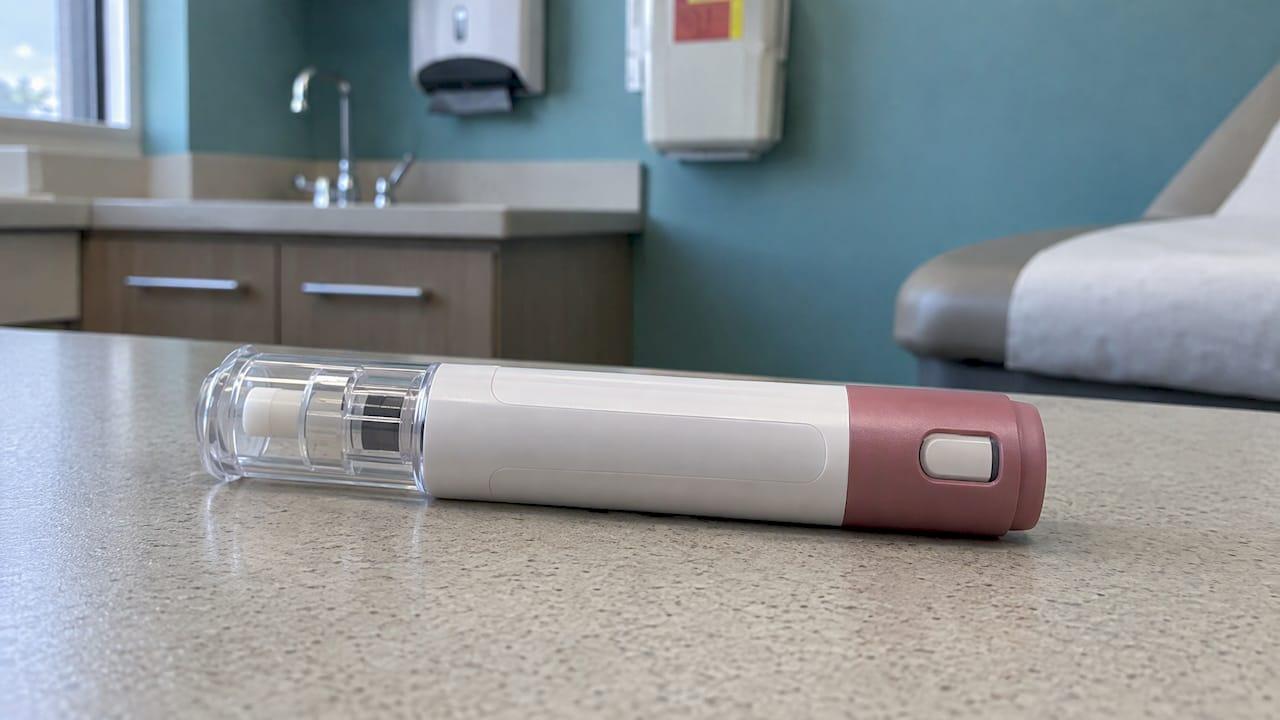
The only PT-141 dose with an FDA-reviewed basis is the one on the label for Vyleesi, the approved brand of bremelanotide. It is 1.75 mg injected under the skin of the abdomen or thigh, as needed, at least 45 minutes before anticipated sexual activity. No more than one dose in 24 hours, and no more than 8 doses a month. This guide explains what those numbers mean, who they were studied in, and what to ask a clinician. It is general education, not a prescription or a dosing plan.
TL;DR
- The labeled dose of bremelanotide (Vyleesi) is 1.75 mg by subcutaneous injection, using a single-dose prefilled autoinjector pen.
- Take it at least 45 minutes before expected sexual activity. Limit: one dose per 24 hours and 8 doses per month.
- It is FDA-approved only for premenopausal women with acquired, generalized hypoactive sexual desire disorder (HSDD). It is not indicated for men or for postmenopausal women.
- Doses quoted on peptide websites for men, vials or oral forms do not come from the approved label. A clinician decides whether any treatment fits you.
- People with uncontrolled high blood pressure or known cardiovascular disease should not use it.
Table of Contents
- What PT-141 is, and why "dosing" means different things online
- The labeled dose and how it is given
- How often you can use it
- Who the approved dose was studied in
- Side effects and who should not use it
- What the trials showed
- What it costs in the United States
- Can a doctor prescribe PT-141? How to prepare for the visit
- Booking a consultation with AirMedFit
- Our perspective
- FAQ
- Sources
What PT-141 is, and why "dosing" means different things online
PT-141 is the research name for bremelanotide, a synthetic peptide. One form of it, Vyleesi, went through FDA review and carries a prescribing label. Other products sold or discussed under the name PT-141, such as vials of lyophilized powder, compounded preparations or oral versions, are not the same thing as the approved pen. They have no FDA-approved label, and the dose ranges attached to them online vary widely from page to page.
That is the main reason a search for PT-141 dosing returns so many conflicting numbers. Some pages quote the label's 1.75 mg. Others quote milligram-per-kilogram figures, 1 to 3 mg ranges, oral doses or weekly caps that do not appear on the label. We do not repeat those numbers here. When a figure has no label, trial or guideline behind it, it is not a dose you can rely on.
It also helps to keep three categories apart:
- FDA-approved: a drug reviewed for a specific use, strength and dosing schedule. Vyleesi is in this group.
- Compounded: a pharmacy-prepared version made for an individual prescription. It is not FDA-approved, and facility registration is not product approval.
- Investigational: a substance still being studied, with no established dose for general use.
If a product page does not say which category it falls in, ask the prescriber or pharmacy before anything else.
The labeled dose and how it is given
Per the FDA prescribing information, the recommended dose is 1.75 mg, given subcutaneously (into the fatty tissue under the skin) in the abdomen or thigh. It is supplied as a 1.75 mg/0.3 mL clear solution in a single-dose prefilled autoinjector pen. Each pen contains 1.75 mg of bremelanotide (equivalent to 1.89 mg bremelanotide acetate) in 0.3 mL.
Two practical points follow from that:
- There is no dose to calculate. The pen is prefilled and single-use, so there is no drawing up, mixing or unit conversion. Conversion math you see on vial-based pages belongs to a different product.
- Site matters for comfort and consistency. The label names the abdomen and thigh. If you are new to injections, a plain-language walkthrough of where to give a subcutaneous injection can help you talk through technique with your clinician. Your prescriber or pharmacist should demonstrate the pen itself.
This article does not give injection instructions for unapproved or investigational peptides, and we recommend against self-directing doses of any prescription peptide.
How often you can use it
The label sets a timing rule and two limits:
| Rule | What the label says |
|---|---|
| Timing | At least 45 minutes before anticipated sexual activity |
| Per day | No more than one dose within 24 hours |
| Per month | More than 8 doses a month is not recommended |
| Schedule | As needed, not a daily or fixed-interval regimen |
These come from the same FDA label. Because it is taken as needed, "how often" has no set rhythm: it depends on how many occasions you expect, up to the ceiling. Using it more often than the label allows is not studied as a way to get a stronger effect.
Also worth knowing: the label does not describe taking a second dose if the first seems not to work in the same window. If that happens, tell the prescriber rather than repeating the injection.
Who the approved dose was studied in
Vyleesi is FDA-approved for premenopausal women with acquired, generalized HSDD. That means low sexual desire that causes marked distress or interpersonal difficulty and is not explained by another medical or psychiatric condition, relationship problems, or the effects of a medication or drug.
The same label says it is not indicated for HSDD in postmenopausal women or in men, and not to enhance sexual performance. So the 1.75 mg figure is not an established "men's dose" or a dose for weight or metabolic goals. Pages that present it that way are going beyond the label. Anyone outside the approved group who is curious about the topic should raise it with a clinician, who can discuss the evidence, alternatives and the cause of the symptoms.
If your question is about erectile function in men, that is a different clinical conversation. Our overview of how TRT and erectile dysfunction relate explains how a treatment goal and a review plan should be separated.
Side effects and who should not use it
The label lists these effects and limits:
- Nausea, reported in about 40% of patients in the label data.
- Transient blood pressure rise: up to about 6 mmHg systolic and 3 mmHg diastolic, peaking 2 to 4 hours after the dose and resolving within 12 hours.
- Focal hyperpigmentation (darkened patches of skin), reported in 1% of patients at up to 8 doses a month.
- Flushing, injection site reactions and headache.
It is contraindicated in people with uncontrolled hypertension or known cardiovascular disease. If you have high blood pressure, heart disease, or take medicines that affect blood pressure, say so at the start of any consultation. The monthly and daily limits exist because of this safety data, not to be conservative for its own sake. Details are in the prescribing information, and a pharmacist can walk you through the patient information.
Seek urgent care for severe symptoms such as chest pain or a very severe headache after a dose.
What the trials showed
The approval rested on two phase 3 studies called RECONNECT. On the FSFI desire domain, bremelanotide beat placebo in both: a mean change of 0.54 vs. 0.24 in Study 301 and 0.63 vs. 0.21 in Study 302, both statistically significant.

In plain terms, about 25% of treated women had a 1.2-point or greater rise in desire score, compared with about 17% on placebo. About 35% had a decrease of one point or more in distress, compared with about 31% on placebo.
Those are group averages. They do not predict what any one person will feel, and no outcome is guaranteed. A clinician can help you set realistic expectations and decide, after a trial period, whether continuing makes sense.
What it costs in the United States
Cost depends on whether you mean the approved pen or something else. For Vyleesi, cash prices run around $930 for 1.2 milliliters, and eligible commercially insured patients may pay as little as $0 per prescription through a manufacturer program. Actual cost varies by insurance coverage, pharmacy and location.
Because the pen contains 0.3 mL, a 1.2 mL quantity corresponds to four pens. Ask your pharmacy for the price per pen and whether your plan covers it. The same discipline applies to other injectables: our guide on checking your plan for GLP-1 coverage shows the questions to ask an insurer, and most apply here.
Be cautious with a low price attached to a PT-141 product that has no label. Ask what the product is, who prepares it, and whether it is an FDA-approved drug.
Can a doctor prescribe PT-141? How to prepare for the visit
A licensed clinician can decide whether bremelanotide is appropriate and, if so, prescribe it. Whether they do depends on your diagnosis, health history, blood pressure and other medicines. No service can promise a prescription in advance, and we do not.
Bring this to the appointment:
- A clear description of the concern. How long has desire been low, and does it cause you distress? Is it new, or has it always been this way?
- Your menopausal status. The approved use is in premenopausal women, so this changes the discussion.
- Blood pressure readings and cardiovascular history. Include home readings if you have them.
- A full medication and supplement list, including antidepressants, hormones and anything that affects blood pressure.
- Recent lab results, if you have any. Thyroid, hormone and metabolic findings can affect desire, and clinicians often check them first.
- Questions about the product. Is it the FDA-approved pen? What are the daily and monthly limits? What side effects should prompt a call?
- Questions about cost and follow-up. What will each fill cost, and when will the plan be reviewed?
Hormone changes are one of several factors that can affect desire. If perimenopause or low testosterone is part of your picture, a clinician may look at those first, and our checklist on testosterone side effects in women is a useful list of what a review should cover.
Booking a consultation with AirMedFit
If you want to talk through sexual health, hormones or metabolic questions with a clinician, AirMedFit lists doctor consultations online. Our site shows an Async Doctor's Consult at 49 USD one-off and a Sync Doctor's Consult at 120 USD one-off. Confirm current availability, scope, costs and follow-up on the consultation page before you book. Whether a treatment is appropriate is the clinician's decision.
If you would like lab context first, our medical services collection lists home-kit lab panels, such as the Women's Essential panel at 139 USD one-off and the Men's Essential panel at 129 USD one-off. You can also browse the full list of services.
Our perspective
Most of the confusion around PT-141 dosing comes from mixing three different things: an approved drug with a label, preparations with no label, and numbers copied from one website to the next. We think readers are best served by starting with the label and working outward with a clinician.
That is how we approach every consultation topic on this site. A good visit begins with your history, your blood pressure, your medications and your goals, not with a dose. Labs can give a clinician useful context, and a clear follow-up plan keeps the conversation going after the first appointment.
We list doctor consultations and lab panels so that you can bring informed questions to a licensed clinician and leave the treatment decision where it belongs. We do not promise prescriptions or outcomes, and we encourage you to confirm current details on our pages before you book.
AirMedFit
FAQ
How much PT-141 should you inject?
The only dose with an FDA label is 1.75 mg, given subcutaneously with the prefilled Vyleesi autoinjector pen, at least 45 minutes before anticipated sexual activity. Do not use dose ranges from websites that sell or discuss unapproved vials. Your prescriber decides what is right for you.
How often can you take PT-141?
According to the label, no more than one dose in 24 hours, and more than 8 doses a month is not recommended. It is used as needed rather than on a daily schedule. Tell your prescriber if you feel you need more than that.
Is PT-141 approved for men?
No. The FDA label covers premenopausal women with acquired, generalized HSDD, and says it is not indicated for men or for postmenopausal women. Men with sexual concerns should talk with a clinician about causes and approved options.
How much does a bremelanotide injection cost?
Cash prices for the approved pen have been listed at around $930 for 1.2 mL, while some commercially insured patients may pay as little as $0 per prescription. Your price depends on insurance, pharmacy and location, so ask for a quote before filling.
Can my doctor prescribe PT-141?
A licensed clinician can prescribe it if they judge it appropriate after reviewing your history, blood pressure and medications. It is not guaranteed. Bring a medication list and your questions to the visit.
Sources
- FDA prescribing information for Vyleesi (bremelanotide), 2026 label
- RECONNECT phase 3 results, SEC exhibit, 2016
- FDA approval announcement for Vyleesi, 2019
- Vyleesi price guide, Drugs.com
Recommended
- Testosterone for Women: Dosage Ranges, Routes and Monitoring
- Which Peptides Are FDA-Approved? A 2026 Guide
- Tadalafil / PT-141 / Oxytocin
This article provides general educational information and is not personalized medical advice. A licensed clinician should assess treatment suitability, risks, and options.