

Research peptides sold online for "research use only" carry real safety risks because they bypass FDA testing, sterility standards, and clinical oversight. The FDA has flagged dozens of these substances as unsafe to compound, and Harvard Health and AP News have both documented adverse effects ranging from gastrointestinal distress to serious infections. If you're considering peptide therapy, the safest path is physician-supervised care, not self-injecting a product ordered off a website.
TL;DR:
- Most unregulated research peptides are sold without manufacturing oversight, and their safety has not been evaluated for human use, increasing health risks.
- Buying peptides from gray-market vendors or social media sellers often involves mislabeled, contaminated, or inconsistent products that can cause infections or adverse reactions.
- Serious health concerns include allergic reactions, infection, pancreatitis, and potential acceleration of cancer growth, but no clinical trial data exists for most peptides.
- Physician supervision, verified sourcing, baseline testing, and proper sterile injection techniques significantly reduce risks compared to self-injection of unregulated products.
- The lack of systematic monitoring and regulation creates a public health blind spot, making supervised treatment the safest approach until better oversight develops.
Table of Contents
- Understanding Research Peptides Risks: What Peptides Are and How They're Sold
- How Unregulated Peptides Reach Consumers
- What Are the Health Risks of Research Peptides?
- Contamination, Sterility, and Injection Hazards
- FDA Regulation of Peptides: What's Actually Being Done
- How to Reduce Peptide Usage Dangers and When to Get Help
- What Physician Supervision Actually Adds
- The Public-Health Blind Spot Nobody's Watching
- A Supervised Path Forward With Airmedfit
- Sources
- FAQ
Understanding Research Peptides Risks: What Peptides Are and How They're Sold
Peptides are short chains of amino acids that act as signaling molecules in the body, telling cells when to grow, repair, or regulate hormones. Some peptides are legitimate, FDA-approved medicines. Insulin is a peptide. So are GLP-1 drugs like semaglutide, which went through years of clinical trials before reaching pharmacy shelves.
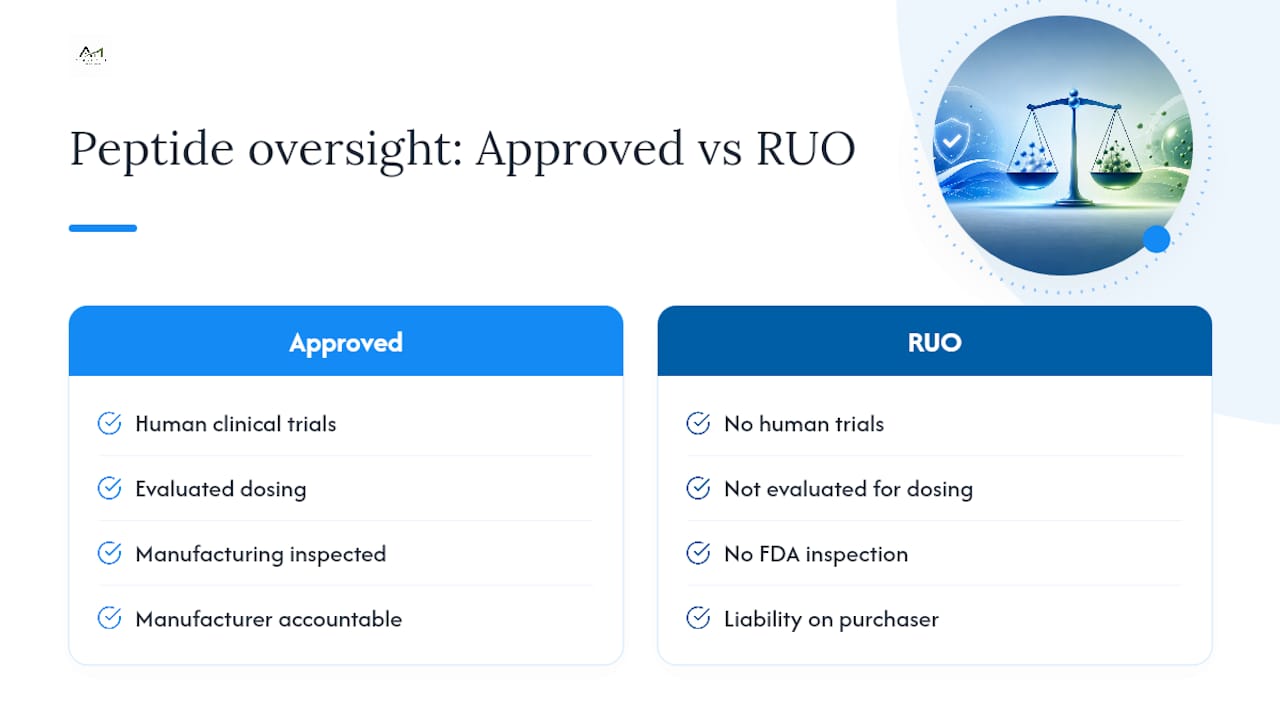
The peptides driving most research peptides risks are different, which is why it helps to understand why peptide compounds are restricted for human use. They're sold under a "research use only" (RUO) label, a legal designation meant for laboratory reagents, not human treatments. That label exists so chemical suppliers can sell compounds to scientists studying them in test tubes or animal models, not to people injecting them at home. Buyers who treat an RUO peptide as though it were a medicine are making a fundamental category error: the product was never evaluated for human dosing, purity standards, or safety.
That distinction carries legal weight, too. RUO labeling shifts all liability onto the purchaser, and most consumers don't realize this when they click "buy." A compound safely handled in a lab, wearing gloves and a fume hood, is not automatically safe to draw into a syringe and inject into your abdomen. There's no manufacturer standing behind the product, no FDA inspection of the facility, and no recourse if something goes wrong. You can compare the difference in oversight for yourself by looking at which peptides actually carry FDA approval versus the ones marketed only for research.
How Unregulated Peptides Reach Consumers
The supply chain for research peptides risks runs through a handful of predictable channels, and none of them involve the kind of vetting a prescription drug goes through.
- Direct-to-consumer research chemical vendors who sell vials online with little more than a checkbox agreeing the buyer won't use the product on humans.
- Compounding pharmacies, some of which have mixed peptides the FDA specifically warns against compounding due to safety concerns.
- Online "wellness" clinics that market peptides as anti-aging or performance tools without the regulatory standing of a licensed medical practice.
- Social media sellers and influencers who promote peptides through testimonials and before-and-after photos rather than data.
The marketing language does a lot of quiet work. Phrases like "for research use only" or a posted certificate of analysis (COA) create an impression of scientific legitimacy, even though a COA from an unverified lab proves very little about what's actually in the vial you receive. This kind of digital promotion and gray-market access is a documented driver of unsupervised peptide use, and it's compounded by a practice called stacking, combining two or three experimental peptides at once. Since most of these compounds have no human trial data on their own, stacking them multiplies unknowns that nobody has actually studied.
What Are the Health Risks of Research Peptides?
The honest answer is that most of what's known about research peptide side effects comes from user reports and clinical concern, not controlled trials. That gap matters, and it's worth being precise about it.
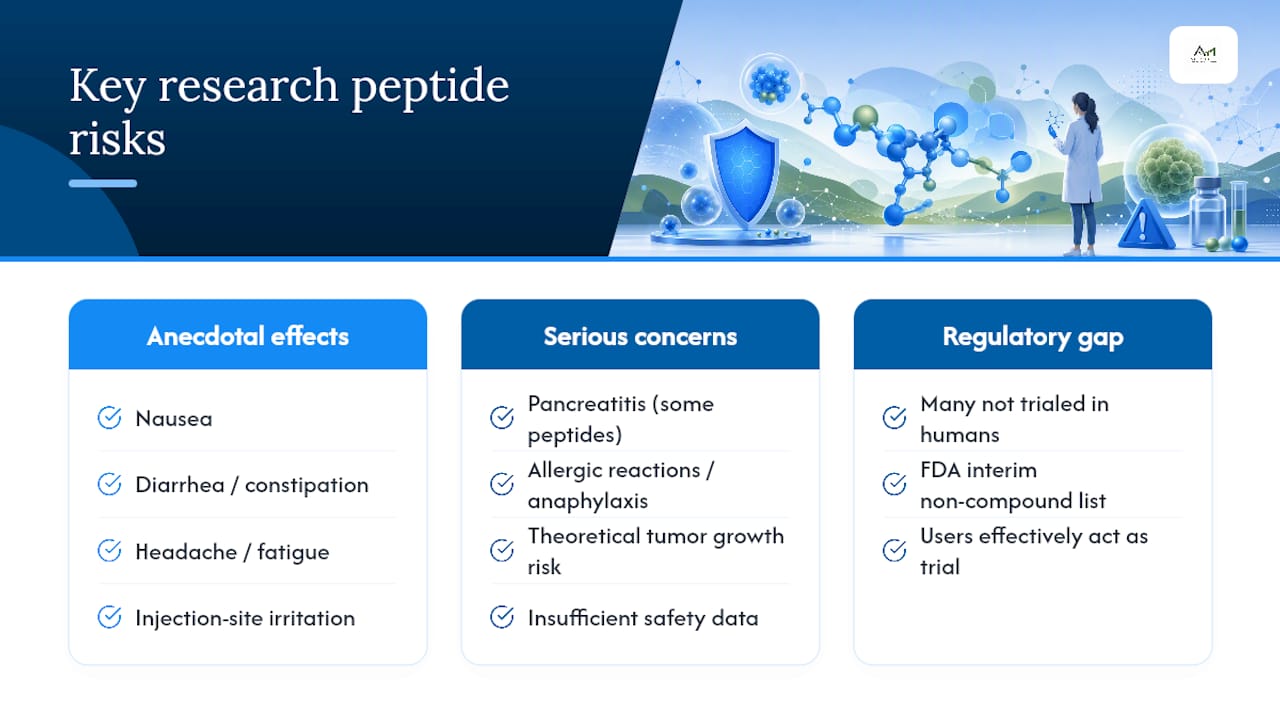
The commonly reported acute effects sit at the milder end: nausea, diarrhea, constipation, headaches, fatigue, and irritation at the injection site. These show up often enough in anecdotal reports and clinical literature that Harvard Health lists them among the safety concerns tied to peptide use generally, including for peptides marketed for weight loss or muscle growth.
The FDA has added numerous peptides to an interim list of substances pharmacies should not compound, citing documented safety concerns and insufficient oversight of their manufacture and use.
The more serious harms are where clinicians get uneasy. Pancreatitis has been raised as a concern with certain metabolic peptides. Allergic reactions, including anaphylaxis, are possible with any injected protein-based compound, especially one with inconsistent purity. Some peptides are designed specifically to stimulate tissue growth or angiogenesis, and experts have raised concern that this mechanism could theoretically accelerate growth in undetected cancerous cells. That risk hasn't been proven in humans, but it hasn't been ruled out either, which is precisely the problem with skipping clinical trials.
Here's the contrast that matters: FDA-approved peptide drugs carry years of trial data on dosing, interactions, and long-term outcomes. Experimental wellness peptides carry none of that. AP News has reported that many peptides trending in wellness circles have never gone through extensive human trials at all, meaning the people injecting them are effectively the trial.
Contamination, Sterility, and Injection Hazards
Even setting aside the biological unknowns, the physical act of buying and injecting an unregulated peptide introduces hazards that have nothing to do with the compound's intended effect.
Product-quality failures are common enough to be a defining feature of this market. Independent testing of gray-market peptides has turned up mislabeling, potency that swings wildly from batch to batch, chemical impurities, and, in some cases, bacterial or endotoxin contamination that can trigger a systemic infection the moment it enters the bloodstream.
Then there's the injection itself. Self-injecting without proper training creates its own list of complications:
- Abscess formation at the injection site from bacterial introduction
- Cellulitis, a spreading skin infection that can require IV antibiotics
- Systemic infection if bacteria enter the bloodstream through a contaminated needle or vial
- Reconstitution errors, mixing the wrong diluent ratio and injecting a far stronger or weaker dose than intended
- Needle reuse or improper disposal, raising infection risk with every subsequent injection
A certificate of analysis posted on a vendor's website doesn't fix any of this. A COA only reflects one tested sample from one batch, often from a lab the vendor selected itself. It says nothing about the specific vial sitting in your refrigerator. Proper reconstitution technique and sterile handling reduce some of this risk, which is why understanding correct dilution ratios and knowing the difference between bacteriostatic and sterile water matters even for people who've already decided to use a peptide product.
Pro Tip: If you ever suspect a product is contaminated or mislabeled, keep the vial, the original packaging, and your purchase receipt. Photograph the label and any COA before you dispose of anything. That documentation is often the only way a clinician or regulator can trace where a bad batch came from.
FDA Regulation of Peptides: What's Actually Being Done
The FDA hasn't stayed on the sidelines here. The agency maintains an interim list of bulk drug substances that pharmacies should not compound, and it has added more than two dozen peptides to that list specifically because of documented safety concerns and the absence of standard manufacturing oversight. The agency has also published companion guidance explaining its rationale for restricting certain substances from compounding altogether.
Enforcement is real but limited. The FDA has issued warning letters against companies marketing unauthorized peptide products, yet online sellers routinely rebrand, relocate, or reappear under new domain names faster than any single agency can track. That's the practical reality for consumers: a peptide's absence from an approval list doesn't mean it's been reviewed and found safe. It usually means it hasn't been reviewed for human use at all, which also means no standardized manufacturing requirements and no organized system for tracking adverse events after the fact.
How to Reduce Peptide Usage Dangers and When to Get Help
If you're weighing peptide therapy, a few concrete choices meaningfully lower your exposure to harm.
- Choose FDA-approved medications or clinician-supervised programs instead of RUO products marketed for injection. Regulated peptide drugs come with known dosing and manufacturing standards; RUO products come with neither.
- Verify sourcing before you ever open a vial. Ask where the product was manufactured, whether it's pharmaceutical-grade, and whether batch-level testing is available, not just a generic COA.
- Get baseline and follow-up labs. Monitoring catches problems, like early signs of pancreatitis or hormonal disruption, before they become emergencies.
- Know the emergency red flags. Difficulty breathing, swelling of the face or throat, hives spreading rapidly, signs of a spreading skin infection (redness, warmth, fever), or severe abdominal pain radiating to the back all warrant immediate medical attention, not a wait-and-see approach.
If you experience a serious reaction, report it to the FDA's MedWatch program and bring the physical product, its packaging, and your purchase record to your appointment. Preserving that evidence helps clinicians identify what happened and gives regulators a paper trail to act on.
Pro Tip: Before you take a first dose of anything ordered online, ask yourself whether you'd be comfortable telling your doctor exactly what you bought and where. If the answer is no, that's worth sitting with.
What Physician Supervision Actually Adds
A supervised program addresses nearly every risk above in one move: verified pharmaceutical-grade sourcing, baseline and ongoing labs, sterile administration guidance, and a clinician reviewing your case before and during treatment. Airmedfit's model includes doctor consultations, lab panels, and FDA-regulated GLP-1 and peptide offerings sourced from licensed US manufacturers. Before starting any peptide protocol, ask a provider directly how they verify their supply chain and what happens if you report a side effect.
The Public-Health Blind Spot Nobody's Watching
The normalization of self-injected peptides through social media has created a surveillance gap: nobody is systematically tracking who's using these compounds or what happens to them. That's the quiet danger behind the trend, more than any single side effect. Expect tighter FDA scrutiny and more enforcement action in the coming years, alongside growing calls for better adverse-event reporting. Until that infrastructure exists, the safer bet is evidence-backed, supervised treatment, and reporting anything that goes wrong.
— Organic
A Supervised Path Forward With Airmedfit
Unlike a vial ordered from an anonymous research-chemical site, Airmedfit puts a licensed physician between you and your treatment plan, working with FDA-regulated GLP-1s and peptides sourced from licensed US manufacturers rather than gray-market suppliers. That means verified sourcing, baseline lab work, and someone actually watching for the side effects covered above instead of leaving you to self-diagnose an injection-site reaction at 2 a.m.
If you're serious about metabolic or hormonal optimization, the first step isn't buying a peptide online, it's talking to a doctor who can review your labs and history first. You can book a doctor's consultation to start that conversation, or check out lab panels for monitoring if you want baseline data before committing to any protocol.
This article is general information, not a substitute for advice from a qualified doctor. Consult a qualified healthcare professional about your own circumstances before acting on anything here.
Sources
- Peptides: What they are, potential benefits, and safety concerns (Harvard Health Publishing)
- Unregulated peptide use in the age of biohacking: digital promotion, gray-market access, and emerging public health risks (PMC narrative review)
- Peptide injections: What to know about the unapproved trend and its risks (AP News)
FAQ
Are Research Peptides Reputable?
Most vendors selling "research use only" peptides for human injection are not operating under any medical or manufacturing oversight, which makes reputability hard to verify. A vendor's certificate of analysis reflects one tested sample, not the specific vial you receive, so it's not proof of safety.
Why Don't Doctors Recommend Unregulated Peptides?
Physicians distinguish between FDA-approved peptide drugs, which have clinical trial data and standardized manufacturing, and experimental peptides sold for research use, which have neither. Doctors are also concerned about theoretical risks like promoting undetected cancer growth in peptides designed to stimulate tissue growth.
What Are the Main Risks of Taking Research Peptides?
The most commonly reported research peptide side effects include nausea, headaches, fatigue, and injection-site irritation, while more serious concerns include allergic reactions, contamination-related infections, and pancreatitis. Because most of these products lack human trial data, the true frequency and severity of risks remain largely undocumented.
Are Peptides Safer Than Steroids?
Peptides and anabolic steroids carry different risk profiles, but "safer" doesn't mean safe when a peptide is unregulated and improperly sourced. Both carry real health risks; an FDA-approved peptide medication used under medical supervision is a fundamentally different risk category than either an unregulated peptide or a steroid obtained without a prescription.
How Can I Reduce My Risk if I'm Considering Peptide Therapy?
Choose FDA-approved medications or a physician-supervised program with verified sourcing and lab monitoring rather than an RUO product bought online. Airmedfit offers doctor consultations starting at $49 for an async consult and lab panels for ongoing monitoring, giving you oversight that self-sourced peptides can't provide.