

TRT benefits men with clinically confirmed testosterone deficiency, not men chasing general anti-aging results. In properly diagnosed hypogonadism, testosterone replacement therapy reliably improves sexual function, increases lean body mass, and raises bone density, with more modest effects on mood. None of it works without a real diagnosis and physician-supervised monitoring first.
TL;DR:
- TRT reliably improves sexual function, libido, lean body mass, and bone density in men with confirmed testosterone deficiency, especially when combined with lifestyle changes.
- The actual impact on mood and vitality is modest, with benefits varying based on baseline testosterone levels and severity of symptoms.
- Cardiovascular risks are still debated, but recent evidence suggests that, with careful monitoring, TRT does not increase short-term heart attack or stroke risk.
- Men should undergo strict diagnosis with two low testosterone readings and discuss fertility plans before starting TRT, as it suppresses natural sperm production.
- Benefits become noticeable within three to six months, but long-term risks like prostate health and fracture prevention require ongoing lab monitoring.
Table of Contents
- TRT Benefits at a Glance: What's Proven vs. What's Uncertain
- Does TRT Improve Sexual Function and Libido?
- How Does TRT Affect Muscle Mass and Bone Density?
- Can TRT Improve Mood, Correct Anemia, and Affect Metabolic Health?
- What Are the Risks and How Is TRT Monitored for Safety?
- Who Actually Qualifies for TRT?
- What's the Realistic Timeline for TRT Benefits?
- What Should You Discuss With a Doctor Before Starting TRT?
- How Does Physician-Supervised TRT Work in Practice?
- Does TRT Affect Cognitive Function and Memory?
- Are There Long-Term Risks Beyond Heart Disease?
- What Happens to Fertility on TRT, and Can It Be Preserved?
- Injections, Gels, or Patches: Which TRT Delivery Method Is Best?
- The Bottom Line on Realistic TRT Expectations
- Ready to Start Physician-Supervised TRT?
- Sources
TRT Benefits at a Glance: What's Proven vs. What's Uncertain
Not every benefit attributed to TRT has the same evidence behind it. Some outcomes show up consistently across trials; others show up occasionally, or only in certain men, or not at all once researchers control for placebo effects.
Here's how the major categories break down:
- Sexual function and libido: Moderate, consistent evidence from randomized trials. Improvements are real but smaller than what PDE5 inhibitors deliver for erectile dysfunction specifically.
- Lean body mass: Consistent increase across trials, especially when paired with resistance training.
- Bone mineral density: Measurable improvement in spine and hip volumetric BMD, though long-term fracture-risk data remains thin.
- Mood and depressive symptoms: Modest but reproducible benefit in men with confirmed low testosterone.
- Energy and general vitality: Inconsistent. Several randomized trials found no reliable benefit for vitality or walking distance, even in men who saw sexual and bone improvements.
Age and baseline testosterone level both shape how much a man responds. A 68-year-old with a total testosterone of 180 ng/dL and severe symptoms tends to see a bigger, clearer shift than a 45-year-old sitting at 280 ng/dL with mild complaints. Magnitude matters here: these are generally modest-to-moderate improvements measured on symptom scales and lab values, not dramatic transformations. Men expecting to feel twenty years younger are setting themselves up for disappointment; men expecting measurable relief from specific symptoms of deficiency are working with realistic expectations.
Does TRT Improve Sexual Function and Libido?
Yes, and this is the benefit with the strongest trial support. The Testosterone Trials (TTrials) and subsequent meta-analyses consistently show improved libido, sexual activity, and erectile function in symptomatic men with confirmed low testosterone. The 2024 AFP clinical review backs this up: TRT reliably improves sexual function and quality of life in men diagnosed with hypogonadism.
It's worth setting the right comparison, though. TRT's effect on erectile function is generally smaller than what a PDE5 inhibitor like sildenafil or tadalafil delivers for ED specifically. Testosterone treats the hormonal deficiency underneath sexual dysfunction; it doesn't act as a direct erectile aid the way ED medications do. Men with both low testosterone and vascular-related ED sometimes need both.
Timeline matters too. Early signs of improved desire often show up within six to eight weeks. Clearer, more consistent changes in sexual activity and erectile function typically take three to six months to fully emerge. Men starting with very low baseline testosterone and severe symptoms tend to notice change faster and more dramatically than men with borderline-low levels and mild symptoms.
How Does TRT Affect Muscle Mass and Bone Density?
Body composition is where TRT's effects are most measurable on paper. Trial data shows consistent increases in lean body mass alongside modest gains in strength, and the AFP review confirms this pattern holds across the hypogonadal population studied.
Bone outcomes follow a similar shape. Trials measuring volumetric bone mineral density at the spine and hip show real improvement over the treatment period. What's missing is long-term fracture-risk data. Increased BMD is a strong surrogate marker, but no large trial has run long enough to confirm that TRT actually reduces the number of men who break a hip or vertebra. The Annual Reviews analysis of testosterone treatment in age-related decline flags this gap directly: bone density improves, but fracture outcomes remain uncertain.
There's a dose-response relationship at play, and it's not automatic. Men who pair TRT with structured resistance training see meaningfully better lean-mass and strength results than men who take testosterone and change nothing else about their activity level. Clinics that build lifestyle modification and resistance training into TRT protocols tend to report better functional outcomes, not just better lab numbers.

Can TRT Improve Mood, Correct Anemia, and Affect Metabolic Health?
Mood improvement is modest but real. Men with confirmed hypogonadism who go on TRT show reproducible, if not dramatic, reductions in depressive symptoms across trial data. This isn't a substitute for treating clinical depression, and it shouldn't be framed as one. It's a secondary benefit tied specifically to correcting the hormonal deficiency, not a standalone antidepressant effect.
TRT also corrects unexplained anemia in some older men. When low testosterone is driving a mild, otherwise unexplained anemia of aging, replacing testosterone can normalize red blood cell counts. This is a well-documented, specific benefit, not a general energy boost.
Metabolic outcomes are the murkiest part of the picture. Effects on lipid profiles and glycemic markers show up inconsistently across studies. Some men see modest improvement; others see no change at all. Metabolic benefit alone is not a reliable enough reason to start TRT. If weight and metabolic health are the primary concern, that's a conversation about broader metabolic interventions, not testosterone in isolation.
What Are the Risks and How Is TRT Monitored for Safety?
Cardiovascular safety has been the most contested question in TRT research, and the evidence has actually shifted over the past decade. Older observational studies raised alarms about heart attack and stroke risk. More recent randomized trials and meta-analyses don't show a consistent increase in cardiovascular or cerebrovascular events in the short-to-medium term. A large propensity-matched cohort study published in JABFM went further, finding lower rates of mortality, stroke, and atrial fibrillation in treated hypogonadal men compared with untreated men. That's an association, not proof of causation. Observational data can't rule out that healthier men were simply more likely to get treated in the first place.
A review of cardiovascular outcomes notes that as trial and cohort data have accumulated, the balance of evidence has moved from cautious concern toward neutrality, and possibly toward benefit, when TRT is carefully managed and monitored.
The predictable risks are better established than the cardiovascular question. These are the ones every man on TRT should know about:
- Erythrocytosis: Testosterone stimulates red blood cell production, and hematocrit can climb high enough to thicken the blood. Many clinics use a hematocrit above 54% as the threshold to pause or reduce dosing.
- PSA changes: Testosterone can raise PSA in some men, which is why baseline and follow-up PSA testing matters, especially in men over 40.
- Fertility suppression: TRT shuts down the body's own sperm production through negative feedback on the pituitary. This is expected, not rare.
- Sleep apnea: Existing sleep apnea can worsen on TRT. Untreated, undiagnosed apnea is a reason to investigate before starting.
- Skin and injection-site reactions: Gels can irritate skin; injections can cause soreness, welling, or minor site infections.
Monitoring is not optional, and it follows a fairly standard cadence. Baseline labs should include a complete blood count with hematocrit, PSA, fasting morning total testosterone, liver enzymes, and a metabolic panel. Testosterone and hematocrit get rechecked three to six months after starting therapy or after any dose change, then annually once levels are stable. A hematocrit that climbs above the clinic's threshold, a rapid unexplained PSA rise, or new severe cardiac symptoms are all triggers to pause therapy and reassess with a physician immediately.
Who Actually Qualifies for TRT?
Diagnosis requires two things together: consistent symptoms of low testosterone and lab-confirmed deficiency on repeat testing. One blood draw isn't enough. Guidelines call for at least two separate morning total testosterone readings, both low, because testosterone naturally fluctuates through the day and can dip temporarily from illness, poor sleep, or acute stress.
The typical threshold for a low reading sits below roughly 300 ng/dL on a morning draw, though exact cutoffs vary slightly by lab and guideline. The treatment goal isn't to push testosterone to the top of the normal range. Guidelines generally aim to restore levels to the mid-normal range, enough to resolve symptoms without overshooting into supraphysiologic territory.
Some men should not start TRT, or need specialist input first:
- Active or untreated prostate cancer is a contraindication.
- Men planning near-term fatherhood need a fertility conversation before starting, since TRT suppresses natural sperm production.
- Uncontrolled, severe heart failure warrants cardiology clearance first.
- Significant untreated sleep apnea or a hematocrit already near the upper threshold both merit a closer look before treatment begins.
Both the Endocrine Society and the American College of Physicians advise against routine TRT for men without confirmed deficiency, even when they're experiencing age-related decline in energy or libido. Low testosterone has to be documented, not assumed.
What's the Realistic Timeline for TRT Benefits?
Patients tend to ask the same question early on: when will I actually feel different? The honest answer unfolds in stages.
- Weeks 6 to 12: Early shifts in libido and mood are often the first noticeable change, sometimes before lab values fully normalize.
- Months 3 to 6: Sexual function improvements become clearer and more consistent. Body composition changes, like lean mass gains, start becoming visible, especially in men also lifting weights.
- Months 6 to 12: Bone density improvements accumulate over this longer window, since bone remodeling is a slow process compared to soft tissue.
- Ongoing: Labs get rechecked three to six months after starting or after any dose adjustment, then annually once everything stabilizes.
Stopping therapy reverses the process. Serum testosterone typically returns to baseline within weeks to a few months after discontinuation, and the symptomatic gains built up during treatment fade along with it. This is genuinely a long-term commitment, not a short course of treatment. Men considering TRT should walk in understanding that stopping and restarting isn't a simple on-off switch without consequence.
What Should You Discuss With a Doctor Before Starting TRT?
A useful conversation with a prescriber covers more ground than just "my labs are low." Bring these points to the table:
- What specific symptoms are you trying to resolve, and how will you both measure whether TRT is working?
- Do you have any near-term fertility plans that TRT could complicate?
- What does the monitoring schedule look like, and who's responsible for tracking it?
- What's the realistic magnitude of improvement you should expect, given your age and baseline testosterone?
- What will this cost over time, and does insurance cover any part of it?
Before jumping straight to medication, it's worth reviewing what else might be suppressing testosterone naturally. Weight loss, resistance training, improved sleep, and a review of medications like statins, opioids, or glucocorticoids can sometimes raise endogenous testosterone enough to change the picture. None of this replaces a real diagnosis, but it's a reasonable first step for borderline cases.
Pro Tip: Ask your prescriber for your exact hematocrit and PSA numbers at every check, not just a "you're fine." Trending your own numbers over time helps you catch a problem early instead of discovering it at an annual physical.
Red flags that warrant slowing down or getting a specialist involved include a rapidly rising PSA, hematocrit creeping toward the upper threshold, new chest pain or shortness of breath, or a partner-related fertility concern that surfaces after treatment has already started.
How Does Physician-Supervised TRT Work in Practice?
A safe TRT pathway follows a consistent sequence: symptom screening, baseline labs, a physician consultation to confirm diagnosis, personalized dosing, and scheduled follow-up labs to catch problems early. Airmedfit builds its physician-supervised HRT and TRT programs around this exact structure, combining telemedicine consults, lab panels, and ongoing monitoring with FDA-regulated peptides and GLP-1s as adjunct options when metabolic goals are part of the picture.
Does TRT Affect Cognitive Function and Memory?
The cognitive data on TRT is genuinely mixed, and it's worth being direct about that instead of overselling it. Some observational research links low testosterone with worse cognitive performance in older men, particularly on measures of processing speed and spatial memory. That correlation has led to hope that replacing testosterone might sharpen cognition.
Randomized trial evidence doesn't back that hope up consistently. Several trials measuring cognitive outcomes as a secondary endpoint found no reliable improvement in memory or overall cognitive performance from TRT, even in men who showed clear sexual and body composition benefits. This mirrors the pattern seen with vitality and energy: some benefits track tightly with testosterone replacement, and cognition doesn't appear to be one of them, at least not consistently.
There's an important nuance for men with clinically severe hypogonadism and documented cognitive complaints. Correcting a genuine, significant deficiency may still help some men indirectly, through better sleep, improved mood, or reduced fatigue that in turn supports mental sharpness. That's a secondary effect, not a direct cognitive benefit of testosterone itself. Men going on TRT specifically hoping for sharper memory or faster thinking should treat that as a possible side effect at best, not a primary reason to start treatment. The strongest, most consistent benefits remain sexual function, lean mass, and bone density, not brain performance.
Are There Long-Term Risks Beyond Heart Disease?
Prostate health draws the most attention, and for good reason. TRT can raise PSA in some men, which is exactly why baseline and periodic PSA testing is standard practice, not an optional extra. The concern historically was that testosterone might fuel prostate cancer growth. Current evidence hasn't shown that TRT causes prostate cancer in men without existing disease, but active or untreated prostate cancer remains a clear contraindication to starting therapy.
Long-term fracture data is another open question, covered earlier in the bone density discussion. Improved bone density on a scan is a good sign, but it isn't the same as proof that fewer men break bones after years on TRT. Nobody has run a trial long enough yet to close that gap definitively.
Erythrocytosis, the thickened-blood risk from elevated hematocrit, is a long-term management issue rather than a one-time hurdle. Men on TRT for years need ongoing hematocrit checks indefinitely, not just during the first year of treatment. Liver function also warrants periodic monitoring, particularly for men using oral formulations less common in modern practice.
The honest summary: most long-term risks beyond cardiovascular concerns are manageable with consistent lab monitoring, but they require indefinite vigilance. TRT isn't a treatment you start, stabilize, and then forget about. It's a chronic therapy that needs the same ongoing attention as any other long-term medication with real physiological effects.
What Happens to Fertility on TRT, and Can It Be Preserved?
TRT suppresses natural sperm production, and this happens in nearly every man who starts therapy, not just a subset. Exogenous testosterone signals the pituitary gland to reduce its own hormone output, specifically luteinizing hormone and follicle-stimulating hormone, both of which are required to drive sperm production in the testes. The net effect is a shutdown of natural fertility for as long as a man stays on standard TRT.
This is a genuinely important conversation to have before starting, not after. Men who want to preserve fertility while on testosterone therapy have a few paths worth discussing with a physician. Sperm banking before starting TRT is the most straightforward option, giving a man a stored reserve regardless of what happens to his fertility during treatment. Some men instead use alternative protocols involving medications that stimulate the body's own testosterone production without fully suppressing sperm output, though these approaches carry their own trade-offs and aren't appropriate for every diagnosis.
Fertility suppression is also reversible for most men after stopping TRT, though the timeline for sperm production to recover varies and isn't guaranteed to return to pre-treatment levels in every case. Men who've been on TRT for many years, or who had borderline fertility beforehand, should treat this recovery as uncertain rather than assumed. Anyone planning to have children in the next few years needs this conversation before the first injection or dose of gel, not as an afterthought once treatment is already underway.
Injections, Gels, or Patches: Which TRT Delivery Method Is Best?
The three main delivery methods work differently, and each comes with real trade-offs worth understanding before choosing one.
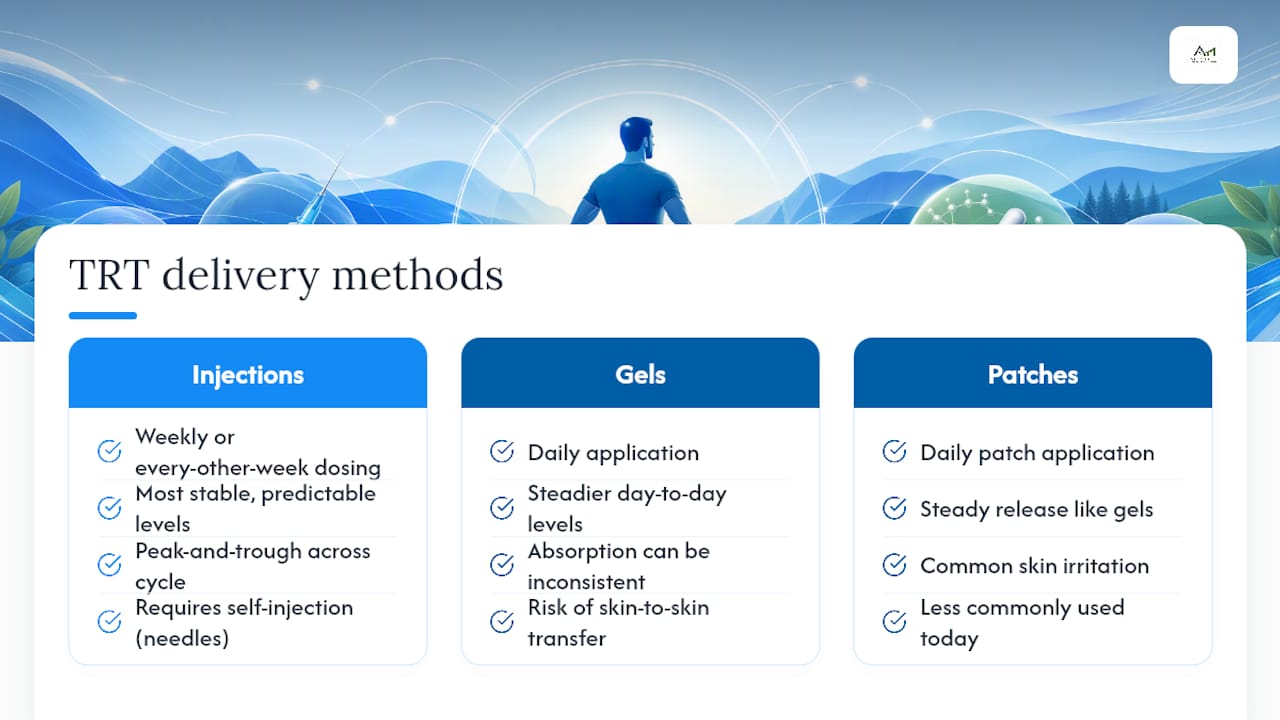
Injections (typically intramuscular or subcutaneous) are the most common method and tend to produce the most stable, predictable blood levels once a man settles into a dosing rhythm, usually weekly or every other week. The downside is the peak-and-trough pattern: testosterone levels can run higher right after an injection and lower right before the next one, which some men feel as mood or energy swings across the week. Self-injection also requires comfort with needles, though most men adjust quickly.
Topical gels applied daily to the skin avoid needles entirely and produce steadier day-to-day levels than injections. The trade-off is absorption inconsistency. Skin-to-skin contact can transfer testosterone to a partner or child, so timing showers and covering the application site matters. Some men also find gels simply don't absorb reliably enough to reach therapeutic levels.
Patches deliver a similarly steady release to gels but are used less often today, largely because skin irritation at the application site is common enough to push many men toward injections or gels instead.
There's no single best option across the board. The right choice depends on a man's tolerance for injections, lifestyle and household considerations around skin contact, and how his individual body responds to each method's absorption pattern. This is exactly the kind of decision worth working through with a supervising physician rather than guessing.
The Bottom Line on Realistic TRT Expectations
Confirm the diagnosis before anything else. Two low morning testosterone readings plus real symptoms, not one blood draw and a hunch. Set expectations around what the trial data actually shows: solid gains in sexual function, lean mass, and bone density; modest mood benefit; unreliable energy improvement. Monitor hematocrit and PSA without exception, and settle the fertility question before starting if kids are part of the plan. Shared decision-making with a physician beats going in with assumptions every time.
— Organic
Ready to Start Physician-Supervised TRT?
If your labs confirm low testosterone and you're tired of guessing your way through symptoms, the next step is a real diagnosis and a real monitoring plan, not another supplement or forum thread. A physician-supervised approach means you get baseline lab work, a licensed physician confirming your diagnosis before anything gets prescribed, and a dosing plan built around your specific numbers rather than a one-size protocol.

The process starts with an online screening, followed by baseline labs and a telemedicine consultation with a physician who reviews your results and symptoms together. From there, therapy begins with a personalized dosing schedule and a follow-up monitoring plan already in place, so hematocrit and PSA get tracked on schedule instead of left to chance. Some providers also offer FDA-regulated GLP-1s and peptides sourced from licensed U.S. manufacturers for men whose goals extend into broader metabolic health. If you're ready to move past guessing and get an actual diagnosis, book your consultation and get your baseline labs scheduled.
This article is general information, not a substitute for advice from a qualified doctor. Consult a qualified healthcare professional about your own circumstances before acting on anything here.
Sources
- Testosterone Replacement Therapy for Male Hypogonadism | AFP
- Benefits of Testosterone Replacement Therapy in Hypogonadal Males | Journal of the American Board of Family Medicine
- Systematic review and meta-analysis on TRT safety and efficacy (PMC11404359)
- Benefits and risks of testosterone treatment in age-related decline — Annual Reviews