
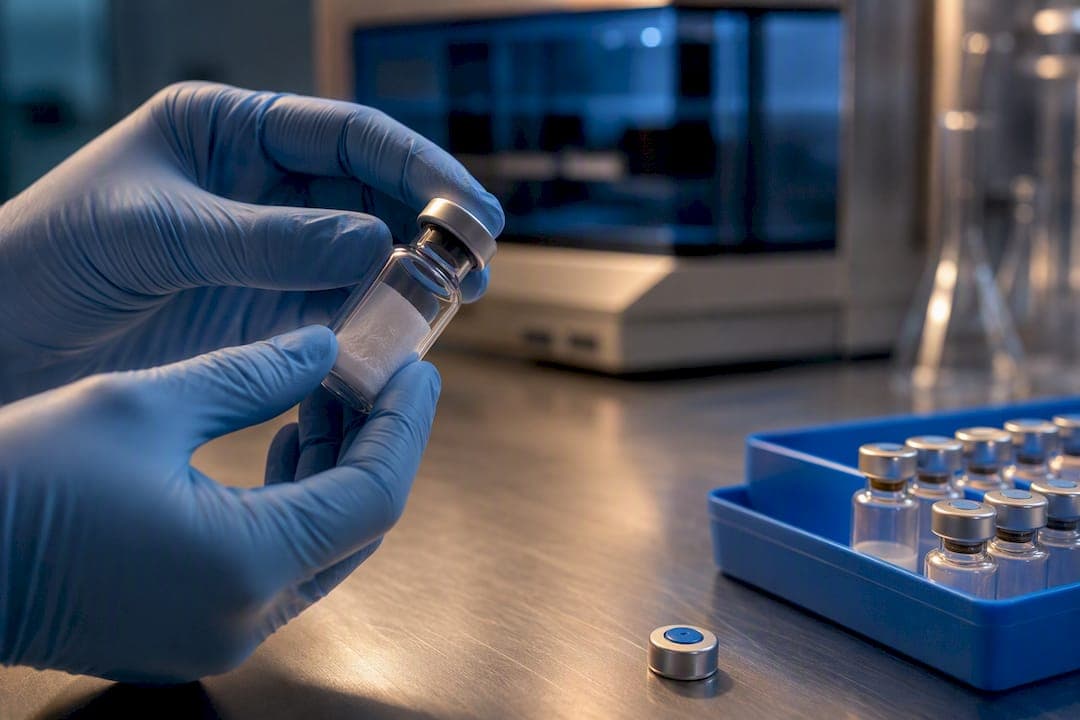
For safe, legal, and medically supervised peptide therapy in the United States, choose a physician-prescribed, U.S.-sourced program over anything shipped in from overseas. Domestic sourcing gives you cGMP-regulated manufacturing, batch-specific testing, and a doctor watching your labs. Airmed Fit builds its programs around exactly that model, using FDA-regulated peptides and GLP-1 medications from licensed U.S. manufacturers instead of unregulated imports.
TL;DR:
- US-sourced peptides are regulated under cGMP standards, with strict batch testing and oversight, unlike overseas supplies which often skip checkpoints.
- Peptides from a registered 503B outsourcing facility are subject to FDA inspections and higher safety standards compared to 503A pharmacies or unregulated foreign sources.
- Before starting therapy, verify that the prescriber is licensed, the product is U.S.-sourced, and independent batch-specific lab reports are available.
- The FDA has expanded import alerts, causing shortages of overseas peptides and pushing clinics toward domestically qualified manufacturers.
- A trustworthy program includes full medical evaluation, traceable U.S. supply chains, scheduled labs, and transparent sourcing, unlike unmonitored self-injection practices.
Table of Contents
- US vs Overseas Peptides: What Actually Changes for Patients
- How Does US Peptide Regulation Actually Work?
- What Should You Check Before Starting Peptide Therapy?
- What Does a Legitimate Peptide Program Look Like?
- How Are 2026 Import Alerts Affecting Peptide Access?
- What Does Airmed Fit Do Differently?
- Why Patients Deserve Clearer Answers Than "Just Buy Overseas"
- Ready to Start a Physician-Supervised Peptide Program?
- Where to Verify These Claims Yourself
- Sources
- FAQ
US vs Overseas Peptides: What Actually Changes for Patients
The gap between domestic and overseas peptide sourcing isn't really about price. It's about who's checking the product before it goes in your body, and who's checking on you after it does.
A U.S.-sourced, physician-prescribed peptide travels through a supply chain with accountability at every step: a licensed manufacturer, a compounding pharmacy or outsourcing facility, and a prescriber who ordered labs before writing the prescription. Overseas or gray-market peptides typically skip every one of those checkpoints.
Here's what separates the two paths in practice:
- Sterility risk. Injectable peptides that aren't manufactured under controlled conditions carry real endotoxin contamination risk, and pharmacovigilance analyses have documented mislabeling and contamination as recurring problems in nonregulated peptide supplies.
- Oversight. U.S. outsourcing facilities registered under Section 503B follow cGMP and face FDA inspection; most overseas sellers answer to no regulator at all.
- Certificates of Analysis. A CoA sounds reassuring, but the same pharmacovigilance work found that consumer-facing CoAs from overseas sellers are frequently falsified. A CoA alone means little without independent, batch-specific verification.
- Clinical support. Baseline labs, dose adjustments, and a pathway to report a bad reaction only exist inside a real medical program, not a shipment from an anonymous vendor.
- Legal standing. Peptides intended for human use generally require a valid prescription in the U.S., and importing them from abroad for self-injection carries both legal and customs risk.
The FDA itself is blunt about the limits here: compounded drugs are not FDA-approved, and even the legitimate compounding system is meant to fill a gap, not replace approved medicine when one exists.
How Does US Peptide Regulation Actually Work?
Peptides sit in a strange regulatory zone. Some are approved drugs with a full New Drug Application behind them. Others are compounded on a patient-by-patient basis under one of two very different frameworks, and a few are restricted from compounding altogether because the FDA doesn't trust the safety data behind them.
- FDA-approved peptides. These went through an NDA or BLA review, meaning a manufacturer proved safety and effectiveness through clinical trials. GLP-1 medications used in weight management fall into this category, along with a handful of others.
- Section 503A compounding. These are state-licensed pharmacies making patient-specific preparations. They're largely overseen by state boards rather than the FDA, and they're not required to follow cGMP or face routine federal inspection.
- Section 503B outsourcing facilities. These register directly with the FDA, must comply with cGMP, and get inspected on a risk-based schedule. This is the tier most physician-supervised peptide programs should be sourcing from for injectables.
- FDA bulk-substance lists. The agency sorts bulk drug substances into Category 1 and Category 2 lists for 503A compounding eligibility. Several peptides, including certain growth-hormone-releasing peptide fragments, have been flagged because the FDA lacks adequate human safety data for the proposed use, especially around immunogenicity.
The practical takeaway: a clinic sourcing from a 503B facility is operating under a fundamentally tighter quality standard than one relying on a 503A pharmacy, and both are worlds apart from an overseas seller with no U.S. oversight at all. Our guide to FDA-approved peptides breaks down which specific compounds fall into each category.
What Should You Check Before Starting Peptide Therapy?
Before you commit to any program, run it through a short checklist. Skipping this step is how people end up with an unsupervised regimen and no idea what's actually in the vial.
- Confirm the prescriber is a licensed physician or nurse practitioner who reviewed your medical history and ordered a real evaluation, not a form you filled out and paid for.
- Ask directly whether the active pharmaceutical ingredient and finished product are U.S.-sourced, and whether compounding happens at a 503B outsourcing facility or an accredited 503A pharmacy.
- Request a batch-specific Certificate of Analysis and ask what independent, third-party sterility and endotoxin testing the clinic requires from its supplier. Get a clear answer on chain-of-custody for the API itself.
- Ask what the clinic's monitoring plan looks like: which labs run at baseline, how often you're rechecked, and how they handle an adverse reaction if one happens.
Walk away from any seller labeling a product "for research use only" while quietly instructing you on self-injection. That label exists specifically so the seller can dodge the drug regulations that would otherwise apply, and it means nobody sterility-tested what you're about to inject.
Pro Tip: Ask the clinic to show documentation that their API manufacturer is registered under Section 510 and to provide independent lab reports tied to the exact lot number you'll receive, not a generic CoA for the product line.
What Does a Legitimate Peptide Program Look Like?
A real program follows a predictable shape, and knowing that shape helps you spot when someone's cutting corners.
Your first visit should include a full history, a physical or telehealth exam, and a baseline lab panel, typically a CBC, a comprehensive metabolic panel, and hormone-specific labs depending on your goals. From there:
- Your prescription arrives labeled, with clear dosing instructions and a traceable source, not an unmarked vial from an unnamed supplier.
- Follow-up labs are scheduled at set intervals, often 4 to 12 weeks depending on the therapy, and doses get adjusted based on those results rather than guesswork.
- Costs vary significantly by clinic, medication, and program length, covering consults, labs, and medication as separate line items in most cases, so ask any clinic for an itemized estimate before enrolling.
Programs built around specific peptide stacks, like CJC-1295 paired with ipamorelin, typically require more frequent monitoring early on while your provider dials in the dose. That monitoring cadence is the part overseas sourcing simply cannot offer.
How Are 2026 Import Alerts Affecting Peptide Access?
Supply has gotten tighter this year, and that's mostly a good sign for patients even though it doesn't feel that way at first. In May 2026, the FDA expanded its import alert to cover 38 additional foreign peptide API manufacturers, flagging suppliers whose materials weren't meeting U.S. quality standards.
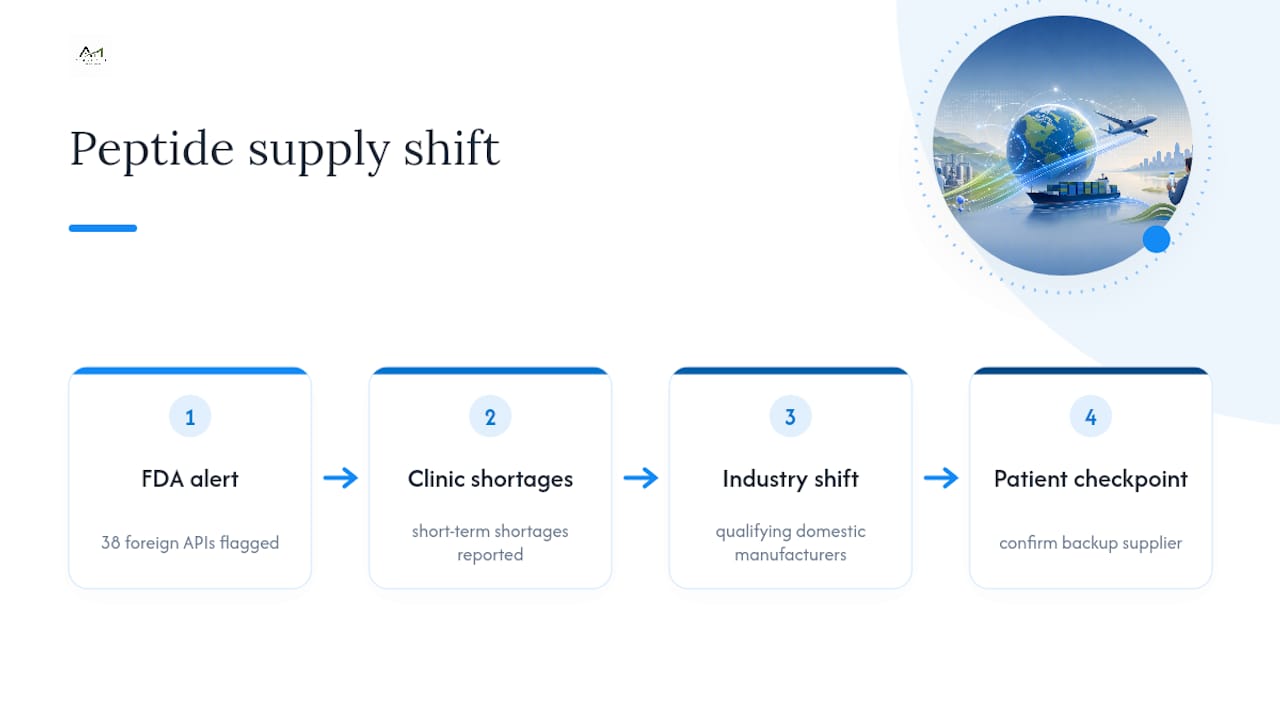
That's caused short-term shortages at clinics that leaned on overseas API sources, and it's pushing the industry toward qualifying domestic manufacturers instead. If you're already in a program, ask your clinic directly what happens if their supplier gets flagged: do they have a qualified backup, and will you be notified before a substitution happens without your knowledge?
What Does Airmed Fit Do Differently?
Airmed Fit builds every program around licensed physician supervision, not a one-time questionnaire. Programs use FDA-regulated GLP-1 medications and peptides sourced from licensed U.S. manufacturers, with lab monitoring built into the process rather than bolted on as an afterthought.
That means baseline labs before treatment starts, a licensed prescriber reviewing your case, and a supply chain you can actually trace back to a U.S. facility. It's the same standard outlined throughout this article, applied as an actual clinical practice rather than a marketing claim.
Why Patients Deserve Clearer Answers Than "Just Buy Overseas"
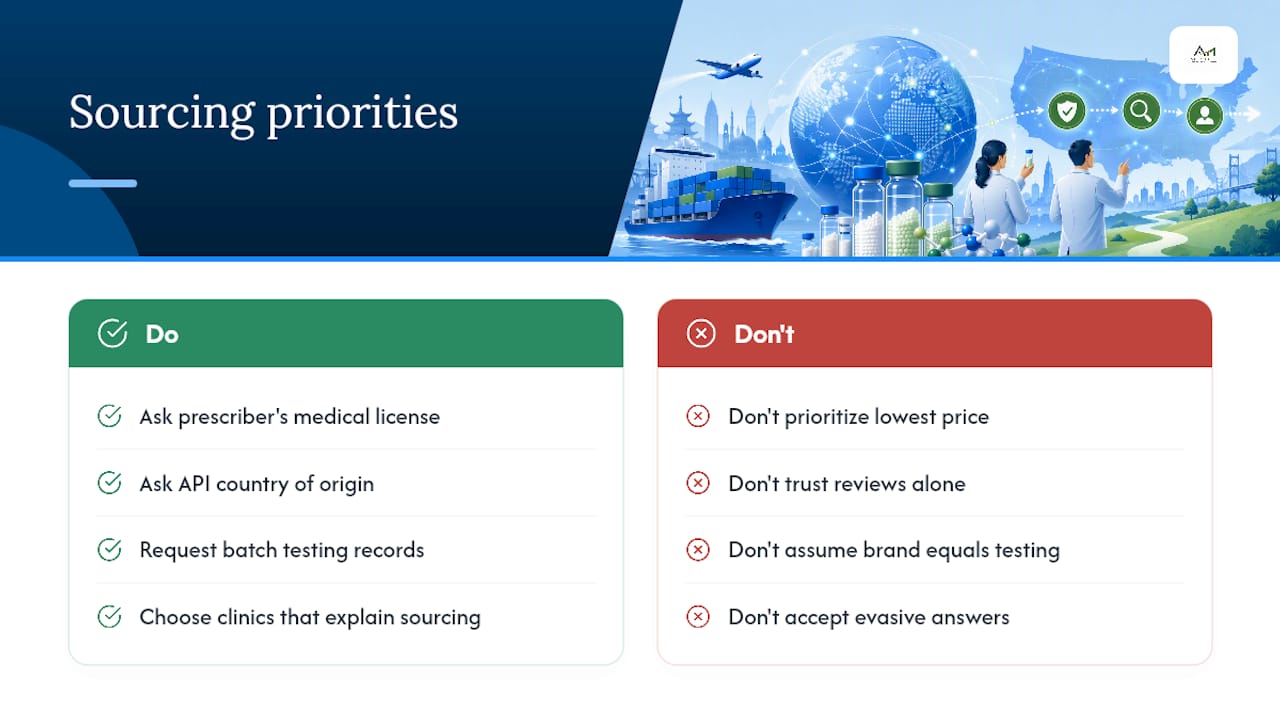
Most of what gets written about peptides online treats sourcing as a footnote, when it's really the whole decision. The conventional advice, buy from whoever ships fastest and check the reviews, completely ignores that reviews can't detect endotoxin contamination and a five-star rating says nothing about what's actually in the vial.
The 2026 import alert expansion changed the calculus here. Clinics that quietly relied on overseas APIs are now scrambling to requalify suppliers, and patients caught in that scramble deserve to know it's happening, not find out when their prescription doesn't show up.
What should you prioritize first? Not price, and not brand names. Ask about the prescriber's licensing and the API's origin before you ask about cost. A cheaper peptide that skipped batch testing isn't a bargain, it's a liability you won't notice until something goes wrong. The clinics worth trusting are the ones willing to answer sourcing questions in detail, without getting defensive about it.
— Organic
Ready to Start a Physician-Supervised Peptide Program?
If you've read this far, you already know the shortcuts aren't worth the risk. Airmed Fit is built as the alternative to overseas sourcing and unmonitored self-injection: physician-led evaluation, baseline labs, and peptides sourced exclusively from licensed U.S. manufacturers, so you're never guessing what's actually in the vial.
Getting started takes three steps. Schedule a telemedicine consultation with a licensed provider, complete your baseline lab panel, and review your personalized program details before your first prescription ships. Every therapy Airmed Fit dispenses traces back to a U.S.-regulated supply chain, with follow-up labs built into the plan from day one. Visit Airmed Fit to book your consult and see which program fits your goals.
Where to Verify These Claims Yourself
- FDA: Compounding and the FDA, Questions and Answers
- FDA: Bulk drug substances that may present significant safety risks
- Clinical review on compounded bioidentical hormone therapy
This article is general information, not a substitute for advice from a qualified doctor. Consult a qualified healthcare professional about your own circumstances before acting on anything here.
Sources
- Compounding and the FDA: Questions and Answers | FDA
- Certain bulk drug substances for use in compounding may present significant safety risks | FDA
- Pharmacovigilance analysis and quality concerns for nonregulated peptide supplies | PMC
FAQ
Is It Legal to Import Peptides From Overseas for Personal Use?
Peptides intended for human injection generally require a valid U.S. prescription, and importing them from unregulated overseas sellers can violate both FDA rules and customs regulations.
What's the Difference Between 503A and 503B Compounding?
503A pharmacies are largely state-regulated and not routinely inspected by the FDA, while 503B outsourcing facilities must follow cGMP and undergo FDA inspection on a risk-based schedule.
Why Are Some Peptides Restricted From Compounding?
The FDA has flagged specific peptides for insufficient safety data, including immunogenicity concerns, and restricted them from certain compounding routes as a result.
Does Airmed Fit Source Its Peptides Domestically?
Yes. Airmed Fit uses FDA-regulated GLP-1 medications and peptides sourced from licensed U.S. manufacturers as part of its physician-supervised programs.
How Much Does Physician-Supervised Peptide Therapy Typically Cost?
Costs vary significantly by clinic, medication, and program length, covering consults, labs, and medication as separate line items in most cases, so ask any clinic for an itemized estimate before enrolling.