
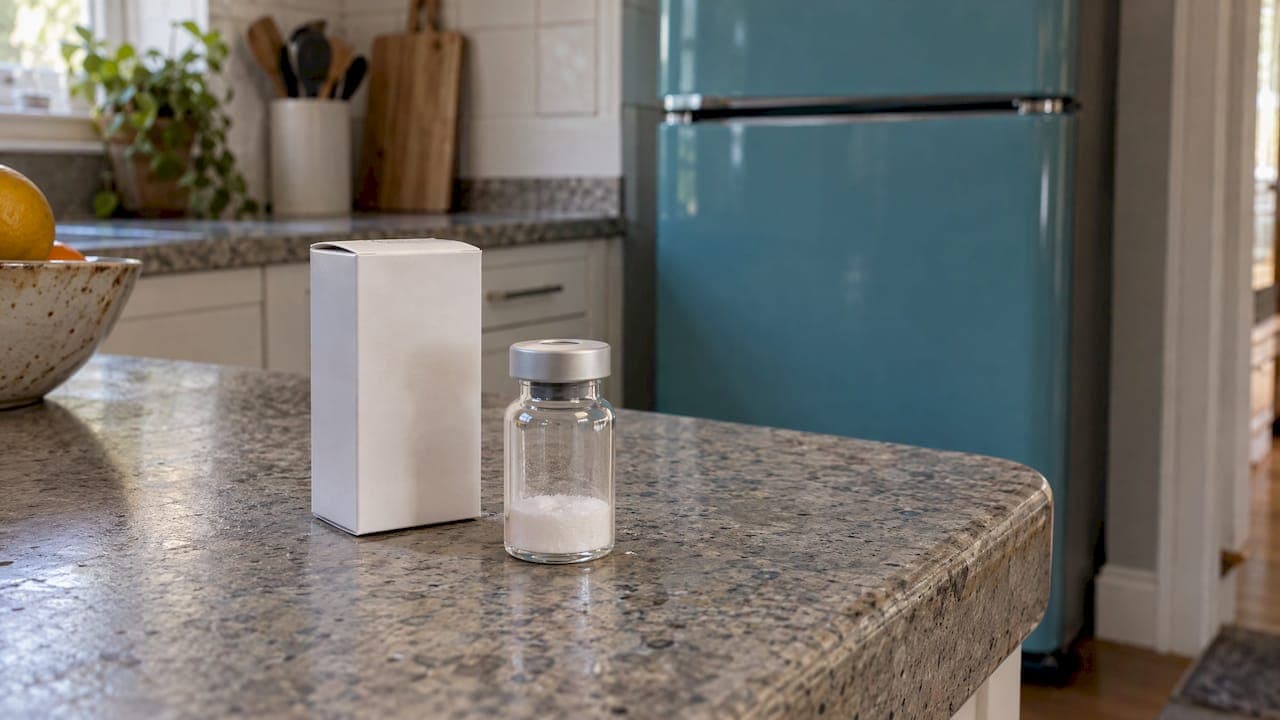
The right way to store a peptide is the way its own label says. A prescription peptide medicine usually goes in the refrigerator at 36 °F to 46 °F (2 °C to 8 °C), in its original carton, and is never frozen. Some products are kept at room temperature, and mixed vials can have a discard window of hours or days. This guide covers the general rules, real label examples, what changes after a vial is opened or mixed, and what to do when a product gets too warm or too cold.
TL;DR
- The pharmacy label or manufacturer instructions outrank any general rule. Storage differs by product, so "28 days" or "always freeze" is never universal.
- Many approved injectable peptide medicines are refrigerated at 36 °F to 46 °F (2 °C to 8 °C), kept in the original carton, and never frozen.
- Opening or mixing a vial starts a new clock. Write the date opened or mixed and the discard date on the vial, and discard at the earliest limit.
- Laboratory freeze-dried peptides follow different guidance (cold, dry, dark, often freezer) than prescription products.
- If a product was exposed to heat, light or freezing, call your pharmacist or clinician before using it.
Table of Contents
- Why peptide storage is product specific
- Before the vial is opened
- After a vial is opened or mixed
- Laboratory peptides: what handbooks say
- Approved, compounded and investigational: why the category affects storage
- Shelf life: what the evidence shows
- Heat, light or freezing: what to do
- Storing supplies and traveling
- A quick checklist
- Perspective
- Questions about storage? Start with a clinician
- FAQ
- Sources
Why peptide storage is product specific
A peptide is a short chain of amino acids, and each sequence breaks down in its own way. Heat speeds chemical change, light can damage some formulations, and water in a solution lets bacteria and degradation reactions move faster. That is why a freeze-dried powder, a mixed solution and a ready-to-use pen can each have different rules, even when they sit in the same drawer.
Two worlds of guidance exist, and mixing them up causes most storage mistakes:
- Prescription and approved products. The FDA-approved label or the pharmacy label sets the temperature, the in-use limit and the discard date. These instructions are tied to the specific formulation that was tested.
- Laboratory peptides. Technical handbooks for research peptides describe general practice for powders and solutions in a lab. They are not dosing or storage instructions for anything a person injects.
If you are not sure which world your product belongs to, read the label, then ask the dispensing pharmacy. Our guide to research peptide risks and safer care explains why that distinction matters, and why a product labeled for research use only is not a medicine.
Before the vial is opened
While a vial or pen is sealed, the job is simple: keep it at the temperature printed on the package, away from light when the label says so, and in the original carton. The carton carries the lot number, expiration date and storage directions, so keeping the vial inside it keeps that information with the product.
A few habits help:
- Unpack deliveries right away. Check that the product is at the temperature the label calls for and that nothing is leaking or damaged.
- Use a stable spot in the refrigerator. The middle shelf, toward the back, is steadier than the door, which swings in temperature each time it opens. A small fridge thermometer shows whether you are really holding 36 °F to 46 °F.
- Do not freeze or refrigerate on a guess. Some products are labeled for room temperature, and chilling them is not automatically safer.
- Keep products away from windows, cars and bathrooms. Heat and bright light are the common culprits in home storage.
Label examples show how much products differ
These approved products show the range. They are examples of what labels say, not advice about any product you hold.
| Product | Before first use | Out of the fridge or after opening |
|---|---|---|
| Mounjaro single-dose pens and vials | Refrigerator, 36 °F to 46 °F, in the original carton; do not freeze | May be kept unrefrigerated up to 86 °F for up to 21 days total, then discarded, per Drugs.com |
| Ozempic | Refrigerator, 36 °F to 46 °F, until the expiration date | After first use, refrigerated or at 59 °F to 86 °F for up to 56 days, per Novo Nordisk Medical |
| Yuviwel (tesamorelin) | Refrigerator, 36 °F to 46 °F, in the carton; do not freeze | Up to 86 °F for up to 6 months; after mixing, use within 4 hours, per the instructions for use |
| Tyenne prefilled syringes | Refrigerator, 36 °F to 46 °F, in the carton; do not freeze | At or below 77 °F for up to 14 days, then discard and do not return to the fridge, per the FDA-approved label |
Notice the pattern. Refrigeration is common, but the out-of-fridge window runs from hours to months. Even Mounjaro's multi-dose forms carry different limits than its single-dose ones, so the exact presentation you hold matters.
After a vial is opened or mixed
Opening or mixing changes everything. Once a freeze-dried powder is dissolved, the peptide is in solution, and two risks run together: the peptide slowly breaking down, and microbes getting in each time a needle pierces the stopper.
For a medicine you were prescribed, follow these steps:
- Write two dates on the vial. Record the day it was opened or mixed, and the discard date given on the label or by your pharmacy.
- Store it as labeled. Some mixed products must be kept cold. Others must not be refrigerated at all, and some must be used right away.
- Track every clock. A bacteriostatic water vial has its own limit after first puncture. A mixed medication has a separate beyond-use date, and a pen may have a different in-use limit. Discard the item when the earliest limit arrives.
- Discard when told, even if liquid remains. Mounjaro KwikPen and multi-dose vial instructions, for instance, call for discarding after the stated days or doses, as summarized by WebMD from the prescribing information, even if medicine is left.
The FDA takes discard dates seriously. In its 2025 review of Forzinity (elamipretide), the agency recommended labeling that says to discard vials 8 days after first opening, and asked that the statement be bolded so it is not overlooked, since missing it can lead to using a deteriorated drug.
Two reminders on supplies. Mixing water has its own timeline, which we cover in bacteriostatic water shelf life and the 28-day question, and the choice of diluent is explained in our piece on bacteriostatic versus sterile water. Used needles belong in a sharps container, not the trash, and home sharps disposal routes are worth knowing before your first delivery.
One brand name does not mean one rule
The same active ingredient can carry different instructions depending on the brand, the pen or vial format and the pharmacy that prepared it. Semaglutide is a good example: different FDA labels for semaglutide exist under different brand names, and storage language is part of what each label sets out. Read the one that came with your product, not the one for a similar product you read about online.
Laboratory peptides: what handbooks say
People searching for storage guidelines often land on technical pages written for researchers. They are accurate for their purpose, which is storing freeze-dried peptides in a laboratory, and they are the source of the "freezer" advice you see repeated online.
The UK's National Institute for Biological Standards and Control says peptides should be kept in a dry, cool, dark place, preferably at 4 °C or colder, away from bright light. It adds that dry peptides are stable at room temperature for days to weeks, that -20 °C is preferred for long-term storage, and that a vial should warm to room temperature before opening, which limits moisture condensing on the powder.
The common threads across laboratory guidance:
- Powder is hardier than solution. Freeze-dried material lasts far longer than the same peptide in liquid.
- Avoid repeated freeze-thaw cycles. Lab protocols divide solutions into small portions for this reason.
- Some sequences are fragile. Peptides rich in certain amino acids oxidize or degrade faster and have shorter shelf lives.
- Keep containers tightly closed and protect them from light and moisture.
These rules do not transfer to a prescription product. A pharmacy-dispensed vial may be labeled for refrigeration, not the freezer, and putting it in a freezer could ruin it. For anything labeled for research use only, there is also no medical approval behind the contents, and that is a reason to talk with a clinician rather than self-treat. Our overview of how US patients can obtain peptides legally lays out the approved, compounded and investigational categories.
Approved, compounded and investigational: why the category affects storage
Three kinds of product reach patients, and they should never be treated as interchangeable.
- FDA-approved products have a label reviewed by the FDA, with storage and discard limits based on the formulation tested.
- Compounded products are prepared by a pharmacy for an individual patient. They are not FDA-approved, and their storage and beyond-use dates come from the compounding pharmacy's label. Registration of a facility is not approval of a product. Our article on compounded semaglutide safety questions lists what to ask your clinician.
- Investigational or research-only peptides have no approved labeling for human use. We do not give doses or injection instructions for them, and storage guidance for them is not a substitute for medical advice.
If a label is missing, unreadable or says something different from what you were told, that is a reason to pause and call the pharmacy, not to guess.
Shelf life: what the evidence shows
There is no single shelf life for peptides. Large-scale data shows why. A 2023 peer-reviewed analysis of licensed biotechnology drug products found that 91.92% of formulations were recommended for refrigeration at 2 °C to 8 °C. For reconstituted and diluted solutions, immediate use was often advised, and where it was not, the recommended storage period ranged from 1 hour to 60 days.

So the honest answer to "how long do peptides last" is: until the earliest date on the label, whether that is the expiration date, the in-use limit or the beyond-use date from mixing. Treat any number you read in a blog or forum as a starting question for your pharmacist, not an answer.
Heat, light or freezing: what to do
Accidents happen: a delivery sits on a porch, a fridge fails, a pen rides in a hot car. A few principles apply.
- Do not assume the fridge fixes it. A 2025 peer-reviewed study in PMC on refrigerated medicines left at room temperature noted that re-refrigeration does not restore the original shelf life, because degradation during warm exposure may be cumulative and irreversible. It also noted that most labeling does not say whether re-refrigeration is acceptable.
- Do not use a frozen product unless the label allows it. For many injectables the label says not to freeze, and freezing typically ruins insulin, vaccines and most biologics, according to Franciscan Health's guidance on refrigerated medicines.
- During an outage, aim for 36 °F to 46 °F unless your label says otherwise. If temperatures drop toward 32 °F or ice crystals form on or near a vial, remove ice packs and add insulation.
- Ask before you discard or use. The same guidance advises contacting your pharmacist or health care provider when a medicine was exposed to excessive heat or freezing, or when you are unsure. If the pharmacy is closed, the manufacturer's contact details are usually on the packaging.
When you call, have the product name, strength, lot number, how long and how warm or cold it got, and whether it was opened or mixed. That lets the pharmacist give a specific answer.
Storing supplies and traveling
Syringes, alcohol swabs and mixing water need their own care. Keep sealed supplies in a clean, dry place at room temperature unless their packaging says otherwise, and check expiration dates when you check your medicine. If you travel with medicine, carry it in its original labeled packaging in a cooler bag if refrigeration is needed, and see our guide to traveling with syringes, TSA rules and paperwork.
A quick checklist
- Read the label and the patient instructions before the product arrives.
- Keep the vial in its original carton at the labeled temperature.
- Never freeze unless the label allows it.
- Write opened or mixed date and discard date on the vial.
- Track the earliest applicable limit: expiration, in-use, beyond-use.
- Call your pharmacist or clinician after any heat, light or freezing exposure.
Perspective
At AirMedFit, we publish educational information so adults can walk into a clinician conversation with better questions. Storage is a good example of a topic where the label wins and general rules lose.
We think the safest habit is also the simplest: treat the pharmacy label as the instruction, write dates on every vial, and bring storage questions to a qualified clinician before a product is used, not after something goes wrong.
That is also why we pair education with access to clinician consultations and lab panels listed on our site. Questions about which product is right, how it should be stored and how to follow up belong in a consultation. We do not promise prescriptions or outcomes, and treatment decisions stay with the clinician.
AirMedFit
Questions about storage? Start with a clinician
If you are weighing hormone care, weight management or other treatments and want a clinician to walk through eligibility, storage and follow-up, our Doctor's Consultation page has the details. Current listings show an Async Doctor's Consult at $49 and a Sync Doctor's Consult at $120, both one-off; confirm the current scope and availability on the site, since consultations do not guarantee a prescription.
You can also browse consultations and services to compare options before you decide.
FAQ
Do peptides need to be refrigerated?
Many approved injectable peptide medicines do, usually at 36 °F to 46 °F (2 °C to 8 °C) in the original carton, and not frozen. Some, such as unmixed tesamorelin products with room-temperature labels, are different. Follow your label.
How long can a peptide vial stay out of the fridge?
It depends on the product. Mounjaro single-dose pens may stay unrefrigerated up to 86 °F for 21 days total, while Tyenne syringes allow 14 days at or below 77 °F. Check your own label, and ask your pharmacist if the time has been exceeded.
Can I freeze a peptide to make it last longer?
Not a prescription product, unless its label says so. Freezer advice comes from laboratory guidance on freeze-dried powders. Many injectable labels say do not freeze, because freezing can ruin the medicine.
What should I write on a vial after mixing?
Write the date it was mixed and the discard date from your label or pharmacy. If several limits apply, such as the mixing water and the mixed medicine, use the earliest one.
What if my medicine got too warm during delivery?
Do not use it until you have asked. Refrigerating it afterward does not undo any damage, so call the dispensing pharmacy or your clinician with the product name, lot number and how long it was exposed.
Sources
- NIBSC peptide storage guidance
- Does Mounjaro need to be refrigerated? (Drugs.com)
- Novo Nordisk Medical: GLP-1 RAs storage and stability
- Yuviwel instructions for use
- Tyenne FDA-approved label
- Mounjaro prescribing information summary (WebMD)
- FDA 2025 review of Forzinity labeling
- Trends in light and temperature sensitivity recommendations (PMC, 2023)
- Stability of refrigerated medications at room temperature (PMC)
- Franciscan Health: refrigerated medicines during a power outage
- Semaglutide and different FDA labels
Recommended
- Peptide Reconstitution: Bacteriostatic vs Sterile Water and 28 Day Rule
- Peptide Reconstitution: A Bench-Ready Protocol for Researchers
- Bacteriostatic Water Shelf Life for Injections: Two Clocks, 28 Days
This article provides general educational information and is not personalized medical advice. A licensed clinician should assess treatment suitability, risks, and options.