

Tirzepatide starts at 2.5 mg subcutaneously once weekly for four weeks, an initiation dose that isn't meant to treat diabetes or drive weight loss on its own. After that, the dose increases by 2.5 mg every four weeks (or longer) until reaching a maintenance dose of 5 mg, 10 mg, or 15 mg once weekly. Fifteen milligrams is the ceiling. No one skips ahead.
TL;DR:
- Doses should increase no faster than 2.5 mg every at least four weeks, with many clinicians waiting longer if gastrointestinal side effects occur.
- The optimal maintenance dose differs by indication and patient tolerance, with 5 mg often sufficient for diabetes, while 10 or 15 mg are used for weight loss and sleep apnea.
- Missed doses can be taken within 96 hours but should not be doubled up if over four days have passed, maintaining consistent weekly injections.
- Patients with thyroid history, severe kidney or liver impairment, pregnancy, or children require special caution and close monitoring during titration.
- Individualized titration based on lab results and tolerability, rather than rigid schedules, improves safety and treatment success.
Table of Contents
- What Is the Standard Tirzepatide Dosing and Titration Schedule?
- Which Maintenance Dose Fits Weight Loss, Diabetes, or Sleep Apnea?
- How Do You Take Tirzepatide, and What if You Miss a Dose?
- What Are the Major Safety Warnings That Affect Dosing Decisions?
- How Do Clinicians Decide When to Raise, Hold, or Lower the Dose?
- Who Needs Extra Caution With Tirzepatide Dosing?
- Why Individualized Titration Beats a One-Size Schedule
- How Airmedfit Supports Safe Tirzepatide Initiation and Follow-Up
- Sources
What Is the Standard Tirzepatide Dosing and Titration Schedule?
Every tirzepatide prescription, whether it's written for Zepbound or Mounjaro, follows the same architecture: start low, climb slowly, stop climbing once the dose is working and tolerable. The FDA prescribing information lays out the increments precisely, and Lilly's own clinical guidance for prescribers matches it step for step.
The first four weeks at 2.5 mg exist for one reason: to let your gut adjust. This starting dose doesn't produce meaningful glycemic control or weight loss on its own. It's a runway, not a destination. Trying to skip it, or jumping straight to a higher dose because progress feels slow, is the single most common reason patients end up with severe nausea that derails treatment altogether.
Here's the full schedule as written into the drug label and echoed in Lilly's dosing guidance:
| Week | Dose | Purpose |
|---|---|---|
| 1–4 | starting low dose | Initiation only, not for glycemic or weight-loss effect |
| 5–8 | first maintenance option | Maintenance dose option |
| 12 | intermediate optional step | Optional step if higher dose is needed |
| 15 | maintenance dose | Maintenance dose |
| 19 | intermediate optional step | Optional step if higher dose is needed |
| — | maximum maintenance dose | Maximum maintenance dose |
Notice the increments never exceed 2.5 mg, and each step requires at least four weeks before the next increase. That's not arbitrary. Clinical guidance summarized in StatPearls treats this timeline as a floor, not a fixed rule. Titration should track tolerance and response, and a slower pace is common in practice when GI symptoms show up.
A few practical notes on how the increments work:
- The 2.5 mg dose is used only during the first four weeks. Once you move up, you don't go back down to it unless a clinician restarts titration after an interruption.
- Each increase happens only after at least four weeks on the current dose, though many prescribers wait longer if nausea or fatigue hasn't settled.
- The 7.5 mg and 12.5 mg doses are optional intermediate steps used mainly for patients who tolerate 5 mg or 10 mg well but need a smaller step up rather than jumping straight to the next round number.
- Tirzepatide pens come in six strengths (2.5, 5, 7.5, 10, 12.5, and 15 mg), each a single-dose auto-injector, so there's no mixing or calculating partial doses.
That last point matters more than it sounds. Because every strength ships as its own pre-filled pen, dosing errors from manual measurement are largely off the table. You inject the pen that matches your current step, once a week, and that's the whole calculation.
Which Maintenance Dose Fits Weight Loss, Diabetes, or Sleep Apnea?
Once you've cleared titration, the maintenance dose you land on isn't one-size-fits-all. It depends heavily on why you're taking tirzepatide in the first place.
For type 2 diabetes, the goal is glycemic control, and a meta-analysis covering multiple trial doses found that 5 mg often balances efficacy against adverse events better than jumping straight to higher maintenance doses. That doesn't mean 5 mg is right for everyone with diabetes. Higher doses (10 or 15 mg) produce larger HbA1c reductions, but the analysis found the incremental benefit comes with a real increase in GI side effects. For a patient whose A1c is only modestly elevated, 5 mg might do the job without the added nausea.
For weight management, the calculus shifts. Trial data consistently shows a dose-response relationship: higher maintenance doses tend to produce greater weight loss, and 15 mg is often the target for patients who need the most aggressive results and can tolerate it. But "can tolerate it" is the operative phrase. A patient who plateaus at 10 mg with good tolerability and continued weight loss doesn't automatically need to push to 15 mg just because it's the maximum on the label.
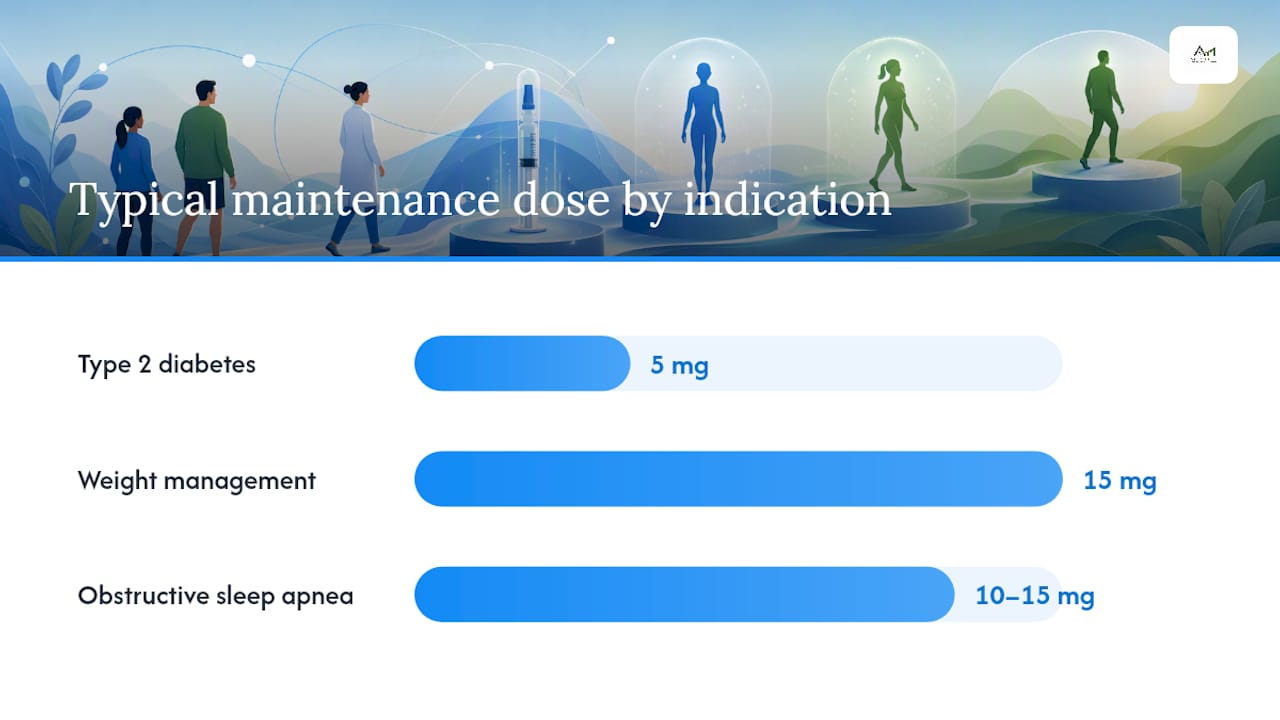
Obstructive sleep apnea (OSA) is the newest indication, and here the pattern leans toward the higher end. Clinical use for OSA more commonly targets 10 mg or 15 mg maintenance, reflecting the dose levels studied for reducing apnea-hypopnea index scores.
Here's how the trade-offs typically break down across indications:
- 5 mg maintenance: Often sufficient for moderate glycemic goals; lower GI burden; a reasonable stopping point if labs and symptoms both improve.
- 10 mg maintenance: A common middle ground for weight loss and OSA; meaningfully more effective than 5 mg for most patients, with a modest increase in nausea or diarrhea risk.
- 15 mg maintenance: Maximum approved dose; associated with the largest average weight loss and glycemic improvement, but also the highest rate of discontinuation due to GI intolerance in trial data.
The through-line across every indication is the same: the lowest effective dose that meets the treatment goal is the right dose. Chasing the maximum because it's available, rather than because a patient needs it, is how avoidable side effects turn into a discontinued prescription. If you're weighing how dose relates to actual weight-loss outcomes, it's worth reading through the evidence on tirzepatide and weight loss in more depth before deciding where to plateau.
How Do You Take Tirzepatide, and What if You Miss a Dose?
Tirzepatide is injected subcutaneously, meaning under the skin rather than into muscle. It's a once-weekly injection, and you can take it at any time of day, with or without food, which is more flexibility than a lot of patients expect from an injectable medication.
Here's the practical routine, step by step:
- Pick a consistent day of the week. Same weekday each time keeps the seven-day interval predictable and makes it easier to remember.
- Rotate your injection site. The abdomen, thigh, and upper arm are all approved sites. Rotating between them, and even within the same region, reduces irritation and lumps at the injection point. If you're unsure how to rotate properly, a site-by-site injection guide walks through exact placement.
- Inspect the pen before injecting. The solution should look clear and colorless to slightly yellow. Don't use it if it's cloudy, discolored, or contains particles.
- Inject at room temperature. Pens stored in the refrigerator can be left out for a short period before injecting; cold medication injected straight from the fridge tends to sting more.
- If you miss a dose, check the clock. If it's been 96 hours (4 days) or less since the missed dose, take it as soon as you remember. If more than four days have passed, skip that dose entirely and resume your regular weekly schedule at the next planned date. Don't double up.
Changing your weekly injection day is allowed if your schedule shifts. The only rule is to keep at least 72 hours between injections, so you're not stacking doses too close together. That flexibility is genuinely useful for people whose weeks aren't the same every time, but it's not a workaround for spacing doses further apart than intended.
Storage matters too. Unopened pens go in the refrigerator between 36°F and 46°F. Once a pen is in use, it can typically be kept at room temperature for a limited window, but check the specific instructions that come with your prescription, since storage windows can vary slightly by formulation.

Pro Tip: Set a recurring weekly reminder on your phone for injection day, and log the site you used each week in a note app. It sounds unnecessary until week six, when you genuinely cannot remember if you rotated to your thigh yet.
If needles themselves are a source of hesitation, it helps to understand why subcutaneous is the preferred route here rather than intramuscular. The short version: subcutaneous injection absorbs the medication more slowly and evenly, which is exactly what a once-weekly drug needs.
What Are the Major Safety Warnings That Affect Dosing Decisions?
Every dosing decision with tirzepatide sits inside a safety framework, and ignoring it is how titration goes wrong.
The most serious warning is a boxed warning, the FDA's highest-level alert. In rodent studies, tirzepatide caused thyroid C-cell tumors. It's contraindicated in anyone with a personal or family history of medullary thyroid carcinoma (MTC) or Multiple Endocrine Neoplasia syndrome type 2 (MEN 2). This isn't a dose-dependent risk that improves by starting low. If either history applies, tirzepatide isn't an option at any dose.
Beyond the boxed warning, the adverse reactions that actually shape day-to-day titration decisions are the GI ones: nausea, diarrhea, vomiting, and constipation. These are the reactions that show up most and are also the ones that slow titration down in real practice. If nausea is significant at 5 mg, most clinicians hold there rather than pushing to 7.5 mg on schedule.
More serious risks require active monitoring rather than just patient reassurance:
- Pancreatitis. Persistent, severe abdominal pain, sometimes radiating to the back, warrants stopping the medication and evaluating promptly.
- Acute gallbladder disease. Rapid weight loss itself raises gallstone risk, and tirzepatide's weight-loss effect can compound that.
- Acute kidney injury. Usually secondary to volume depletion from significant vomiting or diarrhea, particularly in patients who don't increase fluid intake as GI symptoms ramp up.
- Hypersensitivity reactions. Rare but serious; anaphylaxis and angioedema have been reported.
- Hypoglycemia, specifically when tirzepatide is combined with insulin or a sulfonylurea. Tirzepatide alone carries low intrinsic hypoglycemia risk, but stacking it with these other diabetes medications changes the math substantially.
That last point deserves its own emphasis. If you're on insulin or a sulfonylurea and starting tirzepatide, your prescriber should proactively discuss reducing the dose of that other medication before or as tirzepatide titrates up, not after a hypoglycemic episode forces the issue. Home glucose monitoring becomes more important during this transition, not less.
On the discontinuation side, there are clear stop signs. Suspected pancreatitis means withholding the drug pending evaluation. Severe, unmanageable GI intolerance that doesn't improve with a slower titration pace or symptomatic treatment is a reason to pause or reconsider therapy altogether. A true hypersensitivity reaction means stopping tirzepatide and not restarting it.
For a fuller breakdown of what these side effects feel like in practice and which ones are genuinely urgent versus just uncomfortable, the detailed side effects guide covers timing and severity patterns worth knowing before you start.
Pro Tip: Keep a simple symptom log for the first eight weeks, rating nausea and appetite daily on a 1 to 5 scale. It turns "I think the higher dose was worse" into an actual data point your prescriber can use to decide whether to hold or advance.
How Do Clinicians Decide When to Raise, Hold, or Lower the Dose?
Titration on paper looks like a fixed calendar. Titration in practice is closer to a negotiation between the schedule and how the patient's body is actually responding.
Response markers give that negotiation some structure. For type 2 diabetes, HbA1c trending toward target over 12 to 24 weeks is the primary marker of benefit. Falling well short of that doesn't necessarily mean a dose increase is warranted immediately, but it does prompt a conversation about whether the current dose has had enough time to work, or whether other factors (diet, activity, medication adherence) are limiting the response.
Monitoring during titration typically includes:
- Baseline labs before starting, covering metabolic panel, kidney function, and often a lipid panel, since tirzepatide's metabolic effects extend beyond glucose and weight.
- Periodic follow-up labs, particularly renal function checks if a patient reports significant GI symptoms, since dehydration from vomiting or diarrhea is the mechanism behind kidney injury risk.
- Ophthalmologic follow-up for patients with existing diabetic retinopathy, since rapid glycemic improvement has been associated with temporary worsening of retinopathy in some GLP-1 and dual-agonist therapies.
- Symptom check-ins at each planned titration point, ideally before advancing the dose rather than after.
When tolerability is the limiting factor rather than lack of efficacy, clinicians have several levers besides "push through it." Slowing the titration pace, extending time at a given dose from four weeks to six or eight, is often the first move. Adding symptomatic management, like an antiemetic for nausea or dietary adjustments (smaller meals, less fat, more fiber gradually) can smooth the transition. A temporary dose hold, staying flat rather than advancing at the next scheduled interval, is a legitimate and common strategy rather than a failure of treatment.
Documentation matters more than patients usually realize. A clinician who notes "held at 5 mg for 8 weeks due to nausea, resolved by week 6" has a clear record for the next decision point. Setting expectations up front, that nausea in the first few weeks after each increase is common and usually temporary, also reduces the number of patients who quit at week two of a new dose instead of week four when things typically settle.
Who Needs Extra Caution With Tirzepatide Dosing?
The standard titration schedule assumes reasonably typical kidney and liver function, no pregnancy, and an adult patient. Outside those assumptions, the guidance gets more conservative.
Renal and hepatic impairment. Data in patients with severe renal or hepatic impairment is limited. The label doesn't call for a routine dose adjustment based on kidney or liver function alone, but that's different from saying no caution is needed. Because GI side effects can trigger volume depletion, and volume depletion is harder on already-compromised kidneys, patients with reduced renal function need closer monitoring for dehydration signs during titration, not necessarily a different starting dose.
Pregnancy. Safety in pregnancy hasn't been established. Given the significant weight loss and appetite reduction tirzepatide produces, plus limited human data, it's generally avoided unless a physician determines the benefit clearly outweighs the unknowns, and that decision shouldn't happen without direct supervision.
Pediatric use. Safety and efficacy haven't been established for most pediatric populations. This isn't a dosing question so much as an indication question. It's not currently a routine option for younger patients outside of extremely specific circumstances.
Older adults. Age itself isn't a contraindication, but older adults more often carry the comorbidities and medication lists that make tirzepatide's risks sharper. Polypharmacy raises the odds of interacting with insulin or sulfonylureas. Reduced baseline hydration and kidney reserve make volume-depletion-related kidney injury a bigger concern if GI side effects hit hard. None of this rules tirzepatide out for older patients; it just means the monitoring cadence should be tighter and the titration pace often slower.
Why Individualized Titration Beats a One-Size Schedule
The dosing chart on the label is a starting template, not a mandate. Every patient we see moves through it differently, and treating the four-week interval as a countdown to hit rather than a minimum to respect is where a lot of unnecessary side effects come from.
At Airmedfit, titration decisions run through physician consultations, baseline labs, and scheduled follow-ups rather than a fixed calendar handed to a patient at the first visit. That structure exists because the honest answer to "when should I go up to the next dose" is almost always "it depends," and depends-on-what only becomes clear through actual lab values and a real conversation about how the current dose feels.
The lowest effective maintenance dose is the target we work toward, not the highest tolerable one. If 10 mg is producing the glycemic control or weight-loss trajectory a patient needs, there's no clinical reason to chase 15 mg just because it's the ceiling. Active management of GI side effects, through pacing, symptomatic treatment, and sometimes a longer hold at a given dose, tends to keep patients on therapy long enough to actually see results, which matters more than how fast they climb the chart.
The GLP-1 and dual-agonist class as a whole shares this same tension between efficacy and tolerability, and if you're comparing tirzepatide against other options in that class, the evidence behind semaglutide for weight loss is a useful reference point for how dose and side-effect burden trade off across drugs, not just within one.
— Organic
How Airmedfit Supports Safe Tirzepatide Initiation and Follow-Up
Airmedfit gives you what a dosing chart alone can't: a physician actively adjusting your schedule based on your labs and how your body is actually responding, not a generic four-week countdown. Every consult includes baseline lab work, a prescribing physician reviewing your history for contraindications like MTC or MEN 2, and follow-up visits built around whether you're tolerating each step, not just whether the calendar says it's time to advance.

That kind of oversight matters most in the first few months, when GI side effects are most likely and the temptation to either rush the schedule or quit early is highest. Our physicians can slow your titration, order the labs that flag a problem before it becomes serious, and adjust course if a dose isn't working the way it should. A referral to your primary care physician or an endocrinologist is always a reasonable alternative if you already have that relationship in place. For patients who want a faster, more direct path, you can book a telemedicine consult and start with a physician review of your history and goals before your first dose ever ships. Explore the full scope of what's included at Airmedfit.
This article is general information, not a substitute for advice from a qualified doctor. Consult a qualified healthcare professional about your own circumstances before acting on anything here.
Sources
- ZEPBOUND (tirzepatide) full prescribing information — DailyMed
- Optimal dose of tirzepatide for type 2 diabetes mellitus: A meta-analysis and trial sequential analysis — PMC
- Tirzepatide — StatPearls (NCBI Bookshelf)