
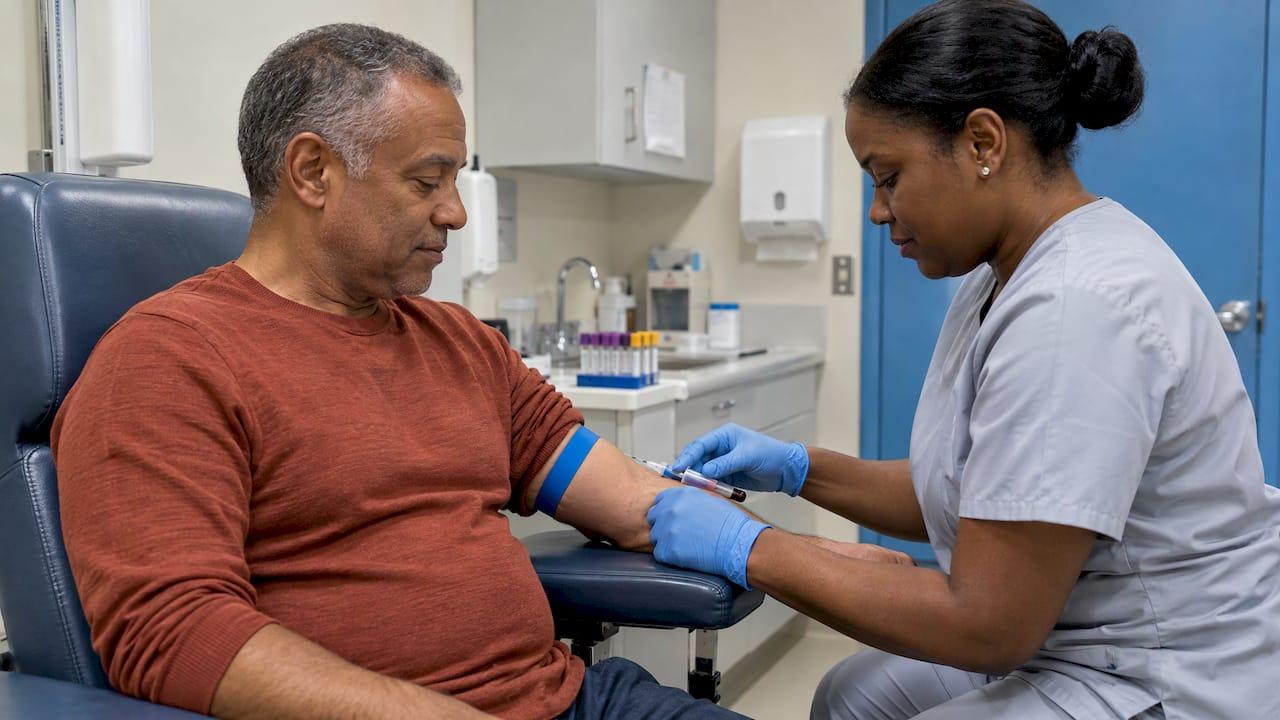
Current evidence does not show that testosterone replacement therapy (TRT) causes prostate cancer in men who are properly selected and monitored. It does call for baseline and follow-up PSA testing, and it leaves real uncertainty about long-term effects. In June 2026 the FDA asked testosterone makers to update their labeling on prostate cancer risk and benign prostatic hyperplasia (BPH). Blood pressure and heart questions come up in the same visit, so this guide covers those too.
This article is general education. It is not medical advice, and whether TRT is right for you is a decision for you and a qualified clinician.
TL;DR
- Large trials and long cohort studies have not generally shown a higher prostate cancer rate in men on TRT, but the FDA says long-term effects are still uncertain.
- TRT does not appear to worsen urinary symptoms in men with mild to moderate BPH. Evidence is thinner for men with severe symptoms.
- Guidelines call for PSA at baseline and during treatment, with urology referral if PSA rises above set thresholds.
- Testosterone products are associated with higher blood pressure as a class, and the largest heart-safety trial found no excess of major cardiac events but did find other risks.
- Bring your PSA history, family history, blood pressure readings and urinary symptoms to your consultation.
Table of Contents
- What the FDA said in June 2026
- Does TRT cause prostate cancer?
- TRT and BPH: urinary symptoms and prostate size
- PSA testing before and during TRT
- TRT after a prostate cancer diagnosis
- TRT and blood pressure
- TRT and heart health
- Perspective
- How to prepare for a TRT consultation
- Where AirMedFit fits
- FAQ
- Sources
What the FDA said in June 2026
In June 2026, the U.S. Department of Health and Human Services, working through the FDA, asked for updates to the prescribing information on testosterone products. The requested changes include removing the statement that safety and effectiveness in men with age-related hypogonadism have not been established, updating prostate cancer risk information, and revising BPH warnings.
On cancer, the same announcement says available clinical trial and epidemiologic data have generally not shown an increased prostate cancer risk in men receiving TRT. It also acknowledges an important caveat: prostate cancer can take years to develop, and existing studies may not have followed men long enough to detect long-term effects.
That pairing is the honest summary of the field. Reassuring so far, not settled for decades of use.
Does TRT cause prostate cancer?
The old worry came from the observation that prostate tumors can be hormone-sensitive. The research since then has mostly pointed the other way for men without existing cancer. Here are three of the data points.
A randomized trial in men with low PSA
A JAMA Network Open trial published in December 2023 enrolled 5,246 men with hypogonadism, no family history of prostate cancer and PSA below 3 ng/mL. They received testosterone gel or placebo. Prostate cancer diagnoses were similarly low in both groups. The findings may not apply to higher-risk men, to longer treatment or to higher doses.
A long Finnish cohort
A study in Andrology followed 2,919 men on TRT for up to 18 years. TRT users did not have a higher incidence or mortality rate of prostate cancer than non-users, and prostate cancer mortality was lower in the TRT group (HR 0.52; 95% CI 0.3 to 0.91). This is observational data. It shows association, not proof that TRT protects the prostate.

What this does and does not mean
None of this says TRT is risk-free. Men in trials were screened first, and their PSA was watched afterward. That is why monitoring is part of responsible care rather than an optional extra.
TRT and BPH: urinary symptoms and prostate size
BPH is the benign enlargement that causes weak stream, urgency and nighttime urination. Many men on or considering TRT are in the age range where it is common.
- Pooled trial data. A network meta-analysis of 21 randomized trials with 2,453 participants found that TRT does not worsen lower urinary tract symptoms, whatever the route of administration.
- FDA review. The FDA's June 2026 review found that trial data do not show worsening in men with mild to moderate BPH. Evidence remains limited for severe symptoms, and the updated labeling would recommend continued monitoring for that group.
- Prostate growth. A Swedish longitudinal study found a small increase in prostate growth rate, about 0.22 mL per year, during treated periods. It found no significant differences in urinary symptoms, quality of life or PSA between treated and untreated periods.
- A firm line for severe symptoms. The VA's January 2026 recommendations say hypogonadal men on testosterone are more likely to have BPH and urinary symptoms but usually do not need treatment for them. They also list severe symptoms (IPSS above 19) as a contraindication to TRT.
If you already have BPH symptoms, tell your clinician before starting. Your symptom score is a starting point for the decision.
PSA testing before and during TRT
PSA is a blood marker. TRT can nudge it, which is why it is tracked. Two sets of recommendations give a practical picture.
| Source | Recommended PSA schedule | When to refer |
|---|---|---|
| VA clinical recommendations, January 2026 | Baseline, 3 to 6 months after starting, at 12 months, then annually or sooner if clinically indicated | PSA rise above 1.4 ng/mL within 12 months, or PSA above 4 ng/mL at any time |
| American Academy of Family Physicians, 2024 | Testosterone, hematocrit and PSA at baseline and at least annually in men 40 and older | Per clinician judgment |
A few practical points:
- Get a baseline PSA before the first dose, so later numbers have something to be compared with.
- Expect hematocrit and testosterone to be checked alongside PSA.
- A single elevated value is not a diagnosis. It is a reason for repeat testing or a urology visit.
- Keep your lab results. If you change clinicians, the trend matters more than any one number.
TRT after a prostate cancer diagnosis
This is the area where caution matters most. Historically, prostate cancer was treated as a reason to avoid testosterone. Research has been revisiting that for men who have completed definitive treatment such as surgery or radiation.
A 2025 review of 12 studies, summarized in search results, concluded that TRT after definitive treatment was generally not associated with higher biochemical recurrence or progression. A review in a urology journal similarly notes that many studies over 15 years support the safety of testosterone therapy in men previously treated for localized prostate cancer, and that close follow-up is recommended by both the American Urological Association and the European Association of Urology.
The studies are mostly small and observational, and they apply to carefully selected men. If you have had prostate cancer, the decision belongs with your urologist or oncologist, and should be made before any testosterone is started.
TRT and blood pressure
Blood pressure is a separate question from the prostate, but it appears in the same safety discussion. According to a media summary of the FDA's February 2025 action, the agency directed sponsors to add TRAVERSE trial results to testosterone labeling and remove the Boxed Warning language tied to cardiovascular risk. It also required product-specific warnings that testosterone products as a class are associated with higher blood pressure.
What this means for you:
- If you have hypertension, say so at your consultation and bring recent home or clinic readings.
- Expect blood pressure to be checked at follow-up visits, not only labs.
- Do not stop or change blood pressure medication on your own. Any adjustment is for your prescribing clinician.
TRT and heart health
The TRAVERSE trial is the largest randomized safety study. It enrolled men aged 45 to 80 with symptomatic hypogonadism and existing or elevated cardiovascular risk. Major adverse cardiac events occurred in 7.0% of the testosterone group and 7.3% of the placebo group, with no difference between them. The testosterone group did have higher rates of atrial fibrillation, acute kidney injury and pulmonary embolism.
The AAFP notes that TRAVERSE showed no increase in heart attack or stroke even in high-risk patients, while also saying that evidence on cardiovascular events and mortality across studies remains conflicting. Read that as: the major fear has eased, and a clinician should still weigh your own heart history, rhythm problems, clotting history and kidney function.

For related topics, see our posts on cholesterol changes on TRT and what to expect from clinician-led TRT.
Perspective
We think the most useful way to approach TRT and the prostate is as a monitoring question rather than a yes-or-no one. The evidence from trials and long cohorts is reassuring for carefully selected men, and the FDA itself says long-term uncertainty remains. Both can be true.
That is why we focus on preparation. A baseline PSA, a blood pressure reading, a clear picture of urinary symptoms and an honest family history make a consultation far more productive. They also make follow-up testing meaningful instead of arbitrary.
We believe men are best served when lab work and clinician review come first, and when treatment decisions stay with a qualified clinician. Our consultation and lab offerings are built around that sequence.
AirMedFit
How to prepare for a TRT consultation
A focused visit covers prostate questions in minutes when you arrive ready. Our guide to six questions to ask at a hormone therapy consultation is a good starting list. Add these:
- Prior PSA values and dates, including any biopsy or MRI.
- Family history of prostate cancer, and any history of your own.
- Urinary symptoms: stream strength, frequency, nighttime waking.
- Blood pressure readings from the past few weeks, and your current medications.
- Heart and clotting history, including atrial fibrillation, stroke, blood clots or kidney disease.
- Questions about follow-up: which labs, how often, and what result would trigger a urology referral.
If you want to understand the telehealth sequence from labs to review, see our walkthrough of the U.S. telehealth TRT process. Whether treatment is appropriate is always the clinician's determination.
Where AirMedFit fits
AirMedFit's website lists doctor's consultations and lab panels you can review before deciding anything. As listed on the site, the Async Doctor's Consult is $49 one-off and the Sync Doctor's Consult is $120 one-off. The Men's Essential lab panel with home kit is listed at $129 one-off. Confirm current availability, scope, costs and follow-up on the site before you order, because a listing is not a guarantee of a prescription.
You can start with the Doctor's Consultation page or compare the lab panel options.

FAQ
Is TRT hard on the prostate?
In the studies above, TRT did not worsen urinary symptoms in men with mild to moderate BPH, and prostate growth changes were small. Men with severe urinary symptoms are a different case, and the VA lists them as a contraindication. Your clinician should check symptoms and PSA before and during treatment.
Can TRT raise PSA levels?
PSA can change on treatment, which is why guidelines call for repeat testing. The VA recommends referral to urology for a rise above 1.4 ng/mL within 12 months or any PSA above 4 ng/mL. A rise is a reason for further evaluation, not a diagnosis.
Is TRT linked to prostate cancer?
The FDA said in June 2026 that available data have generally not shown increased risk, while noting that long-term effects are not fully known. Men with a history of prostate cancer need a specialist's input before any testosterone.
Does testosterone therapy raise blood pressure?
Testosterone products as a class are associated with higher blood pressure, according to the FDA labeling changes reported in 2025. If you have hypertension, your clinician should review your readings and medications before and during treatment.
Sources
- HHS: requested updates to testosterone therapy labeling (June 2026)
- Harvard Health: appropriate use of testosterone therapy and prostate cancer risk
- Andrology cohort: TRT and prostate cancer in Finnish men
- Journal of Evidence-Based Medicine: TRT and lower urinary tract symptoms
- Scandinavian Journal of Urology: long-term effects on the prostate
- VA clinical recommendations for testosterone replacement, January 2026
- AAFP: Testosterone replacement therapy for male hypogonadism
- AAFP: TRAVERSE trial summary
- Review: late-onset hypogonadism and testosterone therapy
- Miami Herald: testosterone therapy and FDA labeling changes
Recommended
- Clinician Led TRT for Men: Evidence, Realistic Benefits, and Safety Steps
- DHT Rises 2–3× on TRT: Clinician Led Care to Prevent Hair Loss
- LDL Falls 5 mg/dL on TRT: Evidence-Based Monitoring for Clinicians
- Act at 54%: How Men on TRT Can Manage Hematocrit and Protect Iron
This article provides general educational information and is not personalized medical advice. A licensed clinician should assess treatment suitability, risks, and options.