
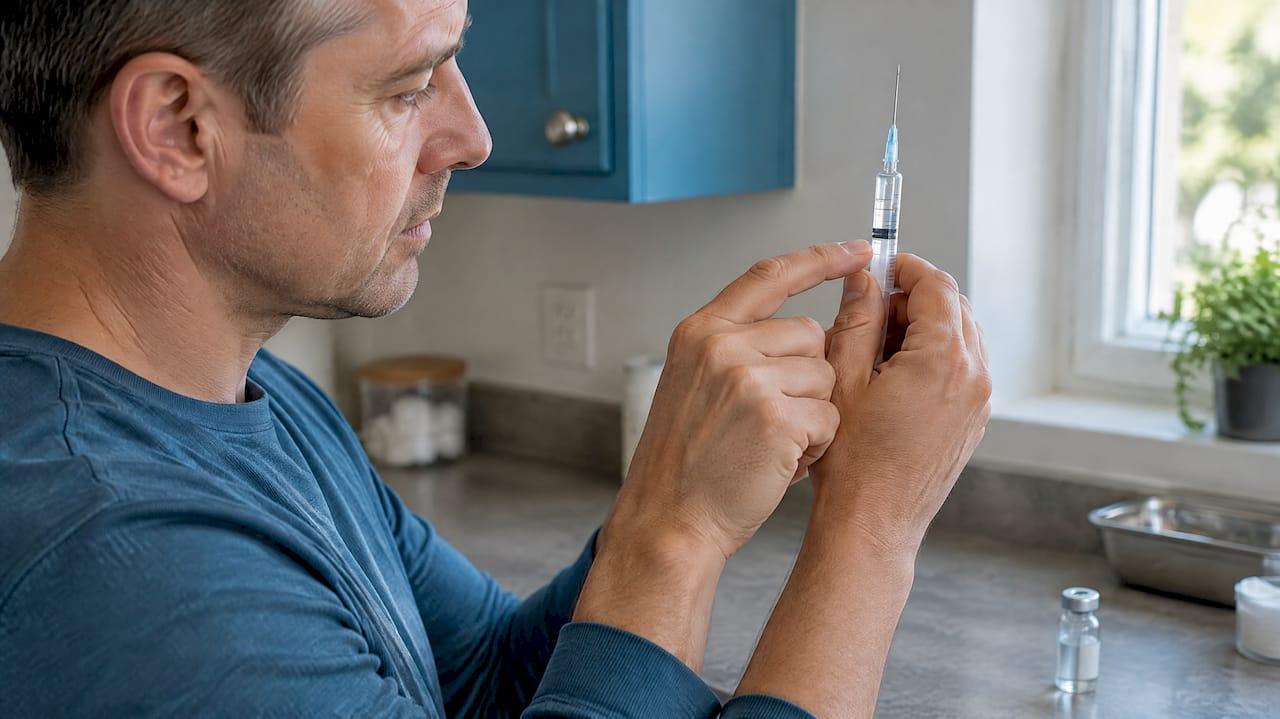
If you drew medicine from a vial into a syringe, point the needle up, tap the barrel so the bubbles rise, and push the plunger slowly until the air is out and only your dose remains. If your syringe or pen came prefilled from the manufacturer, do not assume you should do the same: many labels say a small bubble is normal and tell you to leave it alone. The right move depends on which kind of syringe you hold, so read your own instructions first.
Table of Contents
- TL;DR
- Why air bubbles form in a syringe
- How to remove air bubbles from a syringe you filled from a vial
- Prefilled pens and syringes: leave the bubble unless the label says otherwise
- Is an air bubble in a subcutaneous injection dangerous?
- Will air bubbles go away on their own?
- Prevent bubbles before they start
- A note on peptides and other compounded products
- After the injection: needles and sharps
- Our perspective
- Questions to bring to your clinician
- Talk to a clinician about your questions
- FAQ
- Sources
TL;DR
- For a syringe you filled from a vial, tap out the bubbles and push them back into the vial or out of the needle, then recheck the dose.
- For many prefilled pens and syringes, the manufacturer says a small bubble is normal and should not be removed. Follow your product's instructions for use.
- A small bubble injected under the skin is usually harmless, but it can mean you got a little less medicine than intended.
- Draw up slowly and keep the needle tip in the liquid to prevent most bubbles.
- Ask your pharmacist or prescriber if you are unsure about your specific medicine or device.
This article is general education. It does not replace the instructions from your clinician, pharmacist or the product label, and it gives no doses.
Why air bubbles form in a syringe
Bubbles show up for a few ordinary reasons. Pulling the plunger back too fast creates suction that pulls air in around the needle or through the liquid. Drawing up with the needle tip above the liquid line pulls in air. Loose connections between needle and syringe can leak air in. And some medicines foam slightly when they are moved around.
It helps to separate two situations, because the advice differs:
- A syringe you fill yourself from a vial or ampule. Air here can be a larger volume and should be expelled.
- A prefilled syringe or pen filled at the factory. A small bubble is often built into the design, and the label may tell you not to remove it.
The American Organization for Homecare explains the logic: factory-filled syringes typically hold only a small amount of air, around 0.2 to 0.3 cc, while syringes you fill yourself can take in a larger volume that could displace medicine. That difference in volume is why the rules are not the same.
How to remove air bubbles from a syringe you filled from a vial
These steps follow general patient-education guidance. They are not a substitute for the technique your clinician or pharmacist showed you for your own medicine.
- Wash your hands and set out your supplies on a clean surface.
- Draw up slowly. Keep the needle tip below the surface of the liquid so you are not pulling in air. MedlinePlus advises keeping the syringe tip in the medicine, tapping the syringe to move bubbles to the top, then gently pushing the bubbles back into the vial.
- Tap the barrel. Hold the syringe with the needle pointing up and flick or tap the side with a finger. Small bubbles stick to the walls and tapping helps them rise and merge.
- Push the air out. With the needle still pointing up, press the plunger gently until the air is gone and a tiny bead of liquid appears at the needle tip. PeaceHealth gives the same sequence: needle up, tap the barrel, push the plunger enough to clear the air, and then confirm you still have a full dose, adding a little medicine if needed.
- Recheck the dose. Look at the plunger against the markings on the barrel. If pushing out air took some liquid with it, draw a little more and repeat the check.
If you see lots of small bubbles
A foamy syringe is a sign you drew up too fast. MedlinePlus suggests pushing the medicine back into the vial, drawing it out slowly again, tapping out bubbles and double-checking the dose. Do not just inject a syringe full of foam.

Draw up a little extra
Because purging air wastes a small amount of liquid, the Wisconsin Department of Health Services EMS manual says to draw up a little extra that can be wasted when purging bubbles, so the full dose remains after air is removed. Your clinician may give different instructions for your medicine, so follow theirs.
A note on insulin
For insulin from a bottle, MedlinePlus describes holding the bottle and syringe in one hand, tapping so bubbles float up, pushing them back into the bottle, then pulling back to the right dose. Syringe type matters for accuracy with small volumes. Our guide to the differences between insulin and tuberculin syringes explains how the barrel markings differ.
Prefilled pens and syringes: leave the bubble unless the label says otherwise
This is where people most often go wrong. A prefilled syringe from a manufacturer is not the same as one you drew up, and several makers say plainly not to chase the bubble.
| Product type | What the maker says about bubbles |
|---|---|
| Pfizer's ABRILADA (adalimumab-afzb) pen and syringe | Seeing one or more bubbles is normal, and the instructions say not to try to remove them |
| Johnson & Johnson prefilled syringes and injectors (SIMPONI, STELARA, ustekinumab, TREMFYA) | A bubble is normal because of the fill and finish process and the placement of the stopper |
| Lilly's Omvoh (mirikizumab) pens and syringes | Bubbles will not harm the patient, and Lilly says not to try to remove or expel them |
| Lilly's Zepbound KwikPen (Lilly Canada FAQ) | Small bubbles in the solution will not cause harm when injected |
The Zepbound FAQ also notes that bubbles can form in the cartridge if the needle is left on the pen after the injection, so remove the needle as your instructions direct. That page is from Lilly Canada, so check the U.S. instructions for use that came with your pen.
Some prefilled syringes work the other way. Memorial Sloan Kettering gives a generic method for prefilled syringes: needle up, tap until bubbles rise, then slowly push the plunger to force them out, and then makes an exception: do not do this with Lovenox, which is meant to be injected with its air bubble. That example shows why the label for your exact product wins over any general guide.
The practical rule
- Read the instructions for use that came in the box.
- If it says do not expel the bubble, leave it.
- If it says to prime or purge, follow those steps exactly.
- If the instructions are missing or unclear, call your pharmacist before you inject.
Is an air bubble in a subcutaneous injection dangerous?
For an injection into the fat layer under the skin, a small bubble is generally not a safety problem. PeaceHealth says injecting a small air bubble into the skin or a muscle is usually harmless, but it may mean you did not get the full dose, because the air took up room in the syringe.

That dose point is the real reason to clear bubbles from a syringe you filled yourself. A bubble that takes up a tenth of the barrel is a tenth less medicine. Lilly adds that air in an injection is more of a safety concern when medicine goes into a vein, which is not how subcutaneous injections are given.
What to do if you injected air or are unsure about your dose
- Do not inject a second dose to make up the difference on your own.
- Note the time, the medicine and what happened.
- Call your prescriber or pharmacist and ask how to handle the next dose.
- Get urgent help for symptoms such as trouble breathing, chest pain or severe dizziness after any injection. Call 911 in an emergency.
If you are using a prefilled syringe and cannot use it as the instructions describe, contact your care team. Memorial Sloan Kettering tells patients to call their healthcare provider if they have trouble giving the injection.
Will air bubbles go away on their own?
We did not find a medical source that says bubbles reliably disappear by themselves, so do not plan around it. Bubbles you see in a filled syringe tend to sit against the plunger or barrel wall and shift as you handle the syringe. Tapping and a slow push of the plunger are the documented ways to clear them from a syringe you filled. For a prefilled device, follow its label.
If you are using a syringe you filled earlier, ask your clinician or pharmacist whether prefilling is appropriate for your medicine at all. Storage rules differ by product, and we do not give prefilling advice here.
Prevent bubbles before they start
- Check the connection. Make sure the needle is attached securely before drawing.
- Pull the plunger slowly. Fast pulls create suction and foam.
- Keep the needle tip in the liquid. Do not let it drift to the surface.
- Let cold medicine settle. If your instructions say to bring a vial to room temperature, do that first.
- Use the right syringe size. A syringe sized to your volume makes the dose easier to read. A very large barrel for a tiny dose makes small bubbles hard to judge.
- Mind the diluent. If your medicine is mixed with a liquid first, add it gently down the vial wall instead of squirting it in. Our guide to bacteriostatic versus sterile water covers what the diluent is and how long it lasts, and the page on bacteriostatic water shelf life covers the two clocks to watch.
The injection itself matters too. Our site-by-site guide to subcutaneous injection sites explains where under-the-skin shots go, and subcutaneous versus intramuscular routes explains why the route changes what a bubble means.
A note on peptides and other compounded products
People who ask about syringe bubbles are often using vials rather than factory-filled pens. Vial products can be FDA-approved, compounded by a pharmacy, or investigational, and these are not the same thing. Facility registration is not product approval. Your instructions come from your prescriber and the pharmacy that dispensed the product, and we do not give doses or injection instructions for investigational peptides. If you want to understand the compounding question for GLP-1 medicines, see our safety questions for compounded semaglutide.
After the injection: needles and sharps
Once you have cleared the bubbles and given your dose, do not recap or toss the needle in the trash. Put it in a sharps container right away. We cover the options in four safe sharps disposal routes at home. Traveling with supplies has its own rules, covered in travel with syringes.
Our perspective
Most bubble questions are really technique and instruction questions. People ask whether a bubble is dangerous when the better question is: did I fill this syringe myself, or did a manufacturer fill it, and what does my label say?
At AirMedFit, we publish plain-language education so you can walk into a clinician conversation with better questions. We think a hands-on demonstration from a clinician or pharmacist beats any written guide, and we would rather you ask than guess about your own medicine and device.
If you are exploring hormone care, weight management or other treatment, a consultation is a good place to ask how your specific product is supplied, how it should be drawn up and what to do when something looks off. Treatment decisions, including whether a therapy is appropriate for you, belong to a qualified clinician.
AirMedFit
Questions to bring to your clinician
Bring these to a consultation or pharmacy visit:
- Is my medicine a prefilled pen, a prefilled syringe or a vial?
- Should I remove bubbles, leave them or prime the device?
- Which syringe size and needle fit my prescribed volume?
- What do I do if I think I got a partial dose?
- How should I store the medicine and for how long once opened?
- Who do I call after hours if something goes wrong?
Talk to a clinician about your questions
If you want to go over injection questions as part of a broader conversation about hormone care or weight management, you can review our doctor's consultation page. As listed on our site, the Async Doctor's Consult is $49 one-off and the Sync Doctor's Consult is $120 one-off, and you can see the options on our consultation listing. Availability, scope and follow-up can change, so confirm them on the page. A consultation does not guarantee a prescription; any treatment is a clinician's decision.

You can also browse everything we list on AirMedFit.
FAQ
What happens if there is an air bubble in my syringe?
If you filled the syringe from a vial, the bubble takes up space and you may get less medicine than intended, so tap it up and push it out. If it is a small bubble injected under the skin, it is usually harmless according to PeaceHealth. Ask your pharmacist about the dose if you are unsure.
Should I remove the air bubble from a prefilled pen?
Only if your instructions say to. Several manufacturers, including Pfizer for ABRILADA, say bubbles are normal and should not be removed. Check the instructions for use for your specific product.
Is it dangerous to have air in a subq injection?
A small amount of air in a subcutaneous injection is generally not dangerous. The main concern is an incomplete dose. If you feel unwell afterward, or you are worried, contact your prescriber or pharmacist, and call 911 for severe symptoms.
Why does my syringe fill with so many bubbles?
Usually you are drawing too fast or the needle tip is not fully in the liquid. MedlinePlus suggests pushing the medicine back into the vial and drawing it again slowly, then tapping out the bubbles.
Sources
- Drawing medicine out of a vial: MedlinePlus
- Giving an insulin injection: MedlinePlus
- Common Questions About Giving Yourself Shots: PeaceHealth
- Wisconsin DHS EMS injection skills manual
- Why air bubbles can be injected: American Organization for Homecare
- ABRILADA instructions for use: Pfizer
- Air bubble in prefilled syringe and injectors: Johnson & Johnson
- Air bubbles in Omvoh pens and syringes: Lilly
- Air bubbles in Zepbound KwikPen: Lilly Canada
- Subcutaneous injection using a prefilled syringe: Memorial Sloan Kettering
Recommended
- Contain Sharps Now, 4 Safe Disposal Routes at Home
- Insulin Syringe vs Tuberculin Syringe: Key Differences
- Where to Give a Subcutaneous Injection: A Site-by-Site Guide
- Subcutaneous vs Intramuscular: Which Injection Route Is Right?
This article provides general educational information and is not personalized medical advice. A licensed clinician should assess treatment suitability, risks, and options.